

Revision Notes for Class 11 Accountancy: Chapter 01 Introduction to Accounting
Access comprehensive revision notes for Chapter 01 Introduction to Accounting using the CBSE Class 11 Accountancy Introduction To Accounting Concepts And Illustrations. Designed to align with the 2026-27 academic syllabus for Class 11 Accountancy, these concept summaries help students streamline their exam preparation and review complex topics efficiently.
Review Chapter 01 Introduction to Accounting for Class 11 Accountancy
Access the complete concept summary PDF for Chapter 01 Introduction to Accounting below. Regular review of these targeted notes builds familiarity with complex Class 11 Accountancy themes and helps secure higher marks in final school evaluations.
“There's no business like show business, but there are several businesses like accounting.”
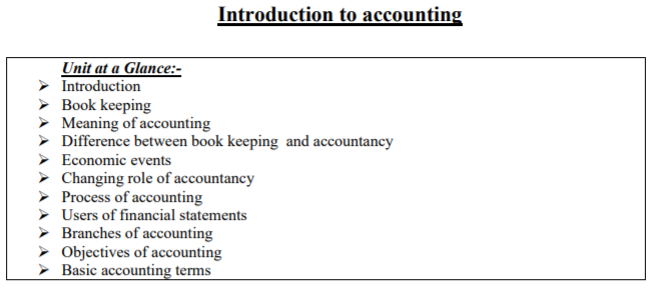
Introduction: Accounting has greater discipline than book keeping. It includes conceptual knowledge of the subject and applications also.
BOOK KEEPING:-It involves journal, ledger, cash book and other subsidiary books, it cannot disclose the results of Business. Meaning of Accounting:-It is process of identifying, measuring, recording and communicating the financial information.
Difference between Bookkeeping and accountancy: Book keeping does not show the net result and accountancy shows net result of the business.
Economic Events:- All events which can be measured in monetary Terms are known as Economic events. (Salary paid to employees, Goods purchased from creditors, cash withdrew from bank)
CHANGING ROLE OF ACCOUNTANCY
1. As a language to communicate information an enterprises.
2. To provide valuable information for judging management ability.
3. To provide quantitative information this is useful in economic decision.
Process of accounting
1. Identification of the economic events. (Selection of important event)
2. Classification of the business transaction (Assets, liability, expenses, income).
3. Measurement in terms (Monetary value transaction.),
4. Recording of business transactions (As per accounting principal)
5. Summarizing the business transaction (Journal, ledger, trial balance and Balance sheet.)
6. Analysis and interpreting the business transactions. (Various reports, ratio etc.)
7. Communication (provide information to internal and external users.)
Users of financial statements:
1. Internal users :- (Owners, shareholders, investors, creditors, employees, customers, management.)
2 External users: - (Regulatory agencies, labor union, stock exchange, public and others)
BRANCHES OF ACCOUNTING
1. Financial accounting (Book Keeping + preparation of financial statement).
2. Cost accounting (Determines the unit cost at different level of production).
3. Management accounting (It blends financial and cost accounting to get maximum profit at maximum cost).
4. Tax accounting (Sales tax and income tax).
5. Social responsibility (Focus on social benefits)
Objectives of Accounting
1. Provides information in systematic way.
2. Enables to get profit or loss of business during certain profit. 3. Shows the actual position of the business.
BASIC ACCOUNTING TERMS
1. Entity:- It means existence of an individual which includes two things 1.Business entity
2. Non business entity.
2. Transactions: - Exchange of goods and services for consideration.
3.Assets:- These are properties or economic resources of an enterprises which can be expressed in monetary terms it can be divided in two parts 1.Fixed assets( more than 1 year period) 2. Current assets(less than 1 year period)
4. Liabilities:-These are certain obligations or dues which firm has to pay.
5. Capital: It is an essential investment for commencement of every business.
6. Sales: It can be credit or cash, in which goods are delivered to customers.
7. Revenues:-It is the amount which is earned by selling of products.
8. Expenses:-It is known as cost of assets consumed or services which used.
9. Expenditure:-It means spending money for some benefit.
10. Profit: - Excess of revenues over expenses is called profit.
11. Gain: - It generates from incidental transaction such as sales of fixed asset, winning of court case.
12. Loss: - Excess of expenses over income is termed as loss.
13. Discount:-It is defined as concession or deduction in price of goods sold.
14. Voucher:-It is known as evidence in support of a transaction.
15. Goods: - It refers all the tangible goods (Raw material, work in progress, finished goods.)
16. Drawings: - Amount of goods or cash which is withdrawn from business for personal use.
17. Purchases: - It means of procurement of goods on credit or cash.
18. Stock: - It is a part of unsold goods. It can be divided into two categories.
1.Opening stock
2. Closing stock.
19 Debtors: - There are persons who owe to an enterprise an amount for buying goods and services on credit.
20. Creditors: - These are persons who have to be paid by an enterprise an amount for providing the enterprise goods and services on credit.
Questions:
1. Write any two users of financial statements.
ANS: - 1.Public 2.Regulatory agencies
2. Write any one advantage of accounting.
ANS: - Provide information in systematic order
3. Write any one example of voucher.
ANS: cash memo
4. Write any two examples of current assets.
Ans. 1.Stock 2.Debtor
Please click the link below to download pdf file for CBSE Class 11 Accountancy Introduction To Accounting Concepts And Illustrations.
Free study material for Accountancy
Download CBSE Revision Notes: Class 11 Accountancy Chapter 01 Introduction to Accounting
Key Concepts and Summary for Class 11 Accountancy Chapter 01 Introduction to Accounting
Explore reliable chapter overviews for Chapter 01 Introduction to Accounting tailored for Class 11 learners. Use these structured points to grasp difficult themes and ensure solid preparation for upcoming assessments.
NCERT-Aligned Chapter Summary and Notes
Built using the official NCERT book for Class 11 Accountancy, these notes provide reliable academic guidance. Pair your summary review with our recommended NCERT solutions to master optimal problem-solving approaches.
Next Steps in Your Exam Preparation
Wrap up your chapter revision by testing your knowledge against standard question formats. Everything on our platform is provided free of charge.
FAQs
You can download the teacher prepared revision notes for CBSE Class 11 Accountancy Introduction To Accounting Concepts And Illustrations from StudiesToday.com. These notes are designed as per 2026-27 academic session to help Class 11 students get the best study material for Accountancy.
Yes, our CBSE Class 11 Accountancy Introduction To Accounting Concepts And Illustrations include 50% competency-based questions with focus on core logic, keyword definitions, and the practical application of Accountancy principles which is important for getting more marks in 2026 CBSE exams.
Yes, our CBSE Class 11 Accountancy Introduction To Accounting Concepts And Illustrations provide a detailed, topic wise breakdown of the chapter. Fundamental definitions, complex numerical formulas and all topics of CBSE syllabus in Class 11 is covered.
These notes for Accountancy are organized into bullet points and easy-to-read charts. By using CBSE Class 11 Accountancy Introduction To Accounting Concepts And Illustrations, Class 11 students fast revise formulas, key definitions before the exams.
No, all study resources on StudiesToday, including CBSE Class 11 Accountancy Introduction To Accounting Concepts And Illustrations, are available for immediate free download. Class 11 Accountancy study material is available in PDF and can be downloaded on mobile.