

Download Class 11 Accountancy Concept Summaries: CBSE Class 11 Accountancy Recording Of Transaction Notes
Explore reliable concept summaries and revision materials through the CBSE Class 11 Accountancy Recording Of Transaction Notes. Tailored for Class 11 learners, utilizing these notes for Accountancy Chapter 03 Recording of Transactions-I ensures thorough preparation and strengthens core academic definitions before final evaluations.
Access Chapter 03 Recording of Transactions-I Notes and Study Material
Navigate directly to the revision notes for Chapter 03 Recording of Transactions-I using the digital viewer below. Each summary is structured to highlight high-weightage sections, allowing students to instantly access critical definitions and focus on core exam topics.
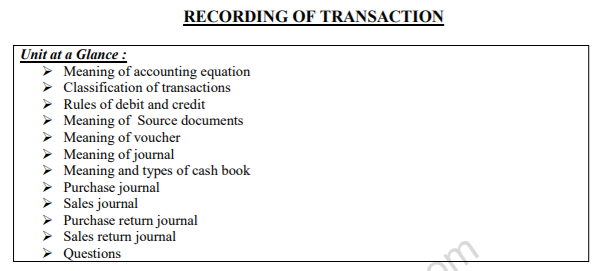
Accounting Equation :
Total Assets = Total Liabilities
Total Assets = Internal Liabilities + External Liabilities
Total Assets = Capital + Liabilities Classification of Transactions
Following are the nine basic transactions:
1. Increase in assets with corresponding increase in capital.
2. Increase in assets with corresponding increase in liabilities.
3. Decrease in assets with corresponding decrease in capital.
4. Decrease in assets with corresponding decrease in liabilities.
5. Increase and decrease in assets.
6. Increase and decrease in liabilities
7. Increase and decrease in capital
8. Increase in liabilities and decrease in capital
9. Increase in capital and decrease in liabilities.
Illustration :
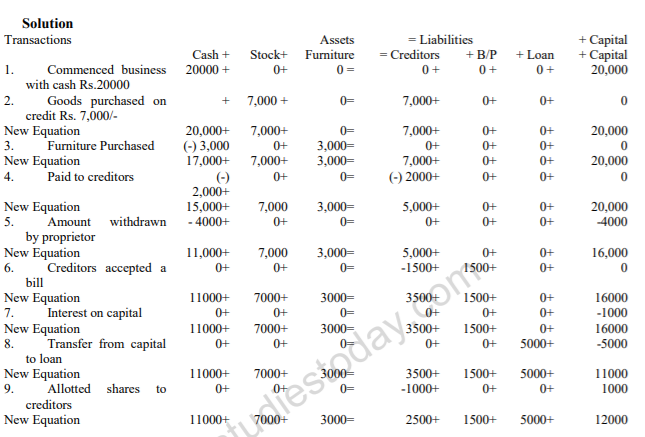
Show the effect of the following business transactions on assets, liabilities and capital through accounting equations:
1. Commenced business with cash 20,000
2. Goods purchased on credit 7,000
3. Furniture purchased 3,000
4. paid to creditors 2,000
5. Amount withdrawn by the proprietor 4,000
6. Creditors accepted a bill for payment 1,500
7. interest on capital 1,000
8. Transfer from capital to loan 5,000
9. Allotted shares to creditors 1,000
Question for Practice:
Prepare Accounting equation on the basis of following information:
(1) Sohan started business with cash =80,000
Machinery =10,000
And stock =10,000
(2) Interest on the above capital was allowed @ 10%
(3) Money withdrew from the business for his personal use 10,000/-
(4) Interest on drawings 500/-
(5) Depreciation charged on machinery 2,000/-
Q. How the assets liabilities and capital will be affected under following cases:
(1) Purchase of building for cash
(2) Purchase of furniture on credit
(3) Receipt of commission
(4) Payment to creditors.
Generally Students commit these mistakes please avoid :
• Treatment of adjustment in accounting equation
• Dual or triple effect of transaction
• Omission in recording amount
• Interest on capital and drawing
• Debit and credit should be done properly
• Depreciation must be treated properly.
RULES OF DEBIT AND CREDIT (I) Traditional or English Approach: This approach is based on the main principle of double entry system i.e. every debit has a credit and every credit has a debit. According to this system we should record both the aspects of a transaction whereas one aspect of a transaction will be debited and other aspect of a transaction will be credited.
(1) Personal Account: Debit the receiver and credit the giver.
(2) Real Account: Debit what comes in and credit what goes out.
(3) Nominal Account: Debit all expenses and losses credit all incomes and gains.
(2) Modern or American Approach: This approach is based on the accounting equation or balance sheet. In this approach accounts are debited or credited according to the nature of an account. In a summarised way the five rules of modern approach is as follows:
1. Increase in asset will be debited and decrease will be credited.
2. Increase in the liabilities will be credited and decrease will be debited.
3. Increase in the capital will be credited and decrease will be debited.
4. Increase in the revenue or income will be credited and decrease will be debited.
5. Increase in expenses and losses will be debited and decrease will be credited.
SOURCE DOCUMENTS
Meaning of Source documents: Business transactions are recorded in the books of accounts on the basis of some written evidence called source document.
Common Source documents are Cash Memo, Invoice or Bill, Receipts, Debit Note, Credit Note, Cheque, Pay in slip
Meaning of Voucher: Voucher is a source by which we record the transactions.
Meaning of Journal: Journal is a book of prime entry in which transactions are copied in order of date from a memorandum or waste book.
Illustration:
Journalise the following transactions in the books of Ravi:
1. Bought goods from Sonam Rs. 20,000 less trade discount 20% plus VAT @ 10%.
2. Sold goods costing Rs. 6,000 to Ram for Rs. 8,000 plus VAT @ 10%
3. Sold the balance goods for Rs. 16,000 and charged VAT @ 10% to Mohan against payment by cheque which was banked on the same day.
4. Deposited the VAT into government account by cheque.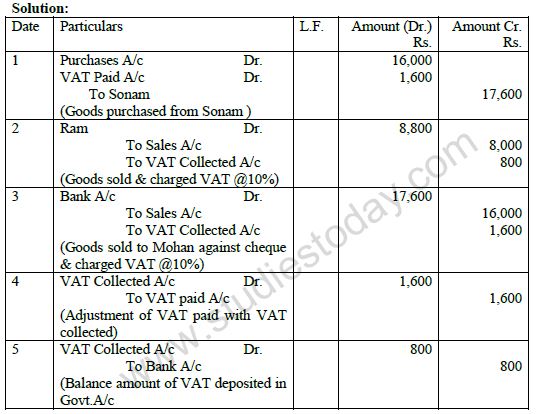
Question for Practice:
Journalise the following transactions:
1. Paid sales tax Rs. 5,000.
2. Sold goods for Rs. 80,000 to Diwan for cash and charged 8% sales tax.
3. Purchased goods from Neelam for Rs. 50,000 plus VAT @ 10%
4. Sold goods to Punam worth Rs. 80,000 plus VAT @ 10%.
5. VAT was deposited into Government Account on its due date.
6. Paid Income Tax Rs. 7,000.
CASH BOOK
Meaning: Cash book is a book in which all the transactions related to cash receipts and cash payments are recorded.
Please click the link below to download pdf file for CBSE Class 11 Accountancy Recording Of Transaction Notes.
Free study material for Accountancy
Study Material and Revision Notes for Class 11 Accountancy Chapter 03 Recording of Transactions-I
Quick Revision Notes: Chapter 03 Recording of Transactions-I (CBSE)
Review targeted chapter notes for Class 11 Accountancy Chapter 03 Recording of Transactions-I. Built according to official CBSE guidelines, these summaries highlight high-yield topics frequently tested in school evaluations.
Expert Study Material for Class 11 Accountancy
Built using the official NCERT book for Class 11 Accountancy, these notes provide reliable academic guidance. Pair your summary review with our recommended NCERT solutions to master optimal problem-solving approaches.
Complete Your Chapter Revision
Wrap up your chapter revision by testing your knowledge against standard question formats. Everything on our platform is provided free of charge.
FAQs
You can download the teacher prepared revision notes for CBSE Class 11 Accountancy Recording Of Transaction Notes from StudiesToday.com. These notes are designed as per 2026-27 academic session to help Class 11 students get the best study material for Accountancy.
Yes, our CBSE Class 11 Accountancy Recording Of Transaction Notes include 50% competency-based questions with focus on core logic, keyword definitions, and the practical application of Accountancy principles which is important for getting more marks in 2026 CBSE exams.
Yes, our CBSE Class 11 Accountancy Recording Of Transaction Notes provide a detailed, topic wise breakdown of the chapter. Fundamental definitions, complex numerical formulas and all topics of CBSE syllabus in Class 11 is covered.
These notes for Accountancy are organized into bullet points and easy-to-read charts. By using CBSE Class 11 Accountancy Recording Of Transaction Notes, Class 11 students fast revise formulas, key definitions before the exams.
No, all study resources on StudiesToday, including CBSE Class 11 Accountancy Recording Of Transaction Notes, are available for immediate free download. Class 11 Accountancy study material is available in PDF and can be downloaded on mobile.