

Revision Notes for Class 11 Accountancy: Chapter 08 Bill of Exchange
Access comprehensive revision notes for Chapter 08 Bill of Exchange using the CBSE Class 11 Accountancy Accounting For Bills Of Exchange Notes Set 02. Designed to align with the 2026-27 academic syllabus for Class 11 Accountancy, these concept summaries help students streamline their exam preparation and review complex topics efficiently.
Review Chapter 08 Bill of Exchange for Class 11 Accountancy
Access the complete concept summary PDF for Chapter 08 Bill of Exchange below. Regular review of these targeted notes builds familiarity with complex Class 11 Accountancy themes and helps secure higher marks in final school evaluations.

“Bills of Exchange are instrument of credit which facilitate the credit sale of goods.”
INTRODUCTION;
A Bill of Exchange and Promissory Note both are legal Instruments which facilitate the credit sale of goods by assuring the seller that the amount will be recovered after a certain period. Both of these are legal instruments under the Negotiable Instruments Act, 1881.
BILL OF EXCHANGE ;
“A Bill of Exchange is an instrument in writing containing an unconditional order signed by the maker, directing a certain person to pay a certain sum of money only to, or to the order of, a certain person or to the bearer of the instrument.” Section 5 of the Negotiable Instrument Act, 1881.
FEATURES OF A BILL OF EXCHANGE ARE :
1. A Bill of Exchange must be in writing.
2. It must contain an order (and not a request) to make payment.
3. The order of payment must be unconditional .
4. The amount of bill of exchange must be certain.
5. The date of payment should be certain.
6. It must be signed by the drawer of the bill.
7. It must be accepted by the drawee by signing on it.
8. The amount specified in the bill of exchange is payable either on demand or on the expiry of a fixed period.
9. The amount specified in the bill is payable either to a certain person or to his order or to the bearer of the bill.
10. It must be stamped as per legal requirements.
PARTIES TO A BILL OF EXCHANGE
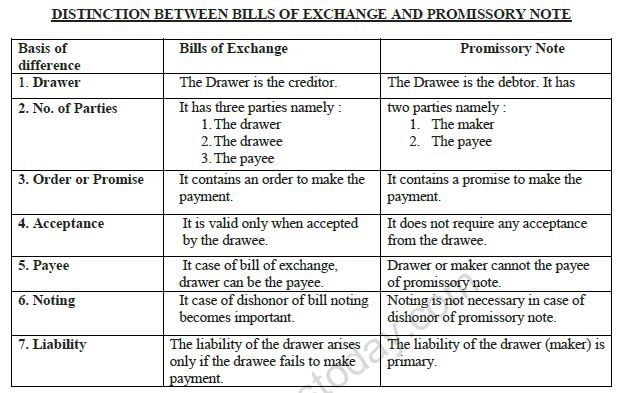
1. DRAWER: Drawer is the person who makes or writes the bill of exchange. Drawer is a person who has granted credit to the person on whom the bill of exchange is drawn. The drawer is entitled to receive money from the drawee (acceptor).
2. DRAWEE: Drawee is the person on whom the bill of exchange is drawn for acceptance. Drawee is the person to whom credit has been granted by the drawer. The drawee is liable to pay money to the creditor/drawer.
3. PAYEE: Payee is the person who receives the payment from the drawee. Usually the drawer and the payee are the same person. In the following cases. drawer and payee are two different persons : (i) When the bill is discounted by the drawer from his bank- payee is the bank. (ii) When the bill is endorsed by the drawer to his creditors: payee is the endorsee.
ADVANTAGES OF BILL OF EXCHANGE
1. It helps in purchases and sales of goods on credit basis.
2. It is a legally valid document in the eyes of law. It assures a easier recovery to the drawer if drawee fails to make the payments.
3. A bill can be discounted from the bank before its date of maturity. By discounting with the bank, drawer can get the money before due date if required.
4. It can be easily transferred from one person to another by endorsement.
5. It helps in recovery of debt without sending reminders to the debtor.
6. It assures the seller about the timely recovery of debt. So a drawer and drawee can plan about its cash management.
PROMISSORY NOTE
A Promissory note is an instrument in writing (not being a bank note or a currency note) containing an unconditional undertaking signed by the maker to pay a certain sum of money only to or to the order of a certain person or to the bearer of the instrument.
FEATURES OF A PROMISSORY NOTE
1. There must be an unconditional promise to pay a certain sum of money on a certain date.
2. It must be signed by the maker.
3. The name of the payee must be mentioned on it.
4. It must be stamped according to its value.
PARTIES TO A PROMISSORY NOTE
1. The maker : The maker is the person who makes the promise to pay the amount on a certain date. Maker of a bill must sign the promissory note before giving it to the payee.
2. The payee : The payee is the person who is entitled to get the payment from the maker of promissory note. Payee is the pesson who has granted the credit.
IMPORTANT TERMS
1. Term of Bill : The period intervening between the date on which a bill is drawn and the date on which it becomes due for payment is called „Term of Bill‟.
2. Due Date : Due date is the date on which the payment of the bill is due.
Due date is ascertained in the following manner :
(i) In case of „Bill at sight‟ -
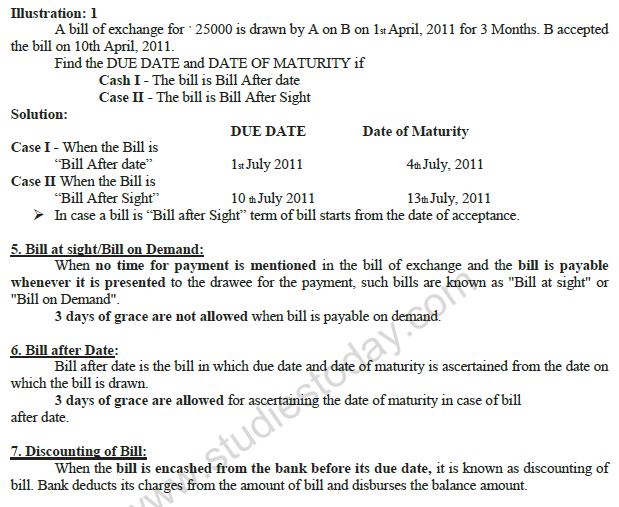
Due date is the date on which a bill is presented for the payment.
(ii) In case of „Bill after Date‟ -
Due Date = Date of Drawing + Term of Bill.
(ii) In case of „ Bill after sight‟ –
Due date = Date of Acceptance + Term of Bill.
3. Days of Grace : Drawee is allowed three extra days after the due date of bill for making payments. Such 3 days are known as „Days of Grace‟. It is a custom to add the days of grace.
4. Date of Maturity : The date which comes after adding three days of grace to the due date of a bill is called „Date of maturity‟.
Please click the link below to download pdf file for CBSE Class 11 Accountancy Accounting For Bills Of Exchange Notes Set B.
Free study material for Accountancy
Study Material and Revision Notes for Class 11 Accountancy Chapter 08 Bill of Exchange
About Chapter 08 Bill of Exchange Revision Notes
Access structured revision notes for Chapter 08 Bill of Exchange designed in alignment with the latest CBSE curriculum for Class 11 Accountancy. These summaries help clarify core themes and support effective daily study.
How to Use These Revision Notes
Each chapter summary is structured around standard CBSE textbooks, allowing students to check their understanding and clarify complex ideas early in their revision.
Enhance Practice with MCQs and Worksheets
Explore our broader library of printable assignments, chapter notes, and mock tests designed to support continuous revision and secure higher marks in CBSE assessments.
FAQs
You can download the teacher prepared revision notes for CBSE Class 11 Accountancy Accounting For Bills Of Exchange Notes Set 02 from StudiesToday.com. These notes are designed as per 2026-27 academic session to help Class 11 students get the best study material for Accountancy.
Yes, our CBSE Class 11 Accountancy Accounting For Bills Of Exchange Notes Set 02 include 50% competency-based questions with focus on core logic, keyword definitions, and the practical application of Accountancy principles which is important for getting more marks in 2026 CBSE exams.
Yes, our CBSE Class 11 Accountancy Accounting For Bills Of Exchange Notes Set 02 provide a detailed, topic wise breakdown of the chapter. Fundamental definitions, complex numerical formulas and all topics of CBSE syllabus in Class 11 is covered.
These notes for Accountancy are organized into bullet points and easy-to-read charts. By using CBSE Class 11 Accountancy Accounting For Bills Of Exchange Notes Set 02, Class 11 students fast revise formulas, key definitions before the exams.
No, all study resources on StudiesToday, including CBSE Class 11 Accountancy Accounting For Bills Of Exchange Notes Set 02, are available for immediate free download. Class 11 Accountancy study material is available in PDF and can be downloaded on mobile.