

Class 9 Science Practice Assignments: CBSE Class 9 Science Gravitation Assignment Set 01
Access comprehensive school assignments for Chapter 09 Gravitation using the CBSE Class 9 Science Gravitation Assignment Set 01. Designed to align with the 2026-27 CBSE academic guidelines, these practice sets help Class 9 Science students reinforce core concepts and improve their problem-solving accuracy.
Download Chapter 09 Gravitation Assignment PDF with Solutions
Access the complete assignment PDF for Class 9 Science below. Regular practice with these targeted academic tasks builds familiarity with standard question patterns and helps secure higher marks in final school evaluations.
Exercises

Exam Questions NCERT Class 9 Science Chapter 09 Gravitation
Question : The gravitational force acts on all objects in proportion to their masses. Why, then, a heavy object does not fall faster than a light object?
Answer : Acceleration due to gravity does not depend on mass of object. Hence, all bodies fall with the same acceleration provided there is no air or other resistance.
Question : How can a person lie on a bed of nails without getting hurt?
Answer : Weight is spread out over them all making the pressure on each individual nail just about equal to a pinch if there are many nails. The greater the number of nails the lesser will be the pressure per square inch. If there are a large number of nails, it will be almost like lying on a solid surface.
Question : Why is G called ‘a universal gravitational constant’?
Answer : The value of G is same for any pair of objects in the universe. Also its value does not depend on the nature of the intervening medium. That is why constant G is called ‘universal gravitational constant’.
Question : Why should we be sent flying in space if the force of gravity somehow vanishes today?
Answer : The centripetal force required to keep us rotating along with the Earth would not be available in the absence of force of gravity. We would then fly off along the tangent to the Earth into the space.
Question : Explain : Centrifugal force and Centripetal force.
Answer : A force which is required to move a body uniformly in a circle is known as centripetal force. This force acts along the radius and towards the centre of the circle, centrifugal force arises when a body is moving actually along a circular path, by virtue of tendency of the body to regain its natural straight line path. This force acts along the radius and away from the centre of the circle.
Question : Discuss the variation of weight of a body with the Latitude of Earth and Altitude of Earth.
Answer :
(i) Earth is not a perfect sphere.
(ii) Its radius at equator is longer than at the poles.
(iii) The acceleration due to gravity is inversely proportional to the square of the radius.
(iv) Therefore, the value of “g” at the poles is higher than that at the equator.
(v) As a result, the weight of an object increases if it moves from the equator to the poles.
Mark (1)
Q 1 Name the force due to which a body performs circular motion.
Q 2 What is the nature of gravitational force?
Q 3 What is the numerical value of gravitational constant?
Q 4 Define thurst.
Q 5 Name the force experienced by the body when it is immersed in a liquid.
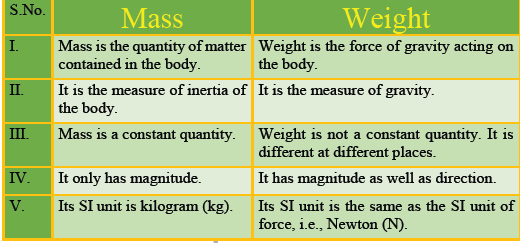
Q 6 What do you mean by the weight of the body?
Q 7 What is the acceleration of free fall?
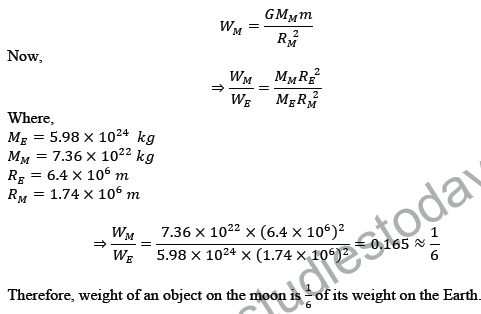
Q 8 What is the weight of an object on moon?
Q 9 Why the cutting edge of a knife should be as sharp as possible?
Q 10 Iron nails sinks in water.Why?
Q 11 Explain, why the value of ‗g‘ is greater at poles than at equator.
Q 12 Why does a truck or motor-bus has much wider tyres?
Q 13 What do you mean by force of buoyancy?
Q 14 State Archimedes‘ principle.
Q 15 The density of gold is 19.3 x 10³ kg/m3. Find its relative density.
Q 16 Give any two applications of Archimedes principle.
Q 17 What is a hydrometer? What is the principle of hydrometer?
Mark (2)
Q 18 Explain why moon moves around earth.
Q 19 A stone is dropped from the top of a building of height 45 m. Calculate its velocity , when it srtikes the ground.(Take g=10 m/s2)
Q 20 A body is thrown up with a velocity of 29.4m/sec.Find the time taken by the body to reach its highest point? After how much
time the body will come back on the ground?
Q 21 If the earth attracts an apple, why does not an apple attracts the earth ?
Q 22 A sheet of paper fall slower than the one that is crumpled into ball. Why?
Q 23 The mass of Seema is 45kg. What will be her weight on the surface of the earth? What will be her weight on the surface of the
moon?
Q 24 Why fluid exert pressure ?How is the pressure transmitted in a fluid?
Q 25 State the importance of the universal law of gravitation.
Q 26 State Newton‘s Law of Gravitation. Why Newton‘s Law of Gravitation is known as Universal Law of Gravitation?
Q 27 What are two main factors on which the buoyant force depends?
Q 28 Why does an iron nail sink in water but a wooden cork float on water?
Q 29 An object of volume V is immersed in a liquid of density .P Calculate the magnitude of buoyant force acting on the objet due to
liquid.
Q 30 What is buoyant force? Write any two applications of Archimedes principle.
Q 31 A student immerses a block into different liquids. Is the buoyant force acting on the block same for all the liquids?
Q 32 A plastic ball is released under water. It comes to the surface of the water and doesn‘t sinks in it. Explain the reason.
Q 33 Define pressure. A force of 200 N is applied on an object of area 10 m2. Find the pressure exerted on the body.
Q 34 Why are the straps of school bags made wider?
Q 35 What are the factors that affect buoyant force exerted by a liquid on a solid when it is immersed in the liquid?
Q 36 In what direction does the buoyant force on an object due to a liquid act? What is the relation of buoyant force with the density
of a fluid?
Q 37 Does Archimedes principle hold true for a satellite moving in a circular orbit? Explain.
Q 38 Mohan threw a pointed dart (arrow) at the dartboard. It stuck to the board, but when he threw a blunt dart, it fell down after
hitting the board. Why?
Q 39 An object is immersed in different liquids. Is same buoyant force acts on an object due to all liquids?
Q 40 A ball is thrown vertically upwards with a velocity of 49 m/s. Calculate
(a) The maximum height to which it reaches
(b) The total time it takes to return to the surface of the earth
Marks (3)
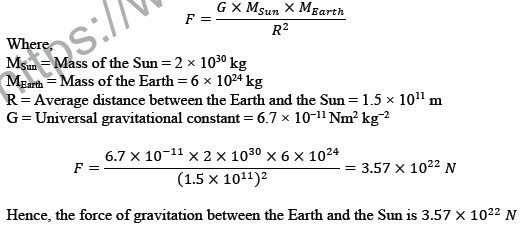
Q 41 What is the force of gravitation between the earth and the sun, given that the mass of the earth = 6X1024kg and of the sun = 2X1030kg? The average distance between them is 1.5X10¹¹m.
Q 42 Two objects of masses m1 and m2 exert a force F on each other when they are separated by a distance,r. What happens when
(i) Mass m1 is doubled,
(ii) The distance between them is halved?
Q 43 Explain why iron nail sinks in water, but a ship made up of iron floats?
Q 44 Distinguish between g and G.
Q 45 A body of weight 600 N rests on the floor of a lift. If the lift begins to fall freely under the gravity, what is the force with which the body presses on the floor?
Q 46 How can you calculate the value of acceleration due to gravity?
Q 47 How one can calculate the value of acceleration due to gravity on the surface of the moon?
Q 48 If the planet existed whose mass and radius both were half those of the earth, then what will be the acceleration due to gravity at its surface?
Q 49 To estimate the height of a bridge over a river, a stone is dropped freely in the river from the bridge. The stone takes 2 seconds to touch the water surface in the river. Calculate the height of the bridge from the water level.(g = 9.8 m/s2).
Q 50 How much would a 70 kg man weigh on the moon? What would be his mass on the earth and on the moon? (Acceleration due to gravity on the moon = 1.63 m/s2)
Q 51 When a spherical ball is suspended with an iron string, the length of the string increases. However, the length of the string decreases when the ball is completely immersed in water. Why? Explain.
Q 52 How do a submarine sink and float on water?
Q 53 Calculate the density of iron if an iron cylinder of radius 14mm and length 80mm weighs 369.6g.
Q 54 In which case is the depression in the cushion more – when a person stands on it or when he lies down on it? Explain.
Q 55 Give reasons for the following.
1. A plastic block released under water never stays under water but comes to the surface of the water.
2. Sleepers are laid below the rails.
Marks (5)
Q 56 State and explain the Universal law of Gravitation.
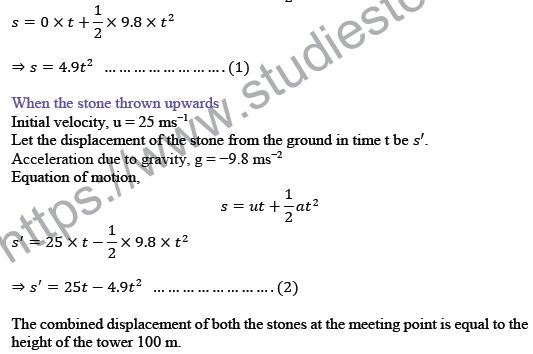
Q 57 A ball is dropped from the top of a tower 100m high and at the same time another ball is projected vertically upwards from the ground with a velocity of 25m/sec. Calculate where and when the two stones will meet. Take g=10m/s2.
Q 58 How will you calculate relative density of a cork using Archimedes‘s Principle?
Q 59 (i) How do fishes float in water?
(ii) Write the conditions that takes place when a solid is immersed in a fluid.
Q 60 The force on a phonogram needle of cross-section of radius of 0.01cm, is 1.5N. Find the pressure it exerts on the record in
(i) Pa
(ii) atm
Q 61 What do you understand by relative density? What is the unit of relative density?
Manoj have a metal block of dimension 25cm x 10cm x 5cm. Now, if the mass of the block is 5kg, then calculate the greatest and least pressure exerted by the block?
Q 62 A piece of iron is totally immersed in water. If its density is 7.8 x 10³ kg/m3 and volume is 10-4m3 then calculate
(i) The upthrust
(ii) Apparent weight of iron piece in water
Most Important Questions
Q 1 An object dropped from a height always fall towards earth. Why?
Q 2 Weight of an object on earth and moon is different. Why?
Q 3 In your daily life you experience force of gravitation. Give some examples,
Q 4 What is gravitation?
Q 5 State Newton‘s law of motion.
Q 6 What do you understand by centripetal force?
Q 7 What do you understand by gravitational force?
Q 8 What do you understand by free fall of an object?
Q 9 How does the force of gravitation between two objects change on reducing the distance to half?
Q 10 If we neglect the friction of air then all the objects fall with the same speed. Why does a heavy object do not fall faster?
Q 11 If the earth attracts moon, why doesn‘t it move towards earth?
Q 12 Every thing exert force on the other. It means that we also exert force on each other. Is this true? If yes, then why we does not feel this force?
Q 13 When my servant bring water in a pitcher, she place a thick piece of cloth on her head before placing pitcher. Why?
Q 14 Moon exert gravitational force on earth. Give one example.
Q 15 State universal law of gravitation.
Q 16 Find the gravitational force acting between earth and an object of 2 kg.
Q 17 What do you mean by free fall?
Q 18 Mass of an object is 20kg. What is its weight of
(i) Earth.
(ii) Moon.
Q 19 What do you understand by thrust?
Q 20 What do you understand by pressure?
Q 21 What is the acceleration for free fall?
Q 22 Acceleration due to gravity is same for all objects. But a book falls faster than a paper. Why?
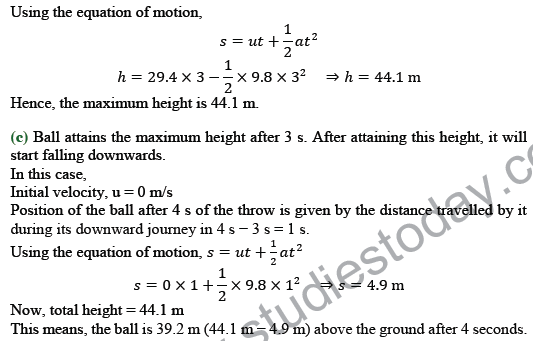
Q 23 Ball thrown up vertically reaches to maximum height in 6 s. Find
(a) The velocity with which it was thrown up.
(b) The maximum height it reaches.
(c) Its position after 4 s.
Q 24 Rahul took a plastic ball. He pushed it deep in a tank full of water. As soon as he released the ball, the ball comes on the surface of water. Why?
Q 25 Tyres of truck are wider than that of a car. Why?
Q 26 I have a book having dimensions 40cmx30cmx4cm and mass 500g. Find the pressure exerted by it on the table.
(i) When book lies down on the table.
(ii) When book is kept on the table such that it covers 30cmx4cm area of the table.
Q 27 State equations of motion for free fall.
Q 28 A stone is released from the top of a building of height 19 m. Calculate its final velocity.
Q 29 Every thing exert force on the other. It means that we also exert force on each other. Is this true? If yes, then why we does not feel this force?
Q 30 When my servant brings water in a pitcher, she place a thick piece of cloth on her head before placing pitcher. Why?
Q 31 What happens to the force between two objects, if
(i) Mass of one object is tripled?
(ii) Distance between the objects is doubled?
(iii) Masses of both objects are doubled?
Q 32 What do you understand by buoyant force?
Q 33 Give two examples of buoyancy.
Q 34 Give the conditions for an object to float or sink.
Q 35 The volume of a substance of 50 g, is 20 cm-3. The density of water is 1 g-cm-3. Will the substance float or sink? What will be the weight of water displaced by the substance?
Q 36 State Archimedes‘ principle.
Q 37 Write some applications of Archimedes‘ principle.
Q 38 What is relative density?
Q 39 Why we measure the relative density of a substance?
Q 40 Relative density of silver is 11 and the density of water is 103 Kg-m-3. What is the density of silver in S.I. Units?
Q 41 How will you detect that the milk is pure or impure?
Q 42 How will you conclude that a particular sample of water is pure?
Q 43 How does a submarine sinks and float?
Q 44 Show that, if the weight of fluid displaced by the object is more than its weight then it will sink in the fluid.
Q 45 An iron piece weighs 600 g in air and 400 g in water. Find volume of the solid.
Q 46 How an air balloon rises up?
Free study material for Science
Chapter 09 Gravitation Printable Assignments & Solutions for Class 9 Science
Revision Assignment: Chapter 09 Gravitation (CBSE)
Access structured practice assignments for Chapter 09 Gravitation designed in alignment with the latest CBSE curriculum for Class 9 Science. These printable sets cover objective and descriptive problem types to support thorough revision.
Key Advantages of Solving Chapter 09 Gravitation Assignments
- Syllabus Compliance: Sets reflect current CBSE evaluation criteria and official marking frameworks.
- Multi-Format Practice: Includes varied problem types designed to deepen comprehension across all sub-topics.
- Time Management: Routine practice optimizes pacing to finish school examinations comfortably within schedule.
Steps to Complete Chapter 09 Gravitation Assignments Successfully
- Concept Foundation: Review the NCERT book for Class 9 Science thoroughly before diving into assignment tasks.
- Self-Evaluation: Solve exercises independently before inspecting professional answer guides.
- Progress Monitoring: Note down complex formulas or concepts, clearing them up using available online practice aids.
FAQs
You can download free PDF assignments for Class 9 Science Chapter 09 Gravitation from StudiesToday.com. These practice sheets have been updated for the 2026-27 session covering all concepts from latest NCERT textbook.
Yes, our teachers have given solutions for all questions in the Class 9 Science Chapter 09 Gravitation assignments. This will help you to understand step-by-step methodology to get full marks in school tests and exams.
Yes. These assignments are designed as per the latest CBSE syllabus for 2026. We have included huge variety of question formats such as MCQs, Case-study based questions and important diagram-based problems found in Chapter 09 Gravitation.
Practicing topicw wise assignments will help Class 9 students understand every sub-topic of Chapter 09 Gravitation. Daily practice will improve speed, accuracy and answering competency-based questions.
Yes, all printable assignments for Class 9 Science Chapter 09 Gravitation are available for free download in mobile-friendly PDF format.