

Download CBSE Class 7 Mathematics Assignments
Explore structured practice materials through the CBSE Class 7 Mathematics Practical Geometry Assignment Set 01. Tailored for Class 7 learners, utilizing these Mathematics assignments ensures thorough preparation and strengthens foundational knowledge before final CBSE evaluations.
Access CBSE School Assignments and Answers
View or download the dedicated CBSE Class 7 Mathematics Practical Geometry Assignment Set 01 resource below. Engaging with these assignments under focused study conditions ensures continuous academic progress and mastery of the 2026-27 curriculum.
Question. Which among the following is used to construct a triangle?
(A) The lengths of the three sides.
(B) The perimeter of the triangle.
(C) The measures of three angles.
(D) The names of three vertices.
Answer : A
Question. In the given figure, find the measure of ∠RQT, if PQ = QR and ∠QPR = 60°.
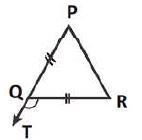
(A) 60°
(C) 120°
(B) 140°
(D) 100°
Answer : C
Question. A triangular sign board is isosceles. If theunequal side is 7 em and one of the equal sides is 6 em, what is the measure of the third side?
(A) 5 em
(C) 7 em
(B) 6 em
(D) Either (A) or (C)
Answer : B
Question. Which of the following statements is incorrect?
(A) The sum of angles in a triangle is 2 right angles.
(B) The exterior angle of a triangle is equal to the interior angle of the triangle.
(C) The hypotenuse is the longest side of a right angled triangle.
(D) All the above.
Answer : B
Question. Identify the true statement.
(A) A triangle with 3 equal sides is isosceles.
(B) A triangle with a 11 oo angle is right angled.
(C) A triangle with 3 acute angles is acute angled.
(D) A triangle with 2 equal sides is equilateral.
Answer : C
Question. In which of the following cases is the construction of a triangle not possible?
(A) Measures of 3 sides are given.
(B) Measures of 2 sides and an included angle are given.
(C) Measures of 2 angles and a side are given.
(D) Measures of 3 angles are given.
Answer : D
Question. Choose the correct option in which a triangle CANNOT be constructed with the given lengths of sides.
(A) 3 em, 4 em, 5 cm
(B) 7 em, 6 em, 5 cm
(C) 10 em, 7 em, 2 cm
(D) 12 em, 8 em, 6 cm
Answer : C
(a - c): David folds a sheet of paper. The dotted lines as shown in the figure are the creases formed, which are
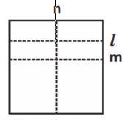
Question a. Which of the following is true?
(A) l // m
(B) l // n
(C) n // m
(D) Either (B) or (C)
Answer : A
Question b. What can you say about lines l and n?
(A) l // n
(B) l ⊥ n
(C) l is the same line as n
(D) Neither (A) nor (B)
Answer : B
Question c. What do you call the linen with respect to the lines l and m?
(A) n is a line parallel to l and m.
(B) n is a line parallel to l only.
(C) n is a transversal.
(D) n is a line parallel to m only.
Answer : C
Question. Which of the following is used to draw a line parallel to a given line?
(A) A protractor
(B) A set square
(C) A ruler
(D) A ruler and compasses
Answer : D
Question. How many parallel lines can be drawn passing through a point not on the given line?
(A} 2
(D) 3
(B) 1
(D) 0
Answer : B
Question. Based on the sides of a triangle, which of the following is a classification of triangles?
(A) A right angled triangle
(B) An acute angled triangle
(C) An obtuse angled triangle
(D) An isosceles triangle
Answer : D
Question. Which type of triangle is in the classification based on angles?
(A) An equil ateral triangle
(B) An isosceles triangle
(C) A right angled triangle
(D) A scalene triangle
Answer : C
Question. In which of the following cases can a triangle be constructed?
(A) Measures of three sides are given.
(B) Measures of two sides and an included angle are given.
(C) Measures of two angles and the side between them are given.
(D) All the above.
Answer : D
Question. The measurements of ΔDEF are EF = 8.4 em, ∠E = 103° and ∠F = 85°.
Which of the following is correct?
(A) ΔDEF can be constructed.
(B) ΔDEF is an obtuse angled triangle.
(C) ΔDEF cannot be constructed.
(D) ΔDEF is an acute angled triangle.
Answer : C
Question. In ΔXYZ , x, y and z denote the three sides.
Which of the following is incorrect?
(A) X - y > z
(B) X + z > y
(C) X - y < z
(D) X + y > z
Answer : A
Question. Which of the following can be used to construct a 30° angle?
(A) Construct a 60° angle using compasses and bisect it.
(B) Construct a perpendicular bisector of a line segment.
(C) Construct the bisector of any angle.
(D) Construct an angle congruent to any given angle.'
Answer : A
Question. Study the steps of construction given.
Step 1: Draw a ray OA.
Step 2: With 0 as centre and any convenient radiusdrawanarcMNtocut OA atM.
Step 3: With Mas centre and the same radius draw an arctocutMNatP.
Step 4: With Pas centre and the same radius, draw an arctocutMNatQ.
Step 5: Draw OQand produce it to D. An angle AOD is constructed.
What is the measure of ∠AOD ?
(A} 60°
(C) 120°
(B) 30°
(D) 45°
Answer : C
Question. Satish foll owed the steps given in the box.
Step 1: Construct an angle of90°.
Step 2: Bisect the 90° angle.
Step 3: Bisect one of the angles obtained in step 2.
Which steps is not required to construct a 45° angle?
(A) Step 1
(B) Step 2
(C) Step 3
(D) Steps 2 and 3
Answer : C
Question. Which of the following is NOT constructed using a ruler and a set square?
(A) A perpendicular to a line from a point not on it.
(B) A perpendicular bisector of a line segment
(C) A perpendicular to a line at a point on the line.
(D) A line parallel to a given line through
Answer : B
Question. Given PQ = 4dm, QR = 3.5 dm and RP = 4.5 dm, what type of a triangle can be constructed?
(A) An acute angled triangle
(B) An obtuse angled triangle
(C) An equilateral triangle
(D) A right angled triangle
Answer : A
Question. ΔPQR isconstructedsuchthatPQ = 5cm, PR = 5cm and ∠RPQ = 50° Identify the type of triangle constructed
(A) An isosceles triangle
(B) An acute angled triangle
(C) An obtuse angled triangle
(D) Both (A) and (B)
Answer : D
Question. Identify the condition when a triangle can be constructed?
(A) All three acute angles are given.
(B) A side and an acute angles are given.
(C) Two obtuse angles are given.
(D) All given sides are equa
Answer : A
Question. Identify the false statement.
(A) A triangle with three equal sides is called an equilateral triangle.
(B) A triangle with a right angle is called a right angled triangle.
(C) A triangle with two equal sides is called a scalene triangle. .
(D) A right angled triangle has two acute angles and a right angle
Answer : C
Question. Identify the condition to be checked before constructing a triangle
(A) Sum of the three angles is 180°
(B) The sum of any two of the sides is greater than the third side.
(C) The difference of any two sides is
(D) All the above
Answer : D
Question. How many perpendicular lines can be
(A) 1
(B) 2
(C) 0
(D) Infinite
Answer : A
Question. In ΔXYZ, XV > YZ > ZX Which of the on the line. following is the smallest angle?
(A) X
(B) Z
(C) y
(D) X = Y = Z
Answer : C
Question. ΔPQR is constructed with all its angles measuring 60° each. Which of the following is correct?
(A) ΔPQR is an equilateral triangle
(B) ΔPQR is isosceles triangle.
(C) ΔPQR is a scalene triangle.
(D) ΔPQR is a right angled triangle.
Answer : A
Question. A triangle is constructed as shown in the
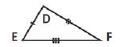
Which of the following is not correct about ΔDEF?
(A) ΔDEF has all its sides equal.
(B) ΔDEF is an acute angled triangle .
(C) ΔDEF is a scalene triangle.
(D) ΔDEF is not an equilateral triangle
Answer : A
Question. An isosceles triangle is constructed as shown in the figure.
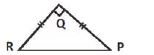
Which of the given statements is incorrect?
(A) PR is the hypotenuse of ΔlPQR.
(B) ΔPQR is an equilateral triangle.
(C) ΔPQR is a right angled triangle.
(D) If right angled ΔPQR has its equal angles measuring 45° each
Answer : B
Question. In ΔABC, ∠C = 50° and ∠A = ∠B. What is the measure of ∠A?
(A) 75°
(B) 80°
(C) 65°
(D) 45°
Answer : C
Question. Which vertex of ΔABC is right angled if AB = 8cm, AC = 6cm, and BC = 10cm?
(A) ∠C
(B) ∠A
(C) ∠B
(D) A or C
Answer : B
Question. A triangle PQR is constructed with PQ = 10 cm, PR = 8 em and L P = 90° .ldentify the correct classification of ΔPQR.
| Based on sides | Based on angles | |
| (A) | Scalene | Right angled |
| {B) | Isosceles | Acute angled |
| (C) | Scalene | Acute angled |
| (D) | Isosceles | Right angled |
Answer : A
Question. ΔPQR is such that ∠P = ∠Q = ∠R = 60 which of the following is true?
(A) ΔPQR is equilateral.
(B) ΔPQR is acute angled.
(C) Both (A) and (B)
(D) Neither (A) nor (B)
Answer : C
Question. Which of the following are the measures of a triangle that can be constructed using the S.S.S. criterion?
(A) X y = 6 cm, ∠X = 40° , ∠V = 10°
(B) DE = 8 cm , EF = 7 cm , FD = 9 cm
(C) PQ = 4 cm, QR = 6 cm, ∠Q = 80°
(D) AB = 5 cm, BC = 4 cm, ∠C = 90°
Answer : B
1. Construct a triangle ABC, given that AB = 5 cm, BC = 6 cm and AC = 7 cm.
2. Construct ΔABC such that AB = 2.5 cm, BC = 6 cm and AC = 6.5 cm. Measure <B.
3. Draw ΔPQR with PQ = 4 cm, QR = 3.5 cm and PR = 4 cm. What type of triangle is this?
4. Construct an equilateral triangle of side 5.5 cm.
5. Construct a triangle PQR, given that PQ = 3 cm, QR = 5.5 cm and <PQR = 60°.
6. Construct ΔDEF such that DE = 5 cm, DF = 3 cm and m<EDF = 90°.
7. Construct an isosceles triangle in which the lengths of each of its equal sides are 6.5 cm and the angle between them is 110°.
8. Construct ΔXYZ if it is given that XY = 6 cm, m<ZXY = 30° and m<XYZ = 100°.
9. Construct ΔABC, given <A = 60°, m<B = 30° and AB = 5.8 cm.
10. Construct ΔPQR if PQ = 5 cm, m<PQR = 105° and m<QRP = 40°.
11. Construct ΔLMN, right-angled at M, given that LN = 5 cm and MN = 3 cm.
12. Construct a right-angled triangle whose hypotenuse is 6 cm long and one of the legs is 4 cm long.
Free study material for Mathematics
Chapter Assignment & Practice Material for Class 7 Mathematics Chapter 10 Practical Geometry
Class 7 Mathematics Chapter 10 Practical Geometry Printable Assignments
Access structured practice assignments for Chapter 10 Practical Geometry designed in alignment with the latest CBSE curriculum for Class 7 Mathematics. These printable sets cover objective and descriptive problem types to support thorough revision.
Why Practice Class 7 Mathematics Assignments?
- Exam Alignment: Questions strictly follow contemporary CBSE sample papers and grading schemes.
- Comprehensive Coverage: Features objective drills, case studies, and structured descriptive problems for Chapter 10 Practical Geometry.
- Pacing & Precision: Regular problem-solving builds critical calculation speed and test-taking accuracy.
Effective Strategy for Class 7 Mathematics Assignments
- Textbook Review: Always study the core NCERT book for Class 7 Mathematics prior to beginning the assignment.
- Independent Attempt: Solve Chapter 10 Practical Geometry questions on your own initially before cross-checking with expert solutions.
- Error Tracking: Record challenging concepts in a dedicated notebook and practice online MCQ tests for revision.
FAQs
You can download free PDF assignments for Class 7 Mathematics Chapter 10 Practical Geometry from StudiesToday.com. These practice sheets have been updated for the 2026-27 session covering all concepts from latest NCERT textbook.
Yes, our teachers have given solutions for all questions in the Class 7 Mathematics Chapter 10 Practical Geometry assignments. This will help you to understand step-by-step methodology to get full marks in school tests and exams.
Yes. These assignments are designed as per the latest CBSE syllabus for 2026. We have included huge variety of question formats such as MCQs, Case-study based questions and important diagram-based problems found in Chapter 10 Practical Geometry.
Practicing topicw wise assignments will help Class 7 students understand every sub-topic of Chapter 10 Practical Geometry. Daily practice will improve speed, accuracy and answering competency-based questions.
Yes, all printable assignments for Class 7 Mathematics Chapter 10 Practical Geometry are available for free download in mobile-friendly PDF format.