

Download CBSE Class 7 Mathematics Assignments
Explore structured practice materials through the CBSE Class 7 Mathematics Comparing Quantities MCQs Assignment Set 01. Tailored for Class 7 learners, utilizing these Mathematics assignments ensures thorough preparation and strengthens foundational knowledge before final CBSE evaluations.
Access CBSE School Assignments and Answers
View or download the dedicated CBSE Class 7 Mathematics Comparing Quantities MCQs Assignment Set 01 resource below. Engaging with these assignments under focused study conditions ensures continuous academic progress and mastery of the 2026-27 curriculum.
Question. See the weighing mechine given with some identical cubes marked 'Z'.How many grams does ‘Z’ weigh?
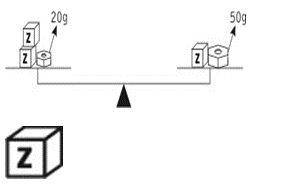
(A) 15
(B) 25
(C) 30
(D) 50
Answer : C
Question. Francis bought an ALTUS PC in May 2006. What is the total price that he would be paying for it?

(A) Rs. 5000
(B) Rs. 32000
(C) Rs. 35500
(D) Rs. 37000
Answer : D
Question. If 6 men take 4 days to complete a job, how many days will 12 men take?
(A) 2 days
(B) 3 days
(C) 8 days
(D) 9 days
Answer : A
Question. Tina called her friends Shama, Jenny, Roma and Aashka over to her house to play. They all arrived at Tina's house at different times. Shama arrived 5 minutes after Jenny but 10 minutes before Aashka. Roma and Tina were playing chess when Jenny arrived. In what order did they arrive at Tina's house?
(A) Roma, Jenny, Shama, Aashka
(B) Jenny, Roma, Shama, Aashka
(C) Roma, Shama, Jenny, Aashka
(D) Jenny, Shama, Aashka, Roma
Answer : A
Question. A square and a regular pentagon have the same perimeter. What is the ratio of a side of the square to that of the pentagon?
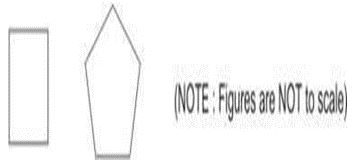
(A) 05:04
(B) 04:05
(C) 25:16
(D) 16:25
Answer : A
Question. A weighing scale with two objects x and y is shown below:
Which of the following relations about the weights of x and y is true?
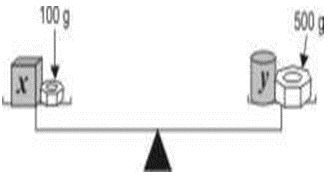
(A) x is 400 g heavier than y.
(B) X is 400 g lighter than y.
(C) y is 5 times as heavy as x.
(D) x and y weigh the same.
Answer : A
Question. The ratio of girls to boys in a class is 3 : 2. Which of the following can be found from this information alone?
(A) The percentage of girls in the class
(B) The number of boys in the class
(C) The total number of students in the class
(D) The ratio of boys to girls in the whole school
Answer : A
Question. Salim and Rajat are looking at the menu card of a restaurant, a part of which is shown here:
Salim and Rajat want to order a drink each and Salim does not want a soft drink. If the rate of sales tax is 7% on the order, and they have just Rs. 50 between them, what could they order?
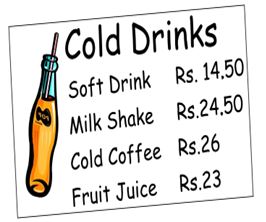
(A) 2 soft drinks
(B) 2 milk shakes
(C) 1 cold coffee and 1 fruit juice
(D) 1 soft drink and 1 cold coffee
Answer : D
Question. If x is reduced by 25%, the result will be:
(A) 0.25x
(B) 25x
(C) 0.75x
(D) 75x
Answer : C
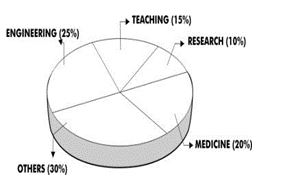
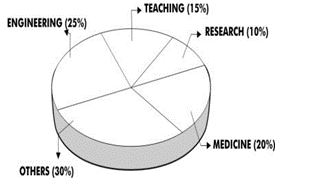
Question. The question is based on the pie-chart shown.
A survey was conducted among 660 students of a certain city in which each student was asked to name the profession of his or her choice. The result of the survey is shown in the pie chart.
How many students want to take up Teaching as a profession?
(A) 15
(B) 66
(C) 99
(D) 132
Answer : C
Question. What percentage of students has named a profession OTHER THAN Medicine or Engineering as their preference?
(A) 30%
(B) 45%
(C) 55%
(D) 65%
Answer : C
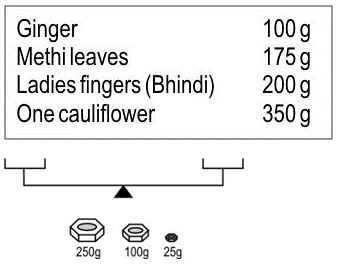
Question. Given here is a list of things Mrs. Cherian bought from a vegetable seller one day.
On reaching home, she wants to check the weight of each item on the list. She has weighing scales of the kind shown and three weights. The weight (mass) of which item will she NOT be able to check?
(A) The ginger
(B) The methi leaves
(C) The ladies fingers
(D) The cauliflower
Answer : C
Question. The ratio of the length of line l to that of line m is about

(A) 03:01
(B) 02:01
(C) 01:03
(D) 01:02
Answer : A
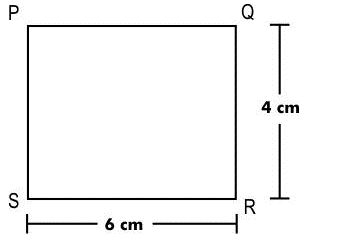
Question. When this rectangle is seen under a magnifying glass, side QR appears to be 6 cm. Nearly how many centimetres long will PQ appear under the magnifying glass?
(A) 4
(B) 8
(C) 9
(D) 10
Answer : C
Question. What percent of the square is shaded?
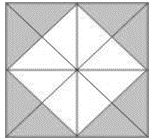
(A) 4%
(B) 25%
(C) 40%
(D) 50%
Answer : D
Question. Koyna made a pattern with red and yellow tiles, with the yellow tiles forming 25% of the whole pattern.
What is the ratio of the YELLOW tiles to the RED ones in the pattern?
(A) 3:4
(B) 1:3
(C) 1:4
(D) 1:25
Answer : B
Question. This is what Arjun weighed last winter. During the year, his weight increased by 10%. What would be his weight this winter?
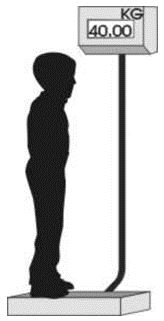
(A) 40.1 kg
(B) 41 kg
(C) 44 kg
(D) 50 kg
Answer : C
Question. The water content of a raw potato is about 85% by weight. If 2 Kg of potatoes are sliced and dried up completely by keeping in sunlight, what will they weigh?
(A) 300g
(B) 850 g
(C) 1 Kg 150 g
(D) 1 Kg 750 g
Answer : A
Question. The diameter of a TENNIS BALL would be about.
(A) 0.5 mm
(B) 5 mm
(C) 50 mm
(D) 500 mm
Answer : C
Question. 90 for every 100 is the same as_ ____for every 200.
(A) 210
(B) 190
(C) 180
(D) 90
Answer : C
Question. In an office the working hours are 10:30 a.m. to 5:30p.m. and in between 30 minutes are spent for lunch. Find the ratio of office hours to the time spent for lunch.
(A) 7 : 30
(B) 1 : 14
(C) 14 : 1
(D) 30: 7
Answer : C
Question. Which of the following is the condition for two ratios to be equal?
(A) Product of means is equal to antecedents.
(B) Product of extremes is equal to consequents.
(C) Antecedents are equal to consequents.
(D) Product of means is equal to product of extremes.
Answer : D
Question. If 20: 5 : : p : 1, what is the value of p?
(A) 1/5
(B) 4
(C) 5
(D) 1
Answer : B
Question. What is the mean proportion of
25 : 20 :: 20: 16?
(A) 25
(B) 20
(C) 16
(D) 100
Answer : B
Question. A boy has enough money to buy 20 books. If each book costs 25 paise less, he could buy two more books and still have 70 paise left. How much money does the boy have?
(A) ₹ 16
(B) ₹ 24
(C) ₹ 48
(D) ₹ 36
Answer : C
Question. When a number is reduced by 4, it becomes 80% of itself. Find the number.
(A) 20
(B) 30
(C) 40
(D) 50
Answer : A
Question. If 2(1/2)% of a number is 0.2, what will be 120% of it?
(A) 10.8
(B) 4.8
(C) 9.6
(D) 12.4
Answer : C
Question. The number of seats for admission is increased by 1 0% every year. If the number of seats in 2001 was 400, what was the number of seats in 2003?
(A) 824
(B) 484
(C) 500
(D) 480
Answer : B
Question. In an election between two candidates, the candidate who gets 30% of the votes polled is defeated by 15000 votes. What is the number of votes polled for the winning candidate?
(A) 37 500
(B) 30000
(C) 26250
(D) 11250
Answer : C
Question. In 2003, Indian cricket team played 60 games and won 30% of the games played. After a phenomenal winning streak, this team raised its average to 50%. How many games did the team win in a row to attain this average?
(A) 36
(B) 24
(C) 48
(D) 12
Answer : B
Question. A pudding is made of 200 g sugar, 800 g eggs, 600 g flour and 200 g dry fruits.
What percent of sugar is present in the whole pudding?
(A) 11(1/9)%
(B) 16(2/3)%
(C) 6(1/4)%
(D) 3(1/2)%
Answer : A
Question. Which of the following statements is wrong?
(A) √225 + 625 = 80% of 1200- 320
(B) 51/2 of 240 = 150% of 880
(C) 25% of 50 = 0.125
(D) 150g is 20% of a kg
Answer : D
Question. 35% population of a town are men and 40% are women. If the number of children is 20,000, what is the number of women?
(A) 3200
(B) 30,050
(C) 32000
(D) 31500
Answer : C
Question. A student has to secure 40% marks to pass. He got 40 marks and failed by 40 marks. What is the maximum number of marks?
(A) 400
(B) 300
(C) 200
(D) 100
Answer : C
vAfter a deduction of 5% from a certain sum and then 10% from the remainder, a sum of ₹171 is left. What was the original sum?
(A) ₹ 200
(B) ₹ 250
(C) ₹ 150
(D) ₹ 300
Answer : A
Question. The C.P. of 25 articles is equal to the S.P. of 20 articles. What is the gain%?
(A) 25%
(B) 20%
(C) 30%
(D) 50%
Answer : A
Question. The value of a machine depreciates every year by 5%. If the present value of the machine is ₹100000, what will be its value after two years?
(A) ₹ 100050
(B) ₹ 90250
(C) ₹ 99250
(D) ₹ 96150
Answer : B
Question. By selling an article for ₹ 600 a man loses 20%. At what price should he sell it in order to gain 25%?
(A) ₹ 800
(B) ₹ 750
(C) ₹ 937.50
(D) ₹ 1000
Answer : C
Question. What profit percent is made by selling an article at a certain price if by selling at (3/4)!h of that price results in a loss of 10%?
(A) 20%
(B) 15%
(C) 25%
(D) 10%
Answer : A
Question. 11 oranges are bought for ₹10 and 10 oranges are sold for ₹11. Find the gain (or) loss percent.
(A) 21% loss
(B) 11% gain
(C) 21% gain
(D) 11 % loss
Answer : C
Question. A man buys a radio for ₹600 and sells it at a gain of 25%. What is the S.P of the radio?
(A) ₹ 700
(B) ₹ 750
(C) ₹ 900
(D) ₹ 1000
Answer : B
Question. A shopkeeper sold two watches for ₹425 each, gaining 10% on one and losing 10% on the other. Which of the following is true?
(A) He gains 1%.
(B) He loses 1 %.
(C) Either (A) or (B)
(D) Neither (A) nor (B)
Answer : B
Question. A man purchased a bag of rice containing 70 kg for ₹17 5. He sold it at the rate of₹ 2.75 per kg. Find the profit or loss%.
(A) 12% loss
(B) 10% gain
(C) 12% gain
(D) 10% loss
Answer : B
Question. Sneha bought a purse for ₹ 480. She sold it to Neha at a gain of 6(1/4)% and Neha sold it to Devi at a gain of 10%. How much did Devi pay for it?
(A) ₹ 561
(B) ₹ 560
(C) ₹ 550
(D) ₹ 525
Answer : A
Question. On what sum of money lent at 9% per annum for 6 years does the S.l. amount to ₹ 810?
(A) ₹ 1000
(B) ₹ 1500
(C) ₹ 1200
(D) ₹ 1600
Answer : B
Question. At what rate of interest per annum will a sum double itself in 8 years?
(A) 25%
(B) 6(1/4)%
(C) 12(1/2)%
(D) 3(2/5)%
Answer : C
Question. The S.l. on a certain sum is 16 over 25 of the sum. Find rate percent and t ime, if both are equal.
(A) 8%, 8 years
(B) 16%, 16 years
(C) 10%, 10 years
(D) 12%, 12 years
Answer : A
Question. A milkman borrowed ₹ 2500 from two money lenders. For one loan, he paid 5% p.a. and for the other, he paid 7% p.a. The total interest paid after two years was ₹ 275. Calculate the money he borrowed at 7% interest.
(A) ₹ 1875
(B) ₹ 1000
(C) ₹ 625
(D) ₹ 1200
Answer : C
Question. Of a certain sum, (1/3)rd is invested at 3%, 1/6th at 6% and the rest at 8%. If the S.l. for 2 years from all these investments amounts to₹ 600, what was the original sum?
(A) ₹ 2000
(B) ₹ 3000
(C) ₹ 4000
(D) ₹ 5000
Answer : D
Question. A certain sum of money lent out at a certain rate of interest per annum, doubles itself in 10 years. In how many years will it triple itself?
(A) 20 years
(B) 16 years
(C) 12 years
(D) 10 years
Answer : A
Question. A sum was invested at S.l at a certain rate for 4 years. Had it been invested at 2% higher rate, it would have fetched ₹ 56 more. Find the sum.
(A) ₹ 500
(B) ₹ 600
(C) ₹ 700
(D) ₹ 800
Answer : C
Question. The S.l on a sum of money is 1th/9 of the principal and the number of years is equal to the rate percent per annum.
Find the rate percent.
(A) 2(1/3)%
(B) 3(1/3)%
(C) 4(1/2)%
(D) 3(1/2)%
Answer : B
Question. If ₹85 amounts to ₹95 in 3 years, what will ₹102 amount to in 5 years at the same rate?
(A)₹ 120
(B)₹ 104
(C)₹ 116
(D) ₹ 122
Answer : D
M.C.Q
Question 1. The SI on Rs. 5000 at 5% p.a. is Rs. 1000. Find the time period
(i) 1 year
(ii) 2 years
(iii) 3 years
(iv) 4 years
Answer: (iv) 4 years
Principal \(P = 5000\)
Rate \(R = 5\%\) per annum
Simple Interest \(SI = 1000\)
Formula: \(SI = \frac{P \times R \times T}{100}\)
\(1000 = \frac{5000 \times 5 \times T}{100}\)
\(1000 = 250 \times T\)
\(T = \frac{1000}{250} = 4\) years
In simple words: By using the simple interest formula with the given principal, rate, and interest, we find the time is 4 years.
Exam Tip: Always substitute the given values into the SI formula and isolate the unknown variable carefully.
Question 2. The C.P. of an article is Rs. 500. He sold it at a loss of 10%, the S.P. is
(i) Rs. 350
(ii) Rs. 300
(iii) Rs. 450
(iv) Rs. 400
Answer: (iii) Rs. 450
Cost Price \(CP = 500\)
Loss percentage \(= 10\%\)
Loss amount \(= 10\% \text{ of } 500 = \frac{10}{100} \times 500 = 50\)
Selling Price \(SP = CP - \text{Loss} = 500 - 50 = 450\)
In simple words: Subtract the 10 percent loss from the cost price to find the selling price of Rs. 450.
Exam Tip: Selling price when there is a loss is given by \(SP = CP \times \left(1 - \frac{\text{Loss}\%}{100}\right)\).
Question 3. The formula for the S.P., given C.P., gain% is
(i) \(\frac{CP \times 100}{100 + g\%}\)
(ii) \(\frac{CP \times (100 + g\%)}{100}\)
(iii) \(\frac{C.P. \times \text{gain}\%}{100}\)
(iv) None of the options
Answer: (ii) \(\frac{CP \times (100 + g\%)}{100}\)
The formula to calculate Selling Price when Cost Price and gain percentage are known is \(SP = CP \times \left( \frac{100 + \text{gain}\%}{100} \right)\).
In simple words: Option (ii) correctly represents the standard formula to calculate selling price with profit percentage.
Exam Tip: Memorize profit and loss formulas thoroughly to avoid confusion during exams.
Question 4. The percentage of marks obtained by Arun in Mathematics if he got 48 out of 80 is
(i) 60%
(ii) 50%
(iii) 40%
(iv) 70%
Answer: (i) 60%
Marks obtained = 48
Total marks = 80
Percentage \(= \frac{48}{80} \times 100\)
\(= \frac{6}{10} \times 100 = 6 \times 10 = 60\%\)
In simple words: Divide the obtained marks by the total marks and multiply by 100 to get 60 percent.
Exam Tip: Percentage is always calculated as \((\text{Part} / \text{Whole}) \times 100\).
Question 5. 125% of a certain sum is Rs. 25, then the sum is
(i) 50
(ii) 40
(iii) 30
(iv) 20
Answer: (iv) 20
Let the sum be \(x\).
\(125\% \text{ of } x = 25\)
\(\frac{125}{100} \times x = 25\)
\(x = 25 \times \frac{100}{125}\)
\(x = 25 \times \frac{4}{5} = 5 \times 4 = 20\)
In simple words: Set up an algebraic equation where 125 percent of the unknown sum equals 25, and solve for the sum.
Exam Tip: Translate percentage statements into algebraic equations directly.
Question 6. A car goes 90 km in 5 litres of petrol. For covering a distance of 135 km, the petrol used will be
(i) \(7\frac{1}{5}\text{ lt.}\)
(ii) \(3\frac{1}{3}\text{ lt.}\)
(iii) \(7\frac{1}{2}\text{ lt.}\)
(iv) \(33\frac{1}{3}\text{ lt.}\)
Answer: (iii) \(7\frac{1}{2}\text{ lt.}\)
Distance covered by 5 litres = 90 km
Petrol required for 1 km \(= \frac{5}{90}\) litres
Petrol required for 135 km \(= \frac{5}{90} \times 135\)
\(= \frac{1}{18} \times 135 = \frac{135}{18} = \frac{15}{2} = 7\frac{1}{2}\) litres
In simple words: Use unitary method to find the petrol needed per kilometer, then multiply by 135 km.
Exam Tip: Unitary method is extremely reliable for solving proportion and rate problems.
Question 7. 5, 6, \(x\) are in continued proportion, the value of \(x\) is
(i) \(\frac{30}{7}\)
(ii) \(\frac{36}{5}\)
(iii) \(\frac{33}{4}\)
(iv) \(\frac{37}{2}\)
Answer: (ii) \(\frac{36}{5}\)
For numbers \(a, b, c\) to be in continued proportion, \(\frac{a}{b} = \frac{b}{c}\).
Here, \(a = 5\), \(b = 6\), \(c = x\).
\(\frac{5}{6} = \frac{6}{x}\)
\(5x = 36\)
\(x = \frac{36}{5}\)
In simple words: Continued proportion means the ratio of the first to the second equals the ratio of the second to the third.
Exam Tip: If \(a, b, c\) are in continued proportion, then \(b^2 = ac\).
Question 8. The ratio of angles of a triangle is 2 : 3 : 4. The largest angle of the triangle is
(i) \(80^\circ\)
(ii) \(60^\circ\)
(iii) \(120^\circ\)
(iv) \(150^\circ\)
Answer: (i) \(80^\circ\)
Let the angles be \(2x\), \(3x\), and \(4x\).
Sum of angles in a triangle = \(180^\circ\)
\(2x + 3x + 4x = 180^\circ\)
\(9x = 180^\circ\)
\(x = 20^\circ\)
Largest angle = \(4x = 4 \times 20^\circ = 80^\circ\)
In simple words: Use the angle sum property of triangles with the ratio parts to find the largest angle.
Exam Tip: Always assign a variable \(x\) to ratio terms when solving geometry problems.
Question 9. If \(A : B = 2 : 3\) and \(B : C = 3 : 4\), then \(A : C\) is
(i) 2 : 3
(ii) 3 : 4
(iii) 1 : 2
(iv) 1 : 3
Answer: (iii) 1 : 2
\(A : B = 2 : 3\)
\(B : C = 3 : 4\)
Since the common term \(B\) is already equal to 3 in both ratios, we can combine them directly:
\(A : B : C = 2 : 3 : 4\)
Therefore, \(A : C = 2 : 4 = 1 : 2\)
In simple words: Since \(B\) is the same in both ratios, we directly compare \(A\) and \(C\) as 2 to 4, which simplifies to 1 to 2.
Exam Tip: Always check if the common term in ratios is already equal before combining them.
Question 10. The mean proportion of 4 and 9 is
(i) 7
(ii) 5
(iii) 4
(iv) 6
Answer: (iv) 6
Mean proportion of two numbers \(a\) and \(b\) is given by \(\sqrt{a \times b}\).
Mean proportion \(= \sqrt{4 \times 9} = \sqrt{36} = 6\)
In simple words: The mean proportion of two numbers is the square root of their product.
Exam Tip: Mean proportional between \(a\) and \(b\) is always \(\sqrt{ab}\).
Free study material for Mathematics
CBSE Class 7 Mathematics Assignments for Chapter 08 Comparing Quantities
Class 7 Mathematics Chapter 08 Comparing Quantities Printable Assignments
Review targeted chapter assignments for Class 7 Mathematics Chapter 08 Comparing Quantities. Built according to official CBSE guidelines, these downloadable problem sets help students build accuracy and prepare effectively for school tests.
Maximize Exam Scores with Chapter Practice Sets
- Exam Alignment: Questions strictly follow contemporary CBSE sample papers and grading schemes.
- Comprehensive Coverage: Features objective drills, case studies, and structured descriptive problems for Chapter 08 Comparing Quantities.
- Pacing & Precision: Regular problem-solving builds critical calculation speed and test-taking accuracy.
Effective Strategy for Class 7 Mathematics Assignments
- Textbook Review: Always study the core NCERT book for Class 7 Mathematics prior to beginning the assignment.
- Independent Attempt: Solve Chapter 08 Comparing Quantities questions on your own initially before cross-checking with expert solutions.
- Error Tracking: Record challenging concepts in a dedicated notebook and practice online MCQ tests for revision.
FAQs
You can download free PDF assignments for Class 7 Mathematics Chapter 08 Comparing Quantities from StudiesToday.com. These practice sheets have been updated for the 2026-27 session covering all concepts from latest NCERT textbook.
Yes, our teachers have given solutions for all questions in the Class 7 Mathematics Chapter 08 Comparing Quantities assignments. This will help you to understand step-by-step methodology to get full marks in school tests and exams.
Yes. These assignments are designed as per the latest CBSE syllabus for 2026. We have included huge variety of question formats such as MCQs, Case-study based questions and important diagram-based problems found in Chapter 08 Comparing Quantities.
Practicing topicw wise assignments will help Class 7 students understand every sub-topic of Chapter 08 Comparing Quantities. Daily practice will improve speed, accuracy and answering competency-based questions.
Yes, all printable assignments for Class 7 Mathematics Chapter 08 Comparing Quantities are available for free download in mobile-friendly PDF format.