

Official CBSE Assignments for Class 7 Mathematics
Review targeted academic assignments with the CBSE Class 7 Mathematics Rational Numbers Assignment Set 02. Built according to official CBSE standards for the 2026-27 term, these downloadable Class 7 Mathematics worksheets support effective daily practice for Chapter 09 Rational Numbers.
Solved Practice Assignments for Mathematics
Access the complete assignment PDF for Class 7 Mathematics below. Regular practice with these targeted academic tasks builds familiarity with standard question patterns and helps secure higher marks in final school evaluations.
Question. p: Every fraction is a rational number.
q: Every rational number is a fraction.
Which of the following is correct?
(A) p is true and q is false.
(B) p is false and q is true.
(C) Both p and q are true.
(D) Both p and q are false.
Answer : A
Question. Which of the following is not a rational number(s)?
(A) -2/9
(B) 4/- 7
(C) -3/17
(D) √2/3
Answer : D
Question. p: All integers are rational numbers.
q : Every rational number is an integer.
Which of the following statements is correct?
(A) p is false and q is true.
(B) p is true and q is false.
(C) Both p and q are true.
(D) Both p and q are false.
Answer : B
Question. What type of a number is -3/0 ?
(A) A positive rational number.
(B) A negative rational number.
(C) Either a positive or a negative rational number.
(D) Neither a positive nor a negative rational number.
Answer : D
Question. Which among the following is a rational number equivalent to 5/3?
(A) -20/15
(B) 25/-15
(C) 25/15
(D) 15/25
Answer : C
Question. What type of a numerator does 7 have?
(A) Positive
(B) Negative
(C) Either positive or negative
(D) Neither positive nor negative
Answer : D
Question. Which of the following statements is true?
A) 3/-8 > -12/32
(B) 3/-8 = -12/32
(C) 3/-8 < -12/32
(D) 3/5 > 4/3
Answer : B
Question. If -4/7 = -32/x, what is the value of x?
(A) -56
(B) 56
(C) 46
(D) -46
Answer : A
Question. Which is the greatest?
(A) -5/11
(B) 5/-12
(C) -5/17
(D) -5/13
Answer : C
Question. Which is the correct descending order of
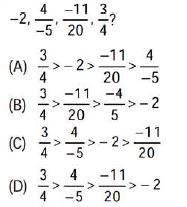
Answer : B
Question. What is the average of the two middle rational numbers if 4/7. 1/3. 2/5 and 5/9 are arranged in ascending order?
(A) 86/90
(B) 86/45
(C) 43/45
(D) 43/90
Answer : D
Question. What is the percentage of the least number in the greatest number of 3/5, 9/5, 1/5 and 7/5 ?
(A) 11(1/9)%
(B) 10%
(C) 20%
(D) 25%
Answer : A
Question. What is the difference between the greatest and least numbers of 5/9. 1/9 and 11/9?
(A) 2/9
(B) 4/9
(C) 10/9
(D) 2/3
Answer : C
Question. Which of the fo ll owing pairs represent the same rational number ?
(A) -7/21 and 1/3
(C) -5/-9 and 5/-9
(B) 1/3 and -1/9
(D) 8/-5 and - 24/15
Answer : D
Question. P :The quotient of two integers is always a rational number.
Q : 1/0 is not rational. Which of the following statements is true?
(A) P is true and Q is the cor rect explanation of P.
(B) P is fa lse and Q is the co rrect explanation of P.
(C) P is true and Q is false.
(D) Both P and Q are false .
Answer : A
Question. What is the result of 2 - 11/39 + 5/26 ?
(A) 149
(B) 149
(C) 149
(D) 149
Answer : B
Question. Which is the equiva lent of - 143/21 ?
(A) -6 + 17/21
(B) 6 + (17/21)
(C) (-6) + ( -17/21)
(D) - 6
Answer : C
Question. Of which property is - 7/5 + (2/-11 + -13/25) = (-7/5 + 2/-11) + -13/25 an exa mp le?
(A) Closu re property
(B) Commutative property
(C) Associative property
(D) Identity property
Answer : C
Question. Which of the following statements is correct?
(A) 0 is called the additive identity for rational numbers.
(B) 1 is called the multiplicative identity for rationa l numbers.
(C) The add itive i nverse of 0 i s zero itself.
(D) All the above.
Answer : D
Question. The sum of two rational numbers is -3. If one of the numbers is -7/5 find the other number.
(A) - 8/5
(B) 8/5
(C) -6/5
(D) 6/5
Answer : A
Question. What number should be added to -5/6 to get 3/2?
(A) -7/3
(B) 2(1/3)
(C) 8/3
(D) -8/3
Answer : B
Question. Which of the following statements is true?
(A) The reciproca ls of 1 and -1 are themselves.
(B) Zero has no reciprocal.
(C) The product of two rational numbers is a rational number.
(D) All the above.
Answer : D
Question. Name the property of multiplication illustrated by -4/3 x (-6/5 + 8/7) = (-4/3 X -6/5 ) + (-4/3 X 8/7)
(A) Associative property
(B) Commutative property
(C) Distributive property
(D) Closure property
Answer : C
Question. What is the product of a rational number and its reciprocal?
(A) 0
(B) 1
(C) - 1
(D) 2
Answer : B
Question. The product of two rational numbers is - 9/16 If one of the numbers is -4/3 what is the other number?
(A) 36/48
(B) 25/64
(C) 27/49
(D) 27/64
Answer : D
Question. By what rational number should -8/39 be multiplied to obtain 26 ?
(A) 507/4
(B) - 507/4
(C) 407/4
(D) - 407/4
Answer : B
Question. How many pieces of equal size can be cut from a rope of 30 metres long, each measuring 3(3/4) metres?
(A) 8
(B) 10
(C) 6
(D) 12
Answer : A
Question. Evaluate p + q given p = ( -2 1/5) and q = (-1 1/3).
(A) 1(8/15)
(C) ( -2 8/15)
(B) ( - 3 8/15)
(D) 3(8/15)
Answer : B
Question. Compute 1(1/4) + (-8/3) - (-5/9)
(A) - 31/36
(B) 13/36
(C) 15/36
(D) -29/36
Answer : A
Question. Find the value of - 6 2/3 x 2/5
(A) 2(2/3)
(B) 2(1/5)
(C) -2(2/3)
(D) -2(1/3)
Answer : C
Question. For what value of 'x' is
7/8 - (- 11/4) + X = 3(7/24) ?
(A) 3
(B) 3
(C) 3
(D) - 3
Answer : A
Question. Determine 'y' so that Y- 2(1/3) = ( - 3 7/12)
(A) - 14
(B) 1'4
(C) - 112
(D) 112
Answer : A
Question. Find the simplest form of ( - 1/2 + 1/3 + 1/6) (-2/5)
(A) 5
(B) 0
(C) 1
(D) 5
Answer : B
Question. Rohit, Peter and Santosh walk around a circularpark.Theytake (1/3)h, (2/5)h and (5/12)h to complete one round. What is the total time taken by them to complete a round in minutes?
(A) 79 minutes
(C) 60 minutes
(B) 50 minutes
(D) 69 minutes
Answer : D
Question. Find a rational number between 3/4 and 9/11
(A) 1/2
(B) 13/11
(C) 69/88
(D) 1/4
Answer : C
RATIONAL NUMBER (Lowest form)
Question. Determine whether the following rational numbers are in the lowest form or not:
(i) (65/84) (ii) (-15/32)
Solution: (i) Given (65/84) Here we can observe that 65 and 84 have no common factor their HCF is 1.
Thus, (65/84) is in its lowest form.
(ii) Given (-15/32) Here we can observe that -15 and 32 have no common factor i.e., their HCF is 1.
Thus, (-15/32) is in its lowest form.
Question. Express each of the following rational numbers to the lowest form:
(i) (4/22) (ii) (-36/180)
Solution: (i) Given (4/22) We know that HCF of 4 and 22 is 2
By dividing the given number by its HCF we get
(4 ÷ 2/22 ÷ 2) = (2/11)
Therefore (2/11) is the simplest form of the given number
(ii) Given (-36/180)
We know that HCF of 36 and 180 is 36
By dividing the given number by its HCF we get
(-36 ÷ 36/180 ÷ 36) = (-1/5)
Therefore (-1/5) is the simplest form of the given number
Question. Fill in the blanks:
(i) (-5/7) = (…/35) = (…/49)
(ii) (-4/-9) = (…/18) = (12/…)
Solution: (i) (-5/7) = (-25/35) = (-35/49)
Explanation:
Given (-5/7) = (…/35) = (…/49)
Here (-5/7) × (5/5) = (-25/35)
And also (-5/7) × (7/7) = (-35/49)
(ii) (-4/-9) = (8/18) = (12/27)
Explanation: Given (-4/-9) = (…/18) = (12/…)
On multiplying by -2 we get
(-4/-9) × (-2/-2) = (8/18)
Also on multiplying by -3
(-4/-9) × (-3/-3) = (12/27)
Question 1. Represent the following on number line. \(\frac{-7}{4}, \frac{-3}{4}, \frac{1}{4}\) and \(\frac{5}{4}\)
Answer: To represent the given rational numbers on a number line, draw a straight line with arrows on both sides. Mark a point as \(0\). Since the denominators are all \(4\), divide each unit length into \(4\) equal parts (sub-divisions).
Mark points to the left of \(0\) for negative fractions at intervals of \(\frac{1}{4}\): \(\frac{-1}{4}, \frac{-2}{4}, \frac{-3}{4}, \frac{-4}{4}, \frac{-5}{4}, \frac{-6}{4}, \frac{-7}{4}\).
Mark points to the right of \(0\) for positive fractions at intervals of \(\frac{1}{4}\): \(\frac{1}{4}, \frac{2}{4}, \frac{3}{4}, \frac{4}{4}, \frac{5}{4}\).
The required numbers \(\frac{-7}{4}, \frac{-3}{4}, \frac{1}{4},\) and \(\frac{5}{4}\) are located at their respective positions on the number line.
In simple words: Divide the space between integers on a number line into four equal parts and locate the given fractions based on their numerator and sign.
Exam Tip: Always make sure the denominator is the same before dividing the scale into equal parts on the number line.
Question 2. Find the sum: (a) \(\left(-2 \frac{3}{10}\right) + \left(-3 \frac{1}{10}\right)\) (b) \(\left(-2 \frac{3}{25}\right) + \left(1 \frac{4}{25}\right)\)
Answer: (a) Convert mixed fractions to improper fractions:
\(-2 \frac{3}{10} = \frac{-23}{10}\)
\(-3 \frac{1}{10} = \frac{-31}{10}\)
Now add them:
\(\frac{-23}{10} + \left(\frac{-31}{10}\right) = \frac{-23 - 31}{10} = \frac{-54}{10} = \frac{-27}{5} = -5 \frac{2}{5}\)
(b) Convert mixed fractions to improper fractions:
\(-2 \frac{3}{25} = \frac{-53}{25}\)
\(1 \frac{4}{25} = \frac{29}{25}\)
Now add them:
\(\frac{-53}{25} + \frac{29}{25} = \frac{-53 + 29}{25} = \frac{-24}{25}\)
In simple words: First change mixed numbers into improper fractions, make sure denominators are same, and then add their numerators.
Exam Tip: Be very careful with negative signs when adding numerators together.
Question 3. Simplify: (a) \(\left(\frac{-11}{9} \times \frac{12}{11}\right) + \left(\frac{-8}{9} \times \frac{-5}{16}\right)\) (b) \(\left(\frac{-3}{5} \times \frac{6}{-7}\right) - \left(\frac{5}{-7} \times \frac{-8}{6}\right)\)
Answer: (a) Simplify each term by cross-multiplication / cancellation:
First term: \(\left(\frac{-11}{9} \times \frac{12}{11}\right) = \frac{-12}{9} = \frac{-4}{3}\)
Second term: \(\left(\frac{-8}{9} \times \frac{-5}{16}\right) = \frac{40}{144} = \frac{5}{18}\)
Now add both terms by taking the LCM of \(3\) and \(18\), which is \(18\):
\(\frac{-4}{3} + \frac{5}{18} = \frac{-24 + 5}{18} = \frac{-19}{18}\)
(b) Simplify each term:
First term: \(\left(\frac{-3}{5} \times \frac{6}{-7}\right) = \frac{-18}{-35} = \frac{18}{35}\)
Second term: \(\left(\frac{-5}{7} \times \frac{-8}{6}\right) = \frac{40}{42} = \frac{20}{21}\)
Now subtract:
\(\frac{18}{35} - \frac{20}{21}\)
LCM of \(35\) and \(21\) is \(105\):
\(\frac{18 \times 3}{105} - \frac{20 \times 5}{105} = \frac{54 - 100}{105} = \frac{-46}{105}\)
In simple words: Perform multiplication inside brackets first by canceling common factors, then add or subtract the resulting fractions using a common denominator.
Exam Tip: Cancel out common factors in numerators and denominators before multiplying to make calculations simpler.
Question 4. Find the area of a rectangle whose length and breadth are \(31 \frac{1}{4}\) m and \(16 \frac{4}{5}\) m respectively.
Answer: Length (\(l\)) = \(31 \frac{1}{4} \text{ m} = \frac{125}{4} \text{ m}\)
Breadth (\(b\)) = \(16 \frac{4}{5} \text{ m} = \frac{84}{5} \text{ m}\)
Area of rectangle = \(l \times b\)
\(\text{Area} = \frac{125}{4} \times \frac{84}{5}\)
Simplify by canceling terms: \(\frac{125}{5} = 25\) and \(\frac{84}{4} = 21\)
\(\text{Area} = 25 \times 21 = 525 \text{ m}^2\)
In simple words: Multiply the length and breadth after converting them into improper fractions.
Exam Tip: Don't forget to write the square unit (\(\text{m}^2\)) in the final answer for area.
Question 5. Evaluate: \(\left(\frac{14}{33} \div \frac{21}{22}\right) \div \frac{-4}{9}\)
Answer: First, solve the division inside the bracket:
\(\frac{14}{33} \div \frac{21}{22} = \frac{14}{33} \times \frac{22}{21}\)
Cancel common factors (\(14\) and \(21\) divided by \(7\); \(22\) and \(33\) divided by \(11\)):
\(= \frac{2}{3} \times \frac{2}{3} = \frac{4}{9}\)
Now, evaluate the remaining expression:
\(\frac{4}{9} \div \frac{-4}{9} = \frac{4}{9} \times \frac{9}{-4} = -1\)
In simple words: Change division into multiplication by taking the reciprocal of the divisor, solve step-by-step from left to right.
Exam Tip: Always evaluate expressions inside parentheses or brackets first following the BODMAS rule.
Question 6. Write the following rational numbers in standard form: (a) \(\frac{-135}{-240}\) (b) \(\frac{168}{-264}\)
Answer: (a) \(\frac{-135}{-240}\)
Both numerator and denominator are negative, so the fraction becomes positive:
\(= \frac{135}{240}\)
Find the HCF of \(135\) and \(240\), which is \(15\):
\(= \frac{135 \div 15}{240 \div 15} = \frac{9}{16}\)
(b) \(\frac{168}{-264}\)
Shift the negative sign to the numerator:
\(= \frac{-168}{264}\)
Find the HCF of \(168\) and \(264\), which is \(24\):
\(= \frac{-168 \div 24}{264 \div 24} = \frac{-7}{11}\)
In simple words: Reduce the fraction to its lowest terms by dividing the numerator and denominator by their HCF, and keep the denominator positive.
Question 7. Find the cost of \(4 \frac{2}{3}\) kg sugar at the rate of Rs \(36 \frac{3}{7}\) per kg.
Answer: Quantity of sugar = \(4 \frac{2}{3} \text{ kg} = \frac{14}{3} \text{ kg}\)
Rate of sugar per kg = Rs \(36 \frac{3}{7} = \text{Rs } \frac{255}{7}\)
Total cost = Quantity \(\times\) Rate
\(\text{Total Cost} = \frac{14}{3} \times \frac{255}{7}\)
Simplify by canceling terms: \(\frac{14}{7} = 2\) and \(\frac{255}{3} = 85\)
\(\text{Total Cost} = 2 \times 85 = \text{Rs } 170\)
In simple words: Multiply the total weight of sugar by the price per kg after converting them into improper fractions.
Exam Tip: Always include the currency unit (Rs) in your final cost calculation statement.
Question 8. By what number should \(-2 \frac{1}{7}\) be divided to obtain \(-2 \frac{1}{2}\).
Answer: Let the required number be \(x\).
According to the question:
\(-2 \frac{1}{7} \div x = -2 \frac{1}{2}\)
Convert mixed fractions into improper fractions:
\(\frac{-15}{7} \div x = \frac{-5}{2}\)
\(\frac{-15}{7} \times \frac{1}{x} = \frac{-5}{2}\)
\(\frac{1}{x} = \frac{-5}{2} \div \left(\frac{-15}{7}\right)\)
\(\frac{1}{x} = \frac{-5}{2} \times \left(\frac{7}{-15}\right)\)
\(\frac{1}{x} = \frac{-35}{-30} = \frac{35}{30} = \frac{7}{6}\)
Taking the reciprocal to find \(x\):
\(x = \frac{6}{7}\)
In simple words: Set up the division equation, convert mixed numbers to fractions, and solve for the unknown variable by isolating it.
Exam Tip: Double-check your equation setup; "A divided by B to obtain C" means \(A \div B = C\).
Free study material for Mathematics
CBSE Class 7 Mathematics Assignments for Chapter 09 Rational Numbers
Chapter Practice Questions for Class 7 Mathematics
Access structured practice assignments for Chapter 09 Rational Numbers designed in alignment with the latest CBSE curriculum for Class 7 Mathematics. These printable sets cover objective and descriptive problem types to support thorough revision.
Why Practice Class 7 Mathematics Assignments?
- Curriculum Standards: Assignments match modern CBSE sample formats to ensure relevant preparation.
- Thorough Revision: Detailed problem sets reinforce core concepts and eliminate conceptual weak spots.
- Execution Speed: Timed practice with assignment sets sharpens overall response timing.
How to Approach Mathematics Chapter 09 Rational Numbers Assignments
- Textbook Review: Always study the core NCERT book for Class 7 Mathematics prior to beginning the assignment.
- Independent Attempt: Solve Chapter 09 Rational Numbers questions on your own initially before cross-checking with expert solutions.
- Error Tracking: Record challenging concepts in a dedicated notebook and practice online MCQ tests for revision.
FAQs
You can download free PDF assignments for Class 7 Mathematics Chapter 09 Rational Numbers from StudiesToday.com. These practice sheets have been updated for the 2026-27 session covering all concepts from latest NCERT textbook.
Yes, our teachers have given solutions for all questions in the Class 7 Mathematics Chapter 09 Rational Numbers assignments. This will help you to understand step-by-step methodology to get full marks in school tests and exams.
Yes. These assignments are designed as per the latest CBSE syllabus for 2026. We have included huge variety of question formats such as MCQs, Case-study based questions and important diagram-based problems found in Chapter 09 Rational Numbers.
Practicing topicw wise assignments will help Class 7 students understand every sub-topic of Chapter 09 Rational Numbers. Daily practice will improve speed, accuracy and answering competency-based questions.
Yes, all printable assignments for Class 7 Mathematics Chapter 09 Rational Numbers are available for free download in mobile-friendly PDF format.