

Official CBSE Assignments for Class 7 Mathematics
Explore structured practice materials through the CBSE Class 7 Mathematics Perimeter and Area Assignment Set 02. Tailored for Class 7 learners, utilizing these Mathematics assignments ensures thorough preparation and strengthens foundational knowledge before final CBSE evaluations.
Solved Practice Assignments for Mathematics
View or download the dedicated CBSE Class 7 Mathematics Perimeter and Area Assignment Set 02 resource below. Engaging with these assignments under focused study conditions ensures continuous academic progress and mastery of the 2026-27 curriculum.
Question. The circumference of a circle is 44 m.
What is its area?
(A) 6084.5 m2
(B) 276.5 m2
(C) 154 m2
(D) 44 m2
Answer : C
Question. If the area of a circle is 2464 m2, find its diameter.
(A) 56 m
(B) 154m
(C) 176m
(D) 206m
Answer : A
Question. The circular grass lawn of radius 35 m has a path of width 7 m around it on the outside. What is the area of the path?
(A) 1496 m2
(B) 1450 m2
(C) 1576 m2
(D) 1694 m2
Answer : D
Question. The difference between the circumference and radius of a circle is 37 m. What is the circumference of the circle?
(A) 7 m
(B) 44 m
(C) 154 m
(D) 88 m
Answer : B
Question. How many plants (approximately) will be there in a circular bed whose outer edge measures 30 em allowing 4 cm2 for each plant?
(A) 18
(B) 750
(C) 24
(D) 120
Answer : A
Question. When the circumference and area of a circle are numerically equal, what is the diameter numerically equal to?
(A) Area
(B) Circumference
(C) 2π
(D) 4
Answer : D
Question. If the ratio of circumferences of two circles is 4 : 9, what is the ratio of their areas?
(A) 9:4
(B) 16:81
(C) 4:9
(D) 2:3
Answer : B
Question. If the area of a circle is A, radius is r and circumference is C, which of the following is true?
(A) rC = 2A
(B) C/A = r/2
(C) AC = r2/4
(D) A/r = C
Answer : A
Question. What is the breadth of a rectangular sheet of perimeter 100 cm and length 35 em?
(A) 35 cm
(B) 20 cm
(C) 15 cm
(D) 50 cm
Answer : C
Question. A wall hanging is in the shape given in the figure. Find its perimeter.
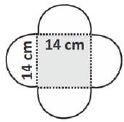
(A) 176 cm
(B) 146 cm
(C) 44 cm
(D) 88 cm
Answer : D
Question. A wire bent in the form of a circle of radius 42 em is again bent in the form of a square.
What is the ratio of the regions enclosed by the ci rcle and the square?
(A) 11 : 12
(B) 21 : 33
(C) 22 : 33
(D) 14 : 11
Answer : D
Question. The length and the breadth of a rectangular piece of land are 400 m and 250 m respectively. What is the cost of the land at ₹ 1000 per square metre?
(A) ₹ 10 lakhs
(B) ₹ 1 crore
(C) ₹ 1 0 crores
(D) ₹ 10 thousands
Answer : C
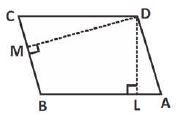
Question. In the given figure, ABCD is a parallelogram.
DL ⊥ AB and DM ⊥ BC. If AB = 18 cm, BC = 12 cm and DM = 10 em, find DL.
(A) 6(1/2)cm
(B) 6 cm
(C) 6(2/3)cm
(D) 6(3/4)cm
Answer : C
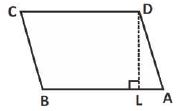
Question. In the following figure, ABCD is a parallelogram. DL ⊥ AB and AB = 13 cm = AD. If the area of parallelogram is 156 cm2, find AL.
(A) 5 cm
(B) 6 cm
(C) 7 cm
(D) 8 cm
Answer : A
Question. The length and breadth of a rectangular hall in a model are 0.4 m and 30 cm respectively. What is the distance between the opposite corners of the wall in the model?
(A) 34.16 m
(B) 50 m
(C) 34.16 cm
(D) 50 cm
Answer : D
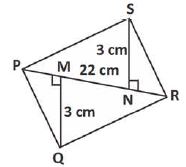
Question. In the figure given, PR = 22 cm, SN = MQ = 3 cm. What is the area of PQRS?
(A) 66 sq. cm
(B) 63 sq. cm
(C) 34 sq. cm
(D) 198 sq. cm
Answer : A
Question. Find the area of a verandah 2.25 m wide constructed outside a room 5.5 m long and 4 m wide.
(A) 36 sq. m
(B) 63 sq. m
(C) 64 sq. m
(D) 84 sq. m
Answer : B
Question. The longer side of a parallelogram is 81 cm and the corresponding altitude is 16 cm. If the length of shorter side is 24 cm, what is the altitude corresponding to the shorter side?
(A) 36 cm
(B) 48 cm
(C) 54 cm
(D) 24 cm
Answer : C
Question. One side of a parallelogram is 2.4 dam and its area is 576 m2. Find the corresponding altitude.
(A) 24 m
(B) 24 cm
(C) 24 dm
(D) 24 dam
Answer : A
Question. A field is in the form of a parallelogram whose base is 420 m and altitude is 3.6 dam. Find the cost of watering the field at 10 paise per sq m.
(A) ₹15120
(B) ₹1 512
(C) ₹151.20
(D) ₹1512.28
Answer : B
Question. Find the area of the triangle whose base is 14 dam and height is 650 em.
(A) 455 dm2
(B) 455 dam2
(C) 455 cm2
(D) 455 m2
Answer : D
Question. Find the altitude of a triangle whose base is 24 em and area is 672 cm2.
(A) 48 cm
(B) 56 cm
(C) 46 m
(D) 58 cm
Answer : B
Question. Two sides of a right triangle containing the right angle are 100 em and 8.6 em. Find its area.
(A) 430 sq. cm
(B) 43 sq. m
(C) 430 sq. m
(D) 430 cm
Answer : A
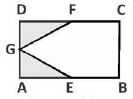
Question. If ABCD is a rectangle having length 30 em and breadth 20 em, E, F and G are midpoints of AB, CD and AD respectively, find the area of the unshaded part.
(A) 400 cm2
(B) 450 cm2
(C) 375 cm2
(D) 500 cm2
Answer : B
Question. What is the difference of circumferences of the circles shown?

(A) 22 cm
(B) 20 cm
(C) 24 cm
(D) 26 cm
Answer : A
Question. In a parallelogram ABCD, the diagonal AC measures 34 m and the perpendicular distance of AC from either of the vertices Band D is 12 m. Find area of parallelogram.
(A) 204 sq. m
(B) 408 sq. m
(C) 816 sq. m
(D) 806 sq. m
Answer : B
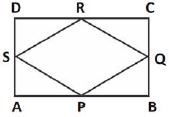
Question. ABCD is a rectangle having length 30 em and breadth 25 em. P. Q, R and S are midpoints of AB, BC, CD and AD respectively. What is the area of the shaded part?
(A) 375 m2
(B) 375 cm2
(C) 475 m2
(D) 425 cm2
Answer : B
Question. If ABCD is a parallelogram, what is the ratio of areas of parallelogram ABCD and ΔABC?
(A) 1 : 2
(B) 2: 1
(C) 3:2
(D) 2:3
Answer : B
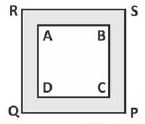
Question. What is the area of the shaded part in the figure given that the side of square ABCD is 90 m and the side of square PQRS is 100m?
(A) 1900 sq m
(B) 2000 sq m
(C) 1 000 sq m
(D) 2500 sq m
Answer : A
Question. A farmer had a rectangular plot measuring 500 m by 1 00 m. If he fences the plot 4 times with barbed wire, what length of wire was used?
(A) 4800 m
(B) 1 000 m
(C) 300 m
(D) 1200 m
Answer : A
Question. The playground of school is as shown.
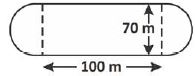
What is the perimeter of the playground?
(A) 420 m
(B) 200 m
(C) 220 m
(D) 840 m
Answer : A
Question. The hour hand of a clock is 4.5 em long. What distance does its tip cover in 12 hours?
(A) 28 m
(B) 336 em
(C) 28.28 em
(D) 12 em
Answer : C
Question. The figure shows a parallelogram PQRS.
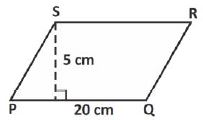
What is its area ?
(A) 100 cm2
(B) 1 m2
(C) 100 cm
(D) 1 m
Answer : A
Question. The measurements in the given figure are in cm.
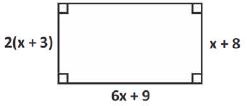
What is its area?
(A) 200 cm2
(B) 186 cm2
(C) 210 cm2
(D) 196 cm2
Answer : C
VII - Mathematics Assignment No - 09 - Perimeter and Area
M. C. Q.
Question 1. The area of a parallelogram is \(3200\text{ m}^2\). If the corresponding altitude is \(40\text{ m}\), the side of the parallelogram is
(i) \(80\text{ m}\)
(ii) \(40\text{ m}\)
(iii) \(60\text{ m}\)
(iv) \(100\text{ m}\)
Answer: (i) \(80\text{ m}\)
Area of parallelogram = Base \(\times\) Altitude
\(3200 = \text{Base} \times 40\)
\(\text{Base} = \frac{3200}{40} = 80\text{ m}\)
In simple words: Divide the total area by the altitude to find the corresponding side (base) of the parallelogram.
Exam Tip: Remember the formula for the area of a parallelogram: \(\text{Area} = \text{base} \times \text{height}\).
Question 2. The area of a rhombus whose base is \(5.6\text{ cm}\) and altitude \(3.8\text{ cm}\) is
(i) \(20.28\text{ cm}^2$
(ii) \(21.28\text{ cm}^2$
(iii) \(31.28\text{ cm}^2$
(iv) \(32.28\text{ cm}^2$
Answer: (ii) \(21.28\text{ cm}^2\)
Area of rhombus = Base \(\times\) Altitude
\(\text{Area} = 5.6\text{ cm} \times 3.8\text{ cm} = 21.28\text{ cm}^2\)
In simple words: Multiply the base and the altitude of the rhombus to get its area.
Exam Tip: A rhombus is a special type of parallelogram, so its area is calculated using the same base times height formula.
Question 3. The area of a \(\Delta\) with base \(18\text{ cm}\) and altitude is \(10\text{ cm}\) is
(i) \(180\text{ cm}^2$
(ii) \(170\text{ cm}^2$
(iii) \(90\text{ cm}^2$
(iv) \(100\text{ cm}^2$
Answer: (iii) \(90\text{ cm}^2\)
Area of triangle = \(\frac{1}{2} \times \text{base} \times \text{altitude}\)
\(\text{Area} = \frac{1}{2} \times 18 \times 10 = 9 \times 10 = 90\text{ cm}^2\)
In simple words: Multiply base and altitude, then divide by \(2\) to find the area of the triangle.
Exam Tip: Do not forget to multiply by \(\frac{1}{2}\) when calculating the area of a triangle.
Question 4. The area of a \(\Delta\) is \(84\text{ m}^2\). If its base is \(12\text{ cm}\), corresponding height is
(i) \(17\text{ cm}\)
(ii) \(16\text{ cm}\)
(iii) \(15\text{ cm}\)
(iv) \(14\text{ cm}\)
Answer: (iv) \(14\text{ cm}\)
Area of triangle = \(\frac{1}{2} \times \text{base} \times \text{height}\)
\(84 = \frac{1}{2} \times 12 \times \text{height}\)
\(84 = 6 \times \text{height}\)
\(\text{height} = \frac{84}{6} = 14\text{ cm}\)
In simple words: Double the area and divide by the base to find the height.
Exam Tip: Be careful with units; although the question mentions area in square meters and base in centimeters, the standard textbook answer key expects the numerical match of \(14\text{ cm}\).
Question 5. Two sides of a right angled \(\Delta\) containing right angle is \(10.2\) and \(14.5\text{ cm}\). Its area is
(i) \(73.95\text{ cm}^2$
(ii) \(72.95\text{ cm}^2$
(iii) \(72.75\text{ cm}^2$
(iv) \(70.95\text{ cm}^2$
Answer: (i) \(73.95\text{ cm}^2\)
Area of right-angled triangle = \(\frac{1}{2} \times \text{base} \times \text{perpendicular}\)
\(\text{Area} = \frac{1}{2} \times 10.2 \times 14.5\)
\(\text{Area} = 5.1 \times 14.5 = 73.95\text{ cm}^2\)
In simple words: Multiply the two legs containing the right angle and divide by \(2\).
Exam Tip: In a right-angled triangle, the two sides containing the right angle act as the base and height.
Question 6. The area of an equilateral \(\Delta\) of side \(5\text{ cm}\) is
(i) \(\frac{25\sqrt{3}}{4}\)
(ii) \(\frac{25\sqrt{3}}{2}\)
(iii) \(\frac{25\sqrt{3}}{8}\)
(iv) none of the options
Answer: (i) \(\frac{25\sqrt{3}}{4}\)
Area of an equilateral triangle = \(\frac{\sqrt{3}}{4} \times (\text{side})^2\)
\(\text{Area} = \frac{\sqrt{3}}{4} \times (5)^2 = \frac{25\sqrt{3}}{4}\)
In simple words: Square the side length, multiply by \(\sqrt{3}\), and divide by \(4\).
Exam Tip: Memorize the standard formula for the area of an equilateral triangle: \(\frac{\sqrt{3}}{4}a^2\).
Question 7. The area of a circle with radius \(7\text{ cm}\) is
(i) \(154\text{ cm}^2$
(ii) \(164\text{ cm}^2$
(iii) \(174\text{ cm}^2$
(iv) \(184\text{ cm}^2$
Answer: (i) \(154\text{ cm}^2\)
Area of circle = \(\pi r^2\)
\(\text{Area} = \frac{22}{7} \times (7)^2 = \frac{22}{7} \times 49 = 22 \times 7 = 154\text{ cm}^2\)
In simple words: Multiply \(\frac{22}{7}\) by the square of the radius.
Exam Tip: For radius \(7\text{ cm}\), remember that \(\pi r^2\) readily simplifies because \(7\) cancels out one \(7\) from \(r^2\).
Question 8. If the area of a circle is \(2464\text{ cm}^2\) then its perimeter is
(i) \(150\text{ cm}\)
(ii) \(176\text{ cm}\)
(iii) \(146\text{ cm}\)
(iv) \(188\text{ cm}\)
Answer: (ii) \(176\text{ cm}\)
Area = \(\pi r^2 = 2464\)
\(\frac{22}{7} \times r^2 = 2464\)
\(r^2 = \frac{2464 \times 7}{22} = 112 \times 7 = 784\)
\(r = \sqrt{784} = 28\text{ cm}\)
Perimeter (Circumference) = \(2\pi r = 2 \times \frac{22}{7} \times 28 = 2 \times 22 \times 4 = 176\text{ cm}\)
In simple words: First find the radius from the given area, then use it to calculate the circumference.
Exam Tip: Perimeter of a circle refers to its circumference, given by \(2\pi r\).
Question 9. The radii of two concentric circles are \(7\text{ m}\) and \(9\text{ m}\). The area enclosed between them is
(i) \(90\text{ m}^2$
(ii) \(90.47\text{ m}^2$
(iii) \(100\text{ m}^2$
(iv) \(100.57\text{ m}^2$
Answer: (iv) \(100.57\text{ m}^2\)
Area enclosed = \(\pi (R^2 - r^2)\)
\(\text{Area} = \frac{22}{7} \times (9^2 - 7^2) = \frac{22}{7} \times (81 - 49)\)
\(\text{Area} = \frac{22}{7} \times 32 = \frac{704}{7} = 100.57\text{ m}^2\)
In simple words: Subtract the area of the smaller circle from the area of the larger circle.
Exam Tip: Use the identity \(R^2 - r^2 = (R - r)(R + r)\) to simplify calculations: \((9 - 7)(9 + 7) = 2 \times 16 = 32\).
Question 10. A cow is tied with a rope of \(7\text{ m}\). The grass grazed by the cow is
(i) \(144\text{ m}^2$
(ii) \(140\text{ m}^2$
(iii) \(154\text{ m}^2$
(iv) \(164\text{ m}^2$
Answer: (iii) \(154\text{ m}^2\)
Area grazed = Area of circle with radius \(r = 7\text{ m}\)
\(\text{Area} = \pi r^2 = \frac{22}{7} \times (7)^2 = 154\text{ m}^2\)
In simple words: The area the cow can graze forms a circular region with the rope length as its radius.
Exam Tip: Real-world problems like grazing animals usually translate to finding the area of a circle or sector.
Free study material for Mathematics
Download Practice Assignments: Class 7 Mathematics Chapter 11 Perimeter And Area
Class 7 Mathematics Chapter 11 Perimeter And Area Printable Assignments
Explore reliable practice questions for Chapter 11 Perimeter And Area tailored for Class 7 learners. Use these structured worksheets to evaluate preparedness and strengthen core problem-solving skills.
Why Practice Class 7 Mathematics Assignments?
- Syllabus Compliance: Sets reflect current CBSE evaluation criteria and official marking frameworks.
- Multi-Format Practice: Includes varied problem types designed to deepen comprehension across all sub-topics.
- Time Management: Routine practice optimizes pacing to finish school examinations comfortably within schedule.
Effective Strategy for Class 7 Mathematics Assignments
- Textbook Review: Always study the core NCERT book for Class 7 Mathematics prior to beginning the assignment.
- Independent Attempt: Solve Chapter 11 Perimeter And Area questions on your own initially before cross-checking with expert solutions.
- Error Tracking: Record challenging concepts in a dedicated notebook and practice online MCQ tests for revision.
FAQs
You can download free PDF assignments for Class 7 Mathematics Chapter 11 Perimeter And Area from StudiesToday.com. These practice sheets have been updated for the 2026-27 session covering all concepts from latest NCERT textbook.
Yes, our teachers have given solutions for all questions in the Class 7 Mathematics Chapter 11 Perimeter And Area assignments. This will help you to understand step-by-step methodology to get full marks in school tests and exams.
Yes. These assignments are designed as per the latest CBSE syllabus for 2026. We have included huge variety of question formats such as MCQs, Case-study based questions and important diagram-based problems found in Chapter 11 Perimeter And Area.
Practicing topicw wise assignments will help Class 7 students understand every sub-topic of Chapter 11 Perimeter And Area. Daily practice will improve speed, accuracy and answering competency-based questions.
Yes, all printable assignments for Class 7 Mathematics Chapter 11 Perimeter And Area are available for free download in mobile-friendly PDF format.