

Class 5 Science Practice Sheet: CBSE Class 5 Science Revision Worksheet Set 19
Access comprehensive chapter-wise worksheets for All Chapters using the CBSE Class 5 Science Revision Worksheet Set 19. Designed to align with the 2026-27 academic syllabus for Class 5 Science, these printable practice sets help students reinforce key concepts and improve their overall exam readiness.
Download All Chapters Worksheet PDF with Answers
Navigate directly to the solved Science worksheets using the digital viewer below. Each practice set includes detailed step-by-step solutions, allowing students to instantly cross-check their work and identify areas requiring further revision.
Q-1 Fill in the blanks with suitable word:-
1. Always follow _________rules on the road and at home.
2. For cuts, clean the affected area with cotton wool soaked in an _______ lotion.
3. Houses in ______ __ areas have thick walls and flat roofs.
4. A house can be made safe by fitting the doors and windows with ________.
5. The three states of matter is ________,_________and__________.
6. A_____________ change is permanent change.
Q-2 Tick the correct answer:-
1. The budget determines
a) Size
c) space
b) Design
d) all of these
2. In which type of houses Eskimos live
a) Pacca house
c) kachcha house
b) Igloo
d) apartments
3. In places which have frequent earthquakes, houses are built of
a) concrete
c) glass
b) iron
d) wood
4. In ice, the water molecules are
a) Move very fast
c) very close to each other
b) Move around freely
d) stuck together
Q-3 Answer in one word:-
1. A virus carried by dogs, cats and bats.
2. It can happen when we throw water on fire caused by defective wiring.
3. The temporary house that Eskimos live in
4. Building materials that is made by mixing cement, sand and water.
5. A plan how available money will be spent over a period of time.
6. Any substance that has mass and occupies space.
7. Substances whose molecules occupy the entire container
8. When two liquids mix together
I. FILL IN THE BLANKS
1. Fungicides are used to kill______________________.
2. The snakes moves with the help of ________________________.
3. Ducks and frogs have __________________ feet to swim in water.
4. Seeds dispersed by wind have ___________________ on them.
5. Mushrooms and moulds reproduce from__________________.
6. All aquatic animals breathe through ________________________.
7. _______________ and ________________ help lizards to climb on trees.
8. Paddy grows well in a _______________ and _____________ soil.
9. Forelimbs are modified into _________________ in man.
10. You can see a very small _________________ between the seed leaves.
11. ____________________ is known as the Birdman of India.
12. A small baby plant coming out of a seed is called __________________.
13. Tiny tubes inside the lungs are called ____________________.
14. Rats and rabbits live in _________________.
15. Plants need to keep their race alive by ____________________.
II. NAME THE FOLLOWING
1. Feeding organ of a butterfly.
Ans. _______________________.
2. A plant which reproduces from leaves.
Ans. _______________________.
3. A single celled animal.
Ans. _______________________.
4. A pointed horny nail on an animals or bird’s foot.
Ans. _______________________.
5. Two insects without wings.
Ans. _______________________.
6. Two seeds dispersed by explosion.
Ans. _______________________.
7. Two herbivores .
Ans.(1) _______________________ (2)___________________________.
8. Two rodents .
Ans.(1) _______________________ (2)___________________________.
9. The four ways in which plants reproduce .
Ans.(1) _______________________ (2)___________________________
(3)________________________ (4)___________________________
10. Name the agents of dispersal of these seeds .
Ans.(1) Madar seeds______________ (2)Coconut____________________
(3)Honesty seeds_______________ (4)Cotton seed_______________
11. Name the breathing organ of these animals .
Ans.(1) Tadpole _________________ (2) Prawn ____________________
(3) Fish __________________ (4)Amoeba ____________________
12. Two fertilisers .
Ans.(1) _______________________ (2)___________________________.
III. WRITE ‘True’ OR ‘ False’
1. Onion is a bulb shaped underground stem. [_______________]
2. Seeds are covered with seed coat. [_________________]
3. Potato grows from seeds. [__________________]
4. The method of reproduction found in rose plant is layering . [________________]
5. The surrounding in which an animal live is its habitat. [__________________]
6. Man is the most developed amongst all the animals. [__________]
7. Dolphin is an animal that lives on land. [_______________]
8. Animals that eat only plants are called carnivores. [______________]
9. All mammals breathe through lungs. [_______________]
10. The thick outer covering of the seed is called seedling. [_____________]
Q-1 Write breathing organs of following animals:-
a. Microbes
b. Fish
c. Frog
d. Whale
e. Bird
f. Tadpoles.
Q-2 Name the type joints present in the following parts:-
a. Elbows
b. Shoulder
c. Neck
d. Knees
e. Hip
f. Fingers
g. Wrist
Q-2 Write two examples for each of the following:-
a. Animals that breathe with through body surface
b. Animals with scales
c. Animals with flippers
Q-3 Answer the following questions-
1. Why do some people migrate?
2. Why do animals need to take in oxygen?
3. How do reptiles move?
4. What are tendons?
5. Name the different kinds of movable joints in your body?
Q.1 Fill in the blanks :
a. The liquid molten rock inside a Volcano is called _________________
b. When Magma comes out of a Volcano it is called __________________.
c. Rock which has holes in it is known as _______________.
d. Marble is formed from _____________________.
e. Slate is formed from __________________.
f. Red fort in Delhi is made of __________________.
g. About _________% of air is oxygen.
h. The Ozone layer is present in __________________ layer.
i. About 78% of the air is ________________.
j. Process of changing water into water vapour on heating is known as____________
Q.2 Answer in one word :
a. Changes in the weather occur in this layer. _____________________
b. It protects Earth from the harmful rays of the Sun. _________________
c. It is the fifth layer of the atmosphere. ___________________
d. It contains many gases. _____________
e. This rock contains calcium. ______________
f. Natural magnet ________________
g. It is formed when lava cools down below the surface of the earth. ___________________
h. This rock is used to make slates and black boards. _________________
i. Minerals from which metals can be extracted are called _____________
Q.3 Name 2 each :
a. Minerals ____________________
b. Sedimentary rocks __________________
c. Igneous rocks _____________________
d. Metamorphic rocks ___________________
e. Fossil fuel _____________________
f. Precious metal ____________________
g. Ends of a magnet __________________
h. Types of water impurities _________________________
i. Methods used to remove insoluble impurities of water. ________________________
j. Methods used to remove soluble impurities of water. _______________________
k. Drinking water can be made germ free by _______________________
l. Diseases caused due to drinking impure water. ________________________
Answer the following :
1. Write the steps involved in distillation.
2. Name and explain different layer of atmosphere.
3. Write a short notes on the formation of following rocks :
i) Igneous rocks :- ________________________________________
ii) Sedimentary rocks :- _____________________________________
4. Write the uses of following rocks :-
i) Granite - _________________________________________________
ii) Pumice - _________________________________________________
iii) Quartzite - _____________________________________________
iv) Marble - _________________________________________________
v) Sandstone - _____________________________________________
5. Define the following :
i) lava - _________________________________________________
ii) Atmosphere - _____________________________________________
6. How are the impurities separated from water through evaporation ?
_________________________________
Q-1 Define the following:-
1. deforestation
2. Minerals
3. Bone marrow
4. Architect
5. Migration
Q-2 Fill in the blanks with suitable words:-
1. __________ by cattle also causes soil erosion.
2. The skull is made up of________ bones .
3. _________ and _________are grown along the boundary of the fields.
4. Thick walls in the house protect from___________.
5. The type of house built depends upon the ___________and_________.
Q-3 Write one word for the following:-
1. The temporary house that Eskimos live in________
2. Houses made from leaves, mud and bamboo_______
3 .Whales and dolphins are classified as ____________
4. Rodents have _________and _________ front teeth.
5. The uppermost layer of earth_________
6. Strong tissues that bind the bones at a joint_________
7. The soft, spongy material found inside the cavities of long bones________.
Q-4 Answer the following question:
1. What do the three Rs stand for?
2. How do insects move?
3. How do muscles work?
4. What are rocks made up of?
5. Why do some rivers change their course?
6. What is organ system?
Waves
• A wave is a disturbance that travels through medium, usually by the transfer of energy.
Forces that Change the Earth’s Crust
The movements of the plates in the earth’s crust.
• Plates – slide past each other.
-push into each other, rock is squeezed.
-pull away from each other, makes a fault.
Types of faults
1.A strike-slip fault-can happen at a transform boundary.
Plates slide, but do not move up or down.
2.A reverse fault can happen at a convergent boundary.
The plates push together, rock above the fault moves up.
3.A normal fault can happen at divergent a boundary.
The plates pull apart, rock above the fault moves down.
An earthquake
• Seismograph is a tool that is used to measure and record earthquake’s activities.
• It helps to find earthquake’s epicenter and to study seismic waves.
Types of seismic waves
1.Surface waves-happens near Earth’s surface.
- move more slowly than body waves.
- cause the most damage.
2.Body waves-move under Earth’s surface.
- move faster than surface waves.
Volcanoes
• Forms at a moving plate boundaries.
• There are 3 kinds of volcanoes.
1.A cinder-cone -is made of small piece of rock called cinders.
has a cone shape with steep sides.
2.A shield volcano- is made of many layers of rock.
has gently sloping side that looks like a shield
3.A composite volcano -is made of some layers of larva and other layers of ash,Cinders, and rocks
has steep sides that curve inward.
Weathering
• Weathering is breaking down of rocks into smaller pieces’
• There are two types of weathering.
1.physical weathering- - is caused by –rain, flood, wind, plant’s root, rivers etc
2.Chemical weathering-is caused by –chemical reaction of oxygen and rock minerals.
Soil
Soil is a mixture substance formed by chemical decomposition and physical disintegration of rock.
Types of soil-
1.Clay soil-has fine particles.
- can hold high water, but not much air.
- is not good for the growth of the plant.
2.Sand soil- has very large particles.
- can hold high air, but not much water.
- is not good for the growth of the plant.
3.Loam soil- has medium particles.
- can hold enough air and water.
- is very good for the growth of the plant.
Soil layers:
- top soil- is upper layer of the earth.
- has high humus, water, minerals, and air
• Sub soil- is the middle layer of the soil.
- has some humus, water, and mineral
• Weathered rock- is parental and bottom layer of soil.
- has high humus, water, minerals, and air.
Uses of soil :
- For the growth of the plants. - To get minerals
- For the construction. - As shelter for animals.
Soil erosion- is washing away of soil particles.
-is caused by-rain, flood, wind, deforestation, over grazing, etc.
Ways that are used to protect soil erosion
Planting trees, using terrace and hash, use horizontal plough, avoiding over grazing, etc
Rocks and minerals
Minerals – are tiny parts of rocks.
-have different properties, such as, luster, streaking, shape, hardness, etc.
Rocks - are substances, made from minerals.
Types of rocks
1.Igneous rocks- are formed from melted rock or magma.
-E.g. Granite- is formed inside the ground.
Basalt- is formed on the surface of the ground.
-are used for construction process.
2.Sedimentary rocks- are re formed from sediment. E.g. -limestone, chalk.
-often has fossils.
3.Metamorphic rocks-are formed from other rocks by high pressure and temperature.
- E.g. Marble, slate etc.
Fossils
• Fossils -are the remains of plants or animals from long ago and found in Earth’s crust.
Steeps of fossils formation
- An animal or plant dies
- Sediment buries the animal or plant.
- Minerals in the sediments change hard parts of the animal or plant to rock.
- Erosion and movement of rock layers can change the fossil’s location
Uses of : fossils give clue about what Earth was like in the past (earth’s history).
Eras- scientists measure earth’s history in length of time called eras.
1.Precambrian era- is the first era of the earth. Scientists found very few fossil of sea’s organism.
2.Paleozoic era- is the second era of the earth. The first forests started.( ocean life)
3.Mesozoic era- is the third era of the earth. There were many mammals such as dinosaurs, birds, and flowering plants.
4.Cenozoic era- is the fourth era of the earth. There were many mammals.(mastodons)
Air- Air is one of the most important substances for life. One can live without food for some days but it is impossible to live without air even for several minutes. Air was taken as the homogeneous
mixture of different gases. The composition of air by volume ratio is as follows: 78% nitrogen, 21% oxygen, 0.04% carbon dioxide, some water vapor and other gases. The percentage of water changes from place to place.
Importance of Air
Air is necessary for all living organisms.
1.For photosynthesis Air supports burning. e.g. oxygen
2.For science and technology development. it extinguish fire. e.g. carbon dioxide for breathing
Properties of air are;
1.Volume: Air occupies space i.e., it has volume but not definite volume.
2.Air moves from place to place
3.Air is odorless and colorless.
4.Air supports burning.
5.Air moves from place to place
Density: Air has its own density. Density is the ratio of mass to volume. i.e. Density = Mass Volume The density of air is 1.27 g/L
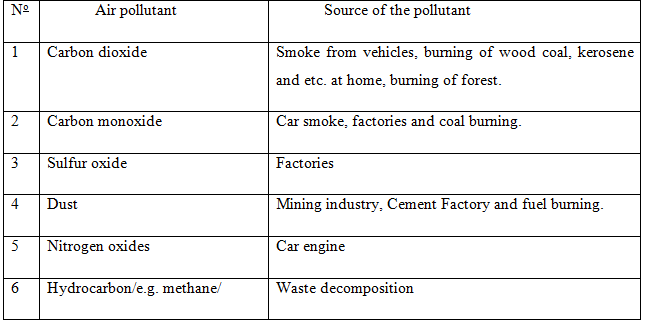
Air pollutants
• Air pollutants are substances that cause air pollution. An air pollutant can be a gas or dust particle that enters into the atmosphere to cause pollution.]
Sources of Air pollutants
• Air pollutants can be released from various sources. The following table summarizes air pollutants and their sources.
Answer the following question correctly
1.What are the two main kinds of seismic waves?
1.____________________________________________________
2._____________________________________________________
2.Write the characteristics of the following terms.
• Surface waves. 1.____________________________________________
2.____________________________________________
3.____________________________________________
• Body waves. 1.______________________________________________
2.______________________________________________
3.Write the properties of the following types of soils.
• Sand soil._________________________________________________
- Clay soil.________________________________________________
- Loam soil.________________________________________________
4.List some important of soil in the ecosystem.
1.______________________ 3.____________________________
2.______________________ 4.____________________________
5.How can soil be formed? Show the steeps properly.
__________________________________________________________________
__________________________________________________________________
6.List the three soil layers and write brief explanation for each
1.____________________________________________________________
2.____________________________________________________________
3.___________________________________________________________
7.How can we protect soil erosion?
1.___________________________ 3.____________________________
2.___________________________ 4.____________________________
8.What is a fossil?__________________________________________________.
9.How can fossils be formed?
________________________________________________________________________
_________________________________________________________________________
10.Write major importance of fossils.
1.____________________________________________________________________
2.____________________________________________________________________
3.____________________________________________________________________
11.List the 4 major types of eras of geological time sale.
1.___________________________ 3.____________________________
2.___________________________ 4.____________________________
12.Write the names of eras in which the following organisms were lived?
• Formation of 1st forest, (ocean life)______________________________________
• Existence of large mammals (mastodons)________________________________
• Water organisms, (ancient sea)________________________________________
• Dinosaurs, mammals and birds. (Dinosaurs)___________________________
13.Write the basic properties of minerals.
1.___________________________ 3.____________________________
2.___________________________ 4.____________________________
14.What does the Mohs scale measures?________________________________________.
15.List the names of 3 types of rock.
1.________________________ 2.________________________ 3.____________________
16.Define the following terms.
• Coarse.____________________________________________________________________
• Extrusive._________________________________________________________________
• Sructure___________________________________________________________________
• Air._______________________________________________________________________
• Aquifer.____________________________________________________________________
17.From what the following rocks are formed?
Igneous rocks._____________________________________________________________
Metamorphic rocks._______________________________________________________
Sedimentary rocks._______________________________________________________
18. Match the following items.
1.Granite and Basalt A. Sedimentary rocks
2. Marble and slate B. Igneous rocks
3. Limestone and Chalk C. Metamorphic rocks
19.Write the components of air.
1._______________ 3.__________________ 5._______________________
2.______________ 4.__________________
Q.1 Fill in the blanks with the words given below:
Seed coat seedling seeds wealth soil germination
(a) A good crop adds to the ……………………………. of the country.
(b) All ………………………. of a plant do not grow into new plants.
(c) A bean seed has an outer protective layer called …………………………
(d) If the seed survives and gets the right amount of water and warmth it produces a baby plant or ……………………………………………..
(e) The baby plant develops roots .These roots absorb water and nutrients from the ……………………………..
(f) The process by which a seed produces a baby plant or seedling is called ……………………………………..
Q.2 Plants grow well in regions which are suitable for them. Match the plant to the state and mark the states on a political map of India.
1. Keekar a. Himachal Pradesh
2. Coconut b. Maharashtra
3. Pine c. Assam
4. Mango d. Rajasthan
5. Tea e. Kerala
6. Cotton f. Uttar Pradesh
Q.1 Fill in the blanks with the words given below:
Seed coat seedling seeds wealth soil germination
(a) A good crop adds to the ……………………………. of the country.
(b) All ………………………. of a plant do not grow into new plants.
(c) A bean seed has an outer protective layer called …………………………
(d) If the seed survives and gets the right amount of water and warmth it produces a baby plant or ……………………………………………..
(e) The baby plant develops roots .These roots absorb water and nutrients from the ……………………………..
(f) The process by which a seed produces a baby plant or seedling is called ……………………………………..
Q.2 Plants grow well in regions which are suitable for them. Match the plant to the state and mark the states on a political map of India.
1. Keekar a. Himachal Pradesh
2. Coconut b. Maharashtra
3. Pine c. Assam
4. Mango d. Rajasthan
5. Tea e. Kerala
6. Cotton f. Uttar Pradesh
Topic : Houses all around
1. Give one word for the following:-
a. Houses made from leaves, mud and bamboo
b. Houses made from iron, wood, concrete and cement.
c. Movement of air due to doors and windows.
d. Person who draws the plan of the house
e. The temporary house that Eskimos live in
f. Building materials that is made by mixing cement, sand and water.
g. A plan how available money will be spent over a period of time.
h. In the language of Eskimos igloos means.
2. Fill in the blanks with suitable words:-
a. Thick walls keep inside of the house _______.
b. Thick walls in the house protect from ___________.
c. The sloping roofs of houses in hills do not allow________ to collect make the houses damp and cold.
d. A fire place is seen houses in__________
e. The type of house built depends upon the ____________, ___________ and ___________.
f. Cooperative housing societies to save _______and __________.
g. A sun-facing house gets a lot of _____________.
h. Houses must have a good__________ system
i. The floors must be ________ and ___________ daily.
Science - SA 1 - Worksheet
I. Name the following:
Question 1. The lowest layer of the atmosphere.
Answer: Troposphere
In simple words: The troposphere is the layer of air closest to the Earth's surface where weather happens.
Exam Tip: Remember that weather phenomena like rain, clouds, and wind occur entirely within the troposphere.
Question 2. The blanket of air surrounding the earth's surface.
Answer: Atmosphere
In simple words: The atmosphere is the thick envelope of gases held around the Earth by gravity.
Exam Tip: Be sure not to confuse atmosphere with troposphere; the atmosphere is the entire blanket of gases, while the troposphere is only its lowest layer.
Question 3. Three gases present in air.
Answer: Nitrogen, Oxygen, and Carbon dioxide (or Argon)
In simple words: Air is a mixture of several gases, with nitrogen and oxygen being the most abundant.
Exam Tip: Nitrogen makes up about 78 percent and oxygen about 21 percent of clean dry air.
Question 4. The outermost layer of the atmosphere.
Answer: Exosphere
In simple words: The exosphere is the highest and final layer of our atmosphere before outer space begins.
Exam Tip: Air in the exosphere is extremely thin, and molecules drift off directly into space.
Question 5. The process by which plants prepare their own food.
Answer: Photosynthesis
In simple words: Plants use sunlight, water, and carbon dioxide to make food in their leaves.
Exam Tip: Always mention chlorophyll and sunlight as essential requirements when explaining photosynthesis.
Question 6. A chemical substance used to kill germs.
Answer: Chlorine (or Potassium permanganate / Antiseptic)
In simple words: Chemicals like chlorine are added to water supplies to destroy harmful microorganisms and germs.
Exam Tip: Chlorination is the standard municipal water treatment method for disinfection.
Question 7. A universal solvent.
Answer: Water
In simple words: Water is called a universal solvent because it can dissolve more substances than any other liquid.
Exam Tip: Water earns this title due to its unique chemical polarity which attracts various solute molecules.
Question 8. The purest form of water.
Answer: Rainwater (or Distilled water)
In simple words: Rainwater is formed by natural evaporation and condensation, making it the purest form of natural water.
Exam Tip: Note that as rainwater falls through polluted air, it can pick up impurities and become slightly acidic.
Question 9. Two methods of removing soluble impurities of water.
Answer: Evaporation and Distillation
In simple words: Dissolved solids cannot be filtered out, so we separate them by boiling away the liquid or using distillation.
Exam Tip: Filtration only removes insoluble impurities, never soluble ones.
Question 10. Two methods of removing insoluble substances of water.
Answer: Filtration and Decantation (or Sedimentation)
In simple words: Insoluble impurities that do not dissolve can be separated using filters or by letting them settle.
Exam Tip: Filtration is the most efficient laboratory method for separating suspended solid particles from liquids.
Write True or False
Question 1. The ozone layer is a part of the stratosphere.
Answer: True
In simple words: Ozone gas collects in the stratosphere to shield the Earth from dangerous ultraviolet rays.
Exam Tip: The ozone layer absorbs harmful UV radiation from the sun, protecting living organisms.
Question 2. Atmosphere is divided into two parts.
Answer: False
In simple words: The atmosphere is divided into five distinct layers, not two.
Exam Tip: The five layers are troposphere, stratosphere, mesosphere, thermosphere, and exosphere.
Question 3. Aircrafts usually fly in the exosphere.
Answer: False
In simple words: Commercial airplanes fly in the lower stratosphere to avoid rough weather in the troposphere.
Exam Tip: The stratosphere offers stable air currents and minimal weather turbulence for smooth flight.
Question 4. Both plants and animals respire.
Answer: True
In simple words: All living organisms need respiration to release energy from food.
Exam Tip: Do not confuse plant respiration with photosynthesis; respiration happens continuously day and night.
Question 5. Ionosphere reflects radio waves back to the earth.
Answer: True
In simple words: Charged particles in the ionosphere bounce radio signals back across the globe, enabling long-distance communication.
Exam Tip: The ionosphere overlaps the thermosphere and contains electrically charged ions.
Question 6. Inhaled air is warmer than exhaled air.
Answer: False
In simple words: Air that we breathe out is warmed up inside our body, so exhaled air is actually warmer than inhaled air.
Question 7. Oceans contain \(75\%\) of earth's water.
Answer: False
In simple words: Oceans actually contain about \(97\%\) of all water on Earth.
Exam Tip: Remember that roughly \(71\%\) of the Earth's surface is covered with water, and \(97\%\) of that water is saline ocean water.
Question 8. Boiling the water is the best method of killing germs.
Answer: True
In simple words: Boiling water effectively destroys disease-causing germs and bacteria.
Exam Tip: Boiling for at least 10 to 15 minutes ensures complete sterilization of drinking water.
Question 9. The substances which dissolve in water are called insoluble substances.
Answer: False
In simple words: Substances that dissolve in water are called soluble substances, not insoluble.
Exam Tip: Insoluble substances like sand and chalk do not dissolve in water.
Question 10. When a solid dissolves in a liquid a solute is formed.
Answer: False
In simple words: When a solid dissolves in a liquid, a solution is formed, while the solid itself is the solute.
Exam Tip: Distinguish clearly between solute (the solid being dissolved) and solution (the resulting mixture).
Question 11. Inspired air is rich in oxygen.
Answer: True
In simple words: Inspired air is the air we breathe in, which contains a high percentage of fresh oxygen.
Exam Tip: Inspired air has about \(21\%\) oxygen, whereas expired air has about \(16\%\) oxygen.
Question 12. Water flow from a higher level to lower level.
Answer: True
In simple words: Gravity causes water to flow naturally downhill from higher elevations to lower elevations.
Exam Tip: Water pumps are needed when we want to move water upward against gravity.
Question 13. Soluble substances can be removed from water by filtration.
Answer: False
In simple words: Filtration only traps undissolved particles; soluble substances pass right through filter paper.
Exam Tip: Use evaporation or distillation to recover soluble substances from water.
Question 14. Air is needed for burning.
Answer: True
In simple words: Combustion or burning cannot take place without oxygen, which is a major component of air.
Exam Tip: Fire extinguishers work by cutting off the supply of oxygen to stop burning.
Question 15. Ionosphere is the outermost layer of the atmosphere.
Answer: False
In simple words: The exosphere is the outermost layer of the atmosphere, whereas the ionosphere lies below it.
Exam Tip: The ionosphere spans across the mesosphere and thermosphere layers.
Fill in the blanks
Question 1. Air has weight so it exerts __________.
Answer: pressure
In simple words: Because air has weight and pulls downward due to gravity, it exerts atmospheric pressure.
Exam Tip: Atmospheric pressure pushes equally in all directions.
Question 2. During photosynthesis plants take in __________.
Answer: carbon dioxide
In simple words: Green plants absorb carbon dioxide gas from the air through tiny pores in their leaves.
Exam Tip: These microscopic pores are called stomata.
Question 3. The substances which dissolve in water are called __________ substances.
Answer: soluble
In simple words: Soluble substances like sugar and salt mix completely into water.
Exam Tip: Soluble items form transparent mixtures where individual particles are invisible.
Question 4. When a solid dissolves in a liquid a __________ is formed.
Answer: solution
In simple words: The resulting uniform mixture of solute and solvent is known as a solution.
Exam Tip: A solution consists of a solute dissolved in a solvent.
Question 5. The method of removing insoluble impurities is called __________.
Answer: filtration
In simple words: Filtration passes muddy water through a porous barrier to trap dirt and particles.
Exam Tip: Filter paper or layers of sand and gravel are common filtering mediums.
Question 6. During photosynthesis plants give out __________.
Answer: oxygen
In simple words: Oxygen is released into the atmosphere as a byproduct of plant food production.
Exam Tip: This oxygen release is vital for human and animal survival on Earth.
Question 7. The ozone layer is a part of __________.
Answer: the stratosphere
In simple words: Ozone gas forms a protective shield located within the stratosphere.
Exam Tip: The stratosphere sits directly above the troposphere.
Question 8. It is the __________ pressure which pushes a liquid through a siphon.
Answer: atmospheric
In simple words: Air pressure pushing down on the liquid surface forces it to flow upward through a siphon tube.
Exam Tip: Siphons rely on gravity and atmospheric pressure working together.
Question 9. Inspired air is rich in __________.
Answer: oxygen
In simple words: The air we breathe in has a high concentration of oxygen gas.
Exam Tip: Inhaled air contains roughly \(21\%\) oxygen.
Question 10. __________ the water is the best way of killing germs.
Answer: Boiling
In simple words: Subjecting water to high heat by boiling eliminates harmful bacteria and pathogens.
Exam Tip: Always boil suspect drinking water to prevent waterborne diseases like typhoid and cholera.
Question 11. During the process of evaporation the __________ is lost.
Answer: water (or liquid)
In simple words: When water evaporates, it turns into water vapor and escapes into the surrounding air.
Exam Tip: Evaporation can happen at any temperature from the surface of a liquid.
Question 12. The substances which do not dissolve in water are called __________ substances.
Answer: insoluble
In simple words: Insoluble substances like chalk powder or oil do not mix into water.
Exam Tip: Insoluble mixtures often appear cloudy or settle out over time.
Question 13. The dissolved substances can be removed from water by __________.
Answer: evaporation (or distillation)
In simple words: By evaporating the water, dissolved solids are left behind as crystals.
Exam Tip: Salt is commercially obtained from sea water using this evaporation method in salt pans.
Question 14. During the process of filtration the clear water obtained is called __________.
Answer: filtrate
In simple words: The liquid that passes cleanly through the filter paper is termed the filtrate.
Exam Tip: The solid trapped on the filter paper is called the residue.
Question 15. Expired air is rich in __________.
Answer: carbon dioxide
In simple words: The air we breathe out contains a higher amount of carbon dioxide waste produced by our body cells.
Exam Tip: Expired air has about \(4\%\) carbon dioxide, compared to only \(0.04\%\) in inspired air.
Download Class 5 Science All Chapters Practice Worksheets
Mastering All Chapters with Printable Worksheets
Review targeted practice exercises for Class 5 Science All Chapters. Curated to match official CBSE guidelines, these printable problem sets support daily revision and improve overall test readiness.
Verified Solutions and NCERT Alignment
Each worksheet draws directly from authorized standard textbooks to maintain academic accuracy. Evaluating your finished exercises against expert-verified solutions helps master the formal presentation standards expected in school evaluations.
Additional Study Resources for Class 5 Science
Wrap up your chapter revision by testing your knowledge against standard objective question formats. Explore our full library of free, up-to-date printable assignments to maximize your academic results in upcoming CBSE evaluations.
FAQs
You can download the latest chapter-wise printable worksheets for Class 5 Science All Chapters for free from StudiesToday.com. These have been made as per the latest CBSE curriculum for this academic year.
Yes, Class 5 Science worksheets for All Chapters focus on activity-based learning and also competency-style questions. This helps students to apply theoretical knowledge to practical scenarios.
Yes, we have provided solved worksheets for Class 5 Science All Chapters to help students verify their answers instantly.
Yes, our Class 5 Science test sheets are mobile-friendly PDFs and can be printed by teachers for classroom.
For All Chapters, regular practice with our worksheets will improve question-handling speed and help students understand all technical terms and diagrams.