

Chapter-wise Worksheets for Class 5 Science: Reproduction In Plants
Review targeted academic worksheets with the CBSE Class 5 Science Reproduction In Plants Worksheet. Built according to official educational standards for the 2026-27 term, these downloadable Class 5 Science resources support effective daily practice and detailed self-evaluation for Reproduction In Plants.
Practice Class 5 Science Worksheets: Reproduction In Plants
Access the complete worksheet PDF for Class 5 Science below. Regular practice with these targeted academic tasks builds familiarity with standard question patterns and helps secure higher marks in final school examinations.
I. Fill in the blanks :
1. Roots of some plants not only store food but also produce new plants. They are known as _________________.
2. Seeds which have only one cotyledon are known as _______________.
3. Seeds which have two cotyledons are known as _______________.
4. The spot where the seed is attached to the plant is known as _______________.
5. The process of spreading seed to different places is called _______________.
6. The practice of growing crops on a large scale for food or other purpose is termed as _______________.
7. The growth of tissues or cells separated from the organism is known as _______________.
8. The chemicals used to destroy harmful insects on plants are called _______________.
9. The baby plant is also known as _______________.
10. _______________ is a bulb shaped underground stem.
II. Name the following :
1. Two plants that reproduce from spore :
_______________________ ____________________
2. Two underground stems
_______________________ ____________________
3. Two plants that reproduce by stem cuttings
_______________________ ____________________
4. Two plants that reproduce by roots
_______________________ ____________________
5. Two plants that reproduce by leaves
_______________________ ____________________
6. Two example of monocotyledonous seeds
_______________________ ____________________
7. Two examples of dicotyledonous seeds
_______________________ ____________________
8. Two plants that disperse their seed by wind
_______________________ ____________________
9. Two plants that disperse their seeds by explosion
_______________________ ____________________
10. Two plants that disperse their seeds by water.
_______________________ ____________________
I FILL IN THE BLANKS
1. ....................... is a process by which new plants are grower from the parents plant.
2. Plant like ferns, mushroams and moulds reproduce from .......................
3. Ginger also grows from the ....................... on the ginger stem.
4. ....................... is a bulb - shaped underground stem.
5. The roots which not only store food in them but also produce new planets are known as ....................... roots.
6. The seed which has two cotyledons is known as .......................
7. The baby plant is also known as .......................
8. The spot where the seed is attached to the plant is known as .......................
9. The seeds which has only one cotyledon is known as ....................... seeds.
10. Same kind of plants when grown at a particular region at a particular time are known as .......................
11. In Jasmine plant we can grow new plant ....................... by process.
12. The process of spreading seeds to different places is called .......................
II. NAME THE FOLLOWING
1. Two examples of monocotyledons
a) .......................
b) .......................
2. Two examples of Di cotyledons
a) .......................
b) .......................
Rreproduction in plants
I FILL IN THE BLANKS
1. .................... is a process by which new plants are growen from the parent plant.
2. Plant like ferns, mushrooms and moulds reproduce from ....................
3. Ginger also grows from the .................... on the ginger stem.
4. .................... is a bulb - shaped underground stem.
5. The roots which not only store food in them but also produce new plan 'ts are known as .................... roots.
6. The seed which has two cotyledons is known as ....................
7. The baby plant is also known as ....................
8. The spot where the seed is attached to the plant is known as ....................
9. The seeds which has only one cotyledon is known as .................... seeds.
10. Same kind of plants when grown at a particular region at a particular time are known as ....................
11. In Jasmine plant we can grow new plant by .................... process.
12. The process of spreading seeds to different places is called ....................
II. NAME THE FOLLOWING
1. Two examples of monocotyledons
a) ....................
b) ....................
2. Two examples of Di cotyledons
a) ....................
b) ....................
3. Two seed that are dispersed by wind
a) ....................
b) ....................
4. Two seeds that are dispersed by water
a) ....................
b) ....................
5. Name two tuberous roots
a) ....................
b) ....................
6. Name two underground stems
a) ....................
b) ....................
7. A bulb-shaped underground stem
a) ....................
b) ....................
8. Two plants that reproduce from spores.
a) ....................
b) ....................
QI. Name the following:
Question 1. Two plants that reproduce from spores.
Answer: Ferns and mosses
In simple words: These non-flowering plants produce tiny spores instead of seeds to grow new plants.
Exam Tip: Remember that ferns, mosses, and fungi do not produce flowers or seeds; they rely on spores for reproduction.
Question 2. Two fertilizers which help to get a high yield of crops.
Answer: Urea and NPK (Nitrogen, Phosphorus, and Potassium)
In simple words: Fertilizers are chemical or organic substances added to soil to provide essential nutrients for plant growth.
Exam Tip: Mention common chemical fertilizers or manure like urea, superphosphate, and NPK.
Question 3. Two monocotyledonous seeds.
Answer: Rice and wheat
In simple words: Monocot seeds have only one seed leaf or cotyledon.
Exam Tip: Examples of monocots include cereals like wheat, rice, maize, and grass.
Question 4. Two underground stems.
Answer: Potato and ginger
In simple words: Some plants store food in their stems that grow horizontally underground.
Exam Tip: Do not confuse underground stems like potato with root vegetables like carrot and radish.
Question 5. Two crops grow well on the hill slopes.
Answer: Tea and coffee
In simple words: These crops require heavy rainfall but do not tolerate water stagnation, making sloping hills ideal for their growth.
Exam Tip: Tea and coffee are typical plantation crops grown on sloped terrains.
QII. Fill in the blanks:
Question 1. Growing of plants from any vegetative part of the parent plant is called __________.
Answer: Vegetative propagation
In simple words: New plants are grown from roots, stems, or leaves instead of seeds.
Exam Tip: Learn the exact definition of vegetative propagation for one-word or fill-in-the-blank questions.
Question 2. Seeds that have __________ or __________ stick to the body of animals or birds.
Answer: hooks, spines (or stiff hairs)
In simple words: Spiky or hooked seeds catch onto animal fur or human clothing to get carried to distant places.
Exam Tip: Mention hooks, barbs, or spines as key adaptations for animal dispersal.
Question 3. __________ are chemicals used to destroy harmful insects.
Answer: Pesticides (or insecticides)
In simple words: Farmers spray these chemicals to protect their crops from pests and insects.
Exam Tip: Pesticides target pests, whereas insecticides specifically target insects.
Question 4. Cotton grows well in black __________ soil and jute grows in the light __________ soil.
Answer: cotton, alluvial (or sandy loam)
In simple words: Different crops require specific soil types rich in particular minerals to thrive.
Exam Tip: Black soil is best for cotton; alluvial or loamy soil is best for jute.
Question 5. The practice of growing crops on a large scale is termed as __________.
Answer: Agriculture
In simple words: Cultivating useful plants extensively for food and other products is called agriculture.
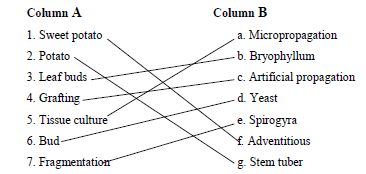
Question 1. Match the plants correctly with their reproducing parts.
Column A: a) Sweet potato, b) Bryophyllum, c) Strawberry, d) Mushroom, e) Bougainvillea
Column B: spores, stem cutting, leaves, roots, buds on the runners
Answer:
a) Sweet potato - roots
b) Bryophyllum - leaves
c) Strawberry - buds on the runners
d) Mushroom - spores
e) Bougainvillea - stem cutting
In simple words: Different plants use different specialized plant parts to reproduce and spread.
Exam Tip: Memorize vegetative parts: Bryophyllum uses leaf buds, sweet potato uses tuberous roots, and roses/Bougainvillea use stem cuttings.
QIV. Give reasons:
Question 1. Soaked seed always germinate but not a dry one.
Answer: Water is essential for activating enzymes inside the seed that break down stored food for the baby plant. Dry seeds lack sufficient moisture to trigger these metabolic processes and start growth.
In simple words: Water wakes up the sleeping baby plant inside the seed, which dry seeds cannot do.
Exam Tip: Always mention that water activates enzymes and softens the seed coat during germination.
Question 2. Plants scatter their seeds over a wide area.
Answer: Dispersal of seeds prevents overcrowding. If all seeds fall directly beneath the parent plant, they will have to compete for sunlight, water, minerals, and space, which would stunt their growth.
In simple words: Spreading seeds helps them find enough space, light, and nutrients to grow properly without overcrowding.
Exam Tip: Key terms to include are: overcrowding, competition for resources, and healthy growth.
QV. Write True or False
Question 1. Fibrous outer coat of coconut seeds help them to be easily carried away by water.
Answer: True
In simple words: Coconut shells are fibrous and trap air, helping them float easily across oceans and rivers.
Exam Tip: Water-dispersed seeds typically have spongy or fibrous outer coats to stay afloat.
Question 2. Cotyledons store food for the baby plant.
Answer: True
In simple words: Cotyledons act as lunchboxes for the embryo until it grows green leaves to make its own food.
Question 3. Dandelion seeds are dispersed by water.
Answer: False
In simple words: Dandelion seeds have hair-like structures and are dispersed by wind, not water.
Exam Tip: Feathery or parachute-like seeds are always dispersed by wind (anemochory).
Question 4. Carrot is an underground stem.
Answer: False
In simple words: Carrot is an underground modified root, not a stem.
Exam Tip: Roots grow underground and absorb water; carrot and radish are swollen taproots.
Question 5. Soaked seed kept in a freezer cannot germinate as it does not get adequate warmth.
Answer: True
In simple words: Seeds need suitable warmth along with water and air to germinate; freezing temperatures prevent growth.
Exam Tip: The three essential conditions for germination are water, air (oxygen), and suitable warmth.
QVI. Choose the right answer:
Question 1. Which of the following is a tuberous root?
(a) onion (b) potato (c) radish
Answer: (c) radish
Radish is a modified root that stores food, whereas onion and potato are modified underground stems.
In simple words: Radish grows underground as a root, while potato and onion are underground stems.
Exam Tip: Distinguish carefully between root vegetables (carrot, radish, beet) and stem vegetables (potato, ginger, onion).
Question 2. Which of the following is a dicotyledonous seed?
(a) rice (b) pea (c) wheat
Answer: (b) pea
Pea seeds easily split into two equal halves (cotyledons), making them dicots. Rice and wheat are monocots.
In simple words: Seeds that split into two halves are dicots like peas and beans.
Exam Tip: Pulses and beans are generally dicots, while cereals and grains are monocots.
Question 3. Which of the following crop is grown in cool climate?
(a) carrot (b) brinjal (c) pumpkin
Answer: (a) carrot
Root vegetables like carrots, radishes, and cabbages grow well in rabi (winter/cool) seasons.
In simple words: Carrots thrive in cooler weather compared to summer crops like pumpkins.
Exam Tip: Connect winter (rabi) crops with cool climates and summer (kharif) crops with warm, rainy climates.
QVII. Identify the seed and name the agent which help in the dispersal of these seeds:
Question 1. Identify the seed and the agent of dispersal for items 1 to 4 shown in the figures.
Answer:
1. Dandelion - Dispersed by Wind (Anemochory)
2. Lotus (or Coconut) - Dispersed by Water (Hydrochory)
3. Xanthium (or Pea pod / Burr) - Dispersed by Animals (Zoochory)
4. Cherry (or Berry) - Dispersed by Animals/Birds (Zoochory)
In simple words: Seeds have special features like hair, hooks, or fleshy fruit to travel by wind, water, or animals.
Exam Tip: Match seed adaptations: feathery/light = wind, spongy/fibrous = water, hooks/spines/edible fruit = animals.
CBSE Class 5 Science Worksheets for Reproduction In Plants
Daily Practice Questions for Class 5 Science
Review targeted practice exercises for Class 5 Science Reproduction In Plants. Curated to match official CBSE guidelines, these printable problem sets support daily revision and improve overall test readiness.
Detailed Answers for Class 5 Science Reproduction In Plants
Each worksheet draws directly from authorized standard textbooks to maintain academic accuracy. Evaluating your finished exercises against expert-verified solutions helps master the formal presentation standards expected in school evaluations.
Complete Your Chapter Revision
Consistent engagement with these exercises builds familiarity with recurring exam themes. If specific areas within Reproduction In Plants cause trouble, utilize our dedicated NCERT solutions for Class 5 Science to clear up doubts immediately.
FAQs
You can download the latest chapter-wise printable worksheets for Class 5 Science Reproduction In Plants for free from StudiesToday.com. These have been made as per the latest CBSE curriculum for this academic year.
Yes, Class 5 Science worksheets for Reproduction In Plants focus on activity-based learning and also competency-style questions. This helps students to apply theoretical knowledge to practical scenarios.
Yes, we have provided solved worksheets for Class 5 Science Reproduction In Plants to help students verify their answers instantly.
Yes, our Class 5 Science test sheets are mobile-friendly PDFs and can be printed by teachers for classroom.
For Reproduction In Plants, regular practice with our worksheets will improve question-handling speed and help students understand all technical terms and diagrams.