

Official Class 6 Science Worksheets: Chapter 12 Electricity and Circuits
Review targeted practice sets for Class 6 Science Chapter 12 Electricity and Circuits. Built according to official educational guidelines for the 2026-27 academic year, these downloadable worksheets support daily revision and core concept reinforcement.
Chapter-wise Practice Material: Chapter 12 Electricity and Circuits
Access the complete worksheet PDF for Chapter 12 Electricity and Circuits below. Regular practice with these targeted questions builds familiarity with standard exam patterns and helps secure higher marks in final Science evaluations.
Learning Objectives
1. Introduction
2. Electric charge
3. Electric current
4. Electric cell
5. Electric circuit
6. Different components of an electric circuit
7. Conductors and insulators
INTRODUCTION
Electricity plays a very important role in our everyday life. It is one of the most useful form of energy used by us. We use electricity for various purpose like to heat or cool our rooms, to run our televisions, to light up our houses etc. Various electrical appliances are used by us. Let us discuss the source of the electrical energy and how the appliances work in an electric circuit.
ELECTRIC CHARGE
It was observed that when a glass rod rubbed with a silk cloth, is brought near another glass rod rubbed with silk, both the glass rods repel each other. But if
a glass rod rubbed with silk is brought near an ebonite rod rubbed with fur, then they attract each other.
This happens because on rubbing a glass rod with silk or ebonite rod with fur, there is a transfer of charge from one body to another. The charges acquired by glass rods are of same nature but charges acquired by ebonite are of different nature. So all these observations lead to a conclusion that
(i) There are only two types of charges viz. positive (proton) and negative (electron) charge.
(ii) Like charges repel each other and unlike charges attract each other.
The positively charged particles present in the nucleus of an atom are called protons and the negatively charged particles present outside the nucleus are called electrons.
The rubbing induces a build-up of static electrical charge.
The rain drops and hailstones have negative charge which is acquired by rubbing.
Electric charge is a fundamental property of matter. Atom on the whole is neutral (no charge) but transfer of electrons creates positive charge on the object which delivers the electrons and negative charge on the object which receives those electrons.
The S.I. unit of charge (Q) is coulomb (C).
ELECTRIC CURRENT
The orderly motion of electrons in a particular direction gives rise to electric current.
Mathematically, electric current (I) is defined as the rate of flow of charge.
I = Q/t
The S.I. unit of electric current is ampere (A)
1A = 1coulomb/1sec.
When a source of current is connected, to an electrical appliance, the electric current flows in one direction i.e., from negative terminal to the positive terminal within the cell and from positive to negative terminal outside the cell.
On average, a current of 20,000 A flows in a lightning bolt, even if the bolt lasts for only a fraction of second. 50 mA is enough to be fatal for a human.
ELECTRIC CELL
Electric cell is a device which converts chemical energy into electrical energy. It is a source of electric current. It has two terminals viz. positive and negative. Dry cell is the most commonly used cell in torches, transistors, toys, calculators and other electrical appliances
The first electric battery was developed by Alessandro volta about 200 years ago. He discovered that when two strips of different metals were put in a sulphuric acid solution and connected with a wire, electricity began to flow
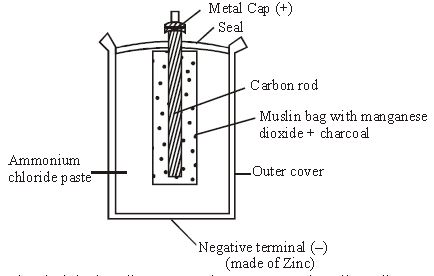
The chemicals in the cell react to produce current. A dry cell supplies current till the chemicals are exhausted and cannot react anymore.
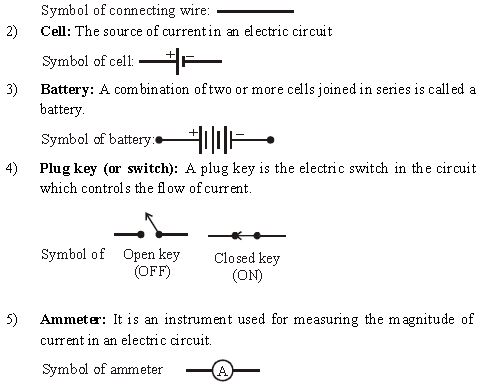
The combination of more than one cells is termed as a battery. Battery is used when one cell cannot provide sufficient amount of current to the appliance.
ELECTRIC CIRCUIT
Electricity requires a path to flow from the positive terminal to the negative terminal of a cell. An arrangement or connection that provides the path to the current to flow from positive to the negative terminal outside the electrical cell via different electrical components is known as an electrical circuit.
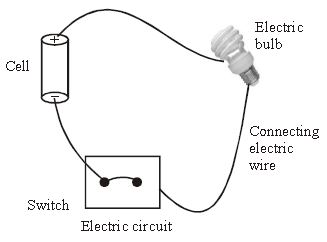
It is important to note here that the bulb will glow only if positive and negative terminal of an electric cell are connected to the two terminals of the bulb.
Open circuit: If no current is flowing through the electric circuit, then it is said to be open circuit. When the switch is in OFF mode, then it is an open circuit.
Closed circuit: The electric circuit through which the current is flowing, is known as closed circuit. When the switch is ON then the circuit is closed.
Do you know Electric cell can produce strong electric shocks of around 500 volts, for both self defense and hunting.
DIFFERENT COMPONENTS OF AN ELECTRIC CIRCUIT
1) Connecting wire: A metal wire usually made of copper or aluminium acts as a connecting wire. It connects all the components of an electrical circuit.
CONDUCTORS AND INSULATORS
The materials which allow the electric current to flow through them are called conductors. Most of the metals conduct electricity, so they are used as connecting wires. For e.g., silver, copper, aluminium, etc. Silver is the best conductor of electricity.
Materials which do not allow the electric current to flow through them are called insulators. For e.g., plastic, rubber, bakelite, leather etc. are insulators. Insulating material is used for insulation of connecting wires. PVC is the most commonly used insulating material.
Benjamin Franklin demonstrated that lightning is electricity. He tied a key to kite string during a thunderstorm and proved that static electricity and lightning were the same thing.
Multiple Choice Questions
Question. Which material is the best conductor of electricity?
(a) metal
(b) glass
(c) wood
(d) plastic
Answer : A
Question. If a body is charged by rubbing, its weight
(a) remains precisely constant
(b) increases slightly
(c) decreases slightly
(d) may increase slightly or may decrease slightly
Answer : D
Question. Metals conduct charges better than wood because metals have more
(a) protons
(b) free electrons
(c) negative ions
(d) space between particles
Answer : B
Question. When a wire is connected through a source of electricity, particles moving through the wire are
(a) protons
(b) atoms
(c) electrons
(d) ions
Answer : C
Question. A battery is connected to an electric lamp. If one more identical lamp is connected in series with the first, what will happen to the current?
(a) It will increase
(b) It will remain the same
(c) It will decrease
(d) It will become zero
Answer : B
Question. A cell is generally provided with a cap. The main function performed by this cap is
(a) it seals the contents of the cell
(b) it keeps various parts of cell in their place
(c) it acts as negative terminal of the cell
(d) None of the above
Answer : D
Question. In an electric circuit, the two terminals of the electric cell are
(a) connected directly to each other
(b) connected to the filament of the bulb
(c) connected to the two terminals of the bulb
(d) All the above are correct
Answer : C
Question. Non metals like .......... and ............. are conductor of electricity.
(a) wood and paper
(b) graphite and gas carbon
(c) glass and rubber
(d) None of these
Answer : B
Question. Two charges are placed at a certain distance. A metallic sheet is placed between them. What will happen to the force between the two charges?
(a) Increase
(b) Decrease
(c) Remains unchanged
(d) Either (a) or (b)
Answer : B
Question. Which of the following is correct?
(a) The air gap surrounding an electric circuit never acts as insulator.
(b) Our body is not a good conductor of electricity
(c) In a cell there are always two terminals
(d) All the above are correct
Answer : C
Question. First electro chemical cell was designed by
(a) Leclanche
(b) Faraday
(c) volta
(d) None of these
Answer : C
Question. A complete electric circuit is called a/an....... electric circuit.
(a) open
(b) closed
(c) terminal
(d) None of these
Answer : B
Question. Electric switch is
(a) a simple device that is used to break the electric circuit
(b) a simple device that is used to complete the electric circuit
(c) a simple device that is used to break or to complete the electric circuit
(d) None of the above is correct
Answer : C
Question. The electric current passes from one terminal to the other terminal of the electric cell, when
(a) electric circuit is open
(b) electric circuit is closed
(c) electric circuit is provided with a switch
(d) All the above are correct
Answer : B
Question. What is a tester used for by an electrician?
(a) to test the presence of electric current
(b) to find the amount of electric current passing through an electric circuit
(c) to measure the rate of flow of current through an electric circuit
(d) None of the above
Answer : A
Question. Select the correct statement :
(a) Electrical sockets are made up of conductors, while plug tops are made up of insulators
(b) Electrical sockets are made up of insulators, while plug tops are made up of conductors
(c) Wire coverings are made up of conductors, while fuse wires are made up of insulators
(d) Fuse wires are made up of conductors, while bulb filament is made up of insulators
Answer : C
Question. Why are you advised to take precautions (e.g. wear rubber gloves etc.) while handling electrical appliances?
(a) Your body is a good conductor of electricity
(b) Your body is a bad conductor of electricity
(c) You appear an electrical engineer when you wear gloves
(d) None of the above
Answer : A
Question. A person working as line man with electricity department is advised not to handle electric wires with bare hands and always bear rubber gloves while working with electric wires. This advise is given because
(a) he will get electrocuted if he handles live electric wires with bare hands
(b) the rubber gloves being insulators will protect him from electric shocks
(c) the rubber gloves control the electric flow
(d) Both (a) and (b)
Answer : D
Question. Electric circuit is
(a) any arrangement in which we have the two terminals of a cell connected to each others by a conducting wire
(b) any arrangement in which we have the two terminals of a cell connected to each other by a non-conducting wire.
(c) any arrangement in which we have the two terminals of a cell connected to the two terminals of a bulb.
(d) any arrangement in which two terminals of a bulb are connected to each other, through a switch, with the help of connecting wires.
Answer : C
TOPIC: ELECTRICITY AND CIRCUITS.
Answer the following questions.
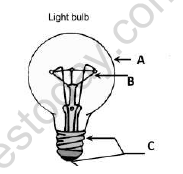
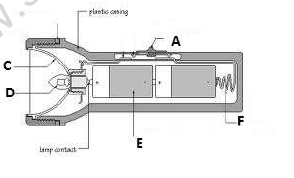
Please click on below link to download CBSE Class 6 Science Electricity And Circuits Worksheet Set C
Free study material for Science
Download CBSE Practice Material: Class 6 Science Chapter 12 Electricity and Circuits
CBSE Practice Material: Class 6 Science Chapter 12 Electricity and Circuits
Explore reliable practice questions for Chapter 12 Electricity and Circuits tailored for Class 6 Science learners. Use these structured worksheets to evaluate preparedness and strengthen problem-solving skills.
NCERT-Aligned Questions and Solutions
Built using the official NCERT book for Class 6 Science, these practice materials provide reliable academic guidance. Pair your practice with our recommended NCERT solutions to master optimal problem-solving approaches.
Next Steps in Your Exam Preparation
Wrap up your chapter revision by testing your knowledge against standard question formats. Everything on our platform is provided free of charge.
FAQs
You can download the teacher-verified PDF for CBSE Class 6 Science Electricity And Circuits Worksheet Set 03 from StudiesToday.com. These practice sheets for Class 6 Science are designed as per the latest CBSE academic session.
Yes, our CBSE Class 6 Science Electricity And Circuits Worksheet Set 03 includes a variety of questions like Case-based studies, Assertion-Reasoning, and MCQs as per the 50% competency-based weightage in the latest curriculum for Class 6.
Yes, we have provided detailed solutions for CBSE Class 6 Science Electricity And Circuits Worksheet Set 03 to help Class 6 and follow the official CBSE marking scheme.
Daily practice with these Science worksheets helps in identifying understanding gaps. It also improves question solving speed and ensures that Class 6 students get more marks in CBSE exams.
All our Class 6 Science practice test papers and worksheets are available for free download in mobile-friendly PDF format. You can access CBSE Class 6 Science Electricity And Circuits Worksheet Set 03 without any registration.