

Class 6 Science Practice Set: Chapter 07 Getting to Know Plants
Review targeted practice sets for Class 6 Science Chapter 07 Getting to Know Plants. Built according to official educational guidelines for the 2026-27 academic year, these downloadable worksheets support daily revision and core concept reinforcement.
Download Chapter 07 Getting to Know Plants Worksheet PDF
Navigate directly to the printable exercises for Chapter 07 Getting to Know Plants using the digital viewer below. Each practice set allows students to isolate specific topics for thorough review and uninterrupted practice alongside standard textbooks.
Question. A plant's leaf turns sunlight into another form of energy. Which man-made structure is most similar to the plant leaf?
(a) An electric bulb
(b) A solar cell
(c) A windmill
(d) A candle
Answer : B
Question. Which of the following actions is likely to reduce soil erosion?
(a) using more fertilizers
(b) growing more trees
(c) increasing cattle grazing
(d) building a wire fence
Answer : B
Question. The tree shown below is likely to be found in.
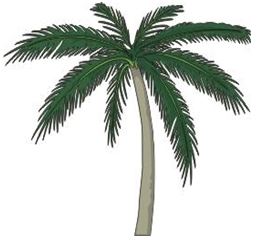
(a) Coastal areas
(b) Arctic region
(c) Tropics
(d) Mountains
Answer : A
Question. PARTHENOCARPIC FRUITS are those which do not have seeds in them. Which of these is an example?

Answer : D
Question. At which of these times would a plant be making its own food?
(a) 9:00 AM
(b) 3:00 AM
(c) 8:00 PM
(d) At all times of the day and night.
Answer : A
Question. Shown here are some cactus plants. These plants grow in places where there is very little water. Most of these plants have no leaves. Why are leaves absent in the cactus plant?
(a) The leaves dry up and disappear in the heat.
(b) The cactus does not need food, so leaves are not needed.
(c) Loss of water through leaves is minimised.
(d) The cactus looks beautiful if there are no leaves.
Answer : C
Question. Seeds have special features that help them to be spread far and wide (This is called seed dispersal) Seeds are dispersed through wind, water, animals, birds or self-explosion. Here is a drawing of a seed. The features of the seed shown above make it most suited for dispersal through ____________.

(a) wind
(b) Water
(c) birds
(d) animals
Answer : A
Question. The picture shows how an insect can carry pollen from the flowers of a tree to the flowers of a small plant. What will most likely happen?
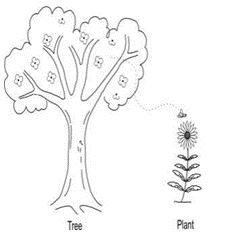
(a) The offspring from the tree will look like the plant.
(b) The offspring from the plant will look like the tree.
(c) The offspring from the plant will look like the tree and the plant.
(d) Nothing will happen because no offspring will be produced.
Answer : D
Question. A potted plant was kept in a black box having a hole to allow sunlight. The plant was watered every day . This is how the plant looked in the beginning .How is the plant likely to look after 10 days?
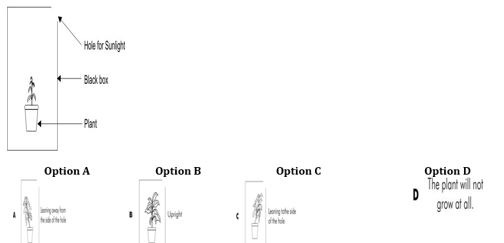
Answer : C
Question. Plants have unique features that help them fit into the environment they live in. Which among these is NOT an illustration of the above statement?
(a) Lotus leaves have a wax like coating on their upper surface.
(b) A submerged water plant hydrilla has finger like leaves.
(c) Money plant is a climber.
(d) Cactus has leaves reduced in size.
Answer : C
Question. Observe the leaves in groups 1 and 2 shown below. They have probably been classified based on.
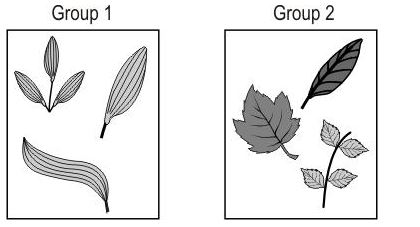
(a) the shape of the leaf.
(b) the type of edge serrations.
(c) the pattern of veins.
(d) the shape of the leaf.
Answer : B
Question. In the skeleton shown below, at which joint can the movement be ONLY like the opening and closing of a door?
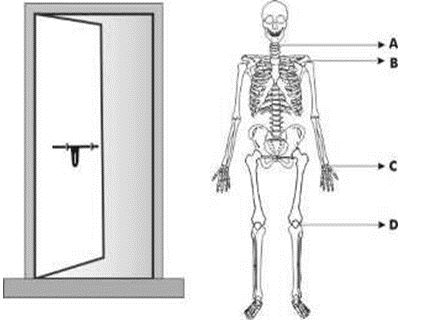
(a) A
(b) B
(c) C
(d) D
Answer : D
Question. In terms of the type of motion that they allow, the joints of our elbows are most like which of these mechanical joints shown here?

Answer : C
Question. Nitin fell down from the steps of his school and injured his left shoulder, which got swollen and pained a lot. A shoulder x-ray showed that Nitin had suffered a collar bone fracture. Identify the fractured bone in the figure showing a part of the skeleton.
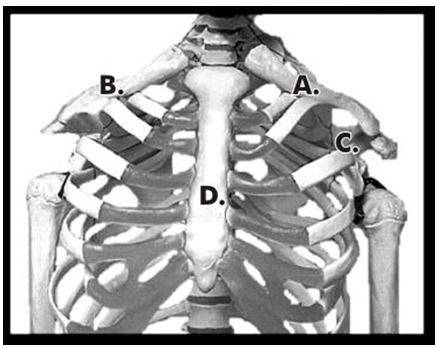
(a) A
(b) B
(c) C
(d) D
Answer : A
Question. The graph shows Ashok's heart beat when he was exercising.
How did the heart beat change between 10:10 and 10:16?
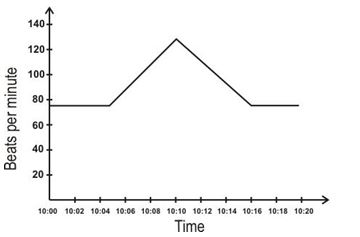
(a) It increased and then decreased.
(b) It increased at a uniform pace.
(c) It decreased at a uniform pace.
(d) It stayed constant.
Answer : C
Question. Shyam learnt at school that leaves have pores called 'stomata' on them. On his way back home, he collected a variety of leaves. But he was unable to see the pores.
Which of these instruments will help Shyam see the pores?

Answer : B
Question. 'Photo' in photosynthesis refers to:
(a) food
(b) picture
(c) light
(d) green
Answer : C
Question. Choose the statement which tells us the function of the stem in a plant.
(a) Stems absorb water and minerals from the soil.
(b) Stems transport raw materials to leaves and food to different parts of the plant.
(c) Stems make the plant look beautiful.
(d) Stems prepare food for the various parts of the plant.
Answer : B
Question. How many times bigger (in area) is the larger leaf compared to the smaller one?
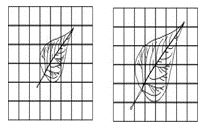
(a) twice as big
(b) thrice as big
(c) four times as big
(d) cannot be found out
Answer : A
Question. Plants absorb sunlight to make their food. What is the energy conversion that takes place here?
(a) Heat energy changes to solar energy.
(b) Solar energy changes to heat energy.
(c) Solar energy changes to chemical energy.
(d) Heat energy changes to chemical energy.
Answer : C
Question. When a seed is planted in the soil, which of these shows the correct order of appearance of other parts?
(a) stem - fruits - leaves - flowers
(b) stem - flowers - fruits - leaves
(c) leaves - stem - flowers - fruits
(d) stem - leaves - flowers -fruits
Answer : D
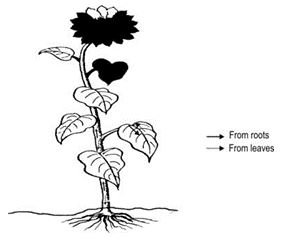
Question. Study the picture of the plant shown here.
Transportation of water and minerals from the root, and food from the leaves is indicated by the arrows.
Which system performs a similar function in human beings?
(a) Skeletal system
(b) Circulatory system
(c) Digestive system
(d) Respiratory system
Answer : B
Question. Which option shows the correct order in the life cycle of a plant.

(a) 1 - 2 - 3 - 4 - 5
(b) 3 - 2 - 4 - 1 - 5
(c) 5 - 3 - 1 – 4- 2
(d) 2 - 5 - 1 - 3 -4
Answer : C
Question. Shown here is the picture of a plant. Which of these observations CANNOT be made by seeing the picture only?
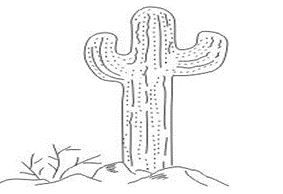
(a) The leaves of this plant are almost invisible.
(b) This plant is found in the desert.
(c) The plant must be about 5 years old.
(d) This plant is not eaten by animals.
Answer : C
Question. Manu wanted to verify if fertilizers help plants to grow well. He took a potted plant, mixed fertilizer to the soil and took good care of the plant. He also maintained a record of the growth of the plant. The error in Manu's experiment was ___________________.
(a) mixing fertilizer to the soil
(b) maintaining a growth chart
(c) not growing a similar plant without fertilizer
(d) watering the plant regularly
Answer : C
Question. A vine, with a yellow, 1 mm thick stem, has no leaves or chlorophyll and cannot make its own food. It curls around a host plant and sucks water and nutrients from the host plant by means of suckers. The host plant gets weakened in the process. Based on the given information, the vine can be called a_________.
(a) parasite
(b) predator
(c) saprophyte
(d) decomposer
Answer : A
Question. The raw materials used by plants in order to prepare their food are _____________.
(a) Oxygen and Carbon dioxide
(b) Carbon dioxide and Water
(c) Water and Oxygen
(d) Water and Sunlight
Answer : B
Question. Many trees especially in colder climates lose their leaves during the winter. Then how do they make their food during this period?
(a) The other parts of the tree make food.
(b) The trees feed on nutrients and water from the soil.
(c) Such trees do not make food in winter and die.
(d) Such trees do not make food in winter but do not die.
Answer : D
Question. The absence of which of the following will not affect photosynthesis?
(a) carbon dioxide
(b) light
(c) oxygen
(d) water
Answer : C
Question. Which of the following plants would have a root structure SIMILAR to one shown in the figure below?
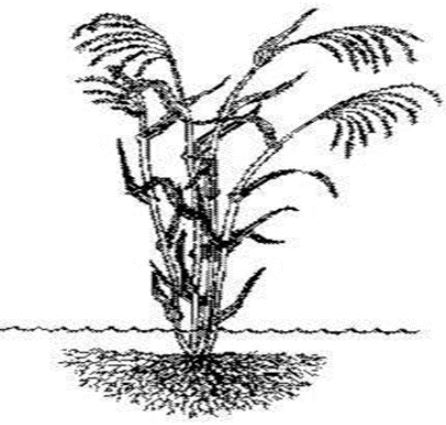
(a) coriander
(b) mango
(c) tulsi
(d) banana
Answer : A
Questions
Very Short Answer
Q1) What are weeds?
Q2) What are climbers?
Q3) What are creepers?
Q4) Define herbs?
Q5) What are the three categories classified plants?
Short Answer
Q6) What do you understand by stem?
Q7) What do you mean by petiole?
Q8) What do you mean by the lamina?
Q9) Distinguish between creepers and climbers?
Q10) Why are leaves different in shape and size?
Long Answer
Q11) State the difference between herbs and shrubs?
Q12) What are the essential characteristics of the plants?
Q13) Write short note on photosynthesis?
Q14) Write short note on transpiration?
Q15) State the difference between shrubs and trees?
Please click on below link to download CBSE Class 6 Science Getting To Know Plants Worksheet Set A
Free study material for Science
Practice Worksheet and Study Resources for Class 6 Science Chapter 07 Getting to Know Plants
CBSE Practice Material: Class 6 Science Chapter 07 Getting to Know Plants
Explore reliable practice questions for Chapter 07 Getting to Know Plants tailored for Class 6 Science learners. Use these structured worksheets to evaluate preparedness and strengthen problem-solving skills.
NCERT-Aligned Questions and Solutions
Built using the official NCERT book for Class 6 Science, these practice materials provide reliable academic guidance. Pair your practice with our recommended NCERT solutions to master optimal problem-solving approaches.
Next Steps in Your Exam Preparation
Explore our broader library of printable assignments, chapter notes, and mock tests designed to support continuous revision and secure higher marks in CBSE assessments.
FAQs
You can download the teacher-verified PDF for CBSE Class 6 Science Getting To Know Plants Worksheet Set 01 from StudiesToday.com. These practice sheets for Class 6 Science are designed as per the latest CBSE academic session.
Yes, our CBSE Class 6 Science Getting To Know Plants Worksheet Set 01 includes a variety of questions like Case-based studies, Assertion-Reasoning, and MCQs as per the 50% competency-based weightage in the latest curriculum for Class 6.
Yes, we have provided detailed solutions for CBSE Class 6 Science Getting To Know Plants Worksheet Set 01 to help Class 6 and follow the official CBSE marking scheme.
Daily practice with these Science worksheets helps in identifying understanding gaps. It also improves question solving speed and ensures that Class 6 students get more marks in CBSE exams.
All our Class 6 Science practice test papers and worksheets are available for free download in mobile-friendly PDF format. You can access CBSE Class 6 Science Getting To Know Plants Worksheet Set 01 without any registration.