

Practice Worksheets for Class 6 Science: Chapter 12 Electricity and Circuits
Explore reliable practice materials for Chapter 12 Electricity and Circuits tailored for Class 6 learners. Utilizing these Science worksheets ensures thorough preparation and strengthens problem-solving speed for upcoming school assessments.
Practice Chapter 12 Electricity and Circuits Worksheets for Class 6 Science
View or download the dedicated Chapter 12 Electricity and Circuits practice resource below. Engaging with these objective and subjective questions daily ensures continuous academic progress and mastery of the 2026-27 curriculum.
Electricity
- Electric energy is a form of energy which can be obtained from other forms of energy. It can also be converted to other forms of energy.
Electric current
- Electric current is the movement of charges per unit time. Substances are grouped into insulators, conductors and semiconductors based on their ability to pass (allow the passage) of electric current.
- Conductors are substances that allow the passage of electric current easily. They contain freely moving electrons.
Example- metal
- Insulators are substances that do not allow the passage of electric current charge through them easily. They contain no freely moving electrons. Examples- non-metals
- Semiconductors are substances that allow the flow of only small current (charge) through them. They contain few freely moving electrons. Example – silicon
Voltage
- The difference of electric charges a cross the terminals of a battery is called voltage. Voltage is measured in a unit called volt (V).
Voltage = Eclectic current x Electric resistance
- Symbolically V = (I) x (R) where I = current, V= voltage, R= resistance
Electric circuit
An electric circuit is a closed path along which the flow of electric current takes place.
It consists of four basic parts (components)
- Dry cell is part of electric circuit which is source of potential difference.
- Connecting wire conduct electric current.
- Electric bulb part of electric circuit which converts electric energy into heat and light.
- Switch is part of electric circuit which off or on the flow of electric current.
Resistors (lamps) in parallel and series connection
There are two electrical circuits. These circuits can be connected in two ways in an electric circuit.
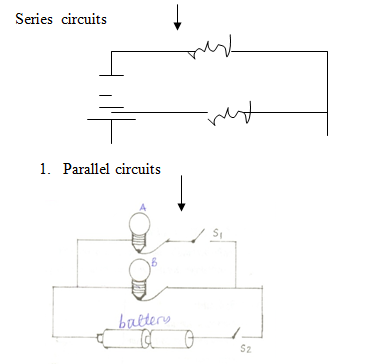
S2 = switch (2), S1 = switch (1), A and B = bulbs
Magnet
- A magnet is a device that attracts iron and products a magnetic field.
There are two types of magnet.
- Bar magnet An electromagnet
- A magnet has two poles.
- North pole (N) South pole(S)
- Properties of magnetic poles( The law of magnet )
- Opposite poles attract each other.
- Similar repel each other.
Glands and Hormones
Glands
- A gland is a structure in our body which produces some kinds of useful substances.
- There are two types of glands in the body; exocrine and endocrine glands.
- Exocrine glands are glands that contain tubes.
-They release their products into the ducts/tubes/.
E.g. -sweat glands, Salivary glands, Mammary glands, Pancreas etc.
- Endocrine glands are glands which do not have tubes.
- They release their products into the bloodstream.
- These glands are sometimes known as ductless glands.
E.g -Thyroid gland, Pituitary gland, Pancreas, Gonads Adrenal gland
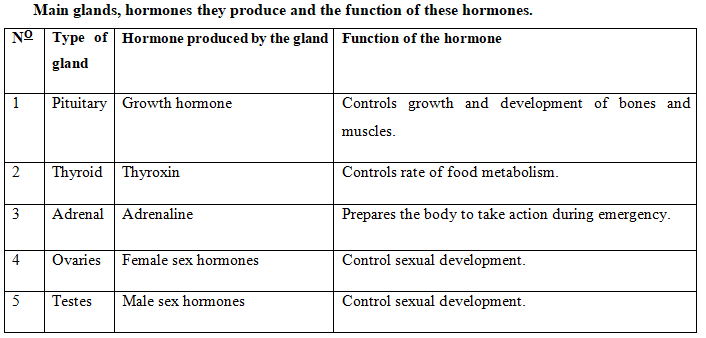
The endocrine glands have different size and locate in different parts of the body. They produce hormones which directly release to the blood stream. The hormones produced by the endocrine glands are carried to all parts of the body by blood. In this section we shall learn the three most important hormones among the several hormones produced in the human body. These hormones include.
- Growth Hormone
- Thyroxin Hormone
- Adrenaline Hormone
Growth Hormone
The pituitary gland locates in the center of the head produces a large number of hormones. One of these hormones is the growth hormone. This hormone controls the development and growth of bones and muscles of the body. Under production/deficiency/ of growth hormone results in dwarfism. While over production/excessive/ of growth hormone causes gigantism.
Thyroxin Hormone
The thyroid gland locates in the neck region, in front of trachea produces a hormone called thyroxin hormone. The hormone contains iodine which is important for normal growth and development. The thyroid gland can produce a swelling in the neck called Goiter due to deficiency of iodine. The thyroid gland cannot produce enough thyroxin if our diet is deficient in iodine mineral. The main function of thyroxin hormone is to control metabolic rate in the body.
Adrenaline hormone
The adrenal glands located just on the top of each kidney produce a hormone called adrenaline hormone. The glands produce adrenaline and release into the blood stream to be carried to various parts of the body. Adrenaline hormone is produced when we angry, fear and excite to help our body in producing much energy. Thus, during emergency situations, the adrenaline hormone released from adrenal glands.
The over-all objective of adrenaline hormone is to give us much energy when we are under emergency situations.
Question. In which of the following is electrical energy converted into mechanical energy?
(a) an electric heater
(b) a steam engine
(c) an electric generator
(d) an electric mixer
Answer : D
Question. Here are the different parts of an electric bulb.
Identify the ones that are conductors.
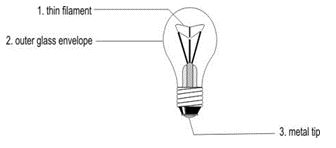
(a) 1 and 3 only
(b) 1 and 2 only
(c) 1 only
(d) 1, 2 and 3
Answer : A
Question. In the simple electric circuit shown, the light will glow when image in the picture 1 corresponds to image in picture 2
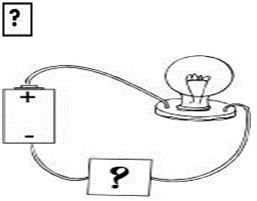
(a) copper
(b) rubber
(c) cork
(d) Plastic
Answer : A
Question. A small pocket radio can be operated either using 4 small cells (batteries) or using mains electric power. How is this possible?
(a) The voltage from both sources is the same.
(b) The radio works within a large range of voltages.
(c) The electric power charges the cells that operate the radio.
(d) The mains electric power voltage is reduced to operate the radio.
Answer : D
Question. Sometimes when we walk barefooted on carpeted floors and then touch an object or even a person we feel a momentary sensation like an electric shock. This sensation is caused by _____________
(a) magnetism
(b) static electricity.
(c) electric current.
(d) psychological factors.
Answer : B
Question. Arrange the following devices in the sequence of their development?

(a) 4,1,3,2
(b) 1,3,4,2
(c) 1,4,3,2
(d) 4,1,2,3
Answer : A
Question. There are 4 bulbs in the circuit shown.
What will happen if bulb 1 gets fused?
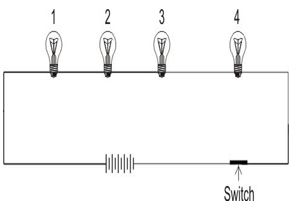
(a) All the other bulbs will continue to glow.
(b) Only bulbs 2, 3 and 4 will glow.
(c) Bulbs 2 and 3 will glow dimly.
(d) None of them will glow.
Answer : D
Questions
Very Short Answer
Q1) What is filament?
Q2) What is the source of the electricity?
Q3) Define electricity?
Q4) How many terminals are there in electric cells?
Q5) What is switch?
Short Answer
Q6) What is the reason of fusing the electric bulb?
Q7) What do you mean by the term electric cell?
Q8) Give an appropriate reason for the given statement: 1. Filament of an electric bulb is made of tungsten and 2. Argon gas is filled in electric bulb?
Q9) What is inside the glass case of the bulb?
Q10) Why should an electrician use rubber gloves while repairing an electric switch at our home?
Long Answer
Q11) Write short note on electric circuit?
Q12) Difference between conductors and insulators?
Q13) Write short note on electric switch?
Q14) State the difference between open circuit and closed circuit?
Q15) Distinguish between current electricity and static electricity?
Please click on below link to download CBSE Class 6 Science Electricity and Circuits Worksheet Set A
Free study material for Science
Exam Preparation Worksheet for Class 6 Science Chapter 12 Electricity and Circuits
CBSE Practice Material: Class 6 Science Chapter 12 Electricity and Circuits
Access structured practice worksheets for Chapter 12 Electricity and Circuits designed in alignment with the latest CBSE curriculum for Class 6 Science. These printable problem sets help students build accuracy and prepare effectively for school tests.
NCERT-Aligned Questions and Solutions
Each worksheet is structured around standard CBSE textbooks, allowing students to check their working steps and correct mistakes early in their revision.
Next Steps in Your Exam Preparation
Follow up your worksheet practice by attempting the interactive online Science MCQ test for this chapter to evaluate your execution speed. All platform resources are free to access.
FAQs
You can download the teacher-verified PDF for CBSE Class 6 Science Electricity and Circuits Worksheet Set 01 from StudiesToday.com. These practice sheets for Class 6 Science are designed as per the latest CBSE academic session.
Yes, our CBSE Class 6 Science Electricity and Circuits Worksheet Set 01 includes a variety of questions like Case-based studies, Assertion-Reasoning, and MCQs as per the 50% competency-based weightage in the latest curriculum for Class 6.
Yes, we have provided detailed solutions for CBSE Class 6 Science Electricity and Circuits Worksheet Set 01 to help Class 6 and follow the official CBSE marking scheme.
Daily practice with these Science worksheets helps in identifying understanding gaps. It also improves question solving speed and ensures that Class 6 students get more marks in CBSE exams.
All our Class 6 Science practice test papers and worksheets are available for free download in mobile-friendly PDF format. You can access CBSE Class 6 Science Electricity and Circuits Worksheet Set 01 without any registration.