
CBSE Class 6 Science Fibre to Fabric Worksheet Set 01

Official Class 6 Science Worksheets: Chapter 03 Fibre to Fabric

Explore reliable practice materials for Chapter 03 Fibre to Fabric tailored for Class 6 learners. Utilizing these Science worksheets ensures thorough preparation and strengthens problem-solving speed for upcoming school assessments.

Chapter-wise Practice Material: Chapter 03 Fibre to Fabric

Navigate directly to the printable exercises for Chapter 03 Fibre to Fabric using the digital viewer below. Each practice set allows students to isolate specific topics for thorough review and uninterrupted practice alongside standard textbooks.

Fibre to Fabric
 
 To know different types of fabric. 
 
Question 1- List any two types of fabric?
Answer- Natural and synthetic.
 
Question 2- How does silk fabric feel?
Answer- Smooth.
 
Question 3- With what kind of fabric your dupatta is made up of?
Answer- Light and smooth cotton.
 
 How is yarn made ? 
 
Question 1- Yarn is made of ……………. ?
Answer- Fibres.
 
Question 2- What is yarn ?
Answer- Yarn is made by pulling and twisting fibres.
 
Question 3- How do you make yarn from cotton?
Answer- Yarn is made by pulling and twisting cotton fibres.
 
EXERCISE
 
Question 1- Fill In The Blanks.
 
a. Silk is smooth and shiny.
 
b. Coir is extracted from the outer covering of coconut.
 
c. Nylon and Polyester are synthetic fibres.
 
d. Cotton is a natural fibre.
 
e. Yarns are made of fibres.
 
 
Question 2- Write True Or False.
 
a. Polyester is a natural fibre. (False)
 
b. In knitting, a single yarn is used to make a piece of fabric. (False)
 
c. Cotton clothes are comfortable to wear in hot humid weather. (True)
 
d. The process of removing seed from cotton is called retting. (False)
 
e. The fibres are spun in yarns by pulling out and twisting the fibres together. (True)
 
 
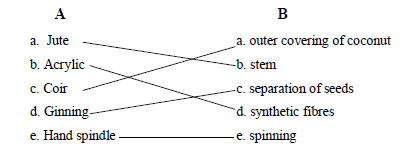
Question 3- Match The Column ‘A’ With Column ‘B’
6th.sci.eng.Ch3.6.10 1
 
 
Question 4. Choose The Correct Answer.
 
(i). Which of the following is not a natural fibre?
a) Wool    b) Nylon (✓)    c) Cotton    d) Jute
 
(ii). Which of these fabrics will you choose to wear in hot and humid weather?
a) Cotton (✓)    b) Wool    c) Silk    d) Nylon
 
(iii). The process of separation of seeds from cotton balls is :
a) Spinning    b) Retting    c) Ginning (✓)    d) Picking
 
(iv). Acrylic is :
a) Natural fibre   b) Animal fibre   c) Plant fibre   d) Synthetic fibre (✓)
 
(v). Which of these is a plant fibre?
a) Polyester    b) Wool (✓)    c) Acrylic    d) Jute (✓)
 
 
Question 5- Very Short Answer Type Questions.
 
(i) Name any two animal fibres ?
Answer- Wool and silk.
 
(ii) Name the two basic types of natural fibres ?
Answer- Cotton and wool.
 
(iii) What is the right time for harvesting of jute plant ?
Answer- When plant is at flowering stage.
 
(iv) List any two uses of jute ?
Answer- Jute is used to make ropes, carpets and ginny bags.
 
 
Question 6- Short Answer Type Questions.
 
(i) Write differences between natural and synthetic fibres ?
Answer
6th.sci.eng.Ch3.6.10 2
 
(ii) What is sericulture ?
Answer- Rearing of silkworms for production of silk is known as sericulture.
 
(iii) What is meant by ginning of cotton ?
Answer- The process of separation of seeds from cotton balls is known as ginning.
 
 
Question 7- Long Answer Type Questions.
 
(i) Why do we prefer cotton clothes in summer ?
Answer- Cotton clothes are good for humid and hot weather (summer), because it absorbs water easily.
 
(ii) How spinning of cotton is done ?
Answer- The fibres are spun in yarns by pulling out and twisting the fibres together. This process is known as spinning. Spinning is done with hand spindle (takli), spinning wheel (charkha) or machines


Questions

            Very Short Answer

Q1)      How silk fibre us drawn from?

Q2)      What is ginning?

Q3)      What is spinning?

Q4)      Define fibres?

Q5)      What is weaving?


            Short Answer

Q6)      What are the uses of fabrics?

Q7)      What do you mean by yarn?

Q8)      What kinds of devices are used for spinning the cotton yarn?

Q9)      What is yarn made up of?

Q10)    Difference between weaving and knitting?


            Long Answer

Q11)    Explain the processing of the cotton?

Q12)    State the difference between nylon and polyster?

Q13)    Write short note on some plant fibres?

Q14)    Explain the history of the clothing material?

Q15)    State the difference between natural fibres and artificial fibres?


Please click on below link to download CBSE Class 6 Science Fibre to Fabric Worksheet Set A


Download CBSE Practice Material: Class 6 Science Chapter 03 Fibre to Fabric

CBSE Practice Material: Class 6 Science Chapter 03 Fibre to Fabric

Review targeted practice exercises for Class 6 Science Chapter 03 Fibre to Fabric. Curated to match official CBSE guidelines, these downloadable PDF sheets support daily revision and core concept reinforcement.

NCERT-Aligned Questions and Solutions

Each worksheet is structured around standard CBSE textbooks, allowing students to check their working steps and correct mistakes early in their revision.

Next Steps in Your Exam Preparation

Explore our broader library of printable assignments, chapter notes, and mock tests designed to support continuous revision and secure higher marks in CBSE assessments.

FAQs

Where can I download the latest PDF for CBSE Class 6 Science Fibre to Fabric Worksheet Set 01?

You can download the teacher-verified PDF for CBSE Class 6 Science Fibre to Fabric Worksheet Set 01 from StudiesToday.com. These practice sheets for Class 6 Science are designed as per the latest CBSE academic session.

Are these Science Class 6 worksheets based on the 2026-27 competency-based pattern?

Yes, our CBSE Class 6 Science Fibre to Fabric Worksheet Set 01 includes a variety of questions like Case-based studies, Assertion-Reasoning, and MCQs as per the 50% competency-based weightage in the latest curriculum for Class 6.

Do you provide solved answers for CBSE Class 6 Science Fibre to Fabric Worksheet Set 01?

Yes, we have provided detailed solutions for CBSE Class 6 Science Fibre to Fabric Worksheet Set 01 to help Class 6 and follow the official CBSE marking scheme.

How does solving CBSE Class 6 Science Fibre to Fabric Worksheet Set 01 help in exam preparation?

Daily practice with these Science worksheets helps in identifying understanding gaps. It also improves question solving speed and ensures that Class 6 students get more marks in CBSE exams.

Is there any charge for the Class 6 Science practice test papers?

All our Class 6 Science practice test papers and worksheets are available for free download in mobile-friendly PDF format. You can access CBSE Class 6 Science Fibre to Fabric Worksheet Set 01 without any registration.