

NCERT Solutions for Class 9 Science: Chapter 13 Why Do We Fall Ill
Explore reliable textbook solutions for Chapter 13 Why Do We Fall Ill tailored for Class 9 learners. Utilizing these Science answers ensures thorough preparation and strengthens foundational knowledge before final NCERT evaluations.
Practice Class 9 Science Solutions: Chapter 13 Why Do We Fall Ill
Navigate directly to the solved Science textbook exercises using the digital viewer below. Each solution includes detailed step-by-step explanations, allowing students to instantly cross-check their work and identify areas requiring further revision.
Class IX Science
Chapter 13 – Why Do We Fall Ill
Question 1: State any two conditions essential for good health.
Answer: The twoconditions essential for good health are:
(i) An individual must have better health facilities and more professionals to deal with health problems.
(ii) All basic necessary conditions to prevent diseases must be present. For example, proper garbage collection and disposal, clearing of drains, supply of healthy drinking water, etc.
Question 2: State any two conditions essential for being free of disease.
Answer: The twoconditions essential for being free of diseases are:
(i) Personal hygiene and cleanliness are necessary to stay away from diseases.
(ii) Individuals should take a balanced diet that contains carbohydrates, fats, proteins, vitamins, fibres, and proper quantity of water.
Question 3: Are the answers to the above questions necessarily the same or different? Why?
Answer: No. The answers to the above questions may not necessarily be the same. This is because a disease free state is not the same as being healthy. Good health is the ability of an individual to realise his or her full potential. Individuals can have poor health without having any identifiable disease. Also, health is related to society and community, whereas having a disease is about an individual sick person. Hence, the conditions for good health and for being disease free can be same or even different.
Chapter 13 – Why Do We Fall Ill
Question 1: List any three reasons why you would think that you are sick and ought to see a doctor. If only one of these symptoms were present, would you still go to the doctor?Why or why not?
Answer: Symptoms such as a headache, stomach pain, nausea, vomiting, fever, etc., make us feel that we are sick and must visit a doctor. These symptoms basically indicate that there might be a disease, but we cannot predict the kind of disease. Therefore, it becomes necessary to visit a doctor so that the disease can be identified and can be treated with proper medication.
However, if only one of these symptoms is present, we usually do not visit a doctor. This is because such symptoms do not have much effect on our general health and ability to work. However, if a person is experiencing these symptoms for quite sometime, then he needs to visit a doctor for proper treatment.
Question 5: In which of the following case do you think the long-term effects on your health are likely to be most unpleasant?
• If you get jaundice,
• if you get lice,
• If you get acne.
Why?
Answer: Jaundice is a disease that can cause long-term effects on our health. It is a chronic disease that lasts for a long period of time. Jaundice does not spread rapidly, but it develops slowly over a period of time.
Chapter 13 – Why Do We Fall Ill
Question 1: Why are we normally advised to take bland and nourishing food when we are sick?
Answer: We are normally advised to consume bland and nourishing food when we are sick so that we can get the nutrients and energy quickly to fight off the foreign diseasecausing agents.
Question 2: What are the different means by which infectious diseases are spread?
Answer: Diseases can be spread through various means such as air, water, sexual contact, blood, and vector.
(i) Certain disease-causing micro-organisms are expelled in air by coughing, sneezing, talking, etc. These micro-organisms can travel through dust particles or water droplets in air to reach other people. For example, tuberculosis, pneumonia, etc. spread through air.
(ii) Sometimes causal micro-organisms get mixed with drinking water and spread water borne diseases. Cholera for example is water borne disease.
(iii) Sexual act between two people can lead to the transfer of diseases such as syphilis, gonorrhoea, AIDS, etc.
(iv) Certain diseases such as AIDS can spread via blood to blood contact during blood transfusion or pregnancy.
(v) Certain diseases spread by animals called vectors. For example mosquitoes spread malaria. Question 3: What precautions can you take in your school to reduce the incidence of infectious diseases?
Answer: Precautions to reduce incidence of infectious diseases are:
(i) Stay away from the diseased person.
(ii) Cover your mouth or nose while coughing or sneezing to prevent the spread of disease.
(iii) Drink safe water.
(iv) Keep the environment clean to prevent mosquitoes from breeding.
Question 4: What is immunization?
Answer: Immunizationis defined as protection of the body from communicable diseases by administration of some agent that mimics the microbe. This suspension of killed microbes that mimics the disease-causing microbes is known as vaccine.
Question 5: What are the immunization programmes available at the nearest health centre in your locality? Which of these diseases are the major health problems in your area? Answer: The immunization programmes available at the nearest health centre are DPT (Diphtheria, Pertusis, and Tetanus), polio vaccine, hepatitis B, MMR (Measles, Mumps, and Rubella), jaundice, typhoid, etc. Of all these diseases, jaundice and typhoid are major health problems.
Chapter 13 – Why Do We Fall Ill
Question 1: How many times did you fall ill in the last one year? What were the illnesses?
(a) Think of one change you could make in your habits in order to avoid any of /most of the above illnesses.
(b) Think of one change you would wish for in your surroundings in order to avoid any of/most of the above illnesses.
Answer: This varies from person to person. Some people fall ill several times in a year, while others do not fall ill at all. A person’s immune system and hygiene-related habits play a major role in determining the person’s health.
Question 2: A doctor/nurse/health-worker is exposed to more sick people than others in the community. Find out how she/he avoids getting sick herself/himself.
Answer: The following precautions must be taken by a doctor/ nurse/ healthworker:
(i) Wearing a mask when in contact with a diseased person.
(ii) Keeping yourself covered while moving around an infected place.
(iii) Drinking safe water.
(iv) Eating healthy and nutritious food.
(v) Ensuring proper cleanliness and personal hygiene.
Question 3: Conduct a survey in your neighbourhood to find out what the three most common diseases are. Suggest three steps that could be taken by your local authorities to bring down the incidence of these diseases.
Answer:
Three most common diseases are:
(i) Tuberculosis
(ii) Typhoid
(iii) Jaundice
Steps to be taken to bring down the incidence of these diseases are:
(i) Proper disposal of sewage.
(ii) Ensuring supply of safe drinking water.
(iii) Providing a clean environment and preventing mosquitoes from breeding.
Question 4: A baby is not able to tell her/his caretakers that she/he is sick. What would help us to find out
(a) that the baby is sick?
(b) what is the sickness?
Answer: (a) The baby is sick can be determined by his/her behavioural changes such as constant crying of baby, improper intake of food, frequent mood changes, etc.
(b) The sickness is determined by symptoms or indications that can be seen in the baby. The symptoms include vomiting, fever, loose motion, paleness in the body, etc.
Question 5: Under which of the following conditions is a person most likely to fall sick?
(a) when she is recovering from malaria.
(b) when she has recovered from malaria and is taking care of someone suffering from chicken-pox.
(c) when she is on a four-day fast after recovering from malaria and is taking care of someone suffering from chicken-pox. Why?
Answer:
(c)A person is more likely to fall sick when she is on a four day fast after recovering from malaria and is taking care of someone who is suffering from chicken pox. This is because she is fasting during recovery, and her immune system is so weak that it is not able to protect its own body from any foreign infection. If she is taking care of someone suffering from chicken pox, then she has more chances of getting infected from chicken pox virus and will get sick again with this disease.
Question 6: Under which of the following conditions are you most likely to fall sick?
(a) when you are taking examinations.
(b) when you have travelled by bus and train for two days.
(c) when your friend is suffering from measles.
Why?
Answer: (c)You are more likely to fall sick when your friend is suffering from measles. This is because measles is highly contagious and can easily spread through respiration i.e., through air. Thus, if your friend is suffering from measles, stay away from him otherwise you might easily get infected with the disease.
Question. What conclusion can be drawn about the relation between the intake of vitamin C and the occurrence of common colds?
(a) Regular intake of vitamin C reduces the occurrence of colds.
(b) Regular intake of vitamin C did not affect the occurrence of colds.
(c) Regular intake of vitamin C increases the occurrence of colds.
(d) Regular intake of vitamin C first increases, then decreases the occurrence of colds.
Answer : B
Question. To which of the cells shown below does the disease TETANUS belong?

Answer : A
Question. We wish to test if a certain vaccine developed for a disease is effective or not. What is the best way to do this?
(a) Vaccinate 100 animals and expose all 100 to the disease.
(b) Vaccinate 100 animals and expose 50 of them to the disease.
(c) Vaccinate 50 animals, do not vaccinate 50 other animals, and expose all 100 to the disease.
(d) Vaccinate 50 animals, do not vaccinate 50 other animals, and expose the vaccinated animals to the disease.
Answer : C
Question. What are vitamins?
(a) Substances required in small amounts for normal body growth and activity.
(b) Substances that serve as a major energy source in the diets of animals.
(c) Complex biological molecules which are the 'building blocks of life'
(d) Inorganic elements that are essential to the nutrition of animals and plants.
Answer : A
Question. The pH of a substance is a measure of its acidity as shown in the scale .When Suresh complained of acidity, his doctor prescribed a liquid antacid which gave him relief. Which of these could be the pH of the antacid?

(a) 0
(b) 3
(c) 7
(d) 9
Answer : D
Question. Read the following statements:(1.) The mould may be producing a substance that kills the bacteria.(2.) As the black circular disk moved across the sun, the sky grew darker.
(3. )Hydrogen gas will be released if a piece of Zinc is dropped in this liquid.(4. )When 2 objects are dropped together, they will reach the ground at the same time.
Which row correctly identifies the statements above?

(a) A
(b) B
(c) C
(d) D
Answer : A
Question. Which of the following diseases is spread by both contaminated food and contaminated water?
(a) Common cold
(b) Chicken pox
(c) Rabies
(d) Typhoid
Answer : D
Question. You read a newspaper report that a food product you consume regularly contains pesticides which can cause cancer in the long term. What would be the scientific thing to do at this stage?
(a) Ignore the report - anyway the effects are very long term
(b) Stop consuming the product with immediate effect.
(c) Obtain more details about the tests and try to understand them.
(d) Discuss the issue widely with your friends and share your fears.
Answer : C
Question. Viruses are responsible for causing many diseases. Among the following, which is NOT true about viruses?
(a) They can only multiply inside another host organism.
(b) They are not visible to the naked eye
(c) They belong to the amoeba family.
(d) They exhibit a variety of structures
Answer : C
Question. Ramesh buys a packet of pasteurized milk from the market. Ramesh then boils the milk and drinks it. Why does Ramesh boil the milk before drinking it?
(a) Boiling kills the germs and bacteria in the milk.
(b) Boiling improves the taste of the milk.
(c) Boiling makes the milk more nutritious.
(d) There is no advantage - it is more out of habit
Answer : D
Question. When people fall ill, their immune system fights the disease and tries to restore the person to good health. Which disease is known to attack the human immune system leaving the body susceptible to various kinds of infection?
(a) Chicken Pox
(b) Pneumonia
(c) Tuberculosis
(d) AIDS
Answer : D
Question. Paracetamol tablets are given by doctors to reduce fever in patients.According to this label found on the tablets, the MAXIMUM amount of Paracetamol that a patient can be given IN 24 HOURS is
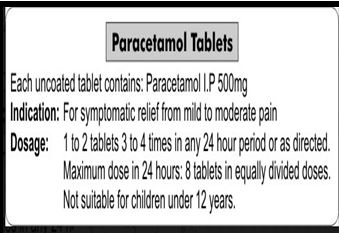
(a) 500 mg
(b) 1000 mg
(c) 2000 mg
(d) 4000 mg
Answer : D
Question. It is likely that when a person sweats, his body's electrical resistance--------------------.
Read the details about the Lie Detector machine and answer the question.(A polygraph or a lie detector is based on the principle that when a person is 'stressed' (as happens when most people tell a lie) the person's involuntary nervous system reacts to that stress by doing a series of things including increasing the respiration, heart rate, and perspiration. Most Lie Detectors measure the amount of perspiration on a person's skin using a pair of electrodes and displaying the result on a meter. The meter movement is proportional to the amount of perspiration on the skin. Devices which measure this perspiration are also called psychogalvanometers or galvanic skin response (GSR) meters.

(a) stays the same
(b) increases
(c) decreases
(d) becomes zero.
Answer : C
Question. We wish to test if a certain vaccine developed for a disease is effective or not. What is the best way to do this?
(a) Vaccinate 100 animals and expose all 100 to the disease.
(b) Vaccinate 100 animals and expose 50 of them to the disease.
(c) Vaccinate 50 animals, do not vaccinate 50 other animals, and expose all 100 to the disease.
(d) Vaccinate 50 animals, do not vaccinate 50 other animals, and expose the vaccinated animals to the disease
Answer : C
Question. To which of the cells shown below does the disease TETANUS belong?

(a) A
(b) B
(c) C
(d) D
Answer : A
Question. Microorganisms causing diseases like tuberculosis (TB) sometimes develop resistance to the drug due to their exposure to the drugs. Which of these could contribute to this resistance?
(a) Patients not completing the treatment but stopping the course once they feel better.
(b) Patients not beginning the prescribed treatment at all for different reasons
(c) Patients continuing the treatment beyond the prescribed period of medication.
(d) Patients following doctors' advice and continuing the treatment exactly as instructed.
Answer : A
Question. From the description above, we can guess that a placebo is ______

(a) Simply another name for an identical vitamin C tablet.
(b) a vitamin C tablet but which looks different (in colour and size)
(c) Something that looks like a vitamin C tablet but has no medicinal value
(d) a tablet containing chemicals to cure the common cold, but not vitamin C
Answer : C
Free study material for Science
NCERT Solutions for Class 9 Science Chapter 13 Why Do We Fall Ill
Accessing Chapter 13 Why Do We Fall Ill Solutions
Explore reliable textbook solutions for Chapter 13 Why Do We Fall Ill tailored for Class 9 learners. Utilizing these complete exercise answers ensures your preparation aligns exactly with official NCERT standards for Science.
Concept-Driven Answers for Class 9 Science
Each solution includes detailed reasoning to foster genuine comprehension of Chapter 13 Why Do We Fall Ill concepts. Reviewing these step-by-step breakdowns allows learners to master both analytical and descriptive questions expected in school evaluations.
Maximizing Study Efficiency
Consistent practice with these solution guides cultivates faster problem-solving habits and clearer logical structuring. For a complete preparation experience, pair these textbook answers with our dedicated revision notes and sample papers for Class 9 Science.
FAQs
The complete and updated NCERT Solutions Class 9 Science Chapter 13 Why Do We Fall Ill is available for free on StudiesToday.com. These solutions for Class 9 Science are as per latest NCERT curriculum.
Yes, our experts have revised the NCERT Solutions Class 9 Science Chapter 13 Why Do We Fall Ill as per 2026 exam pattern. All textbook exercises have been solved and have added explanation about how the Science concepts are applied in case-study and assertion-reasoning questions.
Toppers recommend using NCERT language because NCERT marking schemes are strictly based on textbook definitions. Our NCERT Solutions Class 9 Science Chapter 13 Why Do We Fall Ill will help students to get full marks in the theory paper.
Yes, we provide bilingual support for Class 9 Science. You can access NCERT Solutions Class 9 Science Chapter 13 Why Do We Fall Ill in both English and Hindi medium.
Yes, you can download the entire NCERT Solutions Class 9 Science Chapter 13 Why Do We Fall Ill in printable PDF format for offline study on any device.