
CBSE Class 9 Qualitative Passage Based MCQs (1)

Practice CBSE Class 9 Qualitative Passage Based MCQs (1) provided below. The MCQ Questions for Class 9 Qualitative Passage Based English with answers and follow the latest CBSE/ NCERT and KVS patterns. Refer to more Chapter-wise MCQs for CBSE Class 9 English and also download more latest study material for all subjects

MCQ for Class 9 English Qualitative Passage Based

Class 9 English students should review the 50 questions and answers to strengthen understanding of core concepts in Qualitative Passage Based

Qualitative Passage Based MCQ Questions Class 9 English with Answers

CBSE Class 9 Qualitative Passage Based MCQs (1). Chapter wise Multiple Choice Questions (MCQs) are being given by teachers to students to make them understand the chapter concepts. Its extremely critical for all CBSE students to practice all MCQs which will help them in gaining better marks in examinations. All assignments available for free download on the website are developed by the best teachers having many years of teaching experience in CBSE schools all over the country. Students, teachers and parents are advised to download the CBSE study material. 


Passage No. 1

Rachna has in her kitchen 17 spoons, 3 serving spoons, 22 quarter plates, 25 full plates, 11 forks, 2 lighters and 42 boxes. Some of these boxes contain spices, 7 of the boxes contain pulses and 4 boxes contain rice. Two boxes have ghee and three boxes have oil in them. In this way Rachna‟s kitchen is full of variety of things.

On the basis of your reading of the passage answer the questions given below :

1. How many utensils are there in Rachna‟s kitchen?

(i) 78 (ii) 87 (iii) 68 (iv) 86

2. What percentage of boxes of pulses are there in the kitchen?

(i) 17/3 (ii) 7 (iii) 11 (iv) 50/3

3. What is the ratio of rice boxes to the remaining boxes in the kitchen?

(i) 3:19 (ii) 2:21 (iii) 5:21 (iv) 2:19

4. How many more boxes of pulses arethere other than rice boxes in the kitchen?

(i) 7 (ii) 3 (iii) 4 (iv) 11


Passage No. 2

A survey was conducted among 1200 people of Delhi speaking different languages, which is shown in the given figure. Calculate the following as per given figure.
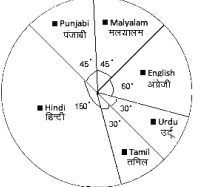
class_9_maths_MCQs_28


1. Number of Hindi speaking people are :

(i) 150 (ii) 45 (iii) 500 (iv) 60

2. How many people speak Punjabi?

(i) 150 (ii) 45 (iii) 90 (iv) 300

3. How many people speak Hindi and Tamil both together?
(i) 180 (ii) 600 (iii)280 (iv) 380
 
4. How many more people speak English than Malyalam?
(i) 25 (ii) 50 (iii) 76 (iv) 67
 
Passage No. 3

The phenomenon of change of a liquid into its vapour at any temperature below its boiling point is called evaporation. Wet clothes dry up in air due to the evaporation of water. Rate of evaporation increases with increase in temperature. The particles in a liquid have different kinetic energies. Some particles have lower kinetic energies and other have higher kinetic energies. The particles having higher kinetic energies at the surface of the liquid overcome the forces of attraction of other particles, leave the surface and get converted into vapour. Evaporation is continuous process and particles keep on escaping the surface of the liquid.
 
1. At what temperature evaporation takes place?
(i) At boiling point
(ii) Above boiling point (iii) At room temperature (i) Below boiling point
 
2. How do wet clothes dry-up?
(i) Due to condensation
(ii) Due to evaporation
(iii) Due to surface tension
(iv) Due to temperature
 
3. What is the effect of temperature on evaporation?
(i) Increases with temperature (ii) Decreases with temperature (iii) No effect of temperature (iv) None of these
 
4. What type of energy do the particles have in a liquid?
(i) Electrical energy (ii) Potential energy (iii) Kinetic energy (iv) Radiation energy
 
Passage No. 4
 
The measures adopted in health arena have increased the life expectancy to over 64 years in 2000. Infant mortality rate (IMR) has come down from 147 in 1951 to 75 in 2000. Crude birth rates have dropped to 26.1 and death rate to 8.7 within the same duration of time. Increase in life expectancy and improvement in childcare are useful in assessing the future progress of the country.
 
1. How much did the life expectancy increase in the year 2000?
(i) 47 (ii) 75 (iii) 26 (iv) 64
 
2. What percentage of the infant mortality rate fell during 1951 to 2000?
(i) 48.9 % (ii) 50% (iii) 51% (iv) 51.9 %
 
3. How much has been the growth rate between 1951 to 2000?
(i) 8.7 (ii) 17.4 (iii) 26.1 (iv) 64
 
4. How much did the death rate reach in 2000?
(i) 7.5 (ii)8.7 (iii) 6.4 (iv) 6.2
 
CBSE Class 9 Hindi Contextual Vocabulary MCQ
CBSE Class 9 Hindi Grammar and Usages Based MCQ (1)
CBSE Class 9 Hindi Grammar and Usages Based MCQ (2)
CBSE Class 9 Hindi Passage Based MCQ (1)
CBSE Class 9 Hindi Passage Based MCQ (2)
CBSE Class 9 Language Conventions Contextual Vocabulary MCQ
CBSE Class 9 Language Conventions Grammar and Usage MCQ
CBSE Class 9 Language Conventions Grammer and Usage MCQ
CBSE Class 9 Language Conventions Passage Based MCQ
CBSE Class 9 Language Conventions Passage Based MCQ (1)
CBSE Class 9 PSA Hindi Contextual Vocabulary MCQs
CBSE Class 9 PSA Hindi Language MCQs
CBSE Class 9 PSA Hindi Passage Based MCQs
CBSE Class 9 PSA Language Conventions MCQs (1)
CBSE Class 9 PSA Language Conventions MCQs (2)
CBSE Class 9 PSA Language Conventions Passage Based MCQs
CBSE Class 9 PSA Qualitative MCQs
CBSE Class 9 PSA Qualitative Passage Based MCQs Set A
CBSE Class 9 PSA Qualitative Passage Based MCQs Set B
CBSE Class 9 PSA Qualitative passage based MCQs Set C
CBSE Class 9 PSA Qualitative Passage Based MCQs Set D
CBSE Class 9 PSA Qualitative Reasoning (1)
CBSE Class 9 PSA Qualitative stand alone MCQ (2)
CBSE Class 9 PSA Qualitative Stand Alone MCQs
CBSE Class 9 PSA Qualitative stand alone MCQs (1)
CBSE Class 9 PSA Qualitative stand alone MCQs (2)
CBSE Class 9 PSA Quantitative Passage Based MCQ (1)
CBSE Class 9 PSA Quantitative Passage Based MCQ (2)
CBSE Class 9 PSA Quantitative Passage Based MCQs (1)
CBSE Class 9 PSA Quantitative Passage Based MCQs (2)
CBSE Class 9 PSA Quantitative Reasoning (1)
CBSE Class 9 PSA Quantitative Stand alone MCQs Set A
CBSE Class 9 PSA Quantitative Stand Alone MCQs Set B
CBSE Class 9 PSA Quantitative Stand alone MCQs Set C
CBSE Class 9 PSA Quantitative Stand Alone MCQs Set D
CBSE Class 9 PSA Stand Alone MCQs
CBSE Class 9 Qualitative Passage Based MCQs (1)
CBSE Class 9 Qualitative Passage Based MCQs (2)
CBSE Class 9 Quantitative Stand Alone MCQs

MCQs for Qualitative Passage Based English Class 9

Students can use these MCQs for Qualitative Passage Based to quickly test their knowledge of the chapter. These multiple-choice questions have been designed as per the latest syllabus for Class 9 English released by CBSE. Our expert teachers suggest that you should practice daily and solving these objective questions of Qualitative Passage Based to understand the important concepts and better marks in your school tests.

Qualitative Passage Based NCERT Based Objective Questions

Our expert teachers have designed these English MCQs based on the official NCERT book for Class 9. We have identified all questions from the most important topics that are always asked in exams. After solving these, please compare your choices with our provided answers. For better understanding of Qualitative Passage Based, you should also refer to our NCERT solutions for Class 9 English created by our team.

Online Practice and Revision for Qualitative Passage Based English

To prepare for your exams you should also take the Class 9 English MCQ Test for this chapter on our website. This will help you improve your speed and accuracy and its also free for you. Regular revision of these English topics will make you an expert in all important chapters of your course.

Where can I access latest CBSE Class 9 Qualitative Passage Based MCQs (1)?

You can get most exhaustive CBSE Class 9 Qualitative Passage Based MCQs (1) for free on StudiesToday.com. These MCQs for Class 9 English are updated for the 2025-26 academic session as per CBSE examination standards.

Are Assertion-Reasoning and Case-Study MCQs included in the English Class 9 material?

Yes, our CBSE Class 9 Qualitative Passage Based MCQs (1) include the latest type of questions, such as Assertion-Reasoning and Case-based MCQs. 50% of the CBSE paper is now competency-based.

How do practicing English MCQs help in scoring full marks in Class 9 exams?

By solving our CBSE Class 9 Qualitative Passage Based MCQs (1), Class 9 students can improve their accuracy and speed which is important as objective questions provide a chance to secure 100% marks in the English.

Do you provide answers and explanations for CBSE Class 9 Qualitative Passage Based MCQs (1)?

Yes, English MCQs for Class 9 have answer key and brief explanations to help students understand logic behind the correct option as its important for 2026 competency-focused CBSE exams.

Can I practice these English Class 9 MCQs online?

Yes, you can also access online interactive tests for CBSE Class 9 Qualitative Passage Based MCQs (1) on StudiesToday.com as they provide instant answers and score to help you track your progress in English.