

Download Class 11 Physics Concept Summaries: CBSE Class 11 Physics Thermodynamics Notes Set 01
Explore reliable concept summaries and revision materials through the CBSE Class 11 Physics Thermodynamics Notes Set 01. Tailored for Class 11 learners, utilizing these notes for Physics Chapter 11 Thermodynamics ensures thorough preparation and strengthens core academic definitions before final evaluations.
Access Chapter 11 Thermodynamics Notes and Study Material
Access the complete concept summary PDF for Chapter 11 Thermodynamics below. Regular review of these targeted notes builds familiarity with complex Class 11 Physics themes and helps secure higher marks in final school evaluations.
THERMODYNAMICS
• Thermal Equilibrium:- Two systems are said to be in thermal equilibrium with each other if they have the same temperature.
• Thermo dynamical system:- An assembly of large numbers of particles having same temperature, pressure etc is called thermo dynamical system.
• Thermodynamic variables :- The variables which determine the thermodynamic behavior of a system are called thermodynamic variables
• Zeroth law of Thermodynamics :- IT states that if two system A and B are in thermal equilibrium with a third system C , then the two system A and B are also in thermal equilibrium with each other.
• Thermodynamic Process :- A thermodynamic process is said to be taking place , if the thermodynamic variable of the system change with time.
•Types of thermodynamic Process:-
(1) Isothermal process – process taking place at constant temperature.
(2) Adiabatic process – process where there is no exchange of heat.
(3) Isochoric process – process taking place at constant volume
(4) Isobaric process –Process taking place at constant Pressure.
(5) Cyclic process:- Process where the system returns to its original state.
•Equation of state : A relation between pressure, volume and temperature for a system is called its equation of state .
Indicator diagram (P-V diagram) :- The graphical representation of the
state of a system with the help of two thermodynamical variables is called
indicator diagram of the system.
•Internal energy of a gas :- It is the sum of kinetic energy and the intermolecular potential energy of the molecules of the gas. Internal energy is a function of temperature.
•First law of Thermodynamics :- It states that if an amount of heat dQ I added to a system , a part of heat is used in increasing its internal energy while the remaining part of heat may be used up as the external work done dW by the system.
K.V. Lumding; K.V. Karimganj; K.V. Langjing
Mathematically dQ=dU+dW
dQ=dU+ PdV.
• Work done during expansion / compression of gas:- When the volume of gas changes from V1 to V2 , the work done is given by W= ∮ v1 v2 = Area under the P -V diagram.
• Thermodynamical operations are
(1) Isothermal process : A thermodynamic process that takes place at constant temperature is called an isothermal process.
- Equation of state for isothermal process : PV = constant.
- Work done during an isothermal process
Wiso = RT loge V1 /V2 = 2.303 RT loge V1 /V2
(2) Adiabatic process : A thermodynamic process that takes place in such a manner that no heat enters or leaves the system is called adiabatic process
√ Equation of state for adiabatic process
(i) PV γ = constant (ii) TV γ-1 =constant (iii) PY-1 / TY =constant
√ Work done during adiabatic change
Wadia = R( T1 -T2) / (Y -1)
• Reversible process :- It is a process in which the system can be retraced to its original state by reversing the condiditions.
• Irreversible process:- It is a process in which the system cannot be retraced to its original state by reversing the conditions.
• Second law of thermodynamics:
⇒ Kelvin’s statement of second law – It is impossible to derive a continous supply of work by cooling a body to a temperature lower than that of the coldest of its surrounding.
⇒ Clausius statement of second law – It is impossible for a self –acting machine unaided by any external agency to transfer heat from a body to another body at higher temperature.
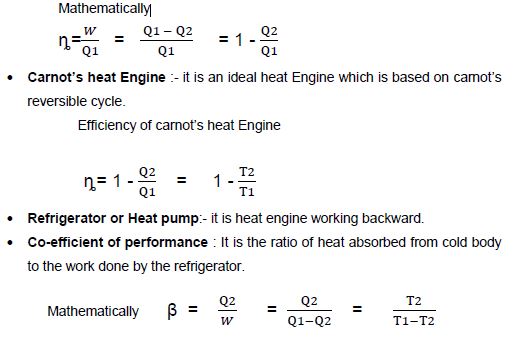
⇒ Heat Engine – a heat engine is a device for converting heat energy continuously into a mechanical work.
⇒ Component of heat engine- (i) source of heat (ii) Sink (iii) Working substance
⇒ Efficiency of heat Engine :-It is defined as the ratio of the external work obtained to the amount of heat energy absorbed from the heat source.
All Questions with **(mark) are HOTs Question
Q1 Which Thermodynamical variable is defined by the first law of thermodynamics?
Ans: Internal energy.
Q2 What is the amount of work done in the Cyclic process?
Ans:It is numerically equal to the area of the cyclic process.
Q3 Out of the parameters- temperature, pressure,work and volume, which parameter does not Characterize the thermodynamics state of matter?
Ans: Work
Q4 What is the nature of P-V diagram for isobaric and isochoric process?
Ans: The P-V diagram for an isobaric process is a straight line parrel to the volume axis while that For an isochoric process is a straight line parallel to pressure axis.
Q5 On what factors does the efficiency of Carnot engine depends?
Ans: Temperature of the source of heat and sink.
Q6 Can we increase the temperature of gas without supplying heat to it?
Ans: Yes, the temperature of gas can be by compressing the gas under Adiabatic condition.
Q7 Why does the gas get heated on compression?
Ans: Because the work done in compressing the gas increases the internal energy of the gas.
Q8 Which thermodynamic variable is defined by Zeroth law of thermodynamics?
Ans: Temperature
Q9 Can the whole of work be converted into heat?
Ans: Yes ,Through friction.
Please click the link below to download pdf file for CBSE Class XI Physics Thermodynamics.
Free study material for Physics
Download CBSE Revision Notes: Class 11 Physics Chapter 11 Thermodynamics
Quick Revision Notes: Chapter 11 Thermodynamics (CBSE)
Explore reliable chapter overviews for Chapter 11 Thermodynamics tailored for Class 11 learners. Use these structured points to grasp difficult themes and ensure solid preparation for upcoming assessments.
Expert Study Material for Class 11 Physics
Cross-reference your comprehension with comprehensive NCERT solutions for Class 11 to ensure absolute clarity across all sub-topics in this chapter.
Complete Your Chapter Revision
Follow up your revision by attempting the interactive online Physics MCQ test and practice worksheets for this chapter to verify your mastery. All platform resources are free to access.
FAQs
You can download the teacher prepared revision notes for CBSE Class 11 Physics Thermodynamics Notes Set 01 from StudiesToday.com. These notes are designed as per 2026-27 academic session to help Class 11 students get the best study material for Physics.
Yes, our CBSE Class 11 Physics Thermodynamics Notes Set 01 include 50% competency-based questions with focus on core logic, keyword definitions, and the practical application of Physics principles which is important for getting more marks in 2026 CBSE exams.
Yes, our CBSE Class 11 Physics Thermodynamics Notes Set 01 provide a detailed, topic wise breakdown of the chapter. Fundamental definitions, complex numerical formulas and all topics of CBSE syllabus in Class 11 is covered.
These notes for Physics are organized into bullet points and easy-to-read charts. By using CBSE Class 11 Physics Thermodynamics Notes Set 01, Class 11 students fast revise formulas, key definitions before the exams.
No, all study resources on StudiesToday, including CBSE Class 11 Physics Thermodynamics Notes Set 01, are available for immediate free download. Class 11 Physics study material is available in PDF and can be downloaded on mobile.