

Download Class 11 Physics Concept Summaries: CBSE Class 11 Physics Laws Of Motion Notes
Explore reliable concept summaries and revision materials through the CBSE Class 11 Physics Laws Of Motion Notes. Tailored for Class 11 learners, utilizing these notes for Physics Chapter 04 Laws of Motion ensures thorough preparation and strengthens core academic definitions before final evaluations.
Access Chapter 04 Laws of Motion Notes and Study Material
Navigate directly to the revision notes for Chapter 04 Laws of Motion using the digital viewer below. Each summary is structured to highlight high-weightage sections, allowing students to instantly access critical definitions and focus on core exam topics.
Class XI
Chapter 4: Laws of Motion
Chapter Notes
Key Learning:
1. Galileo extrapolated simple observations on motion of bodies on inclined planes, and arrived at the law of inertia. Newton’s first law of motion is the same law as the law of inertia. According to it an object acted upon by no net force, will remain at rest or continue to move with a constant velocity and zero acceleration.
2. The tendency of an object to remain at rest or continue to move at a constant velocity is called inertia.
3. The frame of reference in which Newton first law is valid is called inertial frame of reference.
4. The frame of reference in which Newton first law is not valid is known as Non inertial frame of reference. These are accelerating reference frames.
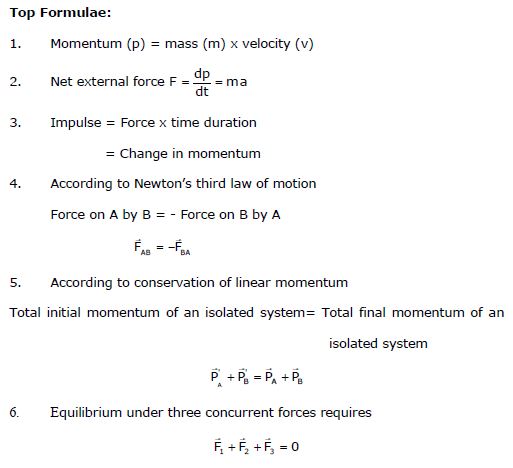
5. Momentum (p) of an object is a vector quantity and is defined as the product of its mass (m) and velocity (v), i.e., p = mv.
6. Newton second law: The rate of change of momentum of an object is equal to the net external force and takes place in the direction in which the net force acts.
7. The net external force on an object is equal to its mass times the acceleration, i.e., F = ma
8. Impulse is the product of average force and time and equals change in momentum.
9. Newton’s third law of motion states whenever object1 exerts a force on object2, then object2 must exert a force on object1 which is equal in magnitude and opposite in direction or to every action force, there is always an equal and opposite reaction force
10. Action and reaction act on different bodies and so they cannot cancel each other.
11. Law of Conservation of Momentum: The total momentum of an isolated system of particles is conserved. The law follows from the second and third law of motion.
12. If an object is at equilibrium, net resultant force acting on it is zero.
13. Normal reaction is the contact force perpendicular to the surface in contact.
14. Tension force is the restoring force in the rigid inextensible string or rope when being pulled down.
15. Centripetal force is always directed along the radius towards the centre.
16. A free body diagram is a diagram showing the chosen body by itself, free of its surroundings.
17. Two points for which one should be careful about while drawing Free Body diagrams are:
i. Include all the forces acting on the body
ii. Do not include any force that the chosen body exerts on any other body.
18. Free body equations represent the two equations of motion framed along two perpendicular axes.
19. Maximum value of Static friction
fs,max ∞ R
fs,max = μs. R
Here fs,max is the limiting value of the static friction, R is the normal reaction
and μs is the coefficient of static friction.
20. Static friction increases with the applied force till it reaches a maximum
value of Fs,max .
21. Kinetic friction
fk ∞ R
fk = μk. R
Here fk is the limiting value of the static friction, R is the normal reaction and μk is the coefficient of kinetic friction.
22. The force required to start a motion is more than the force required to maintain a constant motion in a body.
23. Horizontal component of contact force equals force of friction.
24. Limiting value of static friction is greater than kinetic friction.
25. Force required to initiate the motion in a body should be greater than then the force required to maintain the motion with uniform velocity.
26. The direction of frictional force is always directed in the direction opposite to the relative motion between the two surfaces.
Please click the link below to download pdf file for CBSE Class 11 Physics - Laws of Motion Notes.
Free study material for Physics
Study Material and Revision Notes for Class 11 Physics Chapter 04 Laws of Motion
Quick Revision Notes: Chapter 04 Laws of Motion (CBSE)
Review targeted chapter notes for Class 11 Physics Chapter 04 Laws of Motion. Built according to official CBSE guidelines, these summaries highlight high-yield topics frequently tested in school evaluations.
Expert Study Material for Class 11 Physics
Built using the official NCERT book for Class 11 Physics, these notes provide reliable academic guidance. Pair your summary review with our recommended NCERT solutions to master optimal problem-solving approaches.
Complete Your Chapter Revision
Wrap up your chapter revision by testing your knowledge against standard question formats. Everything on our platform is provided free of charge.
FAQs
You can download the teacher prepared revision notes for CBSE Class 11 Physics Laws Of Motion Notes from StudiesToday.com. These notes are designed as per 2026-27 academic session to help Class 11 students get the best study material for Physics.
Yes, our CBSE Class 11 Physics Laws Of Motion Notes include 50% competency-based questions with focus on core logic, keyword definitions, and the practical application of Physics principles which is important for getting more marks in 2026 CBSE exams.
Yes, our CBSE Class 11 Physics Laws Of Motion Notes provide a detailed, topic wise breakdown of the chapter. Fundamental definitions, complex numerical formulas and all topics of CBSE syllabus in Class 11 is covered.
These notes for Physics are organized into bullet points and easy-to-read charts. By using CBSE Class 11 Physics Laws Of Motion Notes, Class 11 students fast revise formulas, key definitions before the exams.
No, all study resources on StudiesToday, including CBSE Class 11 Physics Laws Of Motion Notes, are available for immediate free download. Class 11 Physics study material is available in PDF and can be downloaded on mobile.