

Official Class 11 Physics Revision Material: CBSE Class 11 Physics Motion In A Straight Line Notes Set 01
Explore reliable concept summaries and revision materials through the CBSE Class 11 Physics Motion In A Straight Line Notes Set 01. Tailored for Class 11 learners, utilizing these notes for Physics Chapter 02 Motion in a Straight Line ensures thorough preparation and strengthens core academic definitions before final evaluations.
Chapter-wise Concept Summaries: Chapter 02 Motion in a Straight Line
Access the complete concept summary PDF for Chapter 02 Motion in a Straight Line below. Regular review of these targeted notes builds familiarity with complex Class 11 Physics themes and helps secure higher marks in final school evaluations.
Motion in a straight line
IMPORTANT POINTS
- Study of motion of objects along a straight line is known as rectilinear motion.
- If a body does not change its position with time it is said to be at rest. If it changes its position with time it is said to be in motion. The position of the object canbe specified with reference to a conveniently chosen origin. For motion in a straight line, position to the right of the origin is taken as positive and to the left as negative.
- Path length is defined as the total length of the path traversed by an object.
- Displacement is the change in position : ∆x=x2-x1, Path length is greater than or equal to the magnitude of the displacement between the two positions
- An object is said to be in uniform motion in a straight line if its displacement is equal in equal intervals of time. Otherwise the motion is said to be non-uniform.
- Average velocity is the ratio of the displacement and time interval in which the displacement occurs. V=∆x/∆t On an x-t graph, the average velocity over a time interval is the slope of the line connecting the initial and final positions corresponding to that interval.
- Average Speed is ratio of the total path length traversedand the corresponding time interval. The average speed of an object is greater than or equal to themagnitude of the average velocity over a given interval of time.
- Instantaneous velocity or simply velocity is defined as the limit of the average velocity as the time interval ∆t becomes infinitesimally small.
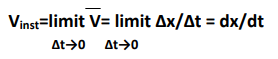
- Instantaneous acceleration is defined as the limit of the average acceleration as the time interval Δt goes to zero.
a =lim (a) =lim (ΔV/Δt) = dv/dt
Δt→0Δt→o
The acceleration of an object at a particular time is the slope of the velocity- time e curve at that instant of time.For uniform motion, acceleration is zero and x-t graph is a straight line inclined to the time axis. And v-t graph is a straight line parallel to the time axis.For motion with uniform acceleration, x-t graph is a parabola, while the v-t graph is a straight line inclined to the time axis.
- The area under the velocity- time curve between times t1 and t2 is equal to the displacement of the object during that interval of time.
- For objects in uniformly accelerated rectilinear motion, the five quantities, displacement x, time taken t, initial velocity u, final velocity v and acceleration are related by a setoff simple equations called kinematic equations of motion.
(i) V= u+ at
(ii) X=ut + ½ a t2
(iii) V2- u2 = 2 a x
Solve the following. Each question carries 1 mark.
1. Distinguish between scalar and vector quantities.Give an example in support of each.
2. Define speed. How is it different from velocity?
3.Define uniform velocity and variable velocity?
4.Plot the velocity- time graph for a uniform motion. What does the areaunder the graphs indicate?
5.Write any two equations of motion of a body moving with uniform acceleration.
6. Plot a velocity- time graph for a body moving with uniform acceleration.
7.Plot position – time graph for a body having uniformly retarded motion
8. What does the speedometer of car indicate?
9. Two cars are running at velocities of 60 km /hr and 45 km/hr respectively. Calculate the relative velocity of car A, if (i) they are both travelling eastwards; and (ii) car A is travelling eastwards and car B is travelling westwards.
10. A body goes from A to B with a velocity of 40 m/sec, and comes back from B to A with a velocity of 60 m/sec.What is the average velocity of the body during the whole journey.
Answer the following questions each question carries 2 marks
11. A player throws a ball upwards with an initial speed of 39.2 m/sec.
(a) What is the direction of acceleration during the upward motion?
(b) Find the velocity and acceleration of the ball at the highest point.
(c) Find the height through which the ball rises, and the time after which it returns to the player’s hands.
12. From the top of a tower 100m height, balls is dropped, and at the same time another ball is projected vertically upwards from the ground with a velocity of 25 m/sec. find when and where the two balls meet. Take g = 9.8 m/sec2
13.The distance travelled by a body is found to be directly proportional to the square of time. Is the body moving with uniform velocity or with uniform acceleration?
14.The displacement (x) of a particle moving in one dimension, under the action of a constant force related to time t by the relation t =√x +3 where x is in meters, and t is in seconds. Find the displacement of the particle when its velocity is zero.
15. Can a body have zero velocity, and finite acceleration?
16. Can a body have constant speed, but a varying velocity?
17.Can a body have constant velocity, but a varying speed?
18. Why is itthat a parachute descends slowly whereas a stone dropped from the same height fallsrapidly?
19.Look at the graphs (a) to (d) in fig carefully and state with reasons which of these cannot possibly represent one dimensional motion of a particle.

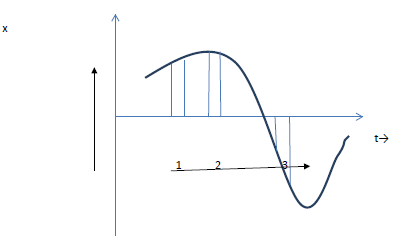
20. Fig gives the x-t plot of a particle in one dimensional motion. Three different equal intervals of time are shown. In which interval is the average speed greatest, and in which is it the least? Give the sign of average velocity for each interval
21.The acceleration –time graph for a body is shown below. Plot the corresponding velocity-time graph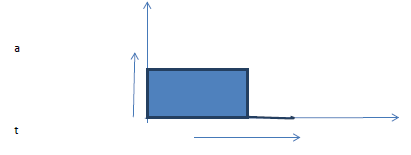
21. Suggest a suitable physical situation for each of the following graphs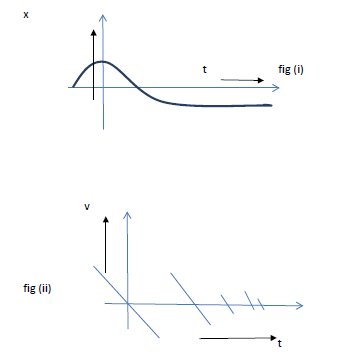
22. Give the equations of motion of a body falling under gravity. Also give the graphs showing the variation of (i) acceleration of a body with time
(ii) Velocity of a body with time
(iii) Distance with time in case of a freely falling body.
23. Discuss the motion of an object under free-fall.
24. Derive a relation between the position and time for a particle moving with uniform acceleration.
25. Derive a relation for the distance covered in the nth secondby a uniformly accelerated body.
26. Show that when a body has uniformly accelerated motion, the distance covered it in a certain interval is equal to the area under the velocity-time graph for that time interval.
27. A body is moving with uniform acceleration its velocity after 5 seconds is 25 m/sec and after 8 seconds is 34 m/sec. Calculate the distance it will cover in the 10th second.
28. The speed of a train increases at a constant rate α from zero, to v, and then remains constant for an interval, and finally decreases to zero at a constant rate β. If L be the total distance described, prove that the total time taken is
(L/v) + (v/2) (1/α + 1/β)
29. A body moving with a uniform acceleration describes 12 m in the third second of its motion and 20m in the fifth second. Find the velocity after 10 seconds.
Description of Motion in Two and Three Dimensions
Main Points:
1.Scalar quantities with magnitudes only. Examples aredistance, speed mass and temperature.
2.Vector quantities with magnitude and direction both. Examples aredisplacement, velocity and acceleration. They obey special rules of vector algebra.
3.A vector ’A’ multiplied by a real number‘λ’ is also a vector, whose magnitude is‘λ’times the magnitude of the vector‘ A ‘and whose direction is same or opposite depending upon whether‘λ’ is positive or negative.
4.Two vectors A and B may be added graphically using head to tail method or parallelogram method.
=Δx i^ + Δy j^
5. Vector addition is commutative:
A + B = B + A
It also obeys the associative law:
(A + B) + C = A + (B +C)
6.A null or zero vector is a vector with zero magnitude. Since the magnitude is zero, we don’t have to specify its direction. It has the properties:
A + 0 =A
λ0 =0
0 .A=0
7.The subtraction of vector B from A is defined as the sum of A and –B:
A – B = A + (-B)
8.A vector A can be resolved into components along two given vectors a and b lying in the same plane:
A= λ a + μb whereλ and μ are real numbers.
9.A unit vector associated with a vector A has magnitude one and is along the vector A :
n ^ = A/ A The unit vectors i^,j^,k^ are vectors of unit magnitude and point in the direction of x, y, and z- axes respectively in a right handed coordinate system.
10. A vector ‘A’ can be expressed as
A = Ax i^ + Ay j ^where Ax , Ay are components along x- and y- axes . If vector A makes an angle Ѳ with the x- axis, then Ax = A cosѲ, Ay = A sinѲ and
Tan Ѳ = Ay/Ax.
11. Vectors can be conveniently added using analytical method. If sum of two vectors‘ A’ and ‘B’ , that lie in x-y plane is ‘R’, then:
R = Rx i^ + Ry j^ , where Rx = Ax + B x and Ry = Ay + By
12. The position vector of an object in x-y plane is given by r =x i^ + y j^ and the displacement from position r to position r’ is given by
Δr = r’-r
= (x’-x)i^ + ( y’-y)j^
13. If an object undergoes a displacement Δr in time Δt, its average velocity is given by
V = Δr/Δt. The velocity of an object at time t is the limiting value of the average velocity as Δt tends to zero..
V= lim Δr/Δt = dr/ dt .It can be written in unit vector notation as
Δt→0
V=vxi^ + vyj^ + vz k^ where Vx = dx/dt, Vy = dy/dt ,Vz= dz/dt
When position of an object is plotted on a coordinate system v is always tangent to the curve representing the path of the object.
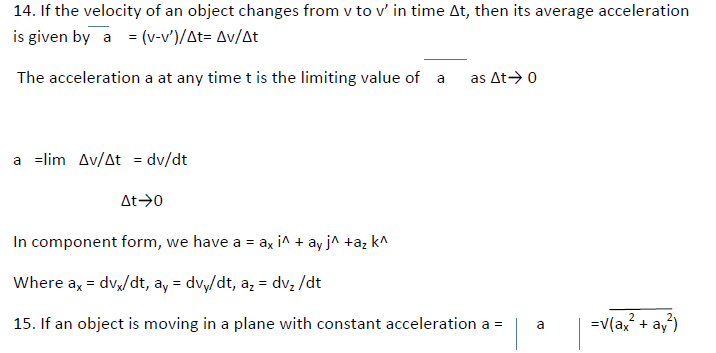
And its position vector at time t = 0 is r0, then at any other time t, it will be at a point given by
r = r0 + V0t + ½ a t2
and its velocity is given by :
V = V0t + atwhere V0 is the velocity at time t = 0
In component form
X = x0 +V0xt + ½ ax t2
Y= y0 + V0y t + ½ ay t2
Vx = V0x + ax t
Vy = V0y + ay t
Motion in a plane can be treated as superposition of two separate simultaneous one dimensional motions along two perpendicular directions.
16. An object that is in flight after being projected is called a projectile.If an object is projected with an initial velocity V0 making an angle Ѳ0, with x=axis and if assume its initial position to coincide with the origin of the coordinate system, then the position and velocity of the projectile at time t are given by
X = (V0cosѲ0)t
Y = (V0 sin Ѳ0)t – ½ g t2
Vx=V0x = V0cosѲ0
Vy = V0sinѲ0 – gt
The path of a projectile is parabolic and is given by
Y= (tan Ѳ0) x – gx2/2V0Cos Ѳ0)2
The maximum height that a projectile attains is
H m= (V0sinѲ0)2/2g
The time taken to reach this height is
tm= V0Sin Ѳ0/g
The horizontal distance travelled by a projectile from its initial position to the position it passes y = 0 during its fall is called the RANGE, R of the projectile. It is:
R =V02Sin 2Ѳ0/g
17. When an object follows a circular path at constant speed. The motion of the object is called uniform circular motion. The magnitude of its acceleration is ac= v2/R. The direction of ac is always towards the centre of the circle.
The angular speed is the rate of change of angular distance. It is related velocity v by V =ω R. The acceleration is ac= ω2 R.
→ If T is the time period of revolution of the object in circular motion and ν is the frequency then we have ω = 2πνV = 2πνR a= 4π2ν2 R
→ Centripetal force is the name given to the force that provides inward radial acceleration to a body in circular motion.We should always look for some material force like tension, gravitational force, electrical force, frictionetc. as the centripetal force.
18. The path length traversed by an object between two points is not the same as the magnitude of displacement always. The displacement depends only on the end points; whereas the path length depends on the actual path. The two quantities are equal only if the object does not change its direction during the course of its motion. In all other cases, the path length is greater than the magnitude of displacement.
19. The average speed of an object is greater than or equal to the magnitude of the average velocity over a given interval of time. The two are equal only if the path length is equal to the magnitude of the displacement.
Please click the link below to download pdf file for CBSE Class 11 Physics notes - Motion in a Straight Line.
Free study material for Physics
Download CBSE Revision Notes: Class 11 Physics Chapter 02 Motion in a Straight Line
Key Concepts and Summary for Class 11 Physics Chapter 02 Motion in a Straight Line
Review targeted chapter notes for Class 11 Physics Chapter 02 Motion in a Straight Line. Built according to official CBSE guidelines, these summaries highlight high-yield topics frequently tested in school evaluations.
NCERT-Aligned Chapter Summary and Notes
Built using the official NCERT book for Class 11 Physics, these notes provide reliable academic guidance. Pair your summary review with our recommended NCERT solutions to master optimal problem-solving approaches.
Next Steps in Your Exam Preparation
Explore our broader library of printable assignments, chapter notes, and mock tests designed to support continuous revision and secure higher marks in CBSE assessments.
FAQs
You can download the teacher prepared revision notes for CBSE Class 11 Physics Motion In A Straight Line Notes Set 01 from StudiesToday.com. These notes are designed as per 2026-27 academic session to help Class 11 students get the best study material for Physics.
Yes, our CBSE Class 11 Physics Motion In A Straight Line Notes Set 01 include 50% competency-based questions with focus on core logic, keyword definitions, and the practical application of Physics principles which is important for getting more marks in 2026 CBSE exams.
Yes, our CBSE Class 11 Physics Motion In A Straight Line Notes Set 01 provide a detailed, topic wise breakdown of the chapter. Fundamental definitions, complex numerical formulas and all topics of CBSE syllabus in Class 11 is covered.
These notes for Physics are organized into bullet points and easy-to-read charts. By using CBSE Class 11 Physics Motion In A Straight Line Notes Set 01, Class 11 students fast revise formulas, key definitions before the exams.
No, all study resources on StudiesToday, including CBSE Class 11 Physics Motion In A Straight Line Notes Set 01, are available for immediate free download. Class 11 Physics study material is available in PDF and can be downloaded on mobile.