

Physics Concept Notes for Class 11: Chapter 11 Thermodynamics
Explore reliable concept summaries and revision materials through the CBSE Class 11 Physics Thermodynamics Notes Set 02. Tailored for Class 11 learners, utilizing these notes for Physics Chapter 11 Thermodynamics ensures thorough preparation and strengthens core academic definitions before final evaluations.
Download Chapter 11 Thermodynamics Revision Notes PDF
View or download the dedicated Chapter 11 Thermodynamics revision resource below. Engaging with these structured concept notes daily ensures continuous academic progress and mastery of the 2026-27 curriculum for Physics.
Class XI
Chapter 12: Thermodynamics
Key Learning
1. The nature of heat and its relationship to mechanical work was studied by Joule.
2. Thermal equilibrium implies that systems are at the same temperature.
3. Internal energy of a system is the sum of kinetic energies and potential energies of the molecular constituents of the system. It does not include the over – all kinetic energy of the system.
4. Equilibrium states of a thermodynamics system are described by state variables. The value of a state variable depends only on the particular state, not on the path used to arrive at that state.
5. Examples of state variables are pressure (P), volume (V), temperature (T) and mass (m). Heat and work are not state variables.
6. Zeroth law of thermodynamics states that two systems in thermal equilibrium with a third system, are in thermal equilibrium with each other.
7. The first law if thermodynamics is based on the principle of conservation of energy. It states that ΔU = ΔQ - PΔV
8. The efficiency of a heat engine is defined as the ratio of the work done by the engine to the input heat.
η= Work done/Input heat=W/QH
9. If all the input heat is converted entirely into heat, the engine would have an efficiency of 1.
10. In a reversible process both the system and its environment can be returned to their initial states.
11. Spontaneous processes of nature are irreversible. The idealized reversible process is a quasi – static process with no dissipative factors such as friction viscosity, etc.
12. A quasi – static process is an infinitely slow process such that the system remains in thermal and mechanical equilibrium with the surroundings throughout. In a quasi – static process, the pressure and temperature of the environment can differ from those of the system only infinitesimally.
13. Heat engine is a device in which a system undergoes a cyclic process resulting in conversion of heat into work.
14. Carnot engine is a reversible engine operating between two temperatures T1 (source) and T2 (sink). The Carnot cycle consists of two isothermal processes connected by two adiabatic processes.
15. The efficiency of the Carnot engine is independent of the working substance of the engine. It only depends on the temperatures of the hot and cold reservoirs.
16. Efficiency of Carnot engine is η = 1 – TC /TH = 1 – (Temperature of cold reservoir/Temperature of hot reservoir).
17. No engine can have efficiency more than that of a Carnot engine.
18. Implications of First law of thermodynamics:
i. Heat lost by hot body = heat gained by the cold body.
ii. Heat can flow from cooler surroundings into the hotter body like coffee to make it hotter.
19. Kelvin’s Statement of second law of thermodynamics: No heat engine can convert heat into work with 100 % efficiency.
20. Clausius’s Statement: No process is possible whose sole result is the transfer of heat from a colder to a hotter body.
21. Kelvin’s Statement: No process is possible whose sole result is the complete conversion of heat into work.
22. The co-efficient of performance of a refrigerator is α = QC/W.
23. A heat pump, is called so, because it pumps heat from the cold outdoors (cold reservoir) into the warm house (hot reservoir).
24. If Q > 0, heat is added to the system
If Q < 0, heat is removed to the system
If W > 0, Work is done by the system
If W < 0, Work is done on the system
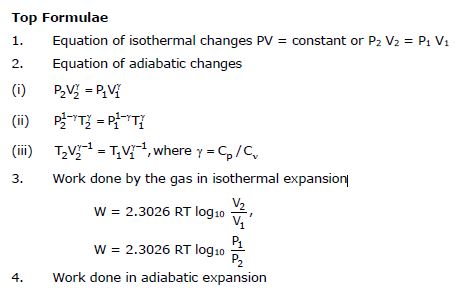
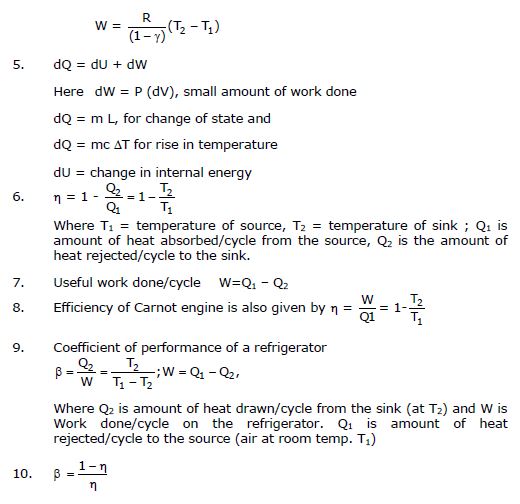
Please click the link below to download pdf file for CBSE Class 11 Physics - Thermodynamics Notes.
Free study material for Physics
Study Material and Revision Notes for Class 11 Physics Chapter 11 Thermodynamics
Quick Revision Notes: Chapter 11 Thermodynamics (CBSE)
Review targeted chapter notes for Class 11 Physics Chapter 11 Thermodynamics. Built according to official CBSE guidelines, these summaries highlight high-yield topics frequently tested in school evaluations.
Expert Study Material for Class 11 Physics
Built using the official NCERT book for Class 11 Physics, these notes provide reliable academic guidance. Pair your summary review with our recommended NCERT solutions to master optimal problem-solving approaches.
Complete Your Chapter Revision
Follow up your revision by attempting the interactive online Physics MCQ test and practice worksheets for this chapter to verify your mastery. All platform resources are free to access.
FAQs
You can download the teacher prepared revision notes for CBSE Class 11 Physics Thermodynamics Notes Set 02 from StudiesToday.com. These notes are designed as per 2026-27 academic session to help Class 11 students get the best study material for Physics.
Yes, our CBSE Class 11 Physics Thermodynamics Notes Set 02 include 50% competency-based questions with focus on core logic, keyword definitions, and the practical application of Physics principles which is important for getting more marks in 2026 CBSE exams.
Yes, our CBSE Class 11 Physics Thermodynamics Notes Set 02 provide a detailed, topic wise breakdown of the chapter. Fundamental definitions, complex numerical formulas and all topics of CBSE syllabus in Class 11 is covered.
These notes for Physics are organized into bullet points and easy-to-read charts. By using CBSE Class 11 Physics Thermodynamics Notes Set 02, Class 11 students fast revise formulas, key definitions before the exams.
No, all study resources on StudiesToday, including CBSE Class 11 Physics Thermodynamics Notes Set 02, are available for immediate free download. Class 11 Physics study material is available in PDF and can be downloaded on mobile.