

Physics Concept Notes for Class 11: Chapter 12 Kinetic Theory
Explore reliable concept summaries and revision materials through the CBSE Class 11 Physics Kinetic Theory Notes Set 01. Tailored for Class 11 learners, utilizing these notes for Physics Chapter 12 Kinetic Theory ensures thorough preparation and strengthens core academic definitions before final evaluations.
Download Chapter 12 Kinetic Theory Revision Notes PDF
View or download the dedicated Chapter 12 Kinetic Theory revision resource below. Engaging with these structured concept notes daily ensures continuous academic progress and mastery of the 2026-27 curriculum for Physics.
KINEMATICS
*rest and Motion are relative terms, nobody can exist in a state of absolute rest or of absolute motion.
*One dimensional motion:- The motion of an object is said to be one dimensional motion if only one out of three coordinates specifying the position of the object change with time. In such a motion an object move along a straight line path.
*Two dimensional motion:- The motion of an object is said to be two dimensional motion if two out of three coordinates specifying the position of the object change with time. In such motion the object moves in a plane.
*Three dimensional motion:- The motion is said to be three dimensional motion if all the three coordinates specifying the position of an object change with respect to time ,in such a motion an object moves in space.
*The magnitude of displacement is less than or equal to the actual distance travelled by the object in the given time interval.
Displacement ≤ Actual distance
*Speed:- It is rate of change of distance covered by the body with respect to time.
Speed = Distance travelled /time taken
Speed is a scalar quantity .Its unit is meter /sec. and dimensional formula is [M0L1T-1] .It is positive or zero but never negative.
*Uniform Speed:- If an object covers equal distances in equal intervals of time than the speed of the moving object is called uniform speed. In this type of motion,
position – time graph is always a straight line.
*Instantaneous speed:-The speed of an object at any particular instant of time is called instantaneous speed. In this measurement, the time Δt→0.
When a body is moving with uniform speed its instantaneous speed = Average
speed = uniform speed.
*Velocity:- The rate of change of position of an object in a particular direction with respect to time is called velocity. It is equal to the displacement covered by an object per unit time.
Velocity =Displacement /Time
Velocity is a vector quantity, its SI unit is meter per sec. Its dimensional formula is [M0L1T-1]. It may be negative, positive or zero.
*When a body moves in a straight line then the average speed and average velocity are equal.
*Acceleration:- The rate of change of velocity of an object with respect to time is called its acceleration.
Acceleration = Change in velocity /time taken
It is a vector quantity, Its SI unit is meter/ sec.2 and dimension is [M0L1T-2], It may be positive ,negative or zero.
*Positive Acceleration:- If the velocity of an object increases with time, its acceleration is positive .
*Negative Acceleration :-If the velocity of an object decreases with time, its acceleration is negative . The negative acceleration is also called retardation or deacceleration.
*Formulas of uniformly accelerated motion along straight line:-
For accelerated motion, For deceleration motion
V = u + at v = u - at
S = ut + 1/2 at2 S = ut - 1/2 at2
V2 =u2+ 2as V2= u2- 2as
Sn = u + a/2(2n- 1) Sn = u - a/2( 2n- 1)
*Free fall :- In the absence of the air resistance all bodies fall with the same acceleration towards earth from a small height. This is called free fall. The acceleration with which a body falls is called gravitational acceleration (g).Its value is 9.8 m/sec2.
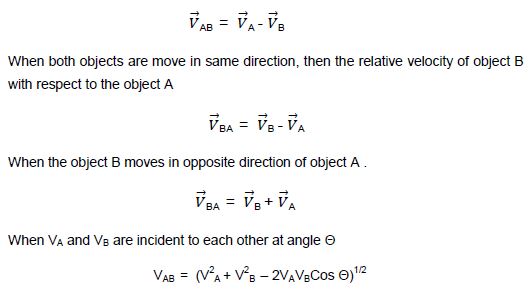
*Relative Motion:- The rate of change of distance of one object with respect to the other is called relative velocity. The relative velocity of an object B with respect to the object A when both are in motion is the rate of change of position of object B with respect to the object A.
*Relative velocity of object A with respect to object B
*Scalars :- The quantities which have magnitude only but no direction. For example : mass, length, time, speed , temperature etc.
*Vectors :- The quantities which have magnitude as well as direction and obeys vector laws of addition, multiplication etc.
For examples : Displacement, velocity, acceleration, force , momentum etc.
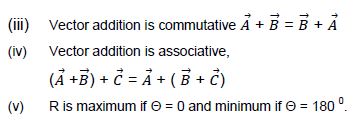
• Addition of Vectors :-
(i) Only vectors of same nature can be added.
(ii) The addition of two vector A and B is resultant R

And R = ( A2 + B2+ 2AB CosΘ)1/2
And tan β = B SinΘ/ ( A + B CosΘ) ,
Where Θ is the angle between vector A and vector B, And β is the angle which R makes with the direction of A.
Please click the link below to download pdf file for CBSE Class XI Physics Kinematics.
Free study material for Physics
Download CBSE Revision Notes: Class 11 Physics Chapter 12 Kinetic Theory
Quick Revision Notes: Chapter 12 Kinetic Theory (CBSE)
Review targeted chapter notes for Class 11 Physics Chapter 12 Kinetic Theory. Built according to official CBSE guidelines, these summaries highlight high-yield topics frequently tested in school evaluations.
Expert Study Material for Class 11 Physics
Cross-reference your comprehension with comprehensive NCERT solutions for Class 11 to ensure absolute clarity across all sub-topics in this chapter.
Complete Your Chapter Revision
Explore our broader library of printable assignments, chapter notes, and mock tests designed to support continuous revision and secure higher marks in CBSE assessments.
FAQs
You can download the teacher prepared revision notes for CBSE Class 11 Physics Kinetic Theory Notes Set 01 from StudiesToday.com. These notes are designed as per 2026-27 academic session to help Class 11 students get the best study material for Physics.
Yes, our CBSE Class 11 Physics Kinetic Theory Notes Set 01 include 50% competency-based questions with focus on core logic, keyword definitions, and the practical application of Physics principles which is important for getting more marks in 2026 CBSE exams.
Yes, our CBSE Class 11 Physics Kinetic Theory Notes Set 01 provide a detailed, topic wise breakdown of the chapter. Fundamental definitions, complex numerical formulas and all topics of CBSE syllabus in Class 11 is covered.
These notes for Physics are organized into bullet points and easy-to-read charts. By using CBSE Class 11 Physics Kinetic Theory Notes Set 01, Class 11 students fast revise formulas, key definitions before the exams.
No, all study resources on StudiesToday, including CBSE Class 11 Physics Kinetic Theory Notes Set 01, are available for immediate free download. Class 11 Physics study material is available in PDF and can be downloaded on mobile.