

Official Class 11 Physics Revision Material: CBSE Class 11 Physics Mechanics Of Solid And Fluid Notes
Review targeted revision notes for Class 11 Physics with the CBSE Class 11 Physics Mechanics Of Solid And Fluid Notes. Built according to official educational guidelines for the 2026-27 academic year, these downloadable summaries for Chapter 09 Mechanical Properties of Fluids support daily study and last-minute exam readiness.
Chapter-wise Concept Summaries: Chapter 09 Mechanical Properties of Fluids
View or download the dedicated Chapter 09 Mechanical Properties of Fluids revision resource below. Engaging with these structured concept notes daily ensures continuous academic progress and mastery of the 2026-27 curriculum for Physics.
MECHANICS OF SOLID AND FLUID
• Deforming force:- A force acting on a body which produces change in its shape of body instead of its state of rest or uniform motion of the body.
• Elasticity:-The property of matter by virtue which it regains its original shape and size, when the deforming forces are removed is called elasticity.
• Plasticity:- The inability of a body to return to its original shape and size, when the deforming forces are removed is called plasticity.
• Hooke’s law:- when a wire is loaded within elastic limit, the extension produced in wire is directly proportional to the load applied.
OR
Within elastic limit stress α strain
Stress / Strain = Constant
• Stress :- Restoring force set up per unit area when deforming force acts on the body
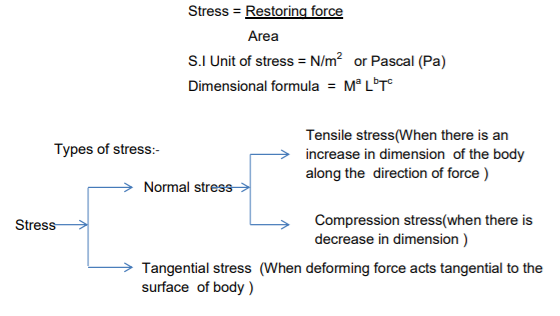
Strain:- The ratio of change in dimension to the original dimension is called strain
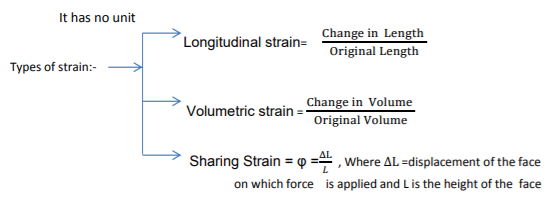
Hooke’s L aw:- Within elastic limit, stress α strain
= Constant (Modulus of Elasticity)
Modulus of elasticity are of 3 types.
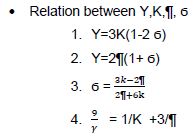
(1) Young’s Modulus (Y) = Normal stress / Longitudinal Strain
(2) Bulk Modulus (K) = Normal stress / Volumetric Strain
(3) Modulus of rigidity modulus (ƞ) = Tangential stress / Shearing Strain
• Compressibility : the reciprocal of bulk modulus of a material is called its
compressibility
Compressibility = 1/K
Stress – Strain- diagram
• Proportionality limit(P) – The stress at the limit of proportionality point P is known as proportionality limit
• Elastic limit - the maximum stress which can be applied to a wire so that on unloading it return to its original length is called the elastic limit
• Yield point(Y)- The stress, beyond which the length of the wire increase virtually for no increase in the stress
• Plastic region- the region of stress- strain graph between the elastic limit and the breaking point is called the plastic region.
• Fracture point or Breaking point(B)- the value of stress corresponding to which the wire breaks is called breaking point
• Work done in stretching a wire per unit volume/energy sored per unit volume of specimen
= ½ x stress x strain
• Elastic after effect:- The delay in regaining the original state by a body after the removal of the deforming force is called elastic after effect.
• Elastic fatigue:- the loss in strength of a material caused due to repeated alternating strains to which the material is subjected.
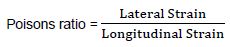
• Poisson’s ratio(ϭ) :- The ratio of lateral strain to longitudinal strain is called
• Applications of elasticity
1. Metallic part of machinery is never subjected to a stress beyond the elastic limit of material.
2. Metallic rope used in cranes to lift heavy weight are decided on the elastic limit of material
3. In designing beam to support load (in construction of roofs and bridges)
4. Preference of hollow shaft than solid shaft
5. Calculating the maximum height of a mountain
MECHANICS OF FLUID
• Pressure :The force/threat acting per unit area is called pressure S.I Unit of pressure is N/M2 or pascal (Pa)
Dimensional formula (ML-1T-2)
• Pascal’s law:- Pressure applied to an enclosed fluid is transmitted to all part of the fluid and to the wall of the container.
• Application of Pascal’s law:-
(1) Hydraulic lift, presses etc.
(2) Hydraulic brakes
• Pressure exerted by liquid column:- P = hρg, where h= depth of liquid,
ρ=density , g=accn. due to gravity.
• Variation of pressure with depth: P = Pa + hρg, where Pa =atmospheric pressure
• Atmospheric pressure:- The pressure exerted by atmosphere is called atmospheric pressure.
At sea level, atmospheric pressure= 0.76m of Hg column
Mathematically 1 atm = 1.013 x 10⁵ Nm-2
• Archimedes’ principle:- It states that when a body is immersed completely or partly in a fluid, it loses in weight equal to the weight of the fluid displaced by it.
Mathematically: Apparent weight = True weight – Vρg
Where V is volume of fluid displaced, ρ is its density.
• Viscosity:- It is the property of liquid (or gases) due to which a backward dragging force acts tangentially between two layers of liquid when there is relative motion between them.
• Newton’s formula for Viscous force:- the viscous force between two liquid layer each of area A and having a velocity gradient dv/dx is
F = ƞ A (dv/dx) , where ƞ is coefficient of viscosity
• Coefficient of viscosity:- It is define as the tangential viscous force which maintains a unit velocity gradient between two parallel layers each of unit area
S.I unit of coefficient of viscosity is poiseuille or pascal-second
• Poiseuille’s equation:- when a liquid of coefficient of viscosity flows through a tube of length ‘l’ and radius r, then the volume of liquid following out per second is given
V = πPr4/8 ƞl ,
Where P is the difference of pressure between the two ends of the tube.
• Stoke’s law: The backward dragging force acing on a small sphere of radius r falling with uniform velocity v through a medium of coefficient of viscosity is given by
F = 6π ƞrv
Please click the link below to download pdf file for CBSE Class XI Physics Mechanics of Solid and Fluid.
Free study material for Physics
Revision Notes and Key Concepts for Class 11 Physics Chapter 09 Mechanical Properties of Fluids
Quick Revision Notes: Chapter 09 Mechanical Properties of Fluids (CBSE)
Access structured revision notes for Chapter 09 Mechanical Properties of Fluids designed in alignment with the latest CBSE curriculum for Class 11 Physics. These summaries help clarify core themes and support effective daily study.
Expert Study Material for Class 11 Physics
Cross-reference your comprehension with comprehensive NCERT solutions for Class 11 to ensure absolute clarity across all sub-topics in this chapter.
Complete Your Chapter Revision
Follow up your revision by attempting the interactive online Physics MCQ test and practice worksheets for this chapter to verify your mastery. All platform resources are free to access.
FAQs
You can download the teacher prepared revision notes for CBSE Class 11 Physics Mechanics Of Solid And Fluid Notes from StudiesToday.com. These notes are designed as per 2026-27 academic session to help Class 11 students get the best study material for Physics.
Yes, our CBSE Class 11 Physics Mechanics Of Solid And Fluid Notes include 50% competency-based questions with focus on core logic, keyword definitions, and the practical application of Physics principles which is important for getting more marks in 2026 CBSE exams.
Yes, our CBSE Class 11 Physics Mechanics Of Solid And Fluid Notes provide a detailed, topic wise breakdown of the chapter. Fundamental definitions, complex numerical formulas and all topics of CBSE syllabus in Class 11 is covered.
These notes for Physics are organized into bullet points and easy-to-read charts. By using CBSE Class 11 Physics Mechanics Of Solid And Fluid Notes, Class 11 students fast revise formulas, key definitions before the exams.
No, all study resources on StudiesToday, including CBSE Class 11 Physics Mechanics Of Solid And Fluid Notes, are available for immediate free download. Class 11 Physics study material is available in PDF and can be downloaded on mobile.