

Download Class 11 Physics Concept Summaries: CBSE Class 11 Physics System Of Particles And Rotational Motion Notes Set 01
Review targeted revision notes for Class 11 Physics with the CBSE Class 11 Physics System Of Particles And Rotational Motion Notes Set 01. Built according to official educational guidelines for the 2026-27 academic year, these downloadable summaries for Chapter 06 System of Particles and Rotational Motion support daily study and last-minute exam readiness.
Access Chapter 06 System of Particles and Rotational Motion Notes and Study Material
Navigate directly to the revision notes for Chapter 06 System of Particles and Rotational Motion using the digital viewer below. Each summary is structured to highlight high-weightage sections, allowing students to instantly access critical definitions and focus on core exam topics.
SYSTEM OF PARTICLES AND ROTATIONAL MOTION
MAIN POINTS
1. A rigid body is one for which the distance between different particles of the body do not change, even though there is a force acting on it.
2. A rigid body fixed at one point or along a line can have only rotational motion. A rigid body not fixed in some way can have either pure rotation or a combination of translation and rotation.
3. In pure translation every particle of the body moves with the same velocity at any instant of time.
4. In rotation about a fixed axis, every particle of the rigid body moves in a circle which lies in a plane perpendicular to the axis and has its centre on the axis. Every point in the rotating rigid body has the same angular velocity at any instant of time.
5. Angular velocity is a vector. Its magnitude is ω = dѲ/dt and it is directed along the axis of rotation. For rotation about a fixed axis, this vector ω has a direction.
6. The vector or a cross product of two vectors A and B is a vector written as A X B. The magnitude of this vector is AB sin Ѳ and its direction is given by right handed screw or the right hand rule.
7. The linear velocity of a particle of rigid body rotating about a fixed axis is given by
v = ω x r wherre r is the position vector of the particle with respect to an origin along the fixed axis. The relation applies even to more general rotation of a rigid body with one point fixed. In that case r is the position vector of the particle with respect to the fixed point taken as the origin.
8. The centre of mass of the system particles is defined as the point whose position vector Is R= (Σmiri )/M
9. Velocity of the centre of mass of a system of particles is given by V = p/M, where P is the linear momentum of the system. The centre of mass moves as if all the mass of the system is concentrated at this point and all the external forces act at it .If the total external force is zero, then the total linear momentum of the system is constant.
10. The angular momentum of a system of n particles about the origin is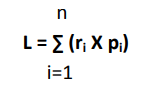
11. The Torque or moment of force on a system of n particles about the origin is given by
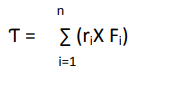
i=1 The force Fi acting on the ithparticle includes the external as well as the internal forces. Assuming Newton’s third law and that forces between any two particles act along the line joining the particles, we can show that Ƭint = 0 and dL/dt = Ƭext.
12. A rigid body is in mechanical equilibrium if
(i)It is I n translational equilibrium, i.e.’ the total external force on it is zero: ΣFi =0and
(ii) It is in rotational equilibrium, i.e., the total external torque on it is zero: Σ τi= Σri x F i = 0
13. The centre of gravity of an extended body is that point where the total gravitational torque on the body is zero.
14. The moment of inertia of a rigid body is defined by the formula I = Σ mi ri2 Where ri Is the perpendicular distance of the ith point of the body from the axis. The kinetic energy of rotation is K = ½ I ω2
15. The theorem of parallel axes :I’= IG + M a2 where IG moment of inertia bout the axis passing through centre of gravity.
Allows us to determine the moment of inertia of a rigid body about an axis as the sum of the moment of inertia of the rigid body about a parallel axis passing through its center of mass and the product of its mass and the square of the perpendicular distance between the two parallel axes.
16. Rotation about a fixed axis is directly analogous to linear motion in respect of kinematics and dynamics.
Please click the link below to download pdf file for CBSE Class 11 Physics notes - System Of Particles And Rotational Motion.
Free study material for Physics
Chapter 06 System of Particles and Rotational Motion Concepts and Summary for Class 11 Physics
Key Concepts and Summary for Class 11 Physics Chapter 06 System of Particles and Rotational Motion
Access structured revision notes for Chapter 06 System of Particles and Rotational Motion designed in alignment with the latest CBSE curriculum for Class 11 Physics. These summaries help clarify core themes and support effective daily study.
NCERT-Aligned Chapter Summary and Notes
Each chapter summary is structured around standard CBSE textbooks, allowing students to check their understanding and clarify complex ideas early in their revision.
Next Steps in Your Exam Preparation
Follow up your revision by attempting the interactive online Physics MCQ test and practice worksheets for this chapter to verify your mastery. All platform resources are free to access.
FAQs
You can download the teacher prepared revision notes for CBSE Class 11 Physics System Of Particles And Rotational Motion Notes Set 01 from StudiesToday.com. These notes are designed as per 2026-27 academic session to help Class 11 students get the best study material for Physics.
Yes, our CBSE Class 11 Physics System Of Particles And Rotational Motion Notes Set 01 include 50% competency-based questions with focus on core logic, keyword definitions, and the practical application of Physics principles which is important for getting more marks in 2026 CBSE exams.
Yes, our CBSE Class 11 Physics System Of Particles And Rotational Motion Notes Set 01 provide a detailed, topic wise breakdown of the chapter. Fundamental definitions, complex numerical formulas and all topics of CBSE syllabus in Class 11 is covered.
These notes for Physics are organized into bullet points and easy-to-read charts. By using CBSE Class 11 Physics System Of Particles And Rotational Motion Notes Set 01, Class 11 students fast revise formulas, key definitions before the exams.
No, all study resources on StudiesToday, including CBSE Class 11 Physics System Of Particles And Rotational Motion Notes Set 01, are available for immediate free download. Class 11 Physics study material is available in PDF and can be downloaded on mobile.