

Official Class 11 Physics Revision Material: CBSE Class 11 Physics Thermal Properties Of Matter Notes Set 01
Access comprehensive revision notes for Chapter 10 Thermal Properties of Matter using the CBSE Class 11 Physics Thermal Properties Of Matter Notes Set 01. Designed to align with the 2026-27 academic syllabus for Class 11 Physics, these concept summaries help students streamline their exam preparation and review complex topics efficiently.
Chapter-wise Concept Summaries: Chapter 10 Thermal Properties of Matter
View or download the dedicated Chapter 10 Thermal Properties of Matter revision resource below. Engaging with these structured concept notes daily ensures continuous academic progress and mastery of the 2026-27 curriculum for Physics.
Class-XI
Chapter 11: Thermal Properties of Matter
Key Learning
1. Heat is a form of energy that brings about changes in temperature.
2. Temperature is that quality of an object which determines the sensation of hotness or coldness felt when there is contact with the object.
3. Heat is the transfer of energy between two systems or a system and its surroundings.
4. Heat flows from body at higher temperature to body at lower temperature.
5. Thermometer uses a measurable property that changes with temperature.
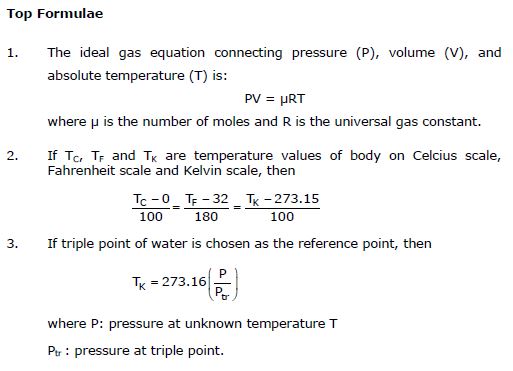
6. In constant volume gas thermometer, PœT
7. When two objects achieve the same temperature and there is no net transfer of heat between then they are in thermal equilibrium.
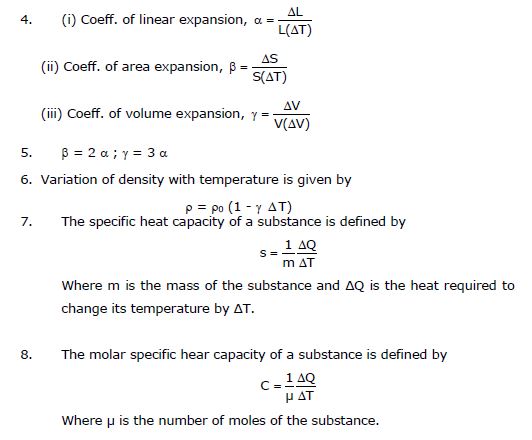
8. Heat capacity is the quantity of heat required to raise the temperature of a body by one degree. Its unit is joules per kelvin or J K-1
9. The specific heat capacity is the amount of heat required to raise the temperature of 1kg of a substance by one degree. SI unit is joules per kilogram per kelvin or J kg -1 K-1and the symbol is c.
10. Calorimeter is a device used for heat measurement.
11. In an isolated system, heat lost = heat gained.
12. Matter exists in three states: solid, liquid and gas.
13. Different phases of a substance at a fixed temperature have different internal energies.
14. Latent heat of fusion is the heat required to change unit mass of a substance from solid to liquid at same temperature and pressure.
15. Latent heat of vaporization is the heat required to change unit mass of a substance from liquid to vapor state at same temperature and pressure.
16. The three mechanisms of heat transfer are – Conduction, Convection and Radiation.
17. Radiation is energy transfer through electromagnetic radiation.
18. Newton’s law of cooling states that the rate of loss of heat is proportional to the excess temperature over the surroundings. -dQ/dt = k (T2 – T1)
19. In conduction, heat is transferred between neighbouring parts of a body through molecular collisions, without any flow of matter.
Please click the link below to download pdf file for CBSE Class 11 Physics - Thermal Properties of Matter Notes.
Free study material for Physics
Revision Notes and Key Concepts for Class 11 Physics Chapter 10 Thermal Properties of Matter
Quick Revision Notes: Chapter 10 Thermal Properties of Matter (CBSE)
Explore reliable chapter overviews for Chapter 10 Thermal Properties of Matter tailored for Class 11 learners. Use these structured points to grasp difficult themes and ensure solid preparation for upcoming assessments.
Expert Study Material for Class 11 Physics
Built using the official NCERT book for Class 11 Physics, these notes provide reliable academic guidance. Pair your summary review with our recommended NCERT solutions to master optimal problem-solving approaches.
Complete Your Chapter Revision
Follow up your revision by attempting the interactive online Physics MCQ test and practice worksheets for this chapter to verify your mastery. All platform resources are free to access.
FAQs
You can download the teacher prepared revision notes for CBSE Class 11 Physics Thermal Properties Of Matter Notes Set 01 from StudiesToday.com. These notes are designed as per 2026-27 academic session to help Class 11 students get the best study material for Physics.
Yes, our CBSE Class 11 Physics Thermal Properties Of Matter Notes Set 01 include 50% competency-based questions with focus on core logic, keyword definitions, and the practical application of Physics principles which is important for getting more marks in 2026 CBSE exams.
Yes, our CBSE Class 11 Physics Thermal Properties Of Matter Notes Set 01 provide a detailed, topic wise breakdown of the chapter. Fundamental definitions, complex numerical formulas and all topics of CBSE syllabus in Class 11 is covered.
These notes for Physics are organized into bullet points and easy-to-read charts. By using CBSE Class 11 Physics Thermal Properties Of Matter Notes Set 01, Class 11 students fast revise formulas, key definitions before the exams.
No, all study resources on StudiesToday, including CBSE Class 11 Physics Thermal Properties Of Matter Notes Set 01, are available for immediate free download. Class 11 Physics study material is available in PDF and can be downloaded on mobile.