

Official Class 11 Physics Revision Material: CBSE Class 11 Physics Circular Motion Notes
Access comprehensive revision notes for Chapter 13 Oscillations using the CBSE Class 11 Physics Circular Motion Notes. Designed to align with the 2026-27 academic syllabus for Class 11 Physics, these concept summaries help students streamline their exam preparation and review complex topics efficiently.
Chapter-wise Concept Summaries: Chapter 13 Oscillations
View or download the dedicated Chapter 13 Oscillations revision resource below. Engaging with these structured concept notes daily ensures continuous academic progress and mastery of the 2026-27 curriculum for Physics.
CIRCULAR MOTION
Circular Motion – When a body moves such that it always remains at a fixed distance from a fixed point then its motion is said to be circular motion. The fixed
distance is called the radius of the circular path and the fixed point is called the center of the circular path.
Uniform Circular Motion – Circular motion performed with a constant speed is known as uniform circular motion.
Angular Displacement – Angle swept by the radius vector of a particle moving on a circular path is known as angular displacement of the particle. Example :– angular displacement of the particle from P1 to P2 is θ.
Relation Between Angular Displacement and Linear Displacement –
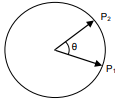
Since, Angle = arc/radius
Anglular Displacement = arc P1P2/radius
θ = s/r
Angular Velocity – Rate of change of angular displacement of a body with respect to time is known as angular displacement. It is represented by ω.
Average Angular Velocity – It is defined as the ratio of total angular displacement to total time taken.
ωavg = Total Angular Displacement/Total Time Taken
ωavg = Δθ/Δ t
Instantaneous Angular Velocity – Angular velocity of a body at some particular instant of time is known as instantaneous angular velocity.
Or
Average angular velocity evaluated for very short duration of time is known as instantaneous angular velocity.
ω = Lim ωavg = Δθ/Δt
ω = dθ/dt
Relation Between Angular Velocity and Linear Velocity We know that angular velocity
We know that angular velocity
ω = dθ/dt
Putting, θ = s/r
ω = d (s/r)/dt
or, ω = 1 ds/r dt
or, ω = v/r
or, v = rω
Time Period of Uniform Circular Motion – Total time taken by the particle performing uniform circular motion to complete one full circular path is known as time period.
]In one time period total angle rotated by the particle is 2p and time period is T. Hence angular velocity
ω = 2p/T or, T = 2p/ω
Frequency - Number of revolutions made by the particle moving on circular path in one second is known as frequency.
f = 1/T = ω/2p
Centripetal Acceleration – When a body performs uniform circular motion its speed remains constant but velocity continuously changes due to change of direction. Hence a body is continuously accelerated and the acceleration experienced by the body is known as centripetal acceleration (that is the acceleration directed towards the center).
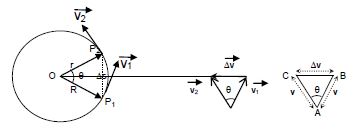
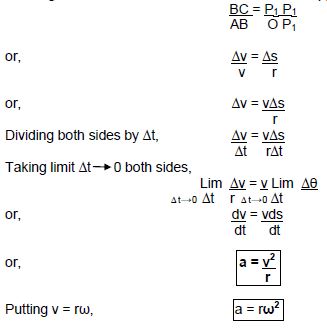
Since the change of velocity is directed towards the center of the circular path, the acceleration responsible for the change in velocity is also directed towards center of circular path and hence it is known as centripetal acceleration.
Centripetal Force – Force responsible for producing centripetal acceleration is known as centripetal force. Since centripetal acceleration is directed towards the center of the circular path the centripetal force is also directed towards the center of the circular path.
If a body is performing uniform circular motion with speed v and angular velocity ω on a circular path of radius r, then centripetal acceleration is given by
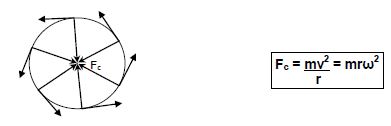
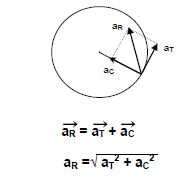
Net Acceleration of a Body Performing Non-Uniform Circular Motion When a body performs non-uniform circular motion its speed i.e. magnitude of instantaneous velocity varies with time due to which it experiences tangential acceleration aT along with the centripetal acceleration aC. Since both the accelerations act simultaneously on a body and are mutually perpendicular to each other, the resultant acceleration aR is given by their vector sum.
Please click the link below to download pdf file for CBSE Class XI Physics Circular Motion.
Free study material for Physics
Download CBSE Revision Notes: Class 11 Physics Chapter 13 Oscillations
Download Chapter Summary: Class 11 Physics Chapter 13 Oscillations
Access structured revision notes for Chapter 13 Oscillations designed in alignment with the latest CBSE curriculum for Class 11 Physics. These summaries help clarify core themes and support effective daily study.
Concept Clarification for Chapter 13 Oscillations
Cross-reference your comprehension with comprehensive NCERT solutions for Class 11 to ensure absolute clarity across all sub-topics in this chapter.
Additional Study Resources for Class 11 Physics
Explore our broader library of printable assignments, chapter notes, and mock tests designed to support continuous revision and secure higher marks in CBSE assessments.
FAQs
You can download the teacher prepared revision notes for CBSE Class 11 Physics Circular Motion Notes from StudiesToday.com. These notes are designed as per 2026-27 academic session to help Class 11 students get the best study material for Physics.
Yes, our CBSE Class 11 Physics Circular Motion Notes include 50% competency-based questions with focus on core logic, keyword definitions, and the practical application of Physics principles which is important for getting more marks in 2026 CBSE exams.
Yes, our CBSE Class 11 Physics Circular Motion Notes provide a detailed, topic wise breakdown of the chapter. Fundamental definitions, complex numerical formulas and all topics of CBSE syllabus in Class 11 is covered.
These notes for Physics are organized into bullet points and easy-to-read charts. By using CBSE Class 11 Physics Circular Motion Notes, Class 11 students fast revise formulas, key definitions before the exams.
No, all study resources on StudiesToday, including CBSE Class 11 Physics Circular Motion Notes, are available for immediate free download. Class 11 Physics study material is available in PDF and can be downloaded on mobile.