CBSE Class 12 Marketing Product Life Cycle Notes

Download the latest CBSE Class 12 Marketing Product Life Cycle Notes in PDF format. These Class 12 Marketing revision notes are carefully designed by expert teachers to align with the 2025-26 syllabus. These notes are great daily learning and last minute exam preparation and they simplify complex topics and highlight important definitions for Class 12 students.

Chapter-wise Revision Notes for Class 12 Marketing Product Life Cycle

To secure a higher rank, students should use these Class 12 Marketing Product Life Cycle notes for quick learning of important concepts. These exam-oriented summaries focus on difficult topics and high-weightage sections helpful in school tests and final examinations.

Product Life Cycle Revision Notes for Class 12 Marketing

PRODUCT
 
Defining Product
 
A product is a bundle of attributes (features, functions, benefits, and uses) that a person receives in an exchange.
 
• The term “product” refers to anything offered by a firm to provide customer satisfaction, tangible or intangible.
 
• A product may be an idea (recycling), a physical good (a pair of sneakers), a service (banking), or any combination of the three.[1]
 
Products fall into one of two categories:
1. consumer products and
2. business products (also called industrial products and B2B products).
 
Consumer products are purchased by the final consumer.
 
Business products are purchased by other industries or firms and can be classified as production goods—i.e., raw materials or component parts used in the production of the final product—or support goods—such as machinery, fixed equipment, software systems, and tools that assist in the production process. Some products, like computers, for instance, may be both consumer products and business products, depending on who purchases and uses them.
 
• The product is the core of the exchange.
 
Consumer Product Categories
Consumer products are often classified into four groups related to different kinds of buying decisions: convenience, shopping, specialty, and unsought products.

Convenience Products
A convenience product is an inexpensive product that requires a minimum amount of effort on the part of the consumer in order to select and purchase it. Examples of convenience products are bread, soft drinks, pain reliever, and coffee.
Marketing strategy - extensive distribution, extensive mass advertising and sales promotion

Shopping Products
Shopping products are usually more expensive and are purchased occasionally. The consumer is more likely to compare a number of options to assess quality, cost, and features.
 
Heterogeneous and homogeneous shopping products. Heterogeneous shopping products are unique. The purchase decision with heterogeneous shopping products is more likely to be based on finding the right fit than on price alone.
Homogeneous shopping products are very similar. Example, refrigerators. Each model has certain features that are available at different price points, but the basic functions of all of the models are very similar. A typical shopper will look for the lowest price available for the features that they desire.

Specialty Products
Specialty goods represent the third product classification. From the consumer’s perspective, these products are so unique that it’s worth it to go to great lengths to find and purchase them. Almost without exception, price is not the principle factor affecting the sales of specialty goods.

Unsought Products
Unsought products are those the consumer never plans or hopes to buy.These are either  products that the customer is unaware of or products the consumer hopes not to need.
Unsought products have a tendency to draw aggressive sales techniques, as it is difficult to get the attention of a buyer who is not seeking the product.
 
STAGES OF THE PRODUCT LIFE CYCLE
 
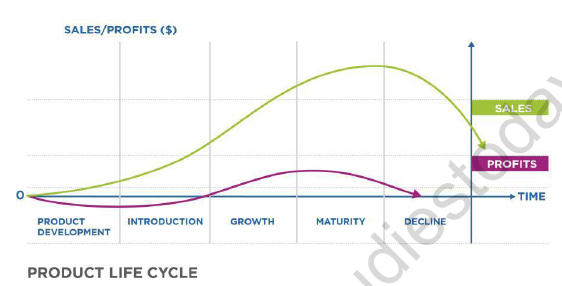
The product life cycle is the process a product goes through from when it is first introduced into the market until it declines or is removed from the market. The life cycle has four stages - introduction, growth, maturity and decline.
CBSE Class 12 Marketing Product Life Cycle Notes 1
 
The four stages of the PLC are:
1. Market introduction
2. Growth
3. Maturity
4. Decline
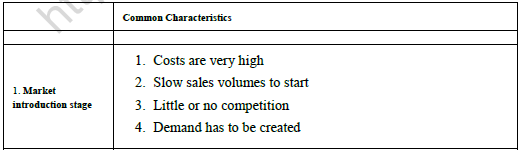
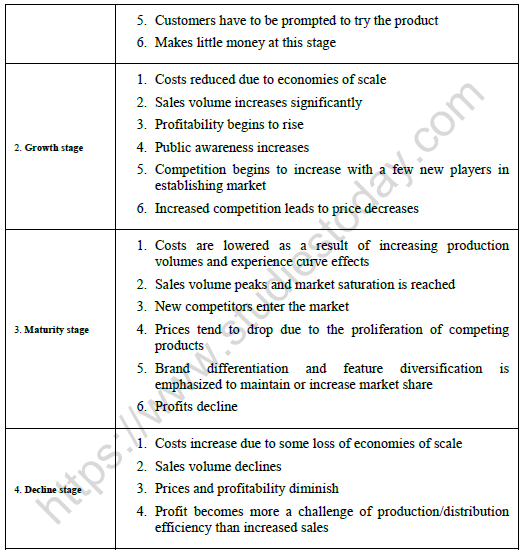
The table below shows common characteristics of each stage.

CBSE Class 12 Marketing Product Life Cycle Notes 2

CBSE Class 12 Marketing Product Life Cycle Notes 3

Please click on below link to download CBSE Class 12 Marketing Product Life Cycle Notes

CBSE Class 12 Marketing Product Life Cycle Notes

Students can use these Revision Notes for Product Life Cycle to quickly understand all the main concepts. This study material has been prepared as per the latest CBSE syllabus for Class 12. Our teachers always suggest that Class 12 students read these notes regularly as they are focused on the most important topics that usually appear in school tests and final exams.

NCERT Based Product Life Cycle Summary

Our expert team has used the official NCERT book for Class 12 Marketing to design these notes. These are the notes that definitely you for your current academic year. After reading the chapter summary, you should also refer to our NCERT solutions for Class 12. Always compare your understanding with our teacher prepared answers as they will help you build a very strong base in Marketing.

Product Life Cycle Complete Revision and Practice

To prepare very well for y our exams, students should also solve the MCQ questions and practice worksheets provided on this page. These extra solved questions will help you to check if you have understood all the concepts of Product Life Cycle. All study material on studiestoday.com is free and updated according to the latest Marketing exam patterns. Using these revision notes daily will help you feel more confident and get better marks in your exams.

Where can I download the latest PDF for CBSE Class 12 Marketing Product Life Cycle Notes?

You can download the teacher prepared revision notes for CBSE Class 12 Marketing Product Life Cycle Notes from StudiesToday.com. These notes are designed as per 2025-26 academic session to help Class 12 students get the best study material for Marketing.

Are these Marketing notes for Class 12 based on the 2026 board exam pattern?

Yes, our CBSE Class 12 Marketing Product Life Cycle Notes include 50% competency-based questions with focus on core logic, keyword definitions, and the practical application of Marketing principles which is important for getting more marks in 2026 CBSE exams.

Do these Class 12 notes cover all topic-wise concepts for Marketing?

Yes, our CBSE Class 12 Marketing Product Life Cycle Notes provide a detailed, topic wise breakdown of the chapter. Fundamental definitions, complex numerical formulas and all topics of CBSE syllabus in Class 12 is covered.

How can I use CBSE Class 12 Marketing Product Life Cycle Notes for quick last-minute revision?

These notes for Marketing are organized into bullet points and easy-to-read charts. By using CBSE Class 12 Marketing Product Life Cycle Notes, Class 12 students fast revise formulas, key definitions before the exams.

Is there any registration required to download Class 12 Marketing notes?

No, all study resources on StudiesToday, including CBSE Class 12 Marketing Product Life Cycle Notes, are available for immediate free download. Class 12 Marketing study material is available in PDF and can be downloaded on mobile.