

Download Class 11 Geography Concept Summaries: CBSE Class 11 Geography Water In The Atmosphere Notes
Explore reliable concept summaries and revision materials through the CBSE Class 11 Geography Water In The Atmosphere Notes. Tailored for Class 11 learners, utilizing these notes for Geography Fundamental of Physical Geography Chapter 10 Water in the Atmosphere ensures thorough preparation and strengthens core academic definitions before final evaluations.
Access Fundamental of Physical Geography Chapter 10 Water in the Atmosphere Notes and Study Material
Navigate directly to the revision notes for Fundamental of Physical Geography Chapter 10 Water in the Atmosphere using the digital viewer below. Each summary is structured to highlight high-weightage sections, allowing students to instantly access critical definitions and focus on core exam topics.
WATER IN THE ATMOSPHERE EVAPORATION AND CONDENSATION
This chapter deals with Humidity, types of humidity, relative humidity, absolute humidity, specific humidity, dew point, condensation, saturated air, types of precipitation –dew, frost, fog, mist, clouds cirrus, cumulus, stratus, nimbus, precipitation, types-(rainfall, sleet, snowfall, hailstones,)rainfall types convectional type, orographic rainfall, cyclonic rainfall, world distribution of rainfall.
Air contains water vapour. It varies from zero to four per cent by volume of the atmosphere and plays an important role in the weather phenomena. Water is present in the atmosphere in three forms namely – gaseous, liquid and solid. The moisture in the atmosphere is derived from water bodies through evaporation and from plants through transpiration. Thus, there is a continuous exchange of water between the atmosphere, the oceans and the continents through the processes of evaporation, transpiration, condensation and precipitation. Water vapour present in the air is known as humidity. It is expressed quantitatively in different ways.
The actual amount of the water vapour present in the atmosphere is known as the absolute humidity.
It is the weight of water vapour per unit volume of air and is expressed in terms of grams per cubic metre. The ability of the air to hold water vapour depends entirely on its temperature. The absolute humidity differs from place to place on the surface of the earth.
The percentage of moisture present in the atmosphere as compared to its full capacityat a given temperature is known as the relative humidity.
The air containing moisture to its full capacity at a given temperature is said to be saturated.
The temperature at which saturation occurs in a given sample of air is known as dew point.
WATER IN THE ATMOSPHERE EVAPORATION AND CONDENSATION
The amount of water vapour in the atmosphere is added or withdrawn due to evaporation and condensation respectively.
Evaporation is a process by which water is transformed from liquid to gaseous state. Heat is the main cause for evaporation.
The temperature at which the water starts evaporating is referred to as the latent heat of vaporization.
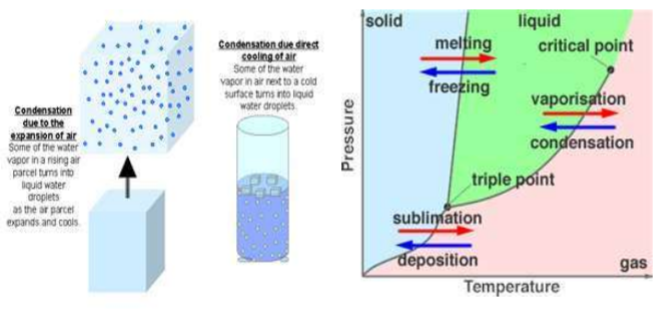
Hence, the greater the movement of air, the greater is the evaporation. The transformation of water vapour into water is called condensation. Condensation is caused by the loss of heat. When moist air is cooled, it may reach a level when its capacity to hold water vapour ceases. Then, the excess water vapour condenses into liquid form. If it directly condenses into solid form, it is known as sublimation. In free air, condensation results from cooling around very small particles termed as hygroscopic condensation nuclei. Particles of dust, smoke and salt from the ocean are particularly good nuclei because they absorb water. Condensation also takes place when the moist air comes in contact with some colder object and it may also take place when the temperature is close to the dew point.
Condensation, therefore, depends upon the amount of cooling and the relative humidity of the air. Condensation is influenced by the volume of air, temperature, pressure and humidity. Condensation takes place:
(i) When the temperature of the air is reduced to dew point with its volume remaining constant;
(ii)when both the volume and the temperature are reduced;
(iii) when moisture is added to the air through evaporation. However, the most favourable condition for condensation is the decrease in air temperature. After condensation the water vapour or the moisture in the atmosphere takes one of the following forms — dew, frost, fog and clouds.
Forms of condensation can be classified on the basis of temperature and location. Condensation takes place when the dew point is lower than the freezing point as well as higher than the freezing point.
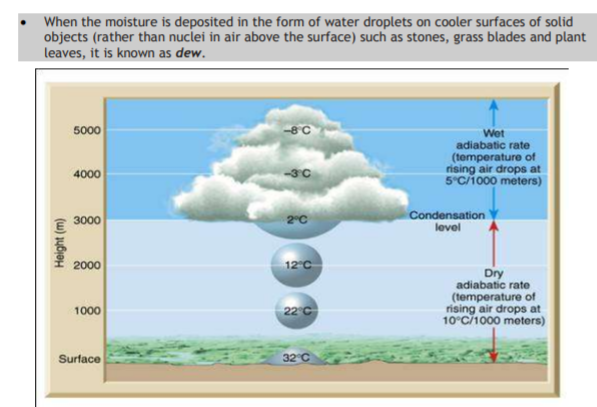
The ideal conditions for its formation are 1. clear sky, 2. calm air, 3. high relative humidity, 4. cold and long nights.
For the formation of dew, it is necessary that the dew point is above the freezing point.
Frost; Frost forms on cold surfaces when condensation takes place below freezing point (0C), i.e. the dew point is at or below the freezing point. The excess moisture is deposited in the form of minute ice crystals instead of water droplets. The ideal conditions for the formation of white frost are the same as those for the formation of dew, except that the air temperature must be at or below the freezing point. 0
Fog and Mist
When the temperature of an air mass containing a large quantity of water vapour falls all of a sudden, condensation takes place within itself on fine dust particles. So, the fog is a cloud with its base at or very near to the ground. Because of the fog and mist, the visibility becomes poor to zero.
In urban and industrial centres smoke provides plenty of nuclei which help the formation of fog and mist. Such a condition when fog is mixed with smoke, is described as smog.
The only difference between the mist and fog is that mist contains more moisture than the fog. In mist each nuclei contains a thicker layer of moisture. Mists are frequent over mountains as the rising warm air up the slopes meets a cold surface. Fogs are drier than mist and they are prevalent where warm currents of air come in contact with cold currents. Fogs are mini clouds in which condensation takes place around nuclei provided by the dust, smoke, and the salt particles.
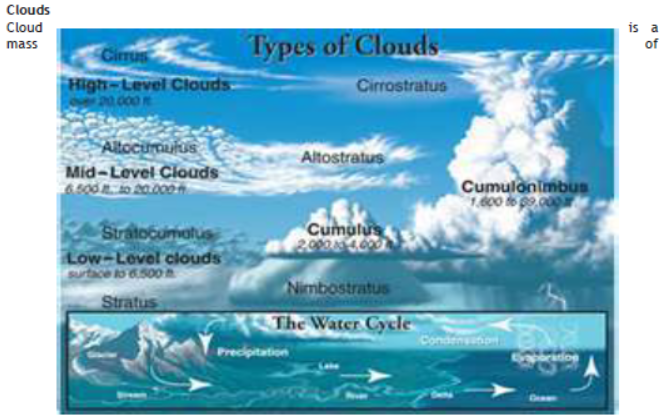
minute water droplets or tiny crystals of ice formed by the condensation of the water vapour in free air at considerable elevations. As the clouds are formed at some height over the surface of the earth, they take
various shapes. According to their height, expanse, density and transparency or opaqueness clouds are grouped under four types :
(i) cirrus; (ii) cumulus; (iii) stratus; (iv) nimbus.
Cirrus
Cirrus clouds are formed at high altitudes(8,000 - 12, 000 m). They are thin and detached clouds having a feathery appearance. They are always white in colour.
Cumulus
Cumulus clouds look like cotton wool. They are generally formed at a height of 4,000 -7,000 m. They exist in patches and can be seen scattered here and there. They have a flat base.
Stratus
As their name implies, these are layered clouds covering large portions of the sky. These clouds are generally formed either due to loss of heat or the mixing of air masses with different temperatures.
Nimbus
Nimbus clouds are black or dark gray. They form at middle levels or very near to the surface of the earth. These are extremely dense and opaque to the rays of the sun. Sometimes, the clouds are so low that they seem to touch the ground. Nimbus clouds are shapeless masses of thick vapour.
A combination of these four basic types can give rise to the following types of clouds: high clouds – cirrus, cirrostratus, cirrocumulus;
Middle clouds – altostratus and altocumulus;
low clouds– stratocumulus and nimbostratus
and clouds with extensive vertical development – cumulus and cumulonimbus.
Precipitation
The process of continuous condensation in free air helps the condensed particles to grow in size.
When the resistance of the air fails to hold them against the force of gravity, they fall on to the earth‘s surface. So after the condensation of water vapour, the release of moisture is known as precipitation. This may take place in liquid or solid form.
The precipitation in the form of water is called rainfall, when the temperature is lower than the 0C, precipitation takes place in the form of fine flakes of snow and is called snowfall.
Moisture is released in the form of hexagonal crystals. These crystals form flakes of snow. Besides ain and snow, other forms of precipitation are sleet and hail, though the latter are limited in occurrence and are sporadic in both time and space.
Sleet is frozen raindrops and refrozen melted snow-water. When a layer of air with the temperature above freezing point overlies a subfreezing layer near the ground, precipitation takes place in the form of sleet. Raindrops, which leave the warmer air, encounter the colder air below. As a result, they solidify and reach the ground as small pellets of ice not bigger than the raindrops from which they are formed.
Sometimes, drops of rain after being released by the clouds become solidified in to small rounded solid pieces of ice and which reach the surface of the earth are called hailstones.
These are formed by the rainwater passing through the colder layers. Hailstones have several concentric layers of ice one over the other.
Types of Rainfall
On the basis of origin, rainfall may be classified into three main types –
1. the convectional, 2. orographic or relief and 3. the cyclonic or frontal.
Convectional Rain
The, air on being heated, becomes light and rises up in convection currents. As it rises, it expands and loses heat and consequently, condensation takes place and cumulous clouds are formed. With thunder and lightening, heavy rainfall takes place but this does not last long. Such rain is common in the summer or
in the hotter part of the day. It is very common in the equatorial regions and interior parts of the continents, particularly in the northern hemisphere
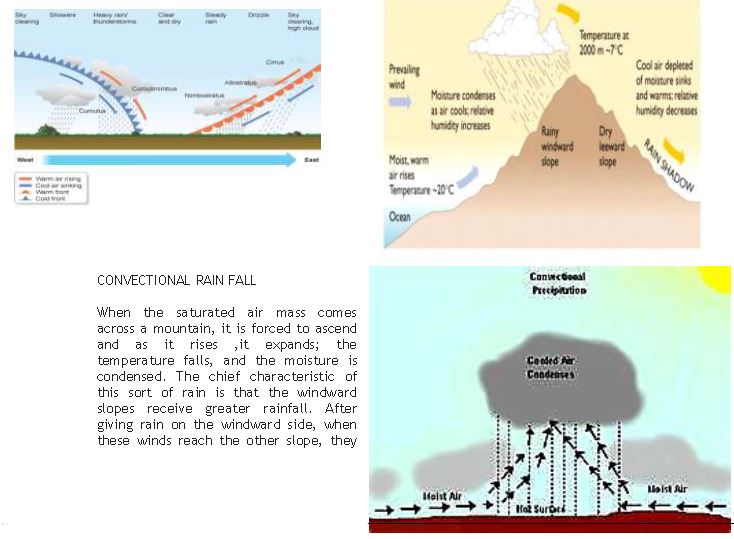
descend, and their temperature rises. Then their capacity to take in moisture increases and hence, these leeward slopes remain rainless and dry. The area situated on the leeward side, which gets less rainfall is known as the rain-shadow area. It is also known as the relief rain. Cyclonic Rain World Distribution of Rainfall
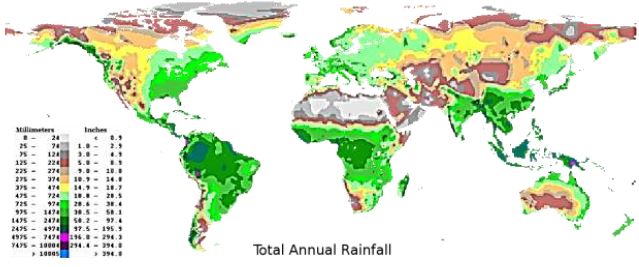
Different places on the earth‘s surface receive different amounts of rainfall in a year and that too in different seasons.
1. In general, as we proceed from the equator towards the poles, rainfall goes on decreasing steadily.
2. The coastal areas of the world receive greater amounts of rainfall than the interior of the continents.
3. The rainfall is more over the oceans than on the landmasses of the world because of being great sources of water.
4. Between the latitudes 35 and 40 N and S of the equator,
5. the rain is heavier on the eastern coasts and goes on decreasing towards the west.
6. But, between 45 and 65 N and S of equator, due to the westerlies, the rainfall is first received on the western margins of the continents and it goes on decreasing towards the east.
7. Wherever mountains run parallel to the coast, the rain is greater on the coastal plain, on the windward side and it decreases towards the leeward side.
ON THE BASIS OF THE TOTAL AMOUNT OF ANNUALPRECIPITATION, MAJOR PRECIPITATION REGIMES OF THEWORLD ARE IDENTIFIED AS FOLLOWS.
1. The equatorial belt, the windward slopes of the mountains along the western coasts in the cool temperate zone and the coastal areas of the monsoon land receive heavy rainfall of over 200 cm per annum.
2. Interior continental areas receive moderate rainfall varying from 100 - 200 cm per annum.
3. The coastal areas of the continents receive moderate amount of rainfall.
4. The central parts of the tropical land and the eastern and interior parts of the temperate lands receive rainfall varying between 50 - 100 cm per annum.
5. Areas lying in the rain shadow zone of the interior of the continents and high latitudes receive very low rainfall-less than 50 cm per annum.
6. Seasonal distribution of rainfall provides an important aspect to judge its effectiveness.
7. In some regions rainfall is distributed evenly throughout the year such as in the equatorial belt and in the western parts of cool temperate regions.
Fundamental of Physical Geography Chapter 10 Water in the Atmosphere Concepts and Summary for Class 11 Geography
Quick Revision Notes: Fundamental of Physical Geography Chapter 10 Water in the Atmosphere (CBSE)
Access structured revision notes for Fundamental of Physical Geography Chapter 10 Water in the Atmosphere designed in alignment with the latest CBSE curriculum for Class 11 Geography. These summaries help clarify core themes and support effective daily study.
Expert Study Material for Class 11 Geography
Built using the official NCERT book for Class 11 Geography, these notes provide reliable academic guidance. Pair your summary review with our recommended NCERT solutions to master optimal problem-solving approaches.
Complete Your Chapter Revision
Wrap up your chapter revision by testing your knowledge against standard question formats. Everything on our platform is provided free of charge.
FAQs
You can download the teacher prepared revision notes for CBSE Class 10 Geography Water In The Atmosphere Notes from StudiesToday.com. These notes are designed as per 2026-27 academic session to help Class 11 students get the best study material for Geography.
Yes, our CBSE Class 10 Geography Water In The Atmosphere Notes include 50% competency-based questions with focus on core logic, keyword definitions, and the practical application of Geography principles which is important for getting more marks in 2026 CBSE exams.
Yes, our CBSE Class 10 Geography Water In The Atmosphere Notes provide a detailed, topic wise breakdown of the chapter. Fundamental definitions, complex numerical formulas and all topics of CBSE syllabus in Class 11 is covered.
These notes for Geography are organized into bullet points and easy-to-read charts. By using CBSE Class 10 Geography Water In The Atmosphere Notes, Class 11 students fast revise formulas, key definitions before the exams.
No, all study resources on StudiesToday, including CBSE Class 10 Geography Water In The Atmosphere Notes, are available for immediate free download. Class 11 Geography study material is available in PDF and can be downloaded on mobile.