

Official Class 11 Geography Revision Material: CBSE Class 11 Geography Minerals And Rocks Notes
Explore reliable concept summaries and revision materials through the CBSE Class 11 Geography Minerals And Rocks Notes. Tailored for Class 11 learners, utilizing these notes for Geography Fundamental of Physical Geography Chapter 05 Minerals and Rocks ensures thorough preparation and strengthens core academic definitions before final evaluations.
Chapter-wise Concept Summaries: Fundamental of Physical Geography Chapter 05 Minerals and Rocks
Navigate directly to the revision notes for Fundamental of Physical Geography Chapter 05 Minerals and Rocks using the digital viewer below. Each summary is structured to highlight high-weightage sections, allowing students to instantly access critical definitions and focus on core exam topics.
MINERALS AND ROCKS
This unit deals with
Minerals, elem ents, characteristics of minerals such as crystal form cleavage, fracture,lustre, colour,streak, transparency ,structure, hardness specific grvity, important minerals such as feldspar,quartz,pyroxene,amphibole,mica,olivine and their characteristics classificationof minerals, rocks,igneous,sedimentary ,metamorphic rocks rock cycle
Minerals found in the crust are in solid form where as in intrior they are in liquid form98% of the crust consist of eight elements
1.oxygen 2. Silicon 3. Aluminium 4. Iron. 5. Calcium 6. Sodium 7. Potassium 8. Magnes
the rest is constituted by titanium, hydrogen, phosphorous, manganese, sulphur carbon, nickel & other elements
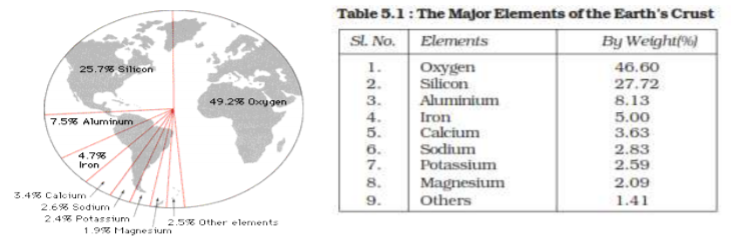
Many elements found in combination with other elements. These substances are called minerals Mineral: naturally occuring inorganic substance having an orderly atomic structure and a definite chemical composition and physical properties.
It is composed of two or three minerals /single element ex. S,Cu, Ag,Au, Graphite.
There are at least 2000 minerals in the crust. There are at least six mineral groups which form rocks in the crust.
The basic source of all minerals is the hot magma in the interior of the earth. Coal, petroleum and natural gas are organic minerals
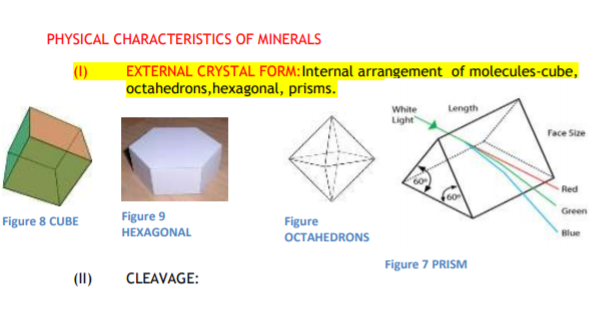
Tendency to break in given direcations producing relatively plane surfaces, it may any direction
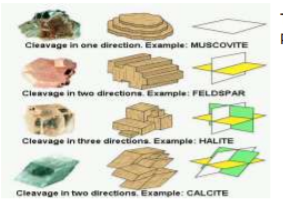
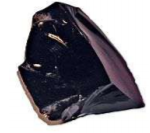
FRACTURE: Conchoidal fracture
Obsidian
Conchoidal fracture is a curved breakage that resembles the concentric ripples of a mussel shell. It often occurs in amorphous or fine-grained minerals such as flint, opal or obsidian, but may also occur in crystalline minerals such as quartz. Sub conchoidal fracture is similar to conchoidal fracture, but not as curved. (Note that obsidian is an igneous rock, not a mineral, but it does illustrate conchoidal fracture well.)
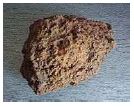
Earthy fracture
Limonite
Earthy fracture is reminiscent of freshly broken soil. It is frequently seen in relatively soft, loosely bound minerals, such as limonite, kaolinite and aluminite.
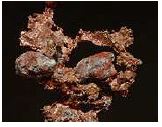
Hackly fracture
Native copper
Hackly fracture (also known as jagged fracture) is jagged, sharp and uneven. It occurs when metals are torn, and so is often encountered in native metals such as copper and silver.
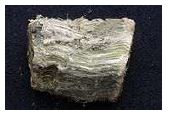
Splintery fracture
Chrysotile
Splintery fracture comprises sharp elongated points. It is particularly seen in fibrous minerals such as chrysotile, but may also occur in nonfibrous minerals such as kyanite.
Please click the link below to download pdf file for CBSE Class XI Geography Minerals and Rocks Concepts.
Download CBSE Revision Notes: Class 11 Geography Fundamental of Physical Geography Chapter 05 Minerals and Rocks
About Fundamental of Physical Geography Chapter 05 Minerals and Rocks Revision Notes
Access structured revision notes for Fundamental of Physical Geography Chapter 05 Minerals and Rocks designed in alignment with the latest CBSE curriculum for Class 11 Geography. These summaries help clarify core themes and support effective daily study.
How to Use These Revision Notes
Each chapter summary is structured around standard CBSE textbooks, allowing students to check their understanding and clarify complex ideas early in their revision.
Enhance Practice with MCQs and Worksheets
Wrap up your chapter revision by testing your knowledge against standard question formats. Everything on our platform is provided free of charge.
FAQs
You can download the teacher prepared revision notes for CBSE Class 11 Geography Minerals And Rocks Notes from StudiesToday.com. These notes are designed as per 2026-27 academic session to help Class 11 students get the best study material for Geography.
Yes, our CBSE Class 11 Geography Minerals And Rocks Notes include 50% competency-based questions with focus on core logic, keyword definitions, and the practical application of Geography principles which is important for getting more marks in 2026 CBSE exams.
Yes, our CBSE Class 11 Geography Minerals And Rocks Notes provide a detailed, topic wise breakdown of the chapter. Fundamental definitions, complex numerical formulas and all topics of CBSE syllabus in Class 11 is covered.
These notes for Geography are organized into bullet points and easy-to-read charts. By using CBSE Class 11 Geography Minerals And Rocks Notes, Class 11 students fast revise formulas, key definitions before the exams.
No, all study resources on StudiesToday, including CBSE Class 11 Geography Minerals And Rocks Notes, are available for immediate free download. Class 11 Geography study material is available in PDF and can be downloaded on mobile.