

Official Class 11 Geography Revision Material: CBSE Class 11 Geography Composition And Structure Of The Atmosphere Notes
Explore reliable concept summaries and revision materials through the CBSE Class 11 Geography Composition And Structure Of The Atmosphere Notes. Tailored for Class 11 learners, utilizing these notes for Geography Fundamental of Physical Geography Chapter 07 Composition and Structure of Atmosphere ensures thorough preparation and strengthens core academic definitions before final evaluations.
Chapter-wise Concept Summaries: Fundamental of Physical Geography Chapter 07 Composition and Structure of Atmosphere
View or download the dedicated Fundamental of Physical Geography Chapter 07 Composition and Structure of Atmosphere revision resource below. Engaging with these structured concept notes daily ensures continuous academic progress and mastery of the 2026-27 curriculum for Geography.
COMPOSITION AND STRUCTURE OF ATMOSPHERE
This unit deals with
• Atmosphere — compositions and structure; elements of weather and climate
• Insolation — angle of incidence and distribution; heat budget of the earth — heating and cooling of atmosphere (conduction, convection, terrestrial radiation, advection); temperature — factors controlling temperature; distribution of temperature — horizontal and vertical; inversion of temperature• Pressure — pressure belts; winds-planetary seasonal and local, air masses and fronts; tropical and extra tropical cyclones
• Precipitation — evaporation; condensation — dew, frost, fog, mist and cloud; rainfall — types and world distribution
• World climates — classification (Koeppen), greenhouse effect, global warming and climatic changes
CHAPTER EIGHT
What is the importance of atmosphere?
Air is essential to the survival of all organisms. Some organisms like humans may survive for some time without food and water but can‘t survive even a few minutes without breathing air. That shows the reason why we should understand the atmosphere in greater detail.
Define The Atmosphere
Atmosphere is a mixture of different gases and it envelopes the earth all round. It contains lifegiving gases like oxygen for humans and animals and carbon dioxide for plants.
What is the average height of the Atmosphere?
The air is an integral part of the earth‘s mass and 99 per cent of the total mass of the atmosphere is confined to the height of 32 km from the earth‘s surface. The air is colourless and odourless and can be felt only when it blows as wind.
Can you imagine what will happen to us in the absence of ozone in the atmosphere?
In the absence of Ozone life is not possible on the earth surface.
COMPOSITION OF THE ATMOSPHERE
The atmosphere is composed of gases, water vapour and dust particles. The proportion of gases changes in the higher layers of the atmosphere in such a way that oxygen will be almost in negligible quantity at the height of 120 km. Similarly, carbon dioxide and water vapour are found only up to 90 km from the surface of the earth.
COMPOSITION AND STRUCTURE OF ATMOSPHERE
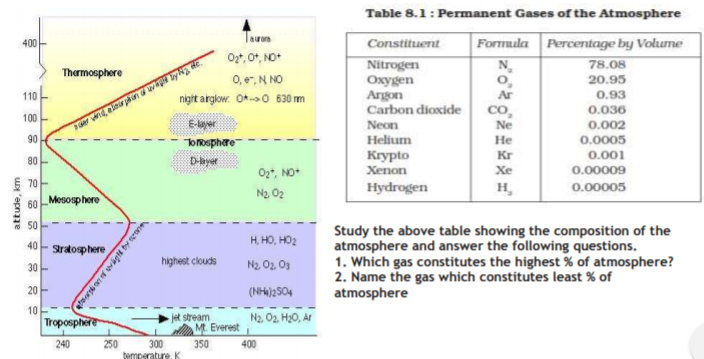
Study the above table showing the composition of the atmosphere and answer the following questions.
1. Which gas constitutes the highest % of atmosphere?
2. Name the gas which constitutes least % of Atmosphere Gases
Carbon dioxide is meteorologically a very important gas as it is transparent to the Incoming solar radiation but opaque to the outgoing terrestrial radiation. It absorbs a part of terrestrial radiation and reflects back some part of it towards the earth‘s surface. It is largely responsible for the green house effect.
The volume of carbon dioxide has been rising in the past few decades mainly because of the burning of fossil fuels. This has also increased the temperature of the air.
Ozone is another important component of the atmosphere found between 10 and 50 km above the earth‘s surface and acts as a filter and absorbs the ultra-violet rays radiating from the sun and prevents them from reaching the surface of the earth.
Water Vapour
Water vapour is also a variable gas in the atmosphere, which decreases with altitude. In the warm and wet tropics, it may account for four per cent of the air by volume, while in the dry and cold areas of desert and polar regions, it may be less than one per cent of the air. Water vapour also decreases from the equator towards the poles. It also absorbs parts of the insolation from the sun and preserves the earth‘s radiated heat. It thus, acts like a blanket allowing the earth neither to become too cold nor too hot. Water vapour also contributes to the stability and instability in the air.
Dust Particles
Atmosphere has a sufficient capacity to keep small solid particles, which may originate from different sources and include sea salts, fine soil, smoke-soot, ash, pollen, dust and disintegrated particles of meteors. Dust particles are generally concentrated in the lower layers of the atmosphere; yet, convectional air currents may transport them to great heights. The higher concentration of dust particles is found in subtropical and temperate regions due to dry winds in comparison to equatorial and polar regions. Dust and salt particles act as hygroscopic nuclei around which water vapour condenses to produce clouds.
STRUCTURE OF THE ATMOSPHERE
1.The atmosphere consists of different layers with varying density and temperature.
2. Density is highest near the surface of the earth and decreases with increasing altitude.
3.The column of atmosphere is divided into five different layers depending upon the temperature condition.
Name the layers of atmosphere
They are: troposphere, stratosphere, mesosphere, thermosphere and exosphere.
The troposphere
1.It is the lowermost layer of the atmosphere.
2. Its average height is 13 km
3. extends roughly to a height of 8 km near the poles and about 18 km at the equator.
4. Thickness of the troposphere is greatest at the equator because heat is transported to great heights by strong convectional currents.
5. This layer contains dust particles and water vapour.
6. All changes in climate and weather take place in this layer.
7. The temperature in this layer decreases at the rate of 1 °C for every 165 m of height.
8. This is the most important layer for all biological activity.
9. The zone separating the troposphere from stratosphere is known as the tropopause.
The air temperature at the tropopause is about minus 800 °C over the equator and about minus 45° C over the poles.
The temperature here is nearly constant, and hence, it is called the tropopause.
The stratosphere
1. It is found above the tropopause and extends up to a height of 50 km.
2. One important feature of the stratosphere is that it contains the ozone layer.
3. This layer absorbs ultra-violet radiation and shields life on the earth from intense, harmful form of energy.
The mesosphere
1. It lies above the stratosphere,
2. which extends up to a height of 80 km.
3. In this layer, once again, temperature starts decreasing with the increase in altitude and Up to minus 100°C at the height of 80 km.
Please click the link below to download pdf file for CBSE Class XI Geography Composition and Structure of the Atmosphere Concepts.
Study Material and Revision Notes for Class 11 Geography Fundamental of Physical Geography Chapter 07 Composition and Structure of Atmosphere
About Fundamental of Physical Geography Chapter 07 Composition and Structure of Atmosphere Revision Notes
Explore reliable chapter overviews for Fundamental of Physical Geography Chapter 07 Composition and Structure of Atmosphere tailored for Class 11 learners. Use these structured points to grasp difficult themes and ensure solid preparation for upcoming assessments.
How to Use These Revision Notes
Each chapter summary is structured around standard CBSE textbooks, allowing students to check their understanding and clarify complex ideas early in their revision.
Enhance Practice with MCQs and Worksheets
Explore our broader library of printable assignments, chapter notes, and mock tests designed to support continuous revision and secure higher marks in CBSE assessments.
FAQs
You can download the teacher prepared revision notes for CBSE Class 11 Geography Composition And Structure Of The Atmosphere Notes from StudiesToday.com. These notes are designed as per 2026-27 academic session to help Class 11 students get the best study material for Geography.
Yes, our CBSE Class 11 Geography Composition And Structure Of The Atmosphere Notes include 50% competency-based questions with focus on core logic, keyword definitions, and the practical application of Geography principles which is important for getting more marks in 2026 CBSE exams.
Yes, our CBSE Class 11 Geography Composition And Structure Of The Atmosphere Notes provide a detailed, topic wise breakdown of the chapter. Fundamental definitions, complex numerical formulas and all topics of CBSE syllabus in Class 11 is covered.
These notes for Geography are organized into bullet points and easy-to-read charts. By using CBSE Class 11 Geography Composition And Structure Of The Atmosphere Notes, Class 11 students fast revise formulas, key definitions before the exams.
No, all study resources on StudiesToday, including CBSE Class 11 Geography Composition And Structure Of The Atmosphere Notes, are available for immediate free download. Class 11 Geography study material is available in PDF and can be downloaded on mobile.