

Geography Concept Notes for Class 11: Fundamental of Physical Geography Chapter 12 Water (Oceans)
Review targeted revision notes for Class 11 Geography with the CBSE Class 11 Geography Water Oceans Notes. Built according to official educational guidelines for the 2026-27 academic year, these downloadable summaries for Fundamental of Physical Geography Chapter 12 Water (Oceans) support daily study and last-minute exam readiness.
Download Fundamental of Physical Geography Chapter 12 Water (Oceans) Revision Notes PDF
View or download the dedicated Fundamental of Physical Geography Chapter 12 Water (Oceans) revision resource below. Engaging with these structured concept notes daily ensures continuous academic progress and mastery of the 2026-27 curriculum for Geography.
WATER (OCEANS)
This unit deals with• Hydrological Cycle
• Oceans — submarine relief; distribution of temperature and salinity; movements of ocean water-waves, tides and currents
The earth, fortunately has an abundant supply of water on its surface. Hence, our planet is called the ‘Blue Planet’.
HYDROLOGICAL CYCLE
The hydrological cycle, is the circulation of water within the earth‘s hydrosphere in different forms i.e. the liquid, solid and the gaseous phases. It also refers to the continuous exchange of water between the oceans,
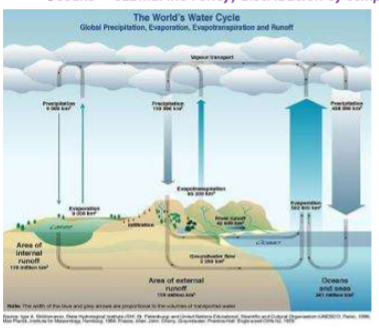
STUDY THE GIVEN TABLE SHOWING THE WATER COMPOSITION ON THE EARTH SURFACE AND ANSWER THE FOLLOWING
QUESTIONS
1. What is the % of water in the oceans?
2. Which component of the earth consists of least percentage of water content?
3. what is the main use of soil moisture? Study above table and answer the questions that fallow
1. What do you mean by evapotranspiration?
2. What are the different forms of water in the atmosphere?
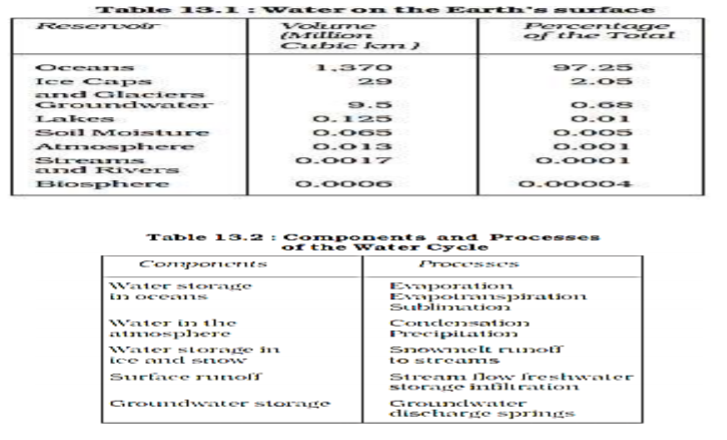
The above table shows the distribution of water on the surface of the earth. About 71 per cent of the planetary water is found in the oceans. The remaining is held as freshwater in glaciers and icecaps, groundwater sources, lakes, soil moisture, atmosphere, streams and within life. Nearly 59 per cent of the water that falls on land returns to the atmosphere through evaporation from over the oceans as well as from other places. The remainder runs-off on the surface, infiltrates into the ground or a part of it becomes glacier. It is to be noted that the renewable water on the earth is constant while the demand is increasing tremendously. This leads to water crisis in different parts of he world — spatially and temporally. The pollution of river waters has further aggravated the crisis. How can you intervene in improving the water quality and augmenting the available quantity of water?
RELIEF OF THE OCEAN FLOOR
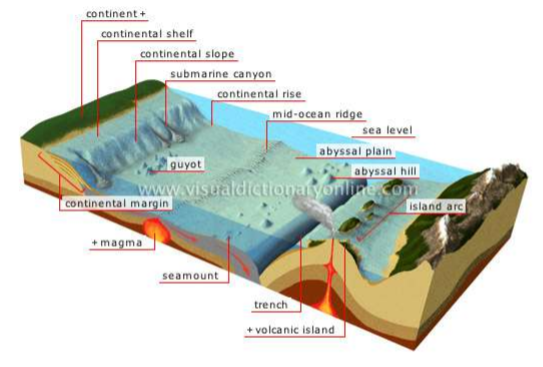
Divisions of the Ocean Floors
The ocean floors can be divided into four major divisions:
1) The Continental Shelf;
2) The Continental Slope;
3) The Deep Sea Plain;
4) The Oceanic Deeps.
Besides, these divisions
There are also major and minor relief features in the ocean floors like ridges, hills, sea mounts, guyots, trenches, canyons, etc.
Continental Shelf
1. The continental shelf is the extended margin of each continent occupied by relatively shallow seas and gulfs.
2. It is the shallowest part of the ocean showing an average gradient of 1° or even less.
3. The shelf typically ends at a very steep slope, called the shelf break.
4. The width of the continental shelves vary from one ocean to another.
5. The average width of continental shelves is about 80 km.
6. The shelves are almost absent or very narrow along some of the margins like the coasts of Chile, the west coast of Sumatra, etc.
7. On the contrary, the Siberian shelf in the Arctic Ocean, the largest in the world, stretches to 1,500 km in width.
8. The depth of the shelves also varies. It may be as shallow as 30 m in some areas while in some areas it is as deep as 600 m.
9. The continental shelves are covered with variable thicknesses of sediments brought down by rivers, glaciers, wind, from the land and distributed by waves and currents.
10.Massive sedimentary deposits received over a long time by the continental shelves, become the source of fossil fuels.
Continental Slope
1. The continental slope connects the continental shelf and the ocean basins.
2. It begins where the bottom of the continental shelf sharply drops off into a steep slope.
3. The gradient of the slope region varies between 2-5°.
Please click the link below to download pdf file for CBSE Class XI Geography Water ( Oceans) Concepts.
Revision Notes and Key Concepts for Class 11 Geography Fundamental of Physical Geography Chapter 12 Water (Oceans)
Quick Revision Notes: Fundamental of Physical Geography Chapter 12 Water (Oceans) (CBSE)
Review targeted chapter notes for Class 11 Geography Fundamental of Physical Geography Chapter 12 Water (Oceans). Built according to official CBSE guidelines, these summaries highlight high-yield topics frequently tested in school evaluations.
Expert Study Material for Class 11 Geography
Built using the official NCERT book for Class 11 Geography, these notes provide reliable academic guidance. Pair your summary review with our recommended NCERT solutions to master optimal problem-solving approaches.
Complete Your Chapter Revision
Explore our broader library of printable assignments, chapter notes, and mock tests designed to support continuous revision and secure higher marks in CBSE assessments.
FAQs
You can download the teacher prepared revision notes for CBSE Class 11 Geography Water Oceans Notes from StudiesToday.com. These notes are designed as per 2026-27 academic session to help Class 11 students get the best study material for Geography.
Yes, our CBSE Class 11 Geography Water Oceans Notes include 50% competency-based questions with focus on core logic, keyword definitions, and the practical application of Geography principles which is important for getting more marks in 2026 CBSE exams.
Yes, our CBSE Class 11 Geography Water Oceans Notes provide a detailed, topic wise breakdown of the chapter. Fundamental definitions, complex numerical formulas and all topics of CBSE syllabus in Class 11 is covered.
These notes for Geography are organized into bullet points and easy-to-read charts. By using CBSE Class 11 Geography Water Oceans Notes, Class 11 students fast revise formulas, key definitions before the exams.
No, all study resources on StudiesToday, including CBSE Class 11 Geography Water Oceans Notes, are available for immediate free download. Class 11 Geography study material is available in PDF and can be downloaded on mobile.