

Official CBSE VBQs for Class 12 Physics
Review targeted competency-based resources with the CBSE Class 12 Physics VBQs Semiconductor Devices. Built according to official CBSE standards for the 2026-27 academic year, these downloadable Class 12 Physics VBQs support holistic learning and critical reasoning for Chapter 14 Semiconductor Electronics Materials Devices and Simple Circuits.
Competency-Based Practice for Physics
Access the complete VBQ PDF for Class 12 Physics below. Regular practice with these targeted competency-based questions builds familiarity with expected application-level question patterns to help secure higher marks.
Semiconductor Devices
ONE MARKS QUESTIONS
Question. What is the net charge in an n-type semi-conductor?
Answer : Zero (Neutral).
Question. What types of minority charge-carriers are there in a p-type semi-conductor?
Answer : Electrons
Question. Give the logical symbol of an OR gate. Mark the inputs and outputs.
Answer : 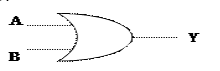
Question. Draw truth table for an AND gate.
Answer : 
Question. Give the logical symbol of an NOR gate. Mark the inputs and outputs.
Answer : 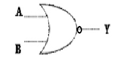
THREE MARKS QUESTIONS
Question. Draw a circuit diagram for use of NPN transistor as an amplifier in common emitter configuration. The input resistance of a transistor is 1000 Ohm. On changing its base current by, 10µA the collector current increases by 2 m A. If a load resistance of 5K Ohm is used in the circuit, calculate (i) the current gain & (ii) voltage gain of the amplifier.
Answer :-β=200,A_V=1000
Question. With the help of a suitable diagram, explain the formation of depletion region in a p-n junction. How does its width change when the junction is (i) forward biased, and (ii) reversebiased?
Answer : Formation of Depletion Layer: At the junction there is diffusion of electrons of n-region to p-region while holes of p-region diffuse into n-region. Some electrons combine with holes to neutralise each other. Thus near the junction there is an excess of positively charged ions in n-region and an excess of negatively charged ions in p-region. This sets up a potentialdifference and hence an internal electric field Ei (junction field) across the junctions. The field Eiis directed from n-region to p-region.
This field stops the further diffusion of charge carriers. Thus the layers (» 10- 4 cm to 10- 6 cm) on either side of the junction becomes free from mobile charge carriers and hence is called the depletion layer. The symbol of p-n junction diode is shown in Fig. (Image 6)
Effect of Forward and Reverse Bias:
(i) Under forward biasing the applied potential difference causes a field which acts opposite to the potential barrier. This results in reducing the potential barrier, and hence the width of depletion layer decreases. (Image 6)
(ii) Under reverse biasing the applied potential difference causes a field which is in the same direction as the field due to internal potential barrier. This results in an increase in barrier voltage and hence the width ofdepletion layer increases.
Question. Give a circuit diagram of a common emitter amplifier using an n-p-n transistor. Draw the input and output waveforms of the signal. Write the expression for its voltage gain.
Answer : Common emitter amplifier using n-p-n transistor
The circuit of common emitter amplifier using n-p-n transistor is shown below:
The phase difference between input signal and output voltage is 180°. (Image 7)
Question. (i) Identify the logic gates marked P and Q in the given logic circuit. (Image 7)
(ii) Write down the output at X for the inputs A=0, B =0 and A =1, B =1.
Answer : (i) P is ‘NAND’ gate and Q is ‘OR’ gate. (Image 7)
Question 1. Ajay observed that there is fluctuation in D c power supply and he made a circuit by using one special semi conductor and regulated the power supply. What values he has shown and name the semiconductor and draw the circuit diagram for regulating power supply.
Answer:
Rising to the occasion, finding solutions to the existing problems.
Zener diode is used to regulate the power supply.
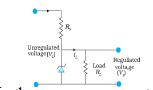
Question 2. when power supply in the home is stopped at night 8 pm Sita immediately switched the light of her mobile phone and could find the sufficient light to see the things. What values that she has shown. What kind of diode is there with the cell phone and what are the advantages of it over incandescent bulb?
Answer:
Sita has shown presence of mind, application of knowledge.
Light Emitting Diodes are used
Advantages 1) low operational voltages and less power consumption.
2) Fast action and no warm up time required
3) Long time and rugged life.
Question 3. A physics teacher explained that electronic components work with D C. Albert ,a student of his class observed that cell phone is charged by connecting charger to A C in his home. Next day he asked the teacher about the same.
What values the student has shown?
How the conflict would have been resolved by the teacher.
Answer:
Albert has applicative mind, curious to learn, reasoning ability. The cell phone charger has the rectifier which converts A C to DC.
Question 4. Father prepared to purchase a LCD TV but his son after studying the semiconductors, could convince his father to purchase an LED TV?
What values the son has shown? Also write any two points where LED is better than LCD TV?
Answer:
Application of learning content in day to day life, convincing skills.
LED TV consumes less power and gives more picture clarity than LCD TV.
Question 5. After reading an article on the generations of computers Abhay asked his teacher how it is possible to reduce the size of the computer so less and much efficient?
What values the student has shown?
What component made the computer size so small and what are its advantages and limitations?
Answer: Connect outer experience with class room learning, eager to find the reasons for things happening around.
Integrated chips could make the size of Computer so small.
Question 6. Teacher said that it is difficult to install the electric polls in the hilly stations as the surface is not flat. Then a student asked the teacher how the people are able to maintain their lives in night. The teacher while explaining took the name of an optoelectronic device.
What values the student has shown?
Name the device that has used to clarify the doubt asked by the student?
Answer: Thinking about other’s needs, interested to know the alternate ways and means.
Solar cells
Question 7. Raghu’s grand father has shown one radio that he purchased with his first salary in 1960, which is bigger than the present portable T V.
Next day Raghu asked his teacher what made the size of the radio so big and how it is possible to make palm size radios now.
What values that Raghu has shown? Write the correct answer for his doubt.
Answer: Raghu was eager to know and curious to learn.
Transistor and IC have made these changes to enable to make palm size radios.
Question 8. After attending the class of semiconductors especially silicon,Rohit asked the teacher is there any relation between this semiconductor silicon and silicon valley?
What values Rohit has shown and what do you think about the relation between Silicon Valley and silicon.
Answer: Enthusiastic and love for learning knowledge and able to connect the outside knowledge to the class room content.
` Silicon Valley is famous for producing Silicon chips and large business activities take place due to this production.
Question 9. A gardener wanted an alarm to make sound when the airtemperature is less than 00 and more than 300 and he told the same to his son, an electrical engineer. His son prepared as per his father’s requirement.
What values the son has shown?
How he could design to meet the required needs and what logic gates he must have used?
Answer: Son is very caring and attends to the needs of old people.
The logic gate was OR gate
Question 10. Grand mother of Harish expressed her worry about the theft of valuable articles in home.Harish mad a burglar’s alarm and shown his grand mother and explain the function of it?Grand mother appreciated the efforts of harish.
What value harish has shown?
What logic gate has he used in the device?
Answer: Harish is very caring towards old people and respect and attends the needs of old people.
The logic gate used is AND gate.
Question 11. Ram was excited to know about the function of traffic signals .His father has prepared a board and explained the working of traffic signals?
What values the father has shown?
What components he must have used to show the working of traffic lights?
Answer: Father is very caring and affectionate towards his son.
He must have used LEDs and other simple electronic components.
VALUE BASED QUESTIONS
Question 1. A pure semiconductor germanium or silicon, free of every impurity is called intrinsic semiconductor. At room temperature, a pure semiconductor has a very small number of current carries (electrons and holes). Hence its conductivity is low. When the impurity atoms of valence five or three are doped in a pure semiconductor, we get respectively n-type or p-type extrinsic semiconductor. In case of a doped semiconductor. ne nh = ni2; where ne and nh are the number density of electrons and holes respectively and ni is the number density of intrinsic charge carriers in a pure semiconductor. The conductivity of extrinsic semiconductor is much higher than that of intrinsic semiconductor.
Read the above passage and answer the following questions:
(i) Name two materials to be doped in pure semiconductor of silicon to get (a) p-type semiconductor (b) n-type semiconductor
(ii) What do you learn from the above study?
Answer: (i) (a) The doping of pure silicon with boron or aluminium will give us p-type semiconductor
(b) The doping of pure silicon with arsenic or phosphorous will give us n-type semiconductor.
(ii) From the above study, we find that to get better output current, pure semiconductor has to be doped with suitable impurity atoms. Similarly, in day to day life, the appearance of right kind of persons (leaders) in society can improve their lot.
Question 2. Rohan was studying in a science college and was staying with his grandfather. One day, the old torch which was being used by Rohan’s grandfather stopped working. He asked Rohan to purchase a new torch for him. Rohan himself made a torch using LED with a small recharge battery and give it to his grandfather as a gift. Rohan explained the advantages of LED over a bulb. Rohan’s grandfather was very happy.
Read the above passage and answer the following questions:
(i) What is LED? Name the two materials used in making LED, whose light falls in the visible region.
(ii) Why LED is a better choice than a bulb in torch?
(iii) What do you think about the attitude of Rohan towards his grandfather?
Answer:. (i) LED stands for light emitting diode. The following materials are used in making LEDs whose light falls in the visible region;
(a) Gallium-phosphide (GaP) – giving red or green light
(b) Gallium-arsenide phosphide (GaAsP) – giving red or yellow light.
(ii) LED is better than conventional bulbs the torch with LED is handy and light. It gives the intense light and consumes less power.
(iii) Rohan had a great love and respect for his grandfather. He proved it by making a torch for him using new technology. By this act, Rohan earned more love and affectionate from his grandfather.
Question 3. Manoj wanted to do social work during his vacations. He visited a remote village where there was no electricity. He made up his mind to help the villagers for getting solar panels. For this he educated the villagers about the technology and uses of solar panels. He requested the villagers to apply for the same to the government as the same was given to the villagers on subsidised rates. Villagers agreed and apply for the solar panels. They got the same from the government at reduced price. When the solar panels started working, the villagers were very happy.
Read the above passage and answer the following questions:
(i) What is a solar panel?
(ii) What is the basic principle of working of a solar panel?
(iii) What are the basic values you assess in Manoj?
Answer: (i) Solar panel is a panel having large number of solar cells fitted by side on it.
(ii) Solar cell is basically a solar energy converter. It is a p-n junction device which converts solar energy into electrical energy. If this energy is stored in a capacitor, it can be used for glowing bulbs.
(iii) Manoj displayed his will to do something for society. Through his shear efforts, he got electricity within the reach of villagers, who were suffering otherwise. The work of Manoj was highly appreciated by the villagers.
Free study material for Physics
CBSE Value-Based Study Material for Class 12 Physics
Chapter VBQs with Solutions (CBSE)
Explore curated Value-Based Questions (VBQs) for Chapter 14 Semiconductor Electronics Materials Devices and Simple Circuits, structured according to the latest CBSE curriculum for Class 12 Physics. These problems focus on ethical and real-world themes to strengthen analytical reasoning.
Verified Answers for Class 12 Physics Chapter 14 Semiconductor Electronics Materials Devices and Simple Circuits
Built using the official NCERT book for Class 12 Physics, these solved problem sets provide reliable guidance. Cross-reference your answers with our expert-verified keys for complete conceptual clarity.
More Study Resources for Chapter 14 Semiconductor Electronics Materials Devices and Simple Circuits
Explore our wider library of free chapter notes, worksheets, and online mock tests to support your ongoing revision and secure top-tier academic results.
FAQs
The latest collection of Value Based Questions for Class 12 Physics Chapter 14 Semiconductor Electronics Materials Devices and Simple Circuits is available for free on StudiesToday.com. These questions are as per 2026 academic session to help students develop analytical and ethical reasoning skills.
Yes, all our Physics VBQs for Chapter 14 Semiconductor Electronics Materials Devices and Simple Circuits come with detailed model answers which help students to integrate factual knowledge with value-based insights to get high marks.
VBQs are important as they test student's ability to relate Physics concepts to real-life situations. For Chapter 14 Semiconductor Electronics Materials Devices and Simple Circuits these questions are as per the latest competency-based education goals.
In the current CBSE pattern for Class 12 Physics, Chapter 14 Semiconductor Electronics Materials Devices and Simple Circuits Value Based or Case-Based questions typically carry 3 to 5 marks.
Yes, you can download Class 12 Physics Chapter 14 Semiconductor Electronics Materials Devices and Simple Circuits VBQs in a mobile-friendly PDF format for free.