

Advanced Study Material for Class 12 Business Studies: Chapter 02 Principles of Management
Explore structured advanced study materials through the CBSE Class 12 Business Studies Principles of Management Short Notes. Tailored for Class 12 learners, utilizing these Business Studies resources ensures thorough preparation and strengthens foundational knowledge before final CBSE evaluations.
Practice Class 12 Business Studies Resources: Chapter 02 Principles of Management
Access the complete useful resource PDF for Class 12 Business Studies below. Regular practice with these targeted academic notes builds familiarity with complex topics and helps secure higher marks in final school evaluations.
Concept of Principles of Management
Principles of Management are the broad and general guidelines for managerial decision making, behaviour and action. The management principles are derived from observation, analysis, experimental studies and personal experiences of the managers.
Nature of Principles of Management
The nature of principles of management can be described in the following points:
Universal applicability i.e. they can be applied in all types of organizations, business as well as non-business, small as well as large enterprises.
General Guidelines: They are general guidelines to action and decision making however they do not provide readymade solutions as the business environment is ever changing or dynamic.
Formed by practice and experimentation: They are developed after thorough research work on the basis of experiences of managers.
Flexible: They can be adapted and modified by the practicing managers as per the demands of the situations as they are manmade principles.
Mainly Behavioural: Since the principles aim at influencing complex human behaviour they are behavioural in nature.
Cause and Effect relationship: They intend to establish cause & effect relationship so that they can be used in similar situations.
Fayol’s Principles of Management
Principles of Management developed by Fayol
Division of work: Work is divided in small tasks/job and each work is done by a trained specialist which leads to greater efficiency, specialisation, increased productivity and reduction of unnecessary wastage and movements.
Authority and Responsibility: Authority means power to take decisionsand responsibility means obligation to complete the job assigned on time. Authority and responsibility should go hand in hand. Mere responsibility without authority, makes an executive less interested in discharging his duties. Similarly giving authority without assigning responsibility makes him arrogant and there is fear of misuse of power.
Discipline: It is the obedience to organizational rules by the subordinates. Discipline requires good supervisors at all levels, clear and fair agreements and judicious application of penalties.
Unity of Command: It implies that every worker should receive orders and instructions from one superior only, otherwise it will create confusion, conflict, disturbance and overlapping of activities.
Unity of Direction: Each group of activities having the same objectivemust have one head and one plan. This ensures unity of action and coordination.
Subordination of Individual Interest to General Interest: The interest of an organization should take priority over the interest of any one individual employee.
Remuneration of Employees: Remuneration of employees should be just and equitable so as to give maximum satisfaction to both the employees and organisation.
The employees should be paid fair wages/salaries which would give at least a reasonable standard of living. At the same time, it should be within the paying capacity of the company
Centralisation and Decentralisation: Centralisation means concentration of decisions making authority in few hands at top level. Decentralisation means evenly distribution of power at every level of management. Both should be balanced as no organization can be completely centralised or completely decentralised.
Scalar Chain: The formal lines of authority between superiors and subordinates from the highest to the lowest ranks is known as scalar chain. This chain should not be violated but in emergency employees at same level can contact through Gang Plank by informing their immediate superiors.
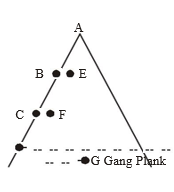
Order: According to the principle of order, a right person should be placedat the right job and a right material should be placed at the right place. According to Fayol, every enterprise should have two different orders – material order for physical resources and social order for human resources.
Equity: The working environment of any organization should be free from all forms of discrimination (religion, language, caste, gender, belief or nationality) and principles of justice and fair play should be followed. No worker should be unduly favoured or punished.
Stability of Personnel: According to this principle, employees once selected, should be kept at their post/position for a minimum fixed tenure. They should be given reasonable time to show results.
Initiative: Workers should be encouraged to develop and carry out their plan for improvements. Initiative means taking the first step with self-motivation. It is thinking out and executing the plan.
Espirit De Corps: Management should promote team spirit, unity and harmony among employees. Management should promote team work.
Taylor’s Scientific Management
Meaning: Conduct of business activities according to standardised tools, methods and trained personal so as to have increased output through effective and optimum utilisation of resources. Hence it stresses that there is always one best way of doing things.
Scientific Management attempts to eliminate wastes to ensure maximum production at minimum cost.
Principles of Scientific Management
Science, not rule of Thumb:
There should be scientific study and analysis of each element of job rather than adopting old rule of the thumb approach on a hit and miss method.
Encourage “thinking before doing”
Harmony, not discord:
There should be complete harmony and proper understanding between management and workers in achieving the organisation goals.
Cooperation not individualism:
Taylor emphasised on the importance of cooperative group efforts between the management and workers in achieving the organisation’s goal and not individualism.
Development of workers to their greatest efficiency and prosperity: The management should scientifically select the workers; assign job as per their physical, mental and intellectual capabilities; and train them as per the job requirement.
Techniques of Scientific Management
Functional Foremanship
Supervision is to be divided into several specialized functions and each function to be entrusted to a special foreman.
Each worker will have to take orders from eight foreman in the related process of function of production Stress on separating planning function from execution function.
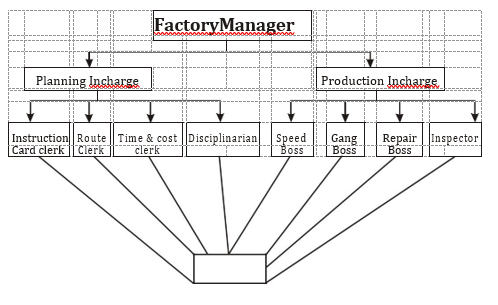
Planning Incharge: The main function of "planning in charge" is to plan all aspects of a job to be performed. It consists of four positions:
(i) Route clerk: He determines the sequence to perform various mechanical and manual operations.
(ii) Instruction card clerk: He issues instructions to the workers to be followed by them.
(iii) Time and cost clerk: He is concerned with the framing of time schedule on the basis of determined route. Also, he keeps the record of the cost of operations.
(iv) Disciplinarian: He is concerned with the coordination in each job from planning to successful execution. He enforces rules and regulations and maintains discipline.
Production Incharge: It consists of following four specialists who are concerned with the execution of plans.
(i) Speed Boss: He checks whether work is progressing as per schedule. He ensures timely and accurate completion of jobs.
(ii) Gang Boss: He arranges machines, materials, tools, and equipments properly so that workers can proceed with their work.
(iii) Repair Boss: He ensures that all machines, tools, equipments are in perfect working order.
(iv) Inspector: He ensures that the work is done as per the standards of quality set by planning department.
Motion Study
Making a thorough analysis of various motions being performed by a worker while doing a particular task.
Identifying and determining the ideal productive movements. Eliminate the unproductive movements and equipments.
Time study
It is the technique used to determine the standard time taken by the workmen with reasonable skills and abilities to perform a particular task.
Here the job is divided into series of elements and the time required to complete each element idealistically is recorded using a stop watch.
Fatigue study
Determines the amount and frequency of rest intervals required in completing a task.
Differential Piece Wage System
Evolve a system wherein the efficient and inefficient workers are paid at different rates. (as financial incentives act as motivators)
First a standard task is established with the aid of time and motion study, then two rates are established. Higher, when standard output is produced and lower, when the standard is not met.
For example: Standard task is 10 units. Rates are: Rs 50 per unit forproducing 10 units or more and Rs 40 per unit for producing less than 10 units
Worker A produces 11 Units; he gets Rs 550 (11 units’ x 50 per unit) Worker B produces 09 units; he gets Rs 360 (9 units’ x 40 per unit) This difference of Rs 190 will motivate B to perform better.
Mental Revolution
It involves a complete change in mental outlook and attitude of workers and management towards one another from competition to cooperation. The management should create pleasant working conditions & workers should work with devotion and loyalty. Instead of fighting over distribution of profits, they must focus attention on increasing it.
MIND MAPPING


Free study material for Business Studies
CBSE Class 12 Business Studies Study Material: Chapter 02 Principles of Management
Comprehensive Study Resources for Chapter 02 Principles of Management
Explore essential learning tools for Class 12 Business Studies Chapter 02 Principles of Management. This curated collection features in-depth notes and targeted practice questions built around the active 2026 curriculum to streamline your daily revision.
Understanding Marking Schemes
Built using official NCERT guidelines for Class 12 Business Studies, these materials provide reliable academic support. Integrating past examination questions and step-by-step solutions helps students understand official CBSE grading criteria.
Complete Revision for Business Studies
For peak performance in upcoming evaluations, integrate official Business Studies sample papers directly into your study schedule. Follow up your revision by attempting online MCQ tests for Chapter 02 Principles of Management to refine calculation speed and precision.
FAQs
Our advanced study package for Chapter 02 Principles of Management includes detailed concepts, diagrams, Mind Maps, and explanation of complex topics to ensure Class 12 students learn as per syllabus for 2026 exams.
The Mind Maps provided for Chapter 02 Principles of Management act as visual anchors which will help faster recall during high-pressure exams.
Yes, teachers use our Class 12 Business Studies resources for lesson planning as they are in simple language and have lot of solved examples.
Yes, You can download the complete, mobile-friendly PDF of the Business Studies Chapter 02 Principles of Management advanced resources for free.
Yes, our subject matter experts have updated the Chapter 02 Principles of Management material to align with the rationalized NCERT textbooks and have removed deleted topics and added new competency-based questions.