

Official CBSE Study Materials for Class 12 Business Studies
Access comprehensive study materials and useful resources for Chapter 05 Organising using the CBSE Class 12 Business Studies Organising Important Questions. Designed to align with the 2026-27 CBSE academic guidelines, these advanced resources help Class 12 Business Studies students reinforce core concepts beyond standard textbooks.
Advanced Resources for Business Studies
Navigate directly to the advanced Business Studies study materials using the digital viewer below. Each resource pack includes detailed conceptual summaries and solved practice questions, allowing students to instantly reinforce their learning.
1 MARKS QUESTIONS
Ques 1: Name the organization which is deliberately created?
Ans: Formal Organisation
Ques 2: Organizing helps in optimum utilization of resources. Which type of resources does it refer?
Ans: All material, financial and human resources.
Ques 3: Give any one importance of organizing?
Ans: Development of personnel.
Ques 4: Divisional structure is more suitable for the firms having several products and each product has distinct features. Do you agree?
Ans: Yes, I do agree.
Ques 5: Name the type of organization in which:
a. Friendly relationship exists among the members.
b. Official relationship exists among the members.
Ans: a) Informal Organisation b) Formal Organisation.
Ques 6: Which term denotes “The number of subordinates that can be effectively managed by a superior?
Ans: - Span of control.
Ques 7: What are the elements of delegation of authority?
Ans: Responsibility, Authority, Accountability.
Ques 8: Scope of decentralization of authority is wider than delegation. Why?
Ans: Decentralization implies extension of delegation to the lowest level of management.
Ques 9: National vritech ltd. Has grown in size. It was a market leader but with changes in business environment and with the entry of mncs its market share is declining. To cope up with the situation CEO starts delegating some of his authority to the general manger, who also felt himself overburdened and with the approval of CEO disperses some of his authority to various levels throughout the organization. Identify the concept of management discussed above.
Ans: -Decentralization
3 MARKS QUESTIONS
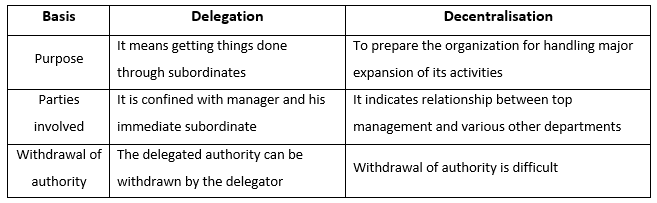
Ques 10: Distinguish between ‘delegation’ and ‘decentralisation’ of authority on the basis of
i) Purpose ii) Parties involved and iii) Withdrawal of authority.
Ans:
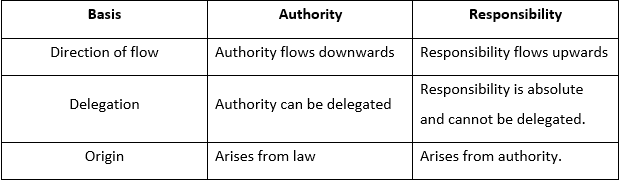
Ques 11: Distinguish between authority and responsibility on the basis of:
a. Direction of flow b. Delegation c. Origin
Ans:
Ques 12: Enumerate the steps in the process of organizing?
Ans: 1) Identification and division of work 2) Grouping Jobs and Departmentalisation
3) Assignment of duties 4) Establishing authority relationship
4 MARKS QUESTIONS
Ques 13: “A manager is of the view that he is not responsible for the quality of work that he has delegated to his subordinate”. Do you agree with his view points? Justify your answer by giving arguments.
Ans: No I do not agree with managers view point.
The reasons are as follows:
i) Principle of delegation by results expected.
ii) Principle of parity of authority and responsibility
iii) Principle of absolute responsibility.
iv) Authority level principle
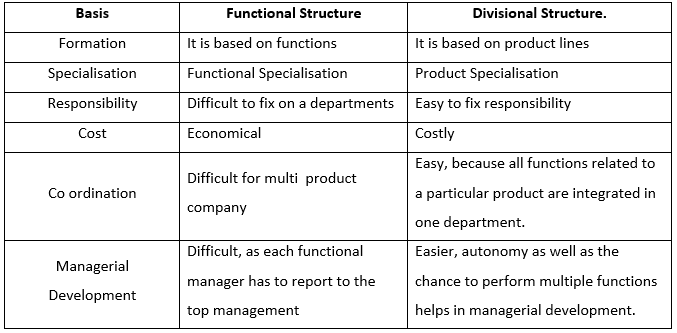
Ques 14: Distinguish between functional structure and divisional structure.
Ans:
5 MARKS QUESTIONS
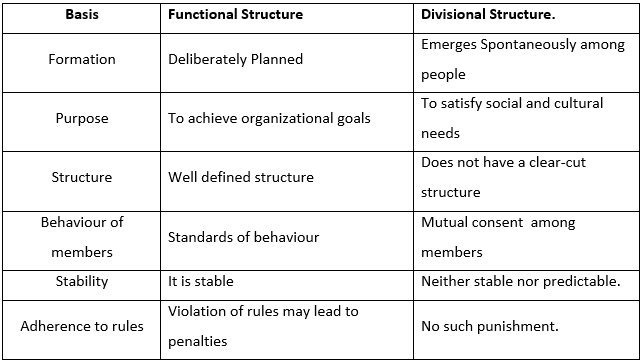
Ques 15: Distinguish between formal and informal organizations on the basis of
a) Formation b. Purpose c. structure d. Behaviour of members e. stability and f. adherence to rules.
Ans:
Ques 16: Ishita works as a corporate event coordinator in an event management company. She has been made an overall official in charge for organizing a painting exhibition for one of the clients of the company. for ensuring that the exhibition takes place successfully, she identifies the various activities involved and divides the whole work into various task groups like marketing committee, decoration committee and reception committee. in order to facilitate coordination within and among committees, she appoints a supervisor of each group. each member in the group is asked to report to their respective supervisor of eac group. each member in the group is asked to report to their respective supervisors and all the supervisors are expected to work as per ishita’s orders. in context of the above case:
1. identify the function of management being performed by ishita.
2. describe briefly the various steps involved in the performance of the function of management as identified in part (a) of the question.
Ans:
1. The organizing function of management is being performed by ishita.
2. The steps involved in the process of organizing are as follows:
1. Identification and division of work:
2. Departmentalization:
3. Assignment of duties:
4. Establishing Reporting Relationship:
6 MARKS QUESTIONS
Ques 17: What are the advantages and disadvantages of divisional structure?
Ans:
A): Advantages:
1) All activities associated with one product. It can be easily integrated.
2) Decision making is faster.
3) Performance can be easily assessed remedial action can be taken
4) It facilitates expansion and growth as new divisions can be added.
Disadvantages:
1) This gives rise to duplication of effort among its divisions.
2) Manages in each department focus on their own product without thinking the rest of the organization.
3) There may not be full utilization of different equipments
4) Conflict may arise among different division.
Free study material for Business Studies
CBSE Class 12 Business Studies Study Material: Chapter 05 Organising
Comprehensive Study Resources for Chapter 05 Organising
Explore essential learning tools for Class 12 Business Studies Chapter 05 Organising. This curated collection features in-depth notes and targeted practice questions built around the active 2026 curriculum to streamline your daily revision.
Understanding Marking Schemes
Designed around the official curriculum, these study guides guarantee standard compliance. Reviewing step-by-step solutions clarifies complex sub-topics within Chapter 05 Organising and demystifies standard marking schemes for Business Studies evaluations.
Complete Revision for Business Studies
For peak performance in upcoming evaluations, integrate official Business Studies sample papers directly into your study schedule. Follow up your revision by attempting online MCQ tests for Chapter 05 Organising to refine calculation speed and precision.
FAQs
Our advanced study package for Chapter 05 Organising includes detailed concepts, diagrams, Mind Maps, and explanation of complex topics to ensure Class 12 students learn as per syllabus for 2026 exams.
The Mind Maps provided for Chapter 05 Organising act as visual anchors which will help faster recall during high-pressure exams.
Yes, teachers use our Class 12 Business Studies resources for lesson planning as they are in simple language and have lot of solved examples.
Yes, You can download the complete, mobile-friendly PDF of the Business Studies Chapter 05 Organising advanced resources for free.
Yes, our subject matter experts have updated the Chapter 05 Organising material to align with the rationalized NCERT textbooks and have removed deleted topics and added new competency-based questions.