

Exercise 20.1
Question 1: Find the curved surface area of a cone, if its slant height is 60 cm and the radius of its base is 21 cm.
Solution:
Slant height of cone (l) = 60 cm
Radius of the base of the cone (r) = 21 cm
CSA of the right circular cone = πrl
CSA of the right circular cone = 22/7 × 21 × 60
CSA of the right circular cone = 3960 cm2
Hence, the CSA of the right circular cone is 3960 cm2
Question 2: The radius of a cone is 5cm and vertical height is 12cm. Find the area of the curved surface.
Solution:
Radius of cone (r) = 5 cm
Height of cone (h) = 12 cm
l2 = r2 + h2
l2 = (5)2 +(12)2
l2 = 25 + 144
l2 = 169
l = 13 cm
CSA of a cone = πrl
CSA of a cone = 3.14 × 5 × 13
CSA of a cone = 204.28
Hence, the CSA of the cone is 204.28 cm2
Question 3 : The radius of a cone is 7 cm and area of curved surface is 176 cm2. Find the slant height.
Solution:
It is given that,
Radius of cone(r) = 7 cm
Curved surface area = 176cm2
CSA of a cone = πrl
176 = πrl
176 = 22/7×7×l
(176×7)/(22×7) =l
8=l
l=8
Hence, the slant height of the cone is 8cm.
Question 4: The height of a cone 21 cm. Find the area of the base if the slant height is 28 cm.
Solution:
It is given that,
Height of cone (h) = 21 cm
Slant height of cone (l) = 28 cm
r2=l2-h2
r2 = (28)2 + (21)2
r2 = 282 – 212
r= 7√7 cm
Area of the circular base = πr2
Area of the circular base = 22/7 × (7√7 )2
Area of the circular base = 22/7 × 343
Area of the circular base = 1078cm2
Hence, the area of the base is 1078cm2.
Question 5: Find the total surface area of a right circular cone with radius 6 cm and height 8 cm.
Solution:
It is given that,
Radius of cone (r) = 6 cm
Height of cone (h) = 8 cm
l2 = r2 + h2
l2 = 62+82
l2 = 36 + 64
l2 = 100
l = 10cm
TSA of the cone = CSA of cone + Area of circular base
TSA of the cone = πrl + πr2
TSA of the cone = (22/7×6×10)+ (22/7×6×6)
TSA of the cone = 1320/7 + 729/7
TSA of the cone = 301.71cm2
Hence, the area of the base is 301.71cm2.
Question 6: Find the curved surface area of a cone with base radius 5.25 cm and slant height 10 cm.
Solution:
Radius of the cone (r) = 5.25 cm
Slant height of the cone (l) = 10 cm
Curved surface area (CSA) = πrl
Curved surface area = 22/7 × 5.25 × 10
Curved surface area = 165
Hence, curved surface area of the cone is 165cm2.
Question 7: Find the total surface area of a cone, if its slant height is 21 m and diameter of its base is 24 m.
Solution:
Diameter of the cone (d) = 24m
Radius of the cone(r) = diameter/2 = 224/2 m = 12m
Slant height of the cone (l) = 21m
TSA of cone = CSA of cone + Area of circular base
TSA of cone = πrl+ πr2
TSA of cone = (22/7×12×21) + (22/7×12×12)
TSA of cone = (22/7×252) + (22/7×144)
TSA of cone = (5544/7) + (3168/7)
TSA of cone = 792 + 453.57
TSA of cone = 1244.57
Hence, TSA of the cone is 1244.57m2.
Question 8: The area of the curved surface of a cone is 60 π cm2. If the slant height of the cone be 8 cm, find the radius of the base.
Solution:
It is given that,
Curved surface area = 60π cm2
Slant height of the cone (l) = 8 cm
Curved surface area = πrl
πrl = 60π
r × 8 = 60
r = 60/8
r = 7.5
Hence, radius of the base of the cone is 7.5 cm.
Question 9: The curved surface area of a cone is 4070 cm2 and diameter is 70 cm .What is its slant height?
(Use π= 22/7)
Solution:
It is given that,
Diameter of the cone (d) = 70 cm
Radius of the cone (r) = diameter/2 = 70/2 cm = 35 cm
Curved surface area = 4070 cm2
We know that, Curved surface area = πrl
Curved surface area = 4070
πrl = 4070
22/7×35×l=4070
22×5×l=4070
110×l=4070
l=4070/110
l=37
Hence, the slant height of cone is 37cm.
Question 10: The radius and slant height of a cone are in the ratio 4:7. If its curved surface area is 792cm2, find its radius. (Use π =22/7)
Solution:
It is given that,
CSA of cone = 792 cm2
Ratio of Radius and slant height of a cone is 4:7
Let 4x be the radius and 7x be the height of cone.
CSA of cone = πrl
22/7 × (4x) × (7x) = 792
22/7 × 28x2 = 792
22 × 4x2 = 792
x2 = 9
x = 3
Radius = 4x
Radius = 4(3) cm
Radius = 12cm
Hence, the radius of cone is 12cm
Exercise 20.2
Question 1: Find the volume of the right circular cone with:
(i) Radius 6cm, height 7cm
(ii) Radius 3.5cm, height 12cm
(iii) Height is 21cm and slant height 28cm
Solution:
(i) Radius of cone (r) = 6cm
Height of cone (h) = 7cm
Volume of a right circular cone = 1/(3πr2 h)
Volume of a right circular cone = 1/3 x 3.14 x 62 x 7
Volume of a right circular cone = 264
Volume of a right circular cone is 264 cm3
(ii) Radius of cone (r) = 3.5 cm
Height of cone (h) = 12cm
Volume of a right circular cone = 1/3πr2h
By substituting the values, we get
Volume of a right circular cone = 1/3 x 3.14 x 3.52 x 12
Volume of a right circular cone = 154
Volume of a right circular cone is 154 cm3
(iii) Height of cone (h) = 21 cm
Slant height of cone (l) = 28 cm
r2 = l2 - h2
r2 = (28)2 – (21)2
r = 784 – 441
r = 343
r = 7√7
Volume of a right circular cone = 1/3 πr2 h
Volume of a right circular cone = 1/3 x 3.14 x (7√7)2 x 21
Volume of a right circular cone = 7546
Hence, the volume of a right circular cone is 7546 cm3
Question 2: Find the capacity in litres of a conical vessel with:
(i) radius 7 cm, slant height 25 cm
(ii) height 12 cm, slant height 13 cm.
Solution:
(i) Radius of the cone(r) =7 cm
Slant height of the cone (l) =25 cm
l2 = r2 + h2
252 = 72 + h2
252 - 72 = h2
625 – 49 = h2
576 = h2
√576 = h
h = 24
Volume of a right circular cone = 1/3πr2h
Volume of a right circular cone = 1/3 × 22/7 × (7)2 × 24
Volume of a right circular cone = 1232
Volume of a right circular cone is 1232 cm3.
Hence, the value of a right circular cone is 1.232 litres.
(ii) Height of cone (h) = 12 cm
Slant height of cone (l) = 13 cm
l2 = r2 + h2
132 = r2 + 122
132 - 122 = r2
169 – 144 = r2
25 = r2
r = 5
Volume of a right circular cone = 1/3πr2h
Volume of a right circular cone = 1/3 × 22/7 × (5)2 × 12
Volume of a right circular cone = 314.28
Volume of a right circular cone is 314.28 cm3.
Hence, the value of a right circular cone is 0.314 litres.
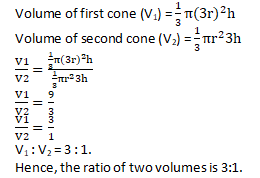
Question 3: Two cones have their heights in the ratio 1:3 and the radii of their bases in the ratio 3:1. Find the ratio of their volumes.
Solution:
Height of first cones = h
Height of second cones = 3h
Radius of first cones = 3r
Radius of second cones = r
Question 4: The radius and the height of a right circular cone are in the ratio 5 : 12. If its volume is 314 cubic meter, find the slant height and the radius. (Use π=3.14).
Solution:
Let us assume the ratio of radius and the height of a right circular cone to be x.
Then, radius be 5x and height be 12x
l2 = r2 + h2
l2 = (5x)2 + (12x)2
l2 = 25x2 + 144x2
l2 = 169x2
l = 13x
Volume of cone = 314 m3
1/3 πr2 h = 314
1/3 × 3.14 × (25x2) × (12x) = 314
25x2 × 12x = 314 × 3 × 3.14
300x3 = 314 × 3 × 3.14
x3=1
x = 1
Radius = 5 × 1
Radius = 5 m
Hence, the slant height and radius is 13m and 5m.
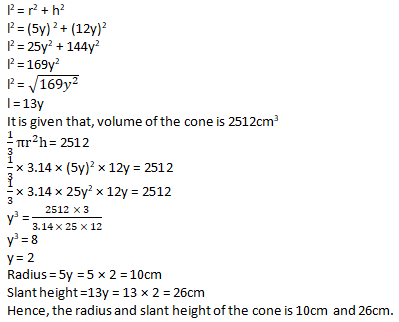
Question 5: The radius and height of a right circular cone are in the ratio 5 : 12 and its volume is 2512 cubic cm. Find the slant height and radius of the cone. (Use π=3.14).
Solution:
Let the ratio of radius and height of a right circular cone be y.
Radius of cone (r) = 5y
Height of cone (h) =12y
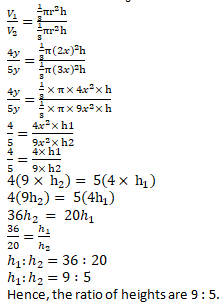
Question 6: The ratio of volumes of two cones is 4 : 5 and the ratio of the radii of their bases is 2 : 3. Find the ratio of their vertical heights.
Solution:
Radius of first cone (r1) = 2x
Radius of second cone (r2) = 3x
Volume of first cone (V1) = 4y
Volume of second cone (V2) = 5y
Volume of a cone = 1/3πr2h
Question 7: A cylinder and a cone have equal radii of their bases and equal heights. Show that their volumes are in the ratio 3:1.
Solution:
It is given that,
Radius of the cone = Radius of the cylinder = r
Height of the cone = Height of the cylinder = h
(Volume of Cylinder)/(Volume of Cone)=(πr2 h)/(1/3 πr2 h)
(Volume of Cylinder)/(Volume of Cone)=1/(1/3)
(Volume of Cylinder)/(Volume of Cone)=3/1
Volume of Cylinder : Volume of Cone = 3 : 1.
Hence, ratio of their volumes is 3 : 1.
Exercise VSAQs.....................
Question 1: The height of a cone is 15 cm. If its volume is 500π cm3, then find the radius of its base.
Solution:
It is givens that,
Height of a cone = 15 cm
Volume of cone = 500π cm3
We know, Volume of cone = 1/3 πr2 h
500π = 1/3 × π × r2 x 15
500 = 1/3 × r2 x 15
(500 × 3)/15 = r2
1500/15 = r2
100 = r2
r = √100
r = 10
Hence, the radius of base is 10cm.
Question 2: If the volume of a right circular cone of height 9 cm is 48π cm3, find the diameter of its base.
Solution:
It is given that,
Height of a cone = 9 cm
Volume of cone = 48π cm3
Volume of cone = 1/3 πr2 h
48π = 1/3 × π × r2 × 9
48 = 1/3 × r2 × 9
(48 × 3)/9 = r2
r2 = 16
r = √16
r = 4
Radius of base = 4cm
Diameter = 2 Radius = 2 × 4cm = 8 cm.
Hence, the diameter of its base is 8cm.
Question 3: If the height and slant height of a cone are 21 cm and 28 cm respectively. Find its volume.
Solution:
It is given that,
Height of cone (h) = 21 cm
Slant height of cone (l) = 28 cm
r2 = l2 - h2
r2 = 282 - 212
r2 = 784 – 441
r2 = 343
r = 7√7 cm
Volume of cone = 1/3 πr2 h
Volume of cone = 1/3 × 22/7 × (7√7)2 × 21
Volume of cone = 1/3 × 22 × 49 × 21
Volume of cone = 22 × 49 × 7
Volume of cone = 7546
Hence, the volume of cone is 7546cm3.
Question 4: The height of a conical vessel is 3.5 cm. If its capacity is 3.3 litres of milk. Find the diameter of its base.
Solution:
It is given that,
Height of a conical vessel = 3.5 cm and
Capacity of conical vessel is 3.3 litres
Change litres in centimetres = 3.3 litres × 1000 = 3300 cm3
Volume of cone = 1/3 πr2h
3300 = 1/3 × 22/7 × r2 × 3.5
3300 = 1/3 × 22 × r2 × 0.5
(3300 × 3)/(22 × 0.5) = r2
900 = r2
r2 = √900
r = 30
Radius of cone is 30cm
Diameter of its base = 2 Radius = 2 × 30 cm = 60cm
Hence, the diameter of conical vessel base is 60cm.