

Class 6 Mathematics Practice Sheet: CBSE Class 6 Mathematics Fractions Worksheet Set 01
Review targeted academic worksheets with the CBSE Class 6 Mathematics Fractions Worksheet Set 01. Built according to official educational standards for the 2026-27 term, these downloadable Class 6 Mathematics resources support effective daily practice and detailed self-evaluation for Chapter 07 Fractions.
Download Chapter 07 Fractions Worksheet PDF with Answers
Navigate directly to the solved Mathematics worksheets using the digital viewer below. Each practice set includes detailed step-by-step solutions, allowing students to instantly cross-check their work and identify areas requiring further revision.
Q1. Fill in the blanks.
1. An improper fraction of 8 is \(\frac{8}{1}\) (or any fraction with numerator 8 times its denominator, e.g., \(\frac{16}{2}\)).
2. \(\frac{7}{21} + \frac{12}{21} = \frac{19}{21}\)
3. The equivalent fraction of \(\frac{3}{5}\) having numerator 24 is \(\frac{24}{40}\).
4. Fractions with same denominators are called like fractions.
5. Which is greater \(\frac{3}{8}\) or \(\frac{3}{5}\)? Answer: \(\frac{3}{5}\).
6. What fraction of a day is 6 hours? Answer: \(\frac{6}{24} = \frac{1}{4}\).
7. Is \(\frac{5}{9}\) equals to \(\frac{4}{5}\)? Answer: No (\(25 \neq 36\)).
8. A fraction is said to be in the simplest (or lowest) form if its numerator and denominator have no common factor except 1.
9. In an improper fraction, the numerator is greater than or equal to than the denominator.
10. The simplest form of \(\frac{18}{36}\) is \(\frac{1}{2}\).
Answer: 1. \(\frac{8}{1}\)
2. \(\frac{19}{21}\)
3. \(\frac{24}{40}\)
4. Like fractions
5. \(\frac{3}{5}\)
6. \(\frac{1}{4}\)
7. No
8. 1
9. greater than or equal to
10. \(\frac{1}{2}\)
In simple words: Fill in the blanks test basic fraction properties, addition, and simplification.
Exam Tip: Remember that for fractions with the same numerator, the one with the smaller denominator is greater.
Q2. Compare the following. [ <, >, = ]
1. a) \(\frac{8}{15} \square \frac{4}{15}\)
b) \(\frac{4}{7}\) and \(\frac{3}{8}\)
c) \(\frac{5}{8}\) and \(\frac{5}{7}\)
2. Show \(\frac{3}{5}, \frac{5}{5}, \frac{7}{5}\) on a number line.
Answer: 1. a) \(\frac{8}{15} > \frac{4}{15}\)
b) \(\frac{4}{7} > \frac{3}{8}\) (since \(32 > 21\) after cross-multiplication)
c) \(\frac{5}{8} < \frac{5}{7}\)
2. To show on a number line, divide each unit distance between integers into 5 equal parts. Mark points at 3, 5, and 7 subdivisions away from 0.
In simple words: Compare fractions by making denominators equal or by cross-multiplying.
Exam Tip: When denominators are equal, simply compare the numerators.
Q3. Express as mixed fractions.
a. \(\frac{17}{7}\)
b. \(\frac{38}{5}\)
c. \(\frac{19}{6}\)
Answer: a. \(17 \div 7 = 2\) remainder 3, so \(2\frac{3}{7}\)
b. \(38 \div 5 = 7\) remainder 3, so \(7\frac{3}{5}\)
c. \(19 \div 6 = 3\) remainder 1, so \(3\frac{1}{6}\)
In simple words: Divide the numerator by the denominator to get the whole number and the remainder becomes the new numerator.
Exam Tip: The denominator of the fractional part always remains the same as the original fraction.
Q4. Express as improper fractions.
a. \(3\frac{2}{8}\)
b. \(5\frac{7}{8}\)
c. \(4\frac{1}{3}\)
Answer: a. \(\frac{(3 \times 8) + 2}{8} = \frac{26}{8}\) (or \(\frac{13}{4}\))
b. \(\frac{(5 \times 8) + 7}{8} = \frac{47}{8}\)
c. \(\frac{(4 \times 3) + 1}{3} = \frac{13}{3}\)
In simple words: Multiply the whole number by the denominator and add the numerator.
Exam Tip: Keep the denominator unchanged while calculating the new numerator.
Q5. Find the equivalent fraction form.
a. \(\frac{66}{99}\)
b. \(\frac{32}{48}\)
c. \(\frac{21}{24}\)
Answer: a. Divide numerator and denominator by 33: \(\frac{66 \div 33}{99 \div 33} = \frac{2}{3}\)
b. Divide numerator and denominator by 16: \(\frac{32 \div 16}{48 \div 16} = \frac{2}{3}\)
c. Divide numerator and denominator by 3: \(\frac{21 \div 3}{24 \div 3} = \frac{7}{8}\)
In simple words: Simplify fractions by dividing both numbers by their highest common factor.
Exam Tip: Always check if the resulting fraction can be simplified further.
Q7. Find the equivalent fraction of \(\frac{7}{15}\) with numerator 35?
Answer: To get numerator 35, multiply 7 by 5. Multiply the denominator by 5 as well:
\(\frac{7 \times 5}{15 \times 5} = \frac{35}{75}\)
In simple words: Multiply both top and bottom by the same number to maintain equivalence.
Exam Tip: Find the multiplier by dividing the target numerator by the given numerator (\(35 \div 7 = 5\)).
Q8. Find the equivalent fraction of \(\frac{45}{54}\) with numerator 5?
Answer: To get numerator 5, divide 45 by 9. Divide the denominator by 9 as well:
\(\frac{45 \div 9}{54 \div 9} = \frac{5}{6}\)
In simple words: Divide both top and bottom by the same number to reduce the fraction.
Exam Tip: Find the divisor by dividing the given numerator by the target numerator (\(45 \div 5 = 9\)).
Q9. Write the natural numbers between 50 to 65 what fraction of them are prime numbers?
Answer: Natural numbers between 50 and 65: 51, 52, 53, 54, 55, 56, 57, 58, 59, 60, 61, 62, 63, 64 (Total = 14 numbers).
Prime numbers in this range: 53, 59, 61 (Total = 3 prime numbers).
Fraction = \(\frac{3}{14}\)
In simple words: Count total numbers and count how many are prime, then write as a fraction.
Exam Tip: Be careful whether the word 'between' includes endpoints or not; usually, numbers strictly between 50 and 65 exclude 50 and 65.
Q10. Solve.
a. \(\frac{5}{12} - \frac{3}{4}\)
b. \(2\frac{1}{5} + 4\frac{3}{4}\)
c. \(4\frac{4}{5} - 3\frac{7}{9}\)
d. \(\frac{1}{4} + \frac{1}{5} + \frac{1}{6}\)
e. \(1 - \frac{3}{5}\)
f. \(4 - \frac{1}{2}\)
Answer: a. LCM of 12 and 4 is 12.
\(\frac{5}{12} - \frac{9}{12} = \frac{-4}{12} = -\frac{1}{3}\)
b. Convert to improper fractions: \(\frac{11}{5} + \frac{19}{4}\). LCM = 20.
\(\frac{44}{20} + \frac{95}{20} = \frac{139}{20} = 6\frac{19}{20}\)
c. Convert to improper fractions: \(\frac{24}{5} - \frac{34}{9}\). LCM = 45.
\(\frac{216}{45} - \frac{170}{45} = \frac{46}{45} = 1\frac{1}{45}\)
d. LCM of 4, 5, 6 is 60.
\(\frac{15}{60} + \frac{12}{60} + \frac{10}{60} = \frac{37}{60}\)
e. \(\frac{5}{5} - \frac{3}{5} = \frac{2}{5}\)
f. \(\frac{8}{2} - \frac{1}{2} = \frac{7}{2} = 3\frac{1}{2}\)
In simple words: Take the LCM of denominators before adding or subtracting fractions.
Exam Tip: Convert mixed fractions to improper fractions first to make addition and subtraction easier.
Q11. Raju had \(\frac{5}{9}\) of a cake. He gave \(\frac{2}{9}\) out of that to his sister. How much is left?
Answer: Initial cake with Raju = \(\frac{5}{9}\)
Cake given to sister = \(\frac{2}{9}\)
Cake left = \(\frac{5}{9} - \frac{2}{9} = \frac{3}{9} = \frac{1}{3}\)
In simple words: Subtract the amount given away from the total amount he had.
Exam Tip: Always reduce the final fraction to its simplest form.
Q12. Meena bought \(2\frac{1}{4}\) kg of vegetables and Reena bought \(3\frac{1}{2}\) kg of vegetables. Find the total weight of vegetables bought by both of them.
Answer: Meena's vegetables = \(2\frac{1}{4} = \frac{9}{4}\) kg
Reena's vegetables = \(3\frac{1}{2} = \frac{7}{2} = \frac{14}{4}\) kg
Total weight = \(\frac{9}{4} + \frac{14}{4} = \frac{23}{4} = 5\frac{3}{4}\) kg
In simple words: Add both quantities to find the total weight.
Exam Tip: Make denominators equal when adding mixed numbers.
Q11. Find the sum.
a) \(4\frac{1}{2} + \frac{1}{10} + 3\frac{1}{5}\)
b) \(2\frac{1}{8} + 1\frac{1}{16} + \frac{3}{4}\)
c) \(8\frac{4}{9} + 5\frac{1}{3}\)
Answer: a) Add whole numbers: \(4 + 3 = 7\). Add fractions: \(\frac{1}{2} + \frac{1}{10} + \frac{1}{5}\). LCM = 10.
\(\frac{5}{10} + \frac{1}{10} + \frac{2}{10} = \frac{8}{10} = \frac{4}{5}\)
Total sum = \(7\frac{4}{5}\)
b) Whole numbers: \(2 + 1 = 3\). Fractions: \(\frac{1}{8} + \frac{1}{16} + \frac{3}{4}\). LCM = 16.
\(\frac{2}{16} + \frac{1}{16} + \frac{12}{16} = \frac{15}{16}\)
Total sum = \(3\frac{15}{16}\)
c) Whole numbers: \(8 + 5 = 13\). Fractions: \(\frac{4}{9} + \frac{1}{3} = \frac{4}{9} + \frac{3}{9} = \frac{7}{9}\)
Total sum = \(13\frac{7}{9}\)
In simple words: Add whole numbers and fractions separately, or convert all to improper fractions.
Exam Tip: Adding whole numbers and fractions separately saves time for mixed numbers.
Q12. Subtract.
a) \(4\frac{5}{8} - 3\frac{3}{16}\)
b) \(3\frac{1}{15} - 2\frac{1}{5}\)
c) subtract \(\frac{3}{4}\) from \(3\frac{1}{7}\)
d) Subtract \(\frac{4}{9}\) from 6.
Answer: a) \(\frac{37}{8} - \frac{51}{16} = \frac{74}{16} - \frac{51}{16} = \frac{23}{16} = 1\frac{7}{16}\)
b) \(\frac{46}{15} - \frac{11}{5} = \frac{46}{15} - \frac{33}{15} = \frac{13}{15}\)
c) \(3\frac{1}{7} - \frac{3}{4} = \frac{22}{7} - \frac{3}{4}\). LCM = 28.
\(\frac{88}{28} - \frac{21}{28} = \frac{67}{28} = 2\frac{11}{28}\)
d) \(6 - \frac{4}{9} = \frac{54}{9} - \frac{4}{9} = \frac{50}{9} = 5\frac{5}{9}\)
In simple words: Convert mixed numbers to improper fractions and find a common denominator to subtract.
Exam Tip: Pay close attention to the order of subtraction when you see the word 'from'.
I. Important Points.
1. Fraction whose Numerators are less than denominators are called Proper fractions.
2. Fractions whose Numerators are greater than Denominators an called Improper fractions.
3. If the Numerators of a fraction is less than Denominator the fraction is less than 1.
4. If Numerator of a fraction is greater than denominator then the fraction is more than 1.
5. If Numerator is equal to the Denominator than the fraction is equal to 1.
6. A Fraction with numerate 1 is called UNIT FRACTION.
7. The Fraction is said to be in the lowest term or in simplest form if the H.C.F. of its numerator and the denominator is 1.
8. A group of fraction with the same denominator are called LIKE FRACTIONS.
9. A group of fraction with the different denominators are called UNLIKE FRACTIONS.
10. Different fractions represents the same part are called EQUIVALENT FRACTIONS.
11. Proper fractions are always less than 1.
12. Improper fractions are greater than or equal to 1.
13. Of the two fractions with same numerator, the fraction with greater denominator is smaller.
14. Of the two fractions with same denominator the fraction with greater numerator is greater.
Answer: Theory definitions reviewed.
In simple words: This section summarizes key fraction concepts for quick revision.
Exam Tip: Memorize these definitions to solve conceptual questions quickly.
II. Solve the following
(i) \(\frac{2}{7} = \frac{8}{\square}\)
(ii) \(\frac{5}{8} = \frac{10}{\square}\)
(iii) \(\frac{3}{5} = \frac{8}{20}\) (Note: original typo in source, solving standard equivalent form: \(\frac{3}{5} = \frac{12}{20}\))
(iv) \(\frac{45}{60} = \frac{15}{\square}\)
(v) \(\frac{18}{24} = \frac{\square}{4}\)
(vi) \(\frac{2}{9} = \frac{\square}{63}\)
(vii) \(\frac{15}{35} = \frac{\square}{7}\)
(viii) \(\frac{4}{5} = \frac{\square}{140}\)
(ix) \(\frac{8}{64} = \frac{\square}{8}\)
(x) \(\frac{12}{72} = \frac{2}{\square}\)
Answer: (i) \(8 \div 2 = 4\), so denominator = \(7 \times 4 = 28\)
(ii) \(10 \div 5 = 2\), so denominator = \(8 \times 2 = 16\)
(iii) \(3 \times 4 = 12\), so numerator = 12 (assuming \(\frac{3}{5} = \frac{12}{20}\))
(iv) \(45 \div 15 = 3\), so denominator = \(60 \div 3 = 20\)
(v) \(24 \div 4 = 6\), so numerator = \(18 \div 6 = 3\)
(vi) \(63 \div 9 = 7\), so numerator = \(2 \times 7 = 14\)
(vii) \(35 \div 5 = 7\), so numerator = \(15 \div 5 = 3\)
(viii) \(140 \div 5 = 28\), so numerator = \(4 \times 28 = 112\)
(ix) \(64 \div 8 = 8\), so numerator = \(8 \div 8 = 1\)
(x) \(12 \div 2 = 6\), so denominator = \(72 \div 6 = 12\)
In simple words: Find the missing number by multiplying or dividing both numerator and denominator by the same factor.
Exam Tip: Use cross-multiplication if you get stuck finding missing terms in equivalent fractions.
III. Reduce the following fractions into simplest form.
(i) \(\frac{48}{60}\)
(ii) \(\frac{150}{60}\)
(iii) \(\frac{84}{98}\)
(iv) \(\frac{12}{52}\)
(v) \(\frac{7}{28}\)
(vi) \(\frac{36}{24}\)
(vii) \(\frac{112}{128}\)
(viii) \(\frac{63}{189}\)
(ix) \(\frac{90}{104}\)
(x) \(\frac{72}{120}\)
Answer: (i) HCF of 48 and 60 is 12 \(\rightarrow \frac{4}{5}\)
(ii) HCF of 150 and 60 is 30 \(\rightarrow \frac{5}{2}\)
(iii) HCF of 84 and 98 is 14 \(\rightarrow \frac{6}{7}\)
(iv) HCF of 12 and 52 is 4 \(\rightarrow \frac{3}{13}\)
(v) HCF of 7 and 28 is 7 \(\rightarrow \frac{1}{4}\)
(vi) HCF of 36 and 24 is 12 \(\rightarrow \frac{3}{2}\)
(vii) HCF of 112 and 128 is 16 \(\rightarrow \frac{7}{8}\)
(viii) HCF of 63 and 189 is 63 \(\rightarrow \frac{1}{3}\)
(ix) HCF of 90 and 104 is 2 \(\rightarrow \frac{45}{52}\)
(x) HCF of 72 and 120 is 24 \(\rightarrow \frac{3}{5}\)
In simple words: Divide numerator and denominator by their highest common factor (HCF).
Exam Tip: You can also simplify step-by-step using prime factors like 2, 3, and 5.
IV. Find an equivalent fraction of \(\frac{3}{5}\) having
(a) Denominator 20
(b) Numerator 36
(c) Denominator 75
(d) Numerator 45
(e) Denominators 125
Answer: (a) \(\frac{3 \times 4}{5 \times 4} = \frac{12}{20}\)
(b) \(\frac{3 \times 12}{5 \times 12} = \frac{36}{60}\)
(c) \(\frac{3 \times 15}{5 \times 15} = \frac{45}{75}\)
(d) \(\frac{3 \times 15}{5 \times 15} = \frac{45}{75}\)
(e) \(\frac{3 \times 25}{5 \times 25} = \frac{75}{125}\)
In simple words: Multiply both numerator and denominator by the scale factor derived from the given value.
Exam Tip: Divide the target value by the given value to find your multiplier.
V. Find an equivalent fraction of \(\frac{16}{144}\) having
(a) numerator 2
(b) denominator 72
(c) numerator 4
(d) numerator 1
Answer: (a) \(\frac{16 \div 8}{144 \div 8} = \frac{2}{18}\)
(b) \(\frac{16 \div 2}{144 \div 2} = \frac{8}{72}\)
(c) \(\frac{16 \div 4}{144 \div 4} = \frac{4}{36}\)
(d) \(\frac{16 \div 16}{144 \div 16} = \frac{1}{9}\)
In simple words: Divide both numerator and denominator by the appropriate divisor.
Exam Tip: Always verify that the ratio remains unchanged.
VI. Change the following into improper fraction
(i) \(2\frac{2}{5}\)
(ii) \(2\frac{3}{5}\) (assuming standard text)
(iii) \(3\frac{3}{7}\)
(iv) \(5\frac{5}{7}\)
(v) \(18\frac{1}{23}\)
(vi) \(7\frac{7}{9}\)
Answer: (i) \(\frac{(2 \times 5) + 2}{5} = \frac{12}{5}\)
(ii) \(\frac{(2 \times 5) + 3}{5} = \frac{13}{5}\)
(iii) \(\frac{(3 \times 7) + 3}{7} = \frac{24}{7}\)
(iv) \(\frac{(5 \times 7) + 5}{7} = \frac{40}{7}\)
(v) \(\frac{(18 \times 23) + 1}{23} = \frac{415}{23}\)
(vi) \(\frac{(7 \times 9) + 7}{9} = \frac{70}{9}\)
In simple words: Multiply whole number by denominator and add numerator.
Exam Tip: Denominator stays the same in the improper fraction.
VII. Change the following into mixed number
(i) \(\frac{8}{3}\)
(ii) \(\frac{16}{3}\)
(iii) \(\frac{54}{7}\)
(iv) \(\frac{209}{14}\)
(v) \(\frac{67}{13}\)
(vi) \(\frac{98}{23}\)
(vii) \(\frac{145}{12}\)
(viii) \(\frac{37}{9}\)
Answer: (i) \(2\frac{2}{3}\)
(ii) \(5\frac{1}{3}\)
(iii) \(7\frac{5}{7}\)
(iv) \(14\frac{13}{14}\)
(v) \(5\frac{2}{13}\)
(vi) \(4\frac{6}{23}\)
(vii) \(12\frac{1}{12}\)
(viii) \(4\frac{1}{9}\)
In simple words: Divide numerator by denominator to get quotient (whole number) and remainder (numerator).
Exam Tip: Double-check by converting back to improper fraction.
VIII. Which of the following pair of fraction are equivalent?
(i) \(\frac{6}{13}\) and \(\frac{30}{65}\)
(ii) \(\frac{16}{20}\) and \(\frac{20}{35}\)
(iii) \(\frac{8}{15}\) and \(\frac{40}{75}\)
(iv) \(\frac{4}{9}\) and \(\frac{32}{72}\)
(v) \(\frac{12}{44}\) and \(\frac{21}{76}\)
(vi) \(\frac{11}{17}\) and \(\frac{55}{85}\)
Answer: (i) \(\frac{30}{65} = \frac{6}{13}\) (Equivalent)
(ii) \(\frac{16}{20} = \frac{4}{5}\), \(\frac{20}{35} = \frac{4}{7}\) (Not equivalent)
(iii) \(\frac{40}{75} = \frac{8}{15}\) (Equivalent)
(iv) \(\frac{32}{72} = \frac{4}{9}\) (Equivalent)
(v) \(\frac{12}{44} = \frac{3}{11}\), \(\frac{21}{76}\) (Not equivalent)
(vi) \(\frac{55}{85} = \frac{11}{17}\) (Equivalent)
In simple words: Fractions are equivalent if their simplest forms are equal or their cross products are equal.
Exam Tip: Cross-multiplication (\(a \times d = b \times c\)) is the fastest test for equivalence.
IX. Fill in the blanks by putting <, >, =
(i) \(\frac{7}{11} \square \frac{5}{11}\)
(ii) \(\frac{17}{19} \square \frac{9}{19}\)
(iii) \(\frac{3}{21} \square \frac{21}{21}\)
(iv) \(\frac{5}{8} \square \frac{5}{16}\)
(v) \(\frac{13}{20} \square \frac{17}{20}\)
(vi) \(\frac{18}{25} \square \frac{18}{24}\)
Answer: (i) \(\frac{7}{11} > \frac{5}{11}\)
(ii) \(\frac{17}{19} > \frac{9}{19}\)
(iii) \(\frac{3}{21} < \frac{21}{21}\)
(iv) \(\frac{5}{8} > \frac{5}{16}\)
(v) \(\frac{13}{20} < \frac{17}{20}\)
(vi) \(\frac{18}{25} < \frac{18}{24}\)
In simple words: Compare numerators if denominators are equal, or compare denominators if numerators are equal.
Exam Tip: With the same numerator, the fraction with the smaller denominator is larger.
X. Arrange the following in Ascending and descending order.
(i) \(\frac{15}{14}, \frac{15}{8}, \frac{15}{19}, \frac{15}{3}\)
(ii) \(\frac{2}{17}, \frac{15}{17}, \frac{9}{17}, \frac{13}{17}\)
(iii) \(\frac{11}{9}, \frac{23}{9}, \frac{15}{9}, \frac{7}{9}\)
(iv) \(\frac{15}{23}, \frac{25}{23}, \frac{9}{23}, \frac{16}{23}\)
(v) \(\frac{17}{8}, \frac{17}{16}, \frac{17}{5}, \frac{17}{11}\)
Answer: (i) Ascending: \(\frac{15}{19}, \frac{15}{14}, \frac{15}{8}, \frac{15}{3}\)
Descending: \(\frac{15}{3}, \frac{15}{8}, \frac{15}{14}, \frac{15}{19}\)
(ii) Ascending: \(\frac{2}{17}, \frac{9}{17}, \frac{13}{17}, \frac{15}{17}\)
Descending: \(\frac{15}{17}, \frac{13}{17}, \frac{9}{17}, \frac{2}{17}\)
(iii) Ascending: \(\frac{7}{9}, \frac{11}{9}, \frac{15}{9}, \frac{23}{9}\)
Descending: \(\frac{23}{9}, \frac{15}{9}, \frac{11}{9}, \frac{7}{9}\)
(iv) Ascending: \(\frac{9}{23}, \frac{15}{23}, \frac{16}{23}, \frac{25}{23}\)
Descending: \(\frac{25}{23}, \frac{16}{23}, \frac{15}{23}, \frac{9}{23}\)
(v) Ascending: \(\frac{17}{16}, \frac{17}{11}, \frac{17}{8}, \frac{17}{5}\)
Descending: \(\frac{17}{5}, \frac{17}{8}, \frac{17}{11}, \frac{17}{16}\)
In simple words: Ascending means smallest to largest; descending means largest to smallest.
Exam Tip: Like denominators make ordering easy by just looking at numerators.
XI. Solve
(i) \(\frac{1}{5} + \frac{3}{10}\)
(ii) \(\frac{2}{4} + \frac{1}{6} + \frac{5}{12}\)
(iii) \(\frac{3}{10} + \frac{1}{15}\)
(iv) \(\frac{7}{15} + \frac{2}{5}\)
(v) \(\frac{5}{6} + \frac{7}{12} + \frac{1}{9}\)
(vi) \(\frac{9}{16} + \frac{5}{12}\)
(vii) \(\frac{5}{14} - \frac{2}{7}\)
(viii) \(\frac{5}{16} - \frac{5}{24}\)
(ix) \(3 - \frac{4}{5}\)
(x) \(5 - \frac{7}{6}\) (Note: source alignment text \(5 - \frac{7}{12}\) or similar)
(xi) \(\frac{31}{15} - \frac{5}{6}\)
Answer: (i) \(\frac{2}{10} + \frac{3}{10} = \frac{5}{10} = \frac{1}{2}\)
(ii) \(\frac{6}{12} + \frac{2}{12} + \frac{5}{12} = \frac{13}{12} = 1\frac{1}{12}\)
(iii) \(\frac{9}{30} + \frac{2}{30} = \frac{11}{30}\)
(iv) \(\frac{7}{15} + \frac{6}{15} = \frac{13}{15}\)
(v) LCM of 6, 12, 9 is 36. \(\frac{30}{36} + \frac{21}{36} + \frac{4}{36} = \frac{55}{36} = 1\frac{19}{36}\)
(vi) LCM of 16, 12 is 48. \(\frac{27}{48} + \frac{20}{48} = \frac{47}{48}\)
(vii) \(\frac{5}{14} - \frac{4}{14} = \frac{1}{14}\)
(viii) LCM of 16, 24 is 48. \(\frac{15}{48} - \frac{10}{48} = \frac{5}{48}\)
(ix) \(\frac{15}{5} - \frac{4}{5} = \frac{11}{5} = 2\frac{1}{5}\)
(x) \(\frac{60}{12} - \frac{7}{12} = \frac{53}{12} = 4\frac{5}{12}\)
(xi) LCM of 15, 6 is 30. \(\frac{62}{30} - \frac{25}{30} = \frac{37}{30} = 1\frac{7}{30}\)
In simple words: Find the LCM of denominators before performing addition or subtraction.
Exam Tip: Always double check your LCM calculation to avoid arithmetic errors.
XII. Find the difference between.
(i) \(\frac{7}{15}\) and \(\frac{9}{10}\)
(ii) \(\frac{2}{24}\) and \(\frac{15}{18}\)
(iii) \(\frac{5}{18}\) and \(\frac{11}{12}\)
(iv) \(\frac{2}{7}\) and \(\frac{5}{14}\)
(v) \(\frac{13}{18}\) and \(\frac{7}{11}\)
(vi) \(\frac{5}{12}\) and \(\frac{13}{15}\)
Answer: (i) LCM of 15, 10 is 30. \(\frac{27}{30} - \frac{14}{30} = \frac{13}{30}\)
(ii) Simplify fractions first: \(\frac{1}{12}\) and \(\frac{5}{6}\). LCM = 12. \(\frac{10}{12} - \frac{1}{12} = \frac{9}{12} = \frac{3}{4}\)
(iii) LCM of 18, 12 is 36. \(\frac{33}{36} - \frac{10}{36} = \frac{23}{36}\)
(iv) LCM of 7, 14 is 14. \(\frac{5}{14} - \frac{4}{14} = \frac{1}{14}\)
(v) LCM of 18, 11 is 198. \(\frac{143}{198} - \frac{126}{198} = \frac{17}{198}\)
(vi) LCM of 12, 15 is 60. \(\frac{52}{60} - \frac{25}{60} = \frac{27}{60} = \frac{9}{20}\)
In simple words: Subtract the smaller fraction from the larger one using a common denominator.
Exam Tip: Simplifying fractions before finding the LCM makes calculations much simpler.
Question. Which jar is exactly two-thirds full?
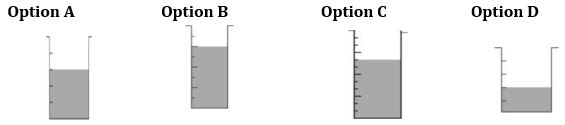
Answer : C
Question. What number is R likely to represent on the number line?
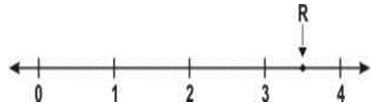
(a) 1/2
(b) 3/4
(c) 4/3
(d) 7/2
Answer : D
Question. The figure shows the length of a new pencil and its length after Seema used it for a day. By what fraction of the original length did the length of the pencil reduce that day?
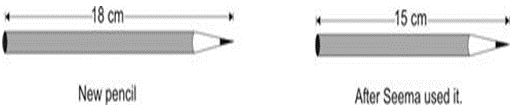
(a) 1/4
(b) 1/5
(c) 1/6
(d) 1/8
Answer : C
Question. 12 children are having a party for which they order some pizzas. Each of them had 1⁄5 a pizza, there is 3⁄5 pizza left over. How many pizzas did the children order?
(a) 2
(b) 3
(c) 5
(d) This is not possible
Answer : B
Question. It is estimated that many adults consume about 28.8 g (about 12 teaspoons) of sodium every day. This quantity is twelve times the amount that is recommended for a healthy heart. According to this, what is the recommended quantity of sodium per day for a healthy heart?
(a) 1 g
(b) 12/5 g
(c) 12 g
(d) 5/12 g
Answer : B
Question. Three quarters of a jug was filled with water. Jyoti poured out half of the water present in the jug into a glass. What part of the jug is filled now?
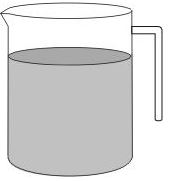
(a) 3/8
(b) 5/8
(c) 1/4
(d) 1/2
Answer : A
Question. On which of these dartboards will you have the best chance of landing your dart on the area marked BLUE"?"
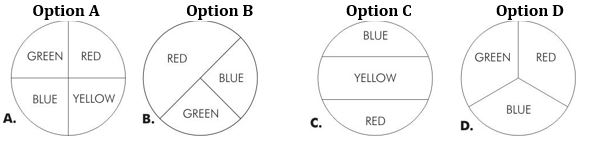
Answer : D
Question. When a number is multiplied by 100 and then divided by 1000, the resultant number is
(a) 1/10 times the original number.
(b) 1/100 of the original number.
(c) 9/100 times the original number.
(d) 10 times the original number.
Answer : A
Question. The piece below is 1 tenth of a chocolate bar. Then, 1 hundredth of the chocolate bar would be equal to

(a) A piece that is 1/10 of the one above
(b) A piece that is 1/100 of the one above
(c) 10 pieces like the one above
(d) 100 pieces like the one above
Answer : A
Question. 3 parathas were cut into 8 equal pieces each and some of the pieces were eaten, leaving the pieces shown in the image. The total number of parathas left is -
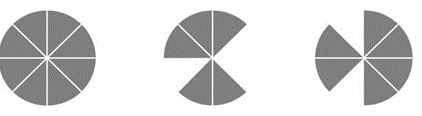
(a) 2
(b) 2 and 1⁄2
(c) 2 and 3⁄8
(d) 11/8
Answer : C
Question. A rectangular piece of paper is taken and folded into two. This is repeated twice as shown in the figure. If the paper is now opened, the creases will divide the paper into how many identical parts?
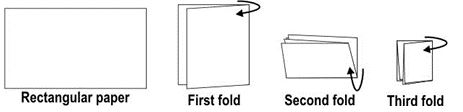
(a) 3
(b) 5
(c) 8
(d) the parts will NOT be identical
Answer : C
Question. If the two bags shown in the figure weigh the same, which of the following would ALSO weigh the same?
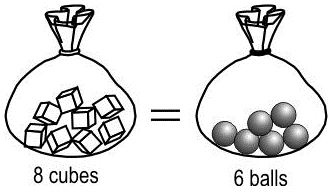
(a) 3 cubes, 2 balls
(b) 5 cubes, 3 balls
(c) 12 cubes, 9 balls
(d) 10 cubes, 8 balls
Answer : C
Question. Nina, Upen, Varun and Geet earn equal monthly salaries. Who saves the greatest amount every month?
| Geet spend 7/8 of his monthly salary every month | Nina spend 3/4 of his monthly salary every month |
| Upen spend 2/3 of his monthly salary every month | Varun spend 5/6 of his monthly salary every month |
(a) Neena
(b) Upen
(c) Varun
(d) Geet
Answer : B
Question. Which of these could have a capacity of about 100 millilitres?
(a) a regular sized water bottle
(b) A Tea Spoon
(c) a medium sized pressure cooker
(d) a very small bowl (katori)
Answer : D
Question. After eating 75% of the chocolates in a box, Dev found 6 chocolates remaining. How many chocolates were there in the box originally?
(a) 8
(b) 24
(c) 36
(d) 48
Answer : B
Question. Geet spend 7/8 of his monthly salary every month
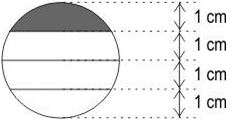
(a) more than ¼
(b) equal to ¼
(c) less than ¼
(d) depends on the radius of the circle
Answer : C
Question. ........ / 21 is a fraction in its lowest form. The value of ........... can be
(a) 6
(b) 7
(c) 14
(d) 16
Answer : D
Question. Half of a certain number is 24. One fourth of the number will be
(a) 6
(b) 8
(c) 12
(d) 48
Answer : C
Question. 5/2 of a lakh can be written as
(a) 25000
(b) 40000
(c) 250000
(d) 520000
Answer : C
Question. Which square has LESS THAN HALF of its area shaded?
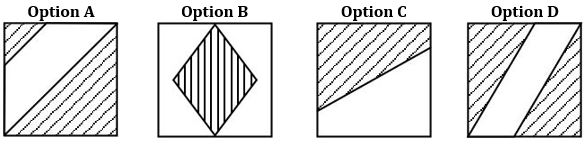
Answer : B
Question. Mrs. Bhole had 2 litres of milk in the fridge this morning.
She used up 3/4 litres of milk in the afternoon. How much milk is left in the fridge after that?
(a) 3/2 litre
(b) 1/4 litre
(c) 1/2 litre
(d) 3/4 litre
Answer : C
Question. The number of boys and girls in 4 sections of class 6 in a certain school are mentioned in the table.
In which two sections is the FRACTION OF GIRLS in the class the same?
| Class | 6A | 6B | 6C | 6D |
| Boys | 20 | 18 | 18 | 19 |
| Girls | 10 | 9 | 8 | 9 |
(a) 6A and 6C
(b) 6B and 6A
(c) 6D and 6C
(d) 6B and 6D
Answer : B
Question. 10 - 4 ÷ 1/2 + 2 equals
(a) 4
(b) 5
(c) 10
(d) 14
Answer : C
Question. A glass of capacity 225 ml is filled with water and this water is then poured into an empty jug of capacity 1 litre. What part of the jug is filled up?
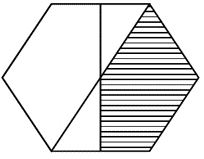
(a) 1/3
(b) 3/4
(c) 5/12
(d) 7/12
Answer : C
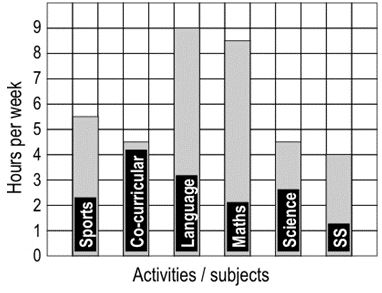
Question. What is the total number of hours the students spend per week on all activities and subjects (excluding breaks, etc.) in Chetana School??
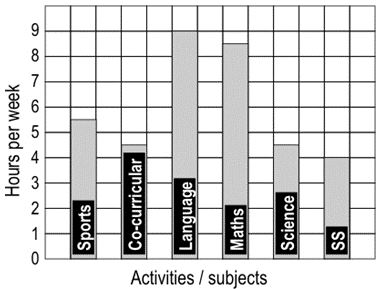
(a) 9
(b) 32
(c) 36
(d) 38
Answer : C
Question. What fraction of a student's weekly time in school is spent on studies?
(a) 2/3
(b) 3/4
(c) 13/18
(d) 15/19
Answer : C
Question. Prashant cuts a watermelon into 12 equal slices and eats 4 of them. If he was to have the same portion of the watermelon for himself with the minimum number of cuts, he should have made
(a) three equal slices and taken one.
(b) four equal slices and taken one.
(c) six equal slices and taken two.
(d) six equal slices and taken two.
Answer : A
Please refer to attached file for Fractions
Free study material for Mathematics
Free CBSE Practice Worksheets: Class 6 Mathematics Chapter 07 Fractions
Download Chapter Worksheets: Class 6 Mathematics
Explore reliable practice questions for Chapter 07 Fractions tailored for Class 6 Mathematics learners. Use these structured worksheets to evaluate exam preparedness and strengthen problem-solving skills throughout the 2026 academic session.
Concept Clarification for Chapter 07 Fractions
Designed around the official curriculum for Class 6 Mathematics, these practice sheets guarantee standard compliance. Reviewing step-by-step solutions after completion sharpens your accuracy and clarifies complex sub-topics within Chapter 07 Fractions.
Effective Revision Strategies for School Exams
Consistent engagement with these exercises builds familiarity with recurring exam themes. If specific areas within Chapter 07 Fractions cause trouble, utilize our dedicated NCERT solutions for Class 6 Mathematics to clear up doubts immediately.
FAQs
You can download the latest chapter-wise printable worksheets for Class 6 Mathematics Chapter 07 Fractions for free from StudiesToday.com. These have been made as per the latest CBSE curriculum for this academic year.
Yes, Class 6 Mathematics worksheets for Chapter 07 Fractions focus on activity-based learning and also competency-style questions. This helps students to apply theoretical knowledge to practical scenarios.
Yes, we have provided solved worksheets for Class 6 Mathematics Chapter 07 Fractions to help students verify their answers instantly.
Yes, our Class 6 Mathematics test sheets are mobile-friendly PDFs and can be printed by teachers for classroom.
For Chapter 07 Fractions, regular practice with our worksheets will improve question-handling speed and help students understand all technical terms and diagrams.