

Class 6 Mathematics Practice Sheet: CBSE Class 6 Mathematics Revision Worksheet Set 01
Review targeted academic worksheets with the CBSE Class 6 Mathematics Revision Worksheet Set 01. Built according to official educational standards for the 2026-27 term, these downloadable Class 6 Mathematics resources support effective daily practice and detailed self-evaluation for All Chapters.
Download All Chapters Worksheet PDF with Answers
Navigate directly to the solved Mathematics worksheets using the digital viewer below. Each practice set includes detailed step-by-step solutions, allowing students to instantly cross-check their work and identify areas requiring further revision.
Prime factorisation
Prime factor A factor of a given number is called a prime factor is a prime number.Example 2 and 3 are prime factors of 12
Prime Factorization
"Prime Factorization" is finding which prime numbers multiply together to make the original number.
Example 1: What are the prime factors of 12
Solution
We have:
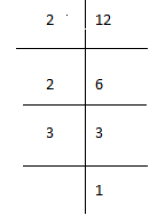
∴ 12 = 2 × 2 × 3
= 22 × 3
The prime factorization of 12 = 22 × 3
Note: 12 = 2 × 2 × 3 can also be written using exponents as 12 = 22 × 3
1. Give the prime factorisation of each of the following numbers:
1. 18
Solve. 18
We have:
∴ 18 = 2 × 3 × 3
= 2 × 32 The prime factorization of 18 = 2 × 32
2. 48
Solve. 48
We have:
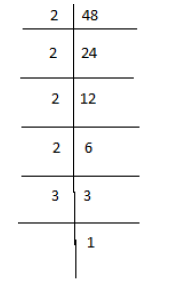
∴ 48 = 2 × 2 × 2 × 2 ×3
= 24 × 3
The prime factorization of 48 = 24 × 3
3. 56
Solve. 56
We have:

∴ 56 = 2 × 2 × 2 × 7
= 23 × 7
The prime factorization of 56 = 23 × 7
4. 90
Solve. 90
We have:
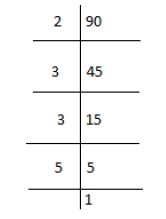
∴ 90 = 2 × 3 × 3 × 5
= 2 × 32 × 5
The prime factorization of 90 = 2 × 32 × 5
5. 136
Solve. 136
We have:
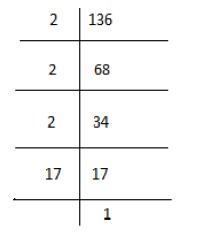
∴ 136 = 2 × 2 × 2 × 17
= 23 × 17
The prime factorization of 136 = 23 × 17
6. 252
Solve. 252
We have:
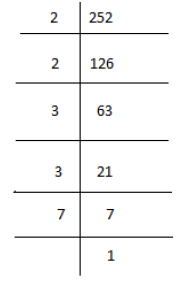
∴ 252 = 2 × 2 × 3 × 3 × 7
= 22 × 32 × 7
The prime factorization of 252 = 22 × 32 × 7
7. 420
Solve. 420
We have:
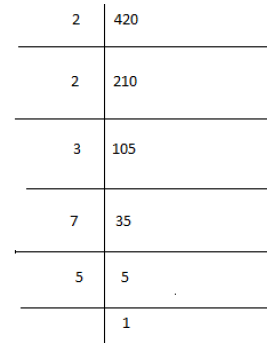
∴ 420 = 2 × 2 × 3 × 7 × 5
The prime factorization of 420 = 22 × 3 × 5 × 7
8. 637
Solve. 637
We have:

∴ 637 = 7 × 7 × 13 = 72 × 13
The prime factorization of 637 = 72 × 13
9. 945
Solve. 945
We have:
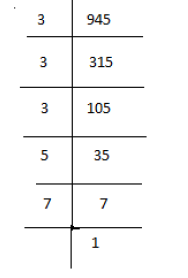
∴ 945 = 3 × 3 × 3 × 5 × 7
= 33 × 5 × 7
The prime factorization of 945 = 33 × 5 × 7
1. Which of the following numbers is divisible by 3?
(a) 24357806 (b) 35769812 (c) 83479560 (d) 3336433
2. Which of the following number is divisible by 9?
(a) 8576901 (b) 96345210 (c) 67594310 (d) None
3. Which of the following number is divisible by 4?
(a) 78653234 (b) 98765042 (c) 24689602 (d) 87941032
4. Which of the following number is divisible by 8?
(a) 96354142 (b) 37450176 (c) 57064214 (d) None
5. Which of the following number is divisible by 6?
(a) 8790432 (b) 98671402 (c) 85492014 (d) None
6. Which of the following number is divisible by 11?
(a) 3333333 (b) 1111111 (c) 22222222 (d) None
7. Which of the following number is a prime number ?
(a) 81 (b) 82 (c) 91 (d) 97
8. Which of the following number is a prime number ?
(a) 117 (b) 171 (c) 179 (d) None
9. Which of the following number is a prime number ?
(a) 323 (b) 361 (c) 263 (d) None
10. Which of the following number is a co-prime?
(a) 8, 12 (b) 9, 10 (c) 6, 8 (d) 15, 18
CHAPTER : 10 TIME
Fill in the blanks:-
Question 1. 1 hour = ____________ minutes
Answer: 1 hour = 60 minutes
In simple words: There are 60 minutes in a single hour.
Exam Tip: Memorize the conversion factor: 1 hour = \(60\) minutes.
Question 2. 1 hour = ____________ seconds
Answer: 1 hour = 3600 seconds
In simple words: Since 1 hour = 60 minutes and 1 minute = 60 seconds, multiply \(60 \times 60\) to get 3600 seconds.
Exam Tip: Calculate seconds in an hour as \(60 \times 60 = 3600\) seconds.
Question 3. 1 minute = ____________ seconds
Answer: 1 minute = 60 seconds
In simple words: Every minute has 60 seconds.
Exam Tip: Standard time unit: 1 minute = \(60\) seconds.
Question 4. 1 day = ____________ hours.
Answer: 1 day = 24 hours
In simple words: A full day and night cycle lasts 24 hours.
Question 5. The time between 12 midnight to 12 noon is called ____________
Answer: The time between 12 midnight to 12 noon is called a.m. (ante meridiem)
In simple words: Morning hours before midday are designated as a.m.
Exam Tip: Use a.m. for the morning period from midnight to noon.
Question 6. The time between 12 noon to 12 midnight is called ____________
Answer: The time between 12 noon to 12 midnight is called p.m. (post meridiem)
In simple words: Afternoon and evening hours after midday are designated as p.m.
Exam Tip: Use p.m. for the afternoon and night period from noon to midnight.
Question 7. a.m. stands for ____________
Answer: a.m. stands for ante meridiem (before midday)
In simple words: It represents the time before noon.
Exam Tip: Learn the Latin root: Ante Meridiem means before midday.
Question 8. p.m. stands for ____________
Answer: p.m. stands for post meridiem (after midday)
In simple words: It represents the time after noon.
Exam Tip: Learn the Latin root: Post Meridiem means after midday.
Question 9. We should not write a.m. or p.m. for the time ____________.
Answer: We should not write a.m. or p.m. for 12 noon or 12 midnight.
In simple words: Exactly at 12 noon or 12 midnight, neither ante meridiem nor post meridiem applies directly, so we write "12 noon" or "12 midnight".
Exam Tip: Always write words ("12 noon" or "12 midnight") instead of a.m./p.m. at those exact hours.
Question 10. 7:00 a.m. = ____________ hours.
Answer: 07:00 hours
In simple words: Morning times up to 12:59 are written in 24-hour format by keeping the same digits with a zero in front if needed.
Exam Tip: For morning times (a.m.), simply format as a 4-digit number (e.g., 07:00 hours).
Question 11. 12:15 a.m. = ____________ hours.
Answer: 00:15 hours
In simple words: 12 midnight in 24-hour clock format is written as 00 hours, so 12:15 a.m. is 00:15 hours.
Exam Tip: 12 midnight hour converts to 00 in 24-hour time.
Question 12. 11:40 a.m. = ____________ hours.
Answer: 11:40 hours
In simple words: Morning times before 12 noon remain the same in 24-hour format.
Exam Tip: Do not add 12 to hours before noon.
Question 13. 17:00 hours = ____________ (12 hour clock)
Answer: 5:00 p.m.
In simple words: Since 17:00 is greater than 12:00, subtract 12 to get 5:00 and label it p.m. (\(17 - 12 = 5\)).
Exam Tip: Subtract 12 from any 24-hour time greater than 12:00 and add p.m.
Question 14. 00:10 hours = ____________ (12 hour clock)
Answer: 12:10 a.m.
In simple words: 00 hours represents midnight (12), so 00:10 is 12:10 in the morning (a.m.).
Exam Tip: 00 hours converts to 12:-- a.m.
Question 15. 21:45 hours = ____________ (12 hour clock)
Answer: 9:45 p.m.
In simple words: Subtract 12 from 21:45 to get 9:45 and designate it as p.m. (\(21 - 12 = 9\)).
Exam Tip: Subtract 12 from hours above 12 to convert to 12-hour p.m. time.
Do the following
Question 1. Give the time. Use a.m. or p.m.
a) Dinner time
b) Waking up time
c) Breakfast time
Answer:
a) Dinner time: Looking at clock hands (short hand near 8, long hand near 12), time is 8:00 p.m.
b) Waking up time: Looking at clock hands (short hand near 6, long hand near 12), time is 6:00 a.m.
c) Breakfast time: Looking at clock hands (short hand near 7, long hand near 12), time is 7:00 a.m.
In simple words: Dinner happens at night (p.m.), while waking up and breakfast happen in the morning (a.m.).
Exam Tip: Always associate daily activities with their correct part of the day (morning = a.m., evening/night = p.m.).
Question 2. Fill in the blanks with a.m. or p.m.
a) Aneesha's school has break time at 10:15 ____________
b) Arvind's school starts at 8:45 ____________
c) Kareem's school gets over at 3:30 ____________
d) Beenu has lunch at 2:00 ____________
e) The sun sets at 6:30 ____________
Answer:
a) 10:15 a.m.
b) 8:45 a.m.
c) 3:30 p.m.
d) 2:00 p.m.
e) 6:30 p.m.
In simple words: Morning school activities use a.m., while afternoon/evening events like afternoon school dismissal, lunch, and sunset use p.m.
Exam Tip: Hours before 12 noon are a.m., and hours after 12 noon are p.m.
Question 3. Is it daylight or darkness at the following times?
a) 4:15 p.m.
b) 1:30 a.m.
c) 3:20 a.m.
d) 12:45 p.m.
e) 12:00 noon
Answer:
a) 4:15 p.m. - Daylight
b) 1:30 a.m. - Darkness
c) 3:20 a.m. - Darkness
d) 12:45 p.m. - Daylight
e) 12:00 noon - Daylight
In simple words: Afternoon hours have sunlight (daylight), while early morning hours before sunrise are dark.
Exam Tip: Remember that night hours (midnight to early morning) are dark, and daytime hours have daylight.
Question 4. What is the time? Use a.m. or p.m.
a) 2 hours before 9:30 a.m.
b) 1 hour after 6:40 p.m.
c) 4 hours before 12 midnight.
d) 3 hours after 8:05 a.m.
Answer:
a) 2 hours before 9:30 a.m. = 7:30 a.m.
b) 1 hour after 6:40 p.m. = 7:40 p.m.
c) 4 hours before 12 midnight = 8:00 p.m.
d) 3 hours after 8:05 a.m. = 11:05 a.m.
In simple words: Add hours for "after" time and subtract hours for "before" time.
Question 5. Rewrite these sentences using 24 hour clock.
a) Mrs Kaul goes for jogging at 5:45 a.m.
b) The night show starts at 9:00 p.m.
c) Rahul's tuition class begins at 8:30 a.m.
d) The flight was delayed and came at 1:55 p.m.
Answer:
a) 05:45 hours
b) 21:00 hours (\(9 + 12 = 21\))
c) 08:30 hours
d) 13:55 hours (\(1 + 12 = 13\))
In simple words: Keep morning times the same with leading zeros; add 12 to p.m. hours (except 12 noon/midnight).
Exam Tip: Always write 24-hour clock times using four digits (e.g., 05:45 hours).
Question 6. Is it daylight or darkness?
a) 00:30 hours.
b) 21:45 hours
c) 15:00 hours.
d) 13:40 hours.
e) 04:35 hours.
f) 08:20 hours.
Answer:
a) 00:30 hours (12:30 a.m.) - Darkness
b) 21:45 hours (9:45 p.m.) - Darkness
c) 15:00 hours (3:00 p.m.) - Daylight
d) 13:40 hours (1:40 p.m.) - Daylight
e) 04:35 hours (4:35 a.m.) - Darkness
f) 08:20 hours (8:20 a.m.) - Daylight
In simple words: Convert to 12-hour time to easily tell if it is daytime or nighttime.
Exam Tip: Hours between 06:00 and 18:00 generally represent daylight.
Question 7. Write out both the 12 hour clock and the 24 hour clock for every hour starting from 12 noon upto 12 noon the next day.
Answer:
12:00 noon - 12:00 hours
1:00 p.m. - 13:00 hours
2:00 p.m. - 14:00 hours
3:00 p.m. - 15:00 hours
4:00 p.m. - 16:00 hours
5:00 p.m. - 17:00 hours
6:00 p.m. - 18:00 hours
7:00 p.m. - 19:00 hours
8:00 p.m. - 20:00 hours
9:00 p.m. - 21:00 hours
10:00 p.m. - 22:00 hours
11:00 p.m. - 23:00 hours
12:00 midnight - 00:00 hours
1:00 a.m. - 01:00 hours
2:00 a.m. - 02:00 hours
3:00 a.m. - 03:00 hours
4:00 a.m. - 04:00 hours
5:00 a.m. - 05:00 hours
6:00 a.m. - 06:00 hours
7:00 a.m. - 07:00 hours
8:00 a.m. - 08:00 hours
9:00 a.m. - 09:00 hours
10:00 a.m. - 10:00 hours
11:00 a.m. - 11:00 hours
12:00 noon - 12:00 hours
In simple words: List each consecutive hour across 24 hours, adding 12 for p.m. hours.
Exam Tip: Verify that you list exactly 24 hourly steps from noon to the next noon.
Free study material for Mathematics
All Chapters Printable Worksheets and Exercises for Class 6 Mathematics
Mastering All Chapters with Printable Worksheets
Access structured practice worksheets for All Chapters aligned with the 2026 CBSE curriculum. These downloadable exercises for Class 6 Mathematics help students build accuracy and reinforce core concepts for upcoming school tests.
Verified Solutions and NCERT Alignment
Each worksheet draws directly from authorized standard textbooks to maintain academic accuracy. Evaluating your finished exercises against expert-verified solutions helps master the formal presentation standards expected in school evaluations.
Additional Study Resources for Class 6 Mathematics
Wrap up your chapter revision by testing your knowledge against standard objective question formats. Explore our full library of free, up-to-date printable assignments to maximize your academic results in upcoming CBSE evaluations.
FAQs
You can download the latest chapter-wise printable worksheets for Class 6 Mathematics All Chapters for free from StudiesToday.com. These have been made as per the latest CBSE curriculum for this academic year.
Yes, Class 6 Mathematics worksheets for All Chapters focus on activity-based learning and also competency-style questions. This helps students to apply theoretical knowledge to practical scenarios.
Yes, we have provided solved worksheets for Class 6 Mathematics All Chapters to help students verify their answers instantly.
Yes, our Class 6 Mathematics test sheets are mobile-friendly PDFs and can be printed by teachers for classroom.
For All Chapters, regular practice with our worksheets will improve question-handling speed and help students understand all technical terms and diagrams.