

Download Class 6 Mathematics Practice Worksheets
Access comprehensive chapter-wise worksheets for Chapter 05 Understanding Elementary Shapes using the CBSE Class 6 Mathematics Understanding Elementary Shapes Worksheet Set 02. Designed to align with the 2026-27 academic syllabus for Class 6 Mathematics, these printable practice sets help students reinforce key concepts and improve their overall exam readiness.
Access Chapter 05 Understanding Elementary Shapes Practice Papers and Solutions
Access the complete worksheet PDF for Class 6 Mathematics below. Regular practice with these targeted academic tasks builds familiarity with standard question patterns and helps secure higher marks in final school examinations.
Question. In a \( \Delta\text{ABC} \), \( \text{AB} = 12\text{ cm} \), \( \text{BC} = 13\text{ cm} \), \( \text{AC} = 5\text{ cm} \) and \( \angle\text{C} = 90^\circ \). Classify the triangle according to sides and angle.
Answer:
• Classification according to sides: Since all three sides are of different lengths (\( \text{AB} \neq \text{BC} \neq \text{AC} \)), it is a Scalene triangle.
• Classification according to angle: Since one angle is a right angle (\( \angle\text{C} = 90^\circ \)), it is a Right-angled triangle.
Therefore, \( \Delta\text{ABC} \) is a Right-angled scalene triangle.
Question. State the following as true or false .Correct the statement if false.
(a) An obtuse angle is \( < 90^\circ \).
(b) A measure of a complete angle is \( 360^\circ \).
(c) Straight angle lies between one fourth and half of a revolution.
Answer:
(a) False. Correct statement: An obtuse angle is greater than \( 90^\circ \) and less than \( 180^\circ \) (an angle less than \( 90^\circ \) is an acute angle).
(b) True. The measure of a complete angle is \( 360^\circ \).
(c) False. Correct statement: A straight angle is equal to half of a revolution (\( 180^\circ \)), whereas an angle that lies between one-fourth and half of a revolution is an obtuse angle.
Question. If \( \text{BD} = 2\text{BA} + \text{AD} \), \( \text{LM} = 3\text{LP} - \text{PM} \) and \( \text{BA} = 3\text{ cm} \), \( \text{AD} = 2.5\text{ cm} \), \( \text{LP} = 4\text{ cm} \) and \( \text{PM} = 1.5\text{ cm} \), find which is one is greater BD or LM?
Answer:
Calculating the value of \( \text{BD} \):
\[ \text{BD} = 2(3\text{ cm}) + 2.5\text{ cm} = 6\text{ cm} + 2.5\text{ cm} = 8.5\text{ cm} \]
Calculating the value of \( \text{LM} \):
\[ \text{LM} = 3(4\text{ cm}) - 1.5\text{ cm} = 12\text{ cm} - 1.5\text{ cm} = 10.5\text{ cm} \]
Comparing the two lengths:
\( 10.5\text{ cm} > 8.5\text{ cm} \implies \text{LM} > \text{BD} \)
Therefore, LM is greater.
Question. If an angle “x” possesses the attribute that it is a straight line and another angle “y” is made by a vertical line and horizontal line. The angles “x” and “y” are
(a) right angle and straight angle
(b) obtuse angle and acute angle
(c) straight angle and right angle
(d) straight angle and obtuse angle
Answer: (c) straight angle and right angle
Question. In the given figure \( \angle\text{BOE} \) represents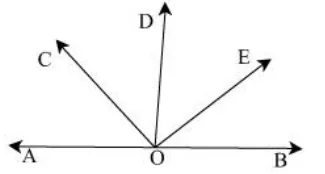
(a) An acute angle
(b) a right angle
(c) an obtuse angle
(d) a straight angle
Answer: (a) An acute angle
Question. How many lines are perpendicular to the line q in the given figure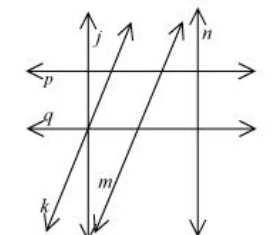
(a) 1
(b) 2
(c) 3
(d) 4
Answer: (b) 2
Question. With respect to the figure given above, which of the following figure is an acute angle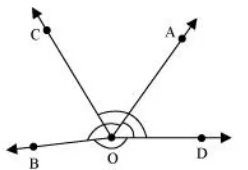
(a) \( \angle\text{AOD} \)
(b) \( \angle\text{COD} \)
(c) \( \angle\text{AOB} \)
(d) \( \angle\text{BOD} \)
Answer: (a) \( \angle\text{AOD} \)
Question. Which of the following statements is incorrect with respect to the given figure?
(a) \( \text{PT} = \text{WZ} \)
(b) \( \text{QS} = \text{UW} = \text{XZ} \)
(c) \( \text{T} \) is the mid-point of \( \text{QW} \)
(d) \( \text{X} \) is the mid-point of \( \text{WZ} \)
Answer: (a) \( \text{PT} = \text{WZ} \)
Question. A three dimensional figure which has two bases of identical polygons which are separated by equal distances and whose lateral faces are rectangular in shape is a
(a) prism
(b) pyramid
(c) sphere
(d) cylinder
Answer: (a) prism
Choose the correct option:-
Q1 The angle formed between the east and the north direction is___________
a) 60°
b) 80°
c) 90°
d) 180°
Q2 A triangle can have _______ right angles.
a) One
b) Two
c) Three
d) None of these
Q3 If a bicycle wheel has 36 spokes , then the angle between a pair of adjacent spokes is
a) 10°
b) 15°
c) 12°
d) 20°
Q4 An angle more than 180° and less than 270° is called
a) Zero angle
b) Right angle
c) Reflex angle
d) Straight angle
Q5 What fraction of a clockwise revolution does the hour hand of a clock turn through, when it goes from
(a) 6 to 12
(b) 5 to 8
Q6 Which direction will you face if you start facing
(i) West and make
of a revolution clockwise?
(ii) East and make one full revolution?
Q7 What part of a revolution have you turned through if you stand facing
(i) North and turn clockwise to face west?
(ii) South and turn anticlockwise to face west?
Q8 Where will the hour hand of a clock stop if it starts:
(i) from 7 and turns through 1 right angle?
(ii) from 11 and turns through 3 right angles?
Q9 Fill in the blanks using appropriate signs (< , > or = )
(i) The measure of one complete angle……………… 360˚
(ii) The measure of reflex angle ………………… 180˚
(iii) The measure of an obtuse angle …………………90˚
(iv) The measure of an acute angle …………………..90˚
(v) The measure of right angle …………………….90˚
Q10 Write all the alphabets that are made of perpendicular lines.
Q11 Name the type of triangles:
(i) 6.5 cm, 8cm, 8.5 cm
(ii) 9 cm, 9 cm, 9 cm
(iii) 30˚, 60˚, 90˚
(iv) 99˚, 50˚, 31˚
(v) 46˚, 58˚, 76˚
(vi) ΔABC with ∠ B=90˚, AB = BC = 6cm
Q12 Fill in the blanks:
(i) The opposite sides of a rectangle are …………..
(ii) A rectangle whose adjacent sides are equal is called………………….
(iii) The opposite sides of a parallelogram are ………………… and …………………..
(iv) A …………….. is a rectangle with a pair of adjacent sides equal.
(v) One right angle = …………… of a revolution
Q13 Make the statement true using ‘All’ or ‘some’ or ‘no’
(i) …………….parallelograms are also quadrilaterals.
(ii) ………………….parallelograms are also trapeziums.
(iii) …………………..rhombuses are squares.
(iv) ………………….trapeziums are quadrilaterals.
(v) …………………..squares are rhombuses.
(vi) …………………trapeziums are isosceles.
(vii) ……………….equilateral triangles are isosceles.
Q14 Define a regular polygon.
Q15 Give two examples of each from your daily life: Cuboid, Cone, Cube, Cylinder, Sphere
Q16 Complete the following table:
| S.No | Solid Figure | Vertices | Faces | Edges |
| 1 | Cuboid | |||
| 2 | Cone | |||
| 3 | Cube | |||
| 4 | Cylinder | |||
| 5 | Sphere | |||
| 6 | Triangular Pyramid | |||
| 7 | Square Pyramid | |||
| 8 | Triangular Prism |
Free study material for Mathematics
Download Class 6 Mathematics Chapter 05 Understanding Elementary Shapes Practice Worksheets
Daily Practice Questions for Class 6 Mathematics
Access structured practice worksheets for Chapter 05 Understanding Elementary Shapes aligned with the 2026 CBSE curriculum. These downloadable exercises for Class 6 Mathematics help students build accuracy and reinforce core concepts for upcoming school tests.
Detailed Answers for Class 6 Mathematics Chapter 05 Understanding Elementary Shapes
Built using official NCERT guidelines for Class 6 Mathematics, these practice sheets provide reliable academic support. Cross-reference your completed work with our detailed solutions to learn standard answer-writing formats for CBSE exams.
Complete Your Chapter Revision
Consistent engagement with these exercises builds familiarity with recurring exam themes. If specific areas within Chapter 05 Understanding Elementary Shapes cause trouble, utilize our dedicated NCERT solutions for Class 6 Mathematics to clear up doubts immediately.
FAQs
You can download the latest chapter-wise printable worksheets for Class 6 Mathematics Chapter 05 Understanding Elementary Shapes for free from StudiesToday.com. These have been made as per the latest CBSE curriculum for this academic year.
Yes, Class 6 Mathematics worksheets for Chapter 05 Understanding Elementary Shapes focus on activity-based learning and also competency-style questions. This helps students to apply theoretical knowledge to practical scenarios.
Yes, we have provided solved worksheets for Class 6 Mathematics Chapter 05 Understanding Elementary Shapes to help students verify their answers instantly.
Yes, our Class 6 Mathematics test sheets are mobile-friendly PDFs and can be printed by teachers for classroom.
For Chapter 05 Understanding Elementary Shapes, regular practice with our worksheets will improve question-handling speed and help students understand all technical terms and diagrams.