

Class 6 Mathematics Practice Sheet: CBSE Class 6 Mathematics Symmetry Worksheet Set 02
Access comprehensive chapter-wise worksheets for Chapter 09 Symmetry using the CBSE Class 6 Mathematics Symmetry Worksheet Set 02. Designed to align with the 2026-27 academic syllabus for Class 6 Mathematics, these printable practice sets help students reinforce key concepts and improve their overall exam readiness.
Download Chapter 09 Symmetry Worksheet PDF with Answers
View or download the dedicated CBSE Class 6 Mathematics Symmetry Worksheet Set 02 resource below. Engaging with these practice papers under focused study conditions ensures continuous academic progress and mastery of the 2026-27 curriculum for Chapter 09 Symmetry.
Symmetry
Question 1. Can you draw a triangle which has
a) exactly one line of symmetry
b) exactly two lines of symmetry?
c) exactly three lines of symmetry?
d) no lines of symmetry?
Answer: a) Yes, an isosceles triangle has exactly one line of symmetry.
b) No, it is not possible to draw a triangle with exactly two lines of symmetry.
c) Yes, an equilateral triangle has exactly three lines of symmetry.
d) Yes, a scalene triangle has no lines of symmetry.
In simple words: Different types of triangles have different numbers of lines of symmetry based on their side lengths.
Exam Tip: Remember that an isosceles triangle has 1 line of symmetry, an equilateral triangle has 3, and a scalene triangle has 0.
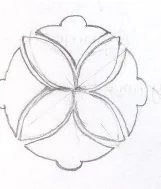
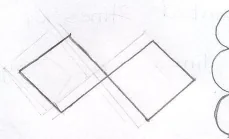
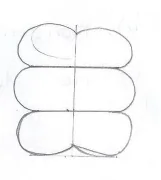
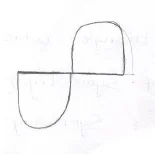
Question 2. Find the number of lines of symmetry in each of the following shapes?
Answer: Counting the lines of symmetry for each given shape from left to right:
1. First shape (four-petaled flower design): 4 lines of symmetry.
2. Second shape (interlocking diamond/square pattern): 2 lines of symmetry.
3. Third shape (capsule/pill shape with horizontal/vertical lobes): 2 lines of symmetry (one horizontal, one vertical).
4. Fourth shape (curved S-like ribbon shape): 0 lines of symmetry (it has rotational symmetry of order 2, but no line symmetry).
5. Fifth shape (swastika / pinwheel shape): 0 lines of symmetry (it has rotational symmetry, but no line symmetry).
6. Sixth shape (hexagon): 2 lines of symmetry (one vertical and one horizontal).
7. Seventh shape (square with a circle and a six-pointed star inside): 2 lines of symmetry.
8. Eighth shape (double-ended vertical arrow): 2 lines of symmetry (one vertical and one horizontal).
In simple words: A line of symmetry divides a shape into two identical, mirror-image halves.
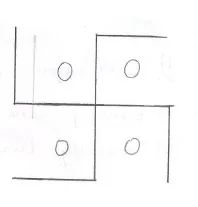
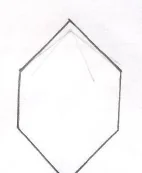
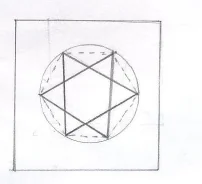
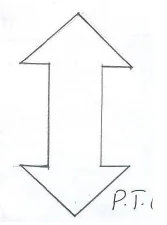
Exam Tip: Always check both horizontal and vertical directions, as well as diagonal lines, when counting lines of symmetry in complex figures.
Question 3. Consider the letters of English alphabets, A to Z. List among them the letters which have
a) Vertical lines of symmetry
b) Horizontal lines of symmetry
c) No lines of symmetry
Answer:
a) Vertical lines of symmetry: A, H, I, M, O, T, U, V, W, X, Y
b) Horizontal lines of symmetry: B, C, D, E, H, I, K, O, X
c) No lines of symmetry: F, G, J, L, N, P, Q, R, S, Z
In simple words: Capital letters can be symmetrical vertically, horizontally, both, or neither.
Question 4. Complete the following table:
Answer:
| Sl No. | Shape | Rough Figure | Number of lines of symmetry |
|---|---|---|---|
| 1. | Equilateral triangle | Triangle with 3 equal sides | 3 |
| 2. | Square | Quadrilateral with 4 equal sides and 90-degree angles | 4 |
| 3. | Rectangle | Quadrilateral with opposite sides equal and 90-degree angles | 2 |
| 4. | Isosceles Triangle | Triangle with 2 equal sides | 1 |
| 5. | Rhombus | Quadrilateral with 4 equal sides | 2 |
| 6. | Circles | Round shape with constant radius | Infinite |
| 7. | Parallelogram | Quadrilateral with opposite sides parallel | 0 |
| 8. | Scalene Triangle | Triangle with 3 unequal sides | 0 |
Exam Tip: A circle has an infinite number of lines of symmetry because every line passing through its center is a line of symmetry.
Question 5. Write some application of symmetry in everyday life.
Answer:
Some common applications of symmetry in everyday life include:
1. Architecture and Design: Buildings, bridges, monuments (like the Taj Mahal), and tile patterns often use symmetry for aesthetic appeal and structural balance.
2. Art and Rangoli: Traditional Indian rangoli designs, kolams, and various cultural art forms rely heavily on symmetrical patterns.
3. Nature: Flowers, leaves, butterflies, and the human body exhibit natural bilateral or radial symmetry.
4. Engineering and Manufacturing: Automobiles, airplanes, tools, and household items are designed with symmetry for aerodynamics, balance, and ease of use.
In simple words: Symmetry makes objects look balanced, beautiful, and stable both in nature and human-made designs.
Exam Tip: Give real-world examples such as buildings, leaves, or vehicles to score full marks in descriptive questions.
Free study material for Mathematics
Free CBSE Practice Worksheets: Class 6 Mathematics Chapter 09 Symmetry
Daily Practice Questions for Class 6 Mathematics
Explore reliable practice questions for Chapter 09 Symmetry tailored for Class 6 Mathematics learners. Use these structured worksheets to evaluate exam preparedness and strengthen problem-solving skills throughout the 2026 academic session.
Detailed Answers for Class 6 Mathematics Chapter 09 Symmetry
Built using official NCERT guidelines for Class 6 Mathematics, these practice sheets provide reliable academic support. Cross-reference your completed work with our detailed solutions to learn standard answer-writing formats for CBSE exams.
Complete Your Chapter Revision
Follow up your worksheet practice by attempting the interactive online MCQ tests for Chapter 09 Symmetry to evaluate your execution speed. All printable assignments and revision sheets on our platform are updated for the 2026 session and available free of charge.
FAQs
You can download the latest chapter-wise printable worksheets for Class 6 Mathematics Chapter 09 Symmetry for free from StudiesToday.com. These have been made as per the latest CBSE curriculum for this academic year.
Yes, Class 6 Mathematics worksheets for Chapter 09 Symmetry focus on activity-based learning and also competency-style questions. This helps students to apply theoretical knowledge to practical scenarios.
Yes, we have provided solved worksheets for Class 6 Mathematics Chapter 09 Symmetry to help students verify their answers instantly.
Yes, our Class 6 Mathematics test sheets are mobile-friendly PDFs and can be printed by teachers for classroom.
For Chapter 09 Symmetry, regular practice with our worksheets will improve question-handling speed and help students understand all technical terms and diagrams.