

Chapter-wise Worksheets for Class 6 Mathematics: Chapter 04 Basic Geometrical Ideas
Access comprehensive chapter-wise worksheets for Chapter 04 Basic Geometrical Ideas using the CBSE Class 6 Mathematics Basic Geometrical Concepts Worksheet Set 06. Designed to align with the 2026-27 academic syllabus for Class 6 Mathematics, these printable practice sets help students reinforce key concepts and improve their overall exam readiness.
Practice Class 6 Mathematics Worksheets: Chapter 04 Basic Geometrical Ideas
View or download the dedicated CBSE Class 6 Mathematics Basic Geometrical Concepts Worksheet Set 06 resource below. Engaging with these practice papers under focused study conditions ensures continuous academic progress and mastery of the 2026-27 curriculum for Chapter 04 Basic Geometrical Ideas.
Question 1. Two lines perpendicular to the same line are
(a) Parallel
(b) intersecting
(c) concurrent
(d) none of the options
Answer: (a) Parallel
If two lines are perpendicular to the same given line, they are always parallel to each other in a plane.
In simple words: Lines that make right angles with the same straight line never meet and are parallel.
Exam Tip: Remember the geometric theorem: Two distinct lines perpendicular to the same line are parallel to each other.
Question 2. Three or more points are collinear if they lie on the
(a) Same surface
(b) two lines
(c) same line
(d) none of the options
Answer: (c) same line
By definition, collinear points are three or more points that lie on a single straight line.
In simple words: Points that sit on the exact same straight line are called collinear.
Exam Tip: "Collinear" comes from 'co' (together) + 'linear' (line).
Question 3. A figure in which the initial and the end points coincide with each other is a _________ figure.
(a) Open
(b) congruent
(c) closed
(d) none of the options
Answer: (c) closed
A closed figure or curve starts and ends at the same point with no open ends.
In simple words: If you trace a loop and end up where you started, it is a closed figure.
Question 4. Choose the false statement:-
(a) Line AB is the same as line BA
(b) Ray AB is the same as ray BA
(c) Line segment AB is the same as line segment BA
Answer: (b) Ray AB is the same as ray BA
A ray has a fixed starting point and extends infinitely in one direction. Ray AB starts at A and goes through B, whereas ray BA starts at B and goes through A. Hence, they are different rays.
In simple words: Rays have a starting point, so direction matters. Ray AB and ray BA point in opposite directions.
Exam Tip: Lines and line segments can be reversed in name (AB = BA), but rays cannot.
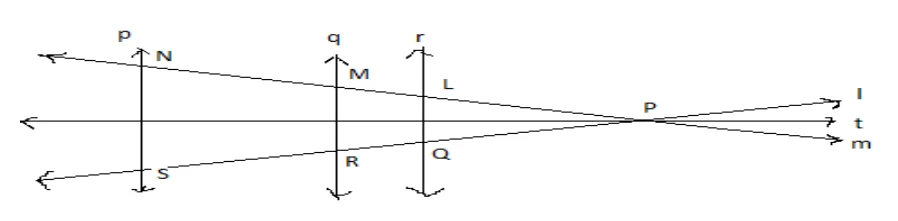
Question 5. From the Figure 1 , Name
a) Collinear Points
b) Lines intersecting at P
c) Two pairs of parallel lines
d) Lines passing through both the points M and R.
e) a pair of lines intersecting at L
f) three concurrent lines with their point of concurrency.
Answer:
a) Collinear Points: Points on line segment or line (e.g., points p, n, s on line p or points q, m, r on line q).
b) Lines intersecting at P: Lines \(l\) and \(t\) (or lines intersecting at point P on the right side).
c) Two pairs of parallel lines: Line \(p\) and line \(q\).
d) Lines passing through both the points M and R: Line \(q\).
e) A pair of lines intersecting at L: Line \(r\) and line \(m\) (the slanted line through N, M, L and P).
f) Three concurrent lines with their point of concurrency: Lines passing through point P on the right side (\(l, t, m\)).
In simple words: Use the labels in Figure 1 to identify which points lie together and which lines cross each other.
Exam Tip: Trace each line carefully with your pencil while reading the diagram labels.
Question 6. Illustrate each one of the following with a rough diagram
a) A closed curve which is not a polygon.
b) A closed curve which is not a simple curve.
c) An open curve which is not a simple curve
d) A polygon with five equal sides.
Answer:
a) A circle or an ellipse (closed curve made of curved lines, not line segments).
b) A figure-eight curve (a closed curve that crosses itself).
c) A curved line that intersects itself and has open ends (like a figure-eight open at one end).
d) A regular pentagon (a five-sided polygon with all equal sides and equal angles).
In simple words: Draw sketches according to whether the shape is closed, crosses over itself, or has straight sides.
Exam Tip: Polygons are made strictly of straight line segments.
Question 7. State True or False
a) The center of a circle is one of the points of the circle.
b) The diameter of a circle may not pass through the center.
c) A Radius is a chord of a circle.
d) Any diameter of a circle is twice its radius.
e) Every chord of a circle is parallel to some diameter of the circle.
Answer:
a) False (The center is in the interior, not on the boundary circle itself).
b) False (By definition, a diameter must pass through the center).
c) False (A radius connects the center to the boundary; a chord connects two points on the boundary).
d) True (Diameter = \(2 \times \text{Radius}\)).
e) False (Not every chord is parallel to a diameter; chords can be at any angle).
In simple words: Check basic circle definitions: center is inside, diameter passes through the center and equals twice the radius.
Exam Tip: Memorize circle parts: radius, diameter, chord, arc, and sector.
Question 8. Identify a point, a line, a plane or a curved surface from the following objects
a) Vertex of a set square in a geometry box.
b) A wall of a room
c) An edge of the table top
d) Surface of a football
e) Tip of a needle.
Answer:
a) Point
b) Plane
c) Line (or line segment)
d) Curved surface
e) Point
In simple words: Match physical objects to their ideal geometric shapes.
Exam Tip: A sharp tip represents a point, and a flat wall represents a plane.
Question 9. Draw any circle and mark
a) Its center
b) A radius
c) A diameter
d) A segment
e) A point in its interior
f) A point in its exterior
g) An arc
h) A sector
i) A chord
j) Any point on the boundary of the circle.
Answer:
Draw a circle with center O. Mark point O as center, line segment from O to boundary as radius, line segment passing through O across the circle as diameter, a point P inside, point Q outside, a curved piece on the boundary as an arc, a region bounded by two radii and an arc as a sector, a line segment joining two boundary points as a chord, and a point R on the boundary circle.
In simple words: Draw a round circle and label each required part clearly inside and around it.
Exam Tip: Use a sharp compass to draw a neat circle.
Question 10. In the given figure name :
(a) The line in as many ways as possible.
(b) Three points on the line.
(c) Two line segments.
Answer:
(a) Line AB, line AC, line AD, line BC, line BD, line CD (and reverse orders like BA, CA, DA, etc.).
(b) Points A, B, C (or D).
(c) Line segment AB, line segment CD (or AC, BD, etc.).
In simple words: Name the line using any two points on it, list any three marked points, and pick two line segments.

Exam Tip: A line can be named by any two points lying on it.
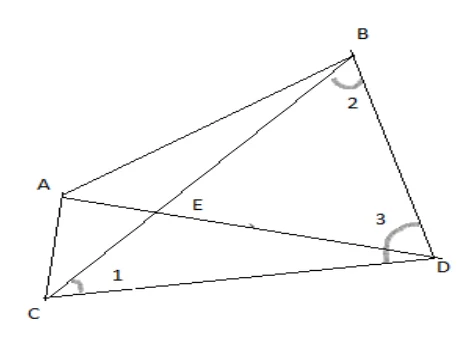
Question 11. In Figure 2 , Name
a) the polygon
b) all sides
c) all vertices
d) two pair of adjacent sides
e) a pair of adjacent vertices
f) all diagonals of the polygon
g) a pair of opposite sides
h) full name of angles 1, 2, 3
Answer:
a) Polygon ABCDE (or quadrilateral/pentagon as shown in Figure 2).
b) Sides: AB, BC, CD, DE, EA.
c) Vertices: A, B, C, D, E.
d) Adjacent sides: AB and BC, BC and CD.
e) Adjacent vertices: A and B (or B and C).
f) Diagonals: AC, AD, BD, BE, etc. (interior connecting lines not forming sides).
g) Opposite sides: AB and CD (or AE and CD depending on polygon type).
h) Angle 1 = angle ACB, Angle 2 = angle ABD, Angle 3 = angle BDE (or corresponding vertex notation from figure).
In simple words: Read the vertex letters from Figure 2 to name the polygon's parts.
Exam Tip: Adjacent sides share a common vertex.
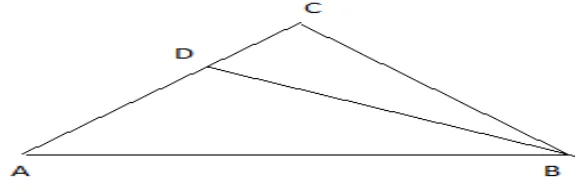
Question 12. In Figure 3
a) Name three triangles
b) Name seven angles
c) Name the triangles having \(\angle\) A common.
d) Name the triangles having \(\angle\) C common
Answer:
a) Triangles: \(\triangle ABD\), \(\triangle DBC\), \(\triangle ABC\).
b) Seven angles: \(\angle BAD\), \(\angle ABD\), \(\angle ADB\), \(\angle DBC\), \(\angle BDC\), \(\angle BCD\), \(\angle ABC\).
c) Triangles having \(\angle\) A common: \(\triangle ABD\), \(\triangle ABC\).
d) Triangles having \(\angle\) C common: \(\triangle DBC\), \(\triangle ABC\).
In simple words: Count the triangles and angles formed by the intersecting lines in Figure 3.
Exam Tip: Use three letters to name an angle precisely, with the vertex in the middle.
Question 13. How many points determine a line?
Answer:
Two distinct points.
In simple words: Exactly two points are needed to uniquely draw a straight line.
Exam Tip: Axiom: Through two distinct points, there is one and only one line.
Students must free download and practice these worksheets to gain more marks in exams. CBSE Class 6 Basic Geometrical Concepts Worksheet(2)
Free study material for Mathematics
CBSE Class 6 Mathematics Worksheets for Chapter 04 Basic Geometrical Ideas
Practice Exercises for Class 6 Mathematics Chapter 04 Basic Geometrical Ideas
Review targeted practice exercises for Class 6 Mathematics Chapter 04 Basic Geometrical Ideas. Curated to match official CBSE guidelines, these printable problem sets support daily revision and improve overall test readiness.
Step-by-Step Solutions and Practice Guidelines
Each worksheet draws directly from authorized standard textbooks to maintain academic accuracy. Evaluating your finished exercises against expert-verified solutions helps master the formal presentation standards expected in school evaluations.
Enhance Speed with Online Practice
Follow up your worksheet practice by attempting the interactive online MCQ tests for Chapter 04 Basic Geometrical Ideas to evaluate your execution speed. All printable assignments and revision sheets on our platform are updated for the 2026 session and available free of charge.
FAQs
You can download the latest chapter-wise printable worksheets for Class 6 Mathematics Chapter 04 Basic Geometrical Ideas for free from StudiesToday.com. These have been made as per the latest CBSE curriculum for this academic year.
Yes, Class 6 Mathematics worksheets for Chapter 04 Basic Geometrical Ideas focus on activity-based learning and also competency-style questions. This helps students to apply theoretical knowledge to practical scenarios.
Yes, we have provided solved worksheets for Class 6 Mathematics Chapter 04 Basic Geometrical Ideas to help students verify their answers instantly.
Yes, our Class 6 Mathematics test sheets are mobile-friendly PDFs and can be printed by teachers for classroom.
For Chapter 04 Basic Geometrical Ideas, regular practice with our worksheets will improve question-handling speed and help students understand all technical terms and diagrams.