

Chapter-wise Worksheets for Class 6 Mathematics: Chapter 14 Practical Geometry
Review targeted academic worksheets with the CBSE Class 6 Mathematics Practical Geometry Worksheet Set 01. Built according to official educational standards for the 2026-27 term, these downloadable Class 6 Mathematics resources support effective daily practice and detailed self-evaluation for Chapter 14 Practical Geometry.
Practice Class 6 Mathematics Worksheets: Chapter 14 Practical Geometry
Access the complete worksheet PDF for Class 6 Mathematics below. Regular practice with these targeted academic tasks builds familiarity with standard question patterns and helps secure higher marks in final school examinations.
TOPIC- LINE,LINE SEGMENT AND RAY
Explanation
Points
It is a position or location on a plane surface, which are denoted by a single capital letter.

LineSegment
It is a part of a line with the finite length and 2 endpoints.

The points A and B are called the endpoints of the segment.
It is named as:

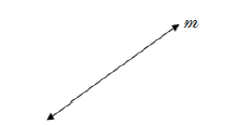
Line
It is made up of infinitely many points with infinite length and no endpoint.

It extends indefinitely in both directions.
Intersecting Lines
The two lines that share one common point are called Intersecting Lines. This shared point is called the point of intersection.
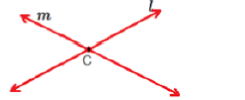
Here, line l and m are intersecting at point C.
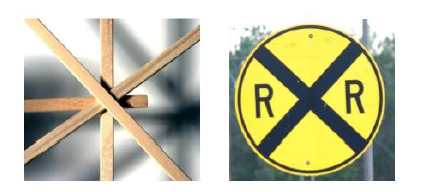
Real life example of intersecting lines:
Parallel Lines
Two or more lines that never intersect (Never cross each other) are called Parallel Lines.
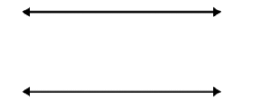
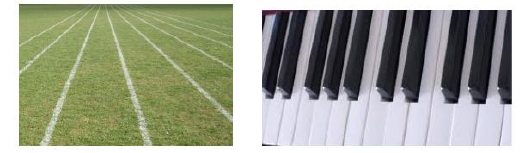
Real life examples of parallel lines:
Ray
It is a part of a line with one starting point whereas extends endlessly in one direction.
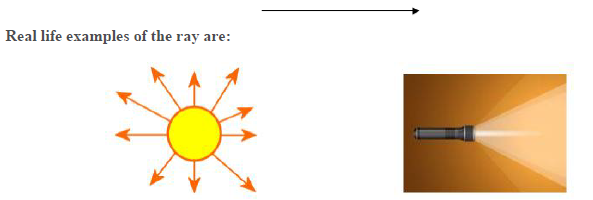
Distinction between line-segment, ray and line:
Line-segment
1. It has two end points.
2. The length of a line-segment is definite. So, it can be measured.
3. The symbol of a line-segment is _____
Ray
1. Ray has one starting point and another near the arrowhead.
2. It has a starting point but no other end point. So, its length cannot be measured.
3. The symbol of a ray is →
Line
1. There are no end points in a line.
2. There are no end points. So, length of a line cannot be measured.
3. The symbol of a line is ↔
Question 1: Use the figure to name:
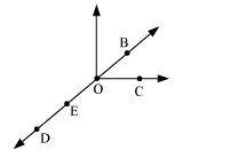
(a) Five points
(b) A line
(c) Four rays
(d) Five line segments
Answer :
(a) The five points are D, E, O, B, and C.
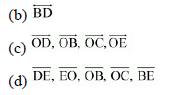
Question 2: Name the line given in all possible (twelve) ways, choosing only two letters at a time from the four given.

Answer :

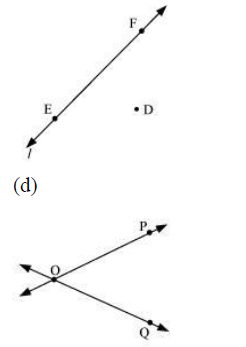
Question 3: Use the figure to name:
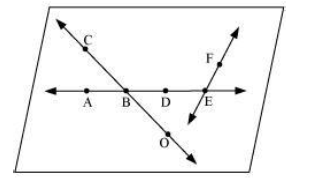
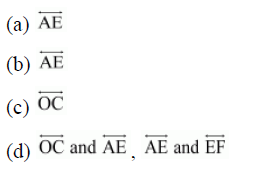
(a) Line containing point E.
(b) Line passing through A.
(c) Line on which O lies
(d) Two pairs of intersecting lines.
ANSWER:
Question 4: How many lines can pass through (a) one given point? (b) Two given points?
Answer :
(a) Infinite number of lines can pass through a single point.
(b) Only one line can pass through two given points.
Question 5:
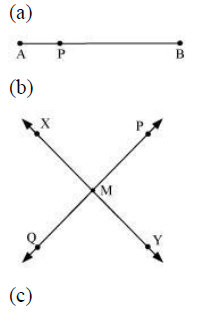
Draw a rough figure and label suitably in each of the following cases:
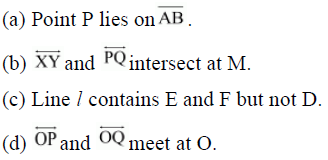
Answer :
1. Draw a circle of radius 5.6cm
2. With the same centre O, draw two circles of radii 5cm and 2.5cm
3. Draw any circle and mark points P, Q and R such that
a) P is on the circle
b) Q is in the interior of the circle.
c) R is in the exterior of the circle.
4. Draw any line segment PQ. Mark any point B on it. Through B, draw a perpendicular to .
5. Draw XY of length 8.3cm and find its axis of symmetry.
6. Draw a line segment of length 10.5cm and construct its perpendicular bisector.
7. With AB of length 6.2cm as diameter, draw a circle.
8. Draw a circle of radius 4.5cm. Draw any two of its chords. Construct the perpendicular bisectors of these chords. Where do they meet.
9. Draw a line segment of length 10.8cm. Using compasses, divide it into four equal parts . Verify by actual measurement.
10. Draw the perpendicular bisector AB of whose length is 8.3cm
a) Take any point P on the bisector drawn. Examine whether PA = PB
b) If M is the mid point of AB, what can you say about the length of MA and MB?
11. Draw an angle of measure 1370 and construct its bisector.
12. Draw a right angle and construct its bisector.
13. Draw an angle of measure 1520 and divide into four equal parts
14. Draw an angle of measure 600 and bisect it.
15. Draw an angle of measure 1500 and bisect it.
16. Construct with ruler and compasses, angles of following measures.
a) 600 b) 1200 c) 900 d) 450 e) 150 f) 300
17. Draw a circle and any two of its diameter. What is the figure obtained? What figure is obtained if the diameter are perpendicular to each other?
Free study material for Mathematics
Free CBSE Practice Worksheets: Class 6 Mathematics Chapter 14 Practical Geometry
Download Chapter Worksheets: Class 6 Mathematics
Review targeted practice exercises for Class 6 Mathematics Chapter 14 Practical Geometry. Curated to match official CBSE guidelines, these printable problem sets support daily revision and improve overall test readiness.
Concept Clarification for Chapter 14 Practical Geometry
Designed around the official curriculum for Class 6 Mathematics, these practice sheets guarantee standard compliance. Reviewing step-by-step solutions after completion sharpens your accuracy and clarifies complex sub-topics within Chapter 14 Practical Geometry.
Effective Revision Strategies for School Exams
Consistent engagement with these exercises builds familiarity with recurring exam themes. If specific areas within Chapter 14 Practical Geometry cause trouble, utilize our dedicated NCERT solutions for Class 6 Mathematics to clear up doubts immediately.
FAQs
You can download the latest chapter-wise printable worksheets for Class 6 Mathematics Chapter 14 Practical Geometry for free from StudiesToday.com. These have been made as per the latest CBSE curriculum for this academic year.
Yes, Class 6 Mathematics worksheets for Chapter 14 Practical Geometry focus on activity-based learning and also competency-style questions. This helps students to apply theoretical knowledge to practical scenarios.
Yes, we have provided solved worksheets for Class 6 Mathematics Chapter 14 Practical Geometry to help students verify their answers instantly.
Yes, our Class 6 Mathematics test sheets are mobile-friendly PDFs and can be printed by teachers for classroom.
For Chapter 14 Practical Geometry, regular practice with our worksheets will improve question-handling speed and help students understand all technical terms and diagrams.