

Step-by-Step Textbook Solutions for Class 8 Mathematics Chapter 04 Practical Geometry
Access comprehensive textbook solutions for Chapter 04 Practical Geometry using the official curriculum guides for Class 8 Mathematics. Designed to align with the 2026-27 NCERT standards, these detailed answers help students reinforce core academic concepts.
Download Chapter 04 Practical Geometry Textbook Solutions PDF
Access the complete solution PDF for Class 8 Mathematics below. Regular practice with these targeted textbook answers builds familiarity with standard question patterns and helps secure higher marks in final school evaluations.
Exercise 4.1
Q.1) Construct the following quadrilaterals:
(i) Quadrilateral ABCD, AB = 4.5 cm, BC = 5.5 cm, CD = 4 cm, AD = 6 cm, AC = 7 cm
(ii) Quadrilateral JUMP, JU = 3.5 cm, UM = 4 cm, MP = 5 cm, PJ = 4.5 cm, PU = 6.5 cm
(iii) Parallelogram MORE, OR = 6 cm, RE = 4.5 cm, EO = 7.5 cm
(iv) Rhombus BEST, BE = 4.5 cm, ET = 6 cm
Sol.1) (i) Given:
AB = 4.5 cm, BC = 5.5 cm, CD = 4 cm, AD = 6 cm, AC = 7 cm
To construct:
A quadrilateral ABCD
Steps of construction:
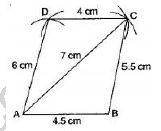
(a) Draw AB = 4.5 cm.
(b) Draw an arc taking radius 5.5 cm from point B.
(c) Taking radius 7 cm, draw another arc from point A which intersects the first arc at point C.
(d) Join BC and AC.
(e) Draw an arc of radius 6 cm from point A and draw another arc of radius 4 cm from point C which intersects at D.
(f) Join AD and CD.
It is required quadrilateral ABCD.
(ii) Given:
JU = 3.5 cm, UM = 4 cm, MP = 5 cm, PJ = 4.5 cm, PU = 6.5 cm
To construct:
A quadrilateral JUMP
Steps of construction:

(a) Draw JU = 3.5 cm.
(b) Draw an arc of radius 4.5 cm taking centre J and then draw another arc of radius 6.5 cm taking U as centre. Both arcs intersect at P.
(c) Join PJ and PU.
(d) Draw arc of radius 5 cm and 4 cm taking P and U as centres respectively, which intersect at M.
(e) Join MP and MU.
It is required quadrilateral JUMP.
(iii) Given:
OR = 6 cm, RE = 4.5 cm, EO = 7.5 cm
To construct:
A parallelogram MORE.
Steps of construction:
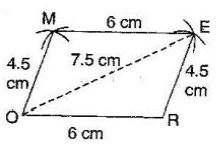
(a) Draw OR = 6 cm.
(b) Draw arcs of radius 7.5 cm and radius 4.5 cm taking O and R as centres respectively, which intersect at E.
(c) Join OE and RE.
(d) Draw an arc of 6 cm radius taking E as centre.
(e) Draw another arc of 4.5 cm radius taking O as centre, which intersects at M.
(f) Join OM and EM.
It is required parallelogram MORE
(iv) Given: BE = 4.5 cm, ET = 6 cm
To construct: A rhombus BEST.
Steps of construction:
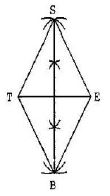
(a) Draw TE = 6 cm and bisect it into two equal parts.
(b) Draw up and down perpendiculars to TE.
(c) Draw two arcs of 4.5 cm taking E and T as centres, which intersect at S.
(d) Again draw two arcs of 4.5 cm taking E and T as centres, which intersects at B.
(e) Join TS, ES, BT and EB.
It is the required rhombus BEST.
Exercise 4.2
Q.1) Construct the following quadrilaterals:
(i) Quadrilateral LIFT, LI = 4 cm, IF = 3 cm, TL = 2.5 cm, LF = 4.5 cm, IT = 4 cm
(ii) Quadrilateral GOLD, OL = 7.5 cm, GL = 6 cm, GD = 6 cm, LD = 5 cm, OD = 10 cm
(iii) Rhombus BEND, BN = 5.6 cm, DE = 6.5 cm
Sol.1) (i) Given:
LI = 4 cm, IF = 3 cm, TL = 2.5 cm, LF = 4.5 cm, IT = 4 cm
To construct: A quadrilateral LIFT
Steps of construction:
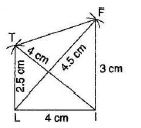
(a) Draw a line segment LI = 4 cm.
(b) Taking radius 4.5 cm, draw an arc taking L as centre.
(c) Draw an arc of 3 cm taking I as centre which intersects the first arc at F.
(d) Join FI and FL.
(e) Draw another arc of radius 2.5 cm taking L as centre and 4 cm taking I as centre which intersect at T.
(f) Join TF, Tl and TI.
It is the required quadrilateral LIFT
(ii) Given:
OL = 7.5 cm, GL = 6 cm, GD = 6 cm, LD = 5 cm, OD = 10 cm
To construct: A quadrilateral GOLD
Steps of construction:
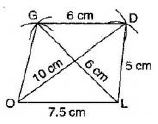
(a) Draw a line segment OL = 7.5 cm
(b) Draw an arc of radius 5 cm taking L as centre and another arc of radius 10 cm taking O as centre which intersect the first arc point at D.
(c) Join LD and OD.
(d) Draw an arc of radius 6 cm from D and draw another arc of radius 6 cm taking L as centre, which intersects at G.
(e) Join GD and GO.
It is the required quadrilateral GOLD
(iii) Given: BN = 5.6 cm, DE = 6.5 cm
To construct: A rhombus BEND.
Steps of construction:
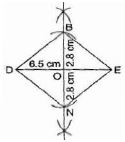
(a) Draw DE = 6.5 cm.
(b) Draw perpendicular bisector of line segment DE.
(c) Draw two arcs of radius 2.8 cm from intersection point O, which intersects the line KN at B and N.
(d)Join BE, BD as well as ND and NE.
It is the required rhombus BEND.
Exercise 4.3
Q.1) Construct the following quadrilaterals:
(i) Quadrilateral MORE, 𝑀𝑂 = 6𝑐𝑚, 𝑂𝑅 = 4.5 𝑐𝑚, ∠ 𝑀 = 60°,∠ 𝑂 = 105°,∠ 𝑅 = 105°
(ii) Quadrilateral PLAN, 𝑃𝐿 = 4 𝑐𝑚, 𝐿𝐴 = 6.5 𝑐𝑚,∠ 𝑃 = 90°,∠ 𝐴 = 110°,∠ 𝑁 = 85°
(iii) Parallelogram HEAR,H𝐸 = 5 𝑐𝑚, 𝐸𝐴 = 6 𝑐𝑚,∠ 𝑅 = 85°
(iv) Rectangle OKAY, 𝑂𝐾 = 7 𝑐𝑚, 𝐾𝐴 = 5 𝑐𝑚
Sol.1) (i) Given: MO = 6 cm, OR = 4.5 cm, ∠ 𝑀 = 60 , ∠ 𝑂 = 105°,∠ 𝑅 = 105°
To construct: A quadrilateral MORE.
Steps of construction:
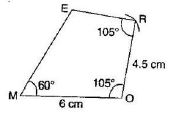
(a) Draw a line segment MO = 6 cm.
(b) Construct ∠ 𝑅 = 105°and taking radius 4.5 cm, draw an arc taking O as centre, which intersects at R.
(c) Also construct an angle 105°at R and produce the side RE.
(d) Construct another angle of 60°at point M and produce the side ME.
Both sides ME and RE intersect at E.
It is the required quadrilateral MORE.
(ii) Given:
𝑃𝐿 = 4 𝑐𝑚, 𝐿𝐴 = 6.5 𝑐𝑚,∠ 𝑃 = 90°,∠ 𝐴 = 110°,∠ 𝑁 = 85°
To construct:
A quadrilateral PLAN.
To find:
∠ 𝐿 = 360° − (90° + 85° + 110°) = 360° − 285° = 75°
Steps of construction:
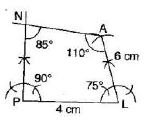
(a) Draw a line segment 𝑃𝐿 = 4 𝑐𝑚.
(b) Construct angle of 90°at P and produce the side PN.
(c) Construct angle of 75°at L and with L as centre, draw an arc of radius 6 cm, which intersects at A.
(d) Construct ∠ 𝐴 = 110°at A and produce the side AN which intersects PN at N.
It is the required quadrilateral PLAN.
(iii) Given:
𝐻𝐸 = 5 𝑐𝑚, 𝐸𝐴 = 6 𝑐𝑚,∠ 𝑅 = 85
To construct:
A parallelogram HEAR.
To find:
∠ 𝐻 = 180° − 85° = 95°
Steps of construction:
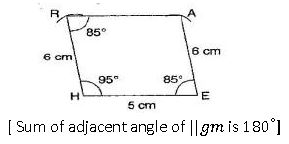
(a) Draw a line segment HE = 5 cm.
(b) Construct ∠ 𝐻 = 95°and draw an arc of radius 6 cm with centre H. It intersects AR at R.
(c) Join RH.
(d) Draw ∠ 𝑅 = ∠ 𝐸 = 85°and draw an arc of radius 6 cm with E as a centre which intersects RA at A.
(e) Join RA .
It is the required parallelogram HEAR.
(iv) Given: OK = 7 cm, KA = 5 cm
To construct: A rectangle OKAY.
Steps of construction:
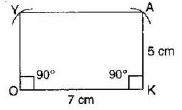
(a) Draw a line segment OK = 7 cm.
(b) Construct angle 90°at both points O and K and produce these sides.
(c) Draw two arcs of radius 5 cm from points O and K respectively. These arcs intersect at Y and A.
(d) Join YA.
It is the required rectangle OKAY.
Exercise 4.4
Q.1) Construct the following quadrilaterals:
(i) Quadrilateral DEAR, 𝐷𝐸 = 4 𝑐𝑚, 𝐸𝐴 = 5 𝑐𝑚, 𝐴𝑅 = 4.5 𝑐𝑚,∠ 𝐸 = 60 °,∠ 𝐴 = 90 °
(ii) Quadrilateral TRUE, 𝑇𝑅 = 3.5 𝑐𝑚, 𝑅𝑈 = 3 𝑐𝑚, 𝑈𝐸 = 4 𝑐𝑚,∠ 𝑅 = 75 ° ,∠ 𝑈 = 120 °
Sol.1) (i) Given: D𝐸 = 4 𝑐𝑚, 𝐸𝐴 = 5 𝑐𝑚, 𝐴𝑅 = 4.5 𝑐𝑚, ∠ 𝐸 = 60 °,∠ 𝐴 = 90 °
To construct: A quadrilateral DEAR.
Steps of construction:
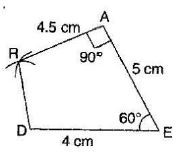
(a) Draw a line segment DE = 4 cm.
(b) At point E, construct an angle of 60 °.
(c) Taking radius 5 cm, draw an arc from point E which intersects at A.
(d) Construct ∠ 𝐴 = 90 °, draw an arc of radius 4.5 cm with centre A which intersect at R.
(e) Join RD.
It is the required quadrilateral DEAR.
(ii) Given:
𝑇𝑅 = 3.5 𝑐𝑚, 𝑅𝑈 = 3 𝑐𝑚, 𝑈𝐸 = 4 𝑐𝑚,∠ 𝑅 = 75 °,∠ 𝑈 = 120 °
To construct: A quadrilateral TRUE
Steps of construction:
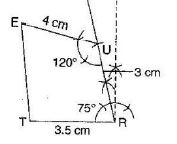
(a) Draw a line segment TR = 3.5 cm.
(b) Construct an angle 75 °at R and draw an arc of radius 3 cm with R as centre, which intersects at U.
(c) Construct an angle of 120 °at U and produce the side UE.
(d) Draw an arc of radius 4 cm with U as centre.
(e) Join UE and TE.
It is the required quadrilateral TRUE
Exercise 4.5
Q.1) Draw the following: The square READ with RE = 5.1 cm.
Sol.1) Given: RE = 5.1 cm.
To construct: A square READ.
Steps of construction:
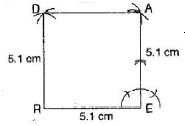
(i) Draw RE = 5.1 cm.
(ii) At point E, construct an angle of 90 °and draw an arc of radius 5.1 cm, which intersects at point A.
(iii) At point R, draw an arc of radius 5.1 cm at point A, draw another arc of radius 5.1 cm which intersects the first arc at point D.
(iv) Join AD and RD.
It is the required square READ
Q.2) Draw the following: A rhombus whose diagonals are 5.2 cm and 6.4 cm.
Sol.2) Given: Diagonals of a rhombus AC = 5.2 cm and BD = 6.4 cm.
To construct: A rhombus ABCD.
Steps of construction:
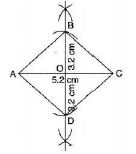
(a) Draw AC = 5.2 cm and draw perpendicular bisectors on AC.
(b) Since, diagonals bisect at mid-point O, therefore get half of 6.4 cm, i.e., 3.2 cm
(c) Draw two arcs on both sides of AC of radius 3.2 cm from intersection point O, which intersects at B and D.
(d) Join AB, BC, CD and DA.
It is required rhombus ABCD.
Q.3) Draw the following: A rectangle with adjacent sides of length 5 cm and 4 cm
Sol.3) Given: MN = 5 cm and MP = 4 cm.
To construct: A rectangle MNOP
Steps of construction:
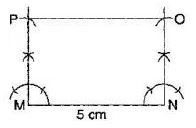
(a) Draw a segment MN = 5 cm.
(b) At points M and N, draw perpendiculars of lengths 4 cm and produce them.
(c) Taking centres M and N, draw two arcs of 4 cm each, which intersect P and Q respectively.
(d) Join side PO.
It is required rectangle MNOP.
Q.4) Draw the following: A parallelogram OKAY where OK = 5.5 cm and KA = 4.2 cm.
Sol.4) Given: OK = 5.5 cm and KA = 4.2 cm.
To construct: A parallelogram OKAY.
Steps of construction:
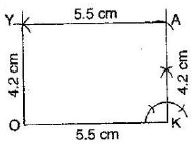
(a) Draw a line segment OK = 5.5 cm.
(b) Draw an angle of 90 at K and draw an arc of
radius KA = 4.2 cm, which intersects at point A.
(c) Draw another arc of radius AY = 5.5 cm and at point O,
draw another arc of radius 4.2 cm which intersect at Y.
(d) Join AY and OY.
It is the required parallelogram OKAY.
Free study material for Mathematics
Mathematics Class 8 Curriculum Solutions: Chapter 04 Practical Geometry
Textbook Solutions for Class 8 Mathematics Chapter 04 Practical Geometry
Review comprehensive exercise answers for Class 8 Mathematics Chapter 04 Practical Geometry. Fully updated to match current NCERT syllabus guidelines, these textbook solutions help students verify their work and maintain accurate study notes.
Mastering Theoretical and Practical Questions
Clear, methodical explanations accompany every challenging problem within the Class 8 Mathematics text. Engaging with these detailed answers lays a solid foundation for advanced learning and improves foundational clarity for upcoming assessments.
Effective Self-Study and Homework Assistance
Frequent review of these structured answers builds strong analytical capabilities and response efficiency. Maximize your academic readiness by combining these textbook solutions with our curated study materials and mock evaluations for Class 8 Mathematics.
FAQs
The complete and updated NCERT Solutions Class 8 Mathematics Chapter 4 Practical Geometry is available for free on StudiesToday.com. These solutions for Class 8 Mathematics are as per latest NCERT curriculum.
Yes, our experts have revised the NCERT Solutions Class 8 Mathematics Chapter 4 Practical Geometry as per 2026 exam pattern. All textbook exercises have been solved and have added explanation about how the Mathematics concepts are applied in case-study and assertion-reasoning questions.
Toppers recommend using NCERT language because NCERT marking schemes are strictly based on textbook definitions. Our NCERT Solutions Class 8 Mathematics Chapter 4 Practical Geometry will help students to get full marks in the theory paper.
Yes, we provide bilingual support for Class 8 Mathematics. You can access NCERT Solutions Class 8 Mathematics Chapter 4 Practical Geometry in both English and Hindi medium.
Yes, you can download the entire NCERT Solutions Class 8 Mathematics Chapter 4 Practical Geometry in printable PDF format for offline study on any device.