

Step-by-Step Textbook Solutions for Class 8 Mathematics Chapter 07 Cube and Cube Roots
Access comprehensive textbook solutions for Chapter 07 Cube and Cube Roots using the official curriculum guides for Class 8 Mathematics. Designed to align with the 2026-27 NCERT standards, these detailed answers help students reinforce core academic concepts.
Download Chapter 07 Cube and Cube Roots Textbook Solutions PDF
Navigate directly to the solved Mathematics textbook exercises using the digital viewer below. Each solution includes detailed step-by-step explanations, allowing students to instantly cross-check their work and identify areas requiring further revision.
Exercise 7.1
Q.1) Which of the following numbers are not perfect cubes?
(i) 216 (ii) 128 (iv)100 (v) 46656
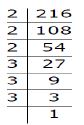
Sol.1) (i) 216
Prime factors of 216
= 2 × 2 × 2 × 3 × 3 × 3
Here all factors are in groups of 3’s (in triplets)
Therefore, 216 is a perfect cube number.
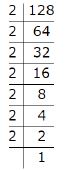
(ii) 128 Prime factors of 128
= 2 × 2 × 2 × 2 × 2 × 2 × 2
Here one factor 2 does not appear in a 3’s group.
Therefore, 128 is not a perfect cube.
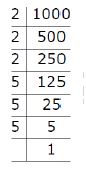
(iii) 1000
Prime factors of 1000
= 2 × 2 × 2 × 3 × 3 × 3
Here all factors appear in 3’s group.
Therefore, 1000 is a perfect cube.
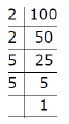
(iv) 100
Prime factors of 100
= 2 × 2 × 5 × 5
Here all factors do not appear in 3’s group.
Therefore, 100 is not a perfect cube.
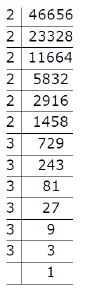
(v) 46656
Prime factors of 46656
= 2 × 2 × 2 × 2 × 2 × 2 × 3
× 3 × 3 × 3 × 3 × 3
Here all factors appear in 3’s group.
Therefore, 46656 is a perfect cube.
Q.2) obtain a perfect cube:
(i) 243 (ii) 256 (iii) 72 (iv) 675 (v) 100
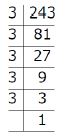
Sol.2) (i) 243
Prime factors of 243
= 3 × 3 × 3 × 3 × 3
Here 3 does not appear in 3’s group.
Therefore, 243 must be multiplied by 3 to make it a perfect cube.
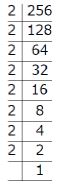
(ii) 256
Prime factors of 256
= 2 × 2 × 2 × 2 × 2 × 2 × 2 × 2
Here one factor 2 is required to make a 3’s group.
Therefore, 256 must be multiplied by 2 to make it a perfect cube.
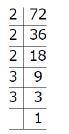
(iii) 72
Prime factors of 72
= 2 × 2 × 2 × 3 × 3
Here 3 does not appear in 3’s group.
Therefore, 72 must be multiplied by 3 to make it a perfect cube.
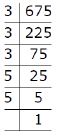
(iv) 675
Prime factors of 675
= 3 𝑥 × 3 × 3 × 5 × 5
Here factor 5 does not appear in 3’s group.
Therefore 675 must be multiplied by 3 to make it a perfect cube.
(v) 100
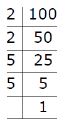
Prime factors of 100 = 2 × 2 × 5 × 5
Here factor 2 and 5 both do not appear in 3’s group.
Therefore 100 must be multiplied by
2 × 5 = 10 to make it a perfect cube.
Q.3) Find the smallest number by which each of the following numbers must be divided to obtain a perfect cube:
(i) 81 (ii) 128 (iii) 135 (iv) 192 (v) 704
Sol.3) (i) 81
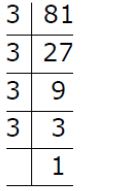
Prime factors of 81
= 3 × 3 × 3 × 3
Here one factor 3 is not grouped in triplets.
Therefore 81 must be divided by 3 to make it a perfect cube.
(ii) 128
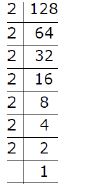
Prime factors of 128
= 2 × 2 × 2 × 2 × 2 × 2 × 2
Here one factor 2 does not appear in a 3’s group.
Therefore, 128 must be divided by 2 to make it a perfect cube.
(iii) 135
Prime factors of 135
= 3 × 3 × 3 × 5
Here one factor 5 does not appear in a triplet.
Therefore, 135 must be divided by 5 to make it a perfect cube.

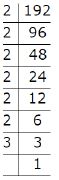
(iv) 192
Prime factors of 192
= 2 × 2 × 2 × 2 × 2 × 2 × 3
Here one factor 3 does not appear in a triplet.
Therefore, 192 must be divided by 3 to make it a perfect cube.
(v) 704
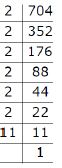
Prime factors of 704
= 2 × 2 × 2 × 2 × 2 × 2 × 11
Here one factor 11 does not appear in a triplet.
Therefore, 704 must be divided by 11 to make it a perfect cube.
Q.4) Parikshit makes a cuboid of plasticine of sides 5 cm, 2 cm, 5 cm. How many such cuboids will he need to form a cube?
Sol.4) Given numbers = 5 × 2 × 5
Since, Factors of 5 and 2 both are not in group of three.
Therefore, the number must be multiplied by 2 ~2 × 5 = 20 to make it a perfect cube.
Hence he needs 20 cuboids.
Exercise 7.2
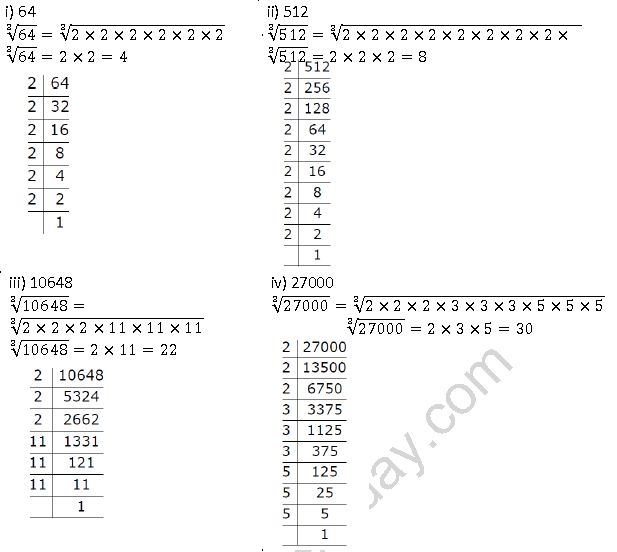
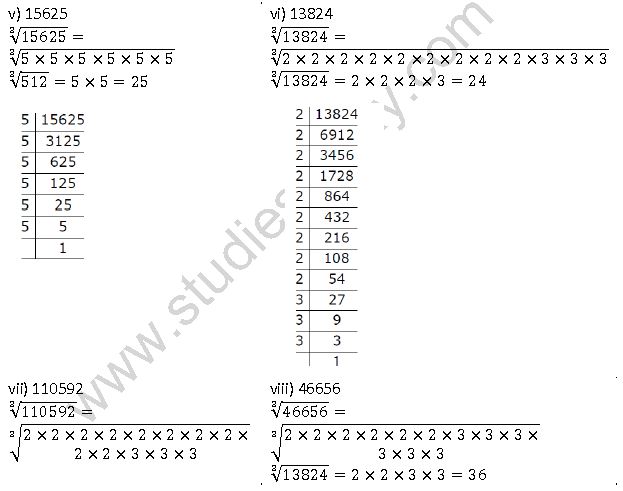
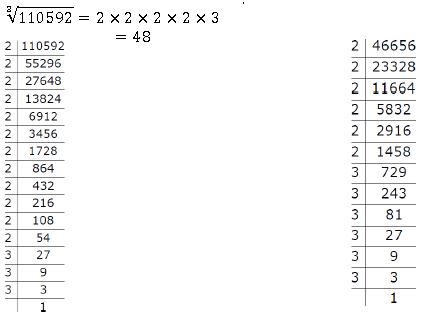
Q.1) Find the cube root of each of the following numbers by prime factorization method:
(i) 64 (ii) 512 (iii) 10648 (iv) 27000 (v) 15625
(vi) 13824 (vii) 110592 (viii) 46656 (ix) 175616 (x) 91125
Sol.1) i) 64

Q.2) State true or false:
(i) Cube of any odd number is even.
(ii) A perfect cube does not end with two zeroes.
(iii) If square of a number ends with 5, then its cube ends with 25.
(iv) There is no perfect cube which ends with 8.
(v) The cube of a two-digit number may be a three- digit number.
(vi) The cube of a two -digit number may have seven or more digits.
(vii) The cube of a single digit number may be a single digit number.
Sol.2) (i) False
Since, 13 = 1, 33 = 27, 53 = 125, … … are all odd.
(ii) True
Since, a perfect cube ends with three zeroes.
e.g. 103 = 1000, 203 = 8000, 303 = 27000, … … so on
Since, 52 = 25, 53 = 125, 152 = 225, 153 = 3375 (Did not end with 25)
(iv) False
Since 123 = 1728 [Ends with 8]
And 223 = 10648 [Ends with 8]
(v) False
Since 103 = 1000 [Four digit number]
And 113 = 1331 [Four digit number]
(vi) False
Since 993 = 970299 [Six digit number]
(vii) True
13 = 1 [Single digit number]
23 = 8 [Single digit number]
Q.3) You are told that 1,331 is a perfect cube. Can you guess with factorization what is its cube root?
Similarly guess the cube roots of 4913, 12167, 32768.
Sol.3) We know that
103 = 1000 and
Possible cube of 113 = 1331
Since, cube of unit’s digit 13 = 1
Therefore, cube root of 1331 is 11.
4913
We know that 73 = 343
Next number comes with 7 as unit place 173 = 4913
Hence, cube root of 4913 is 17
12167
We know that 33 = 27
Here in cube, one’s digit is 7
Now next number with 3 as one’s digit 133 = 2197
And next number with 3 as one’s digit 233 = 12167
Hence cube root of 12167 is 23.
32768
We know that 3 2 = 8
Here in cube, one’s digit is 8
Now next number with 2 as ones digit 123 = 1728
And next number with 2 as ones digit 223 = 10648
And next number with 2 as ones digit 323 = 32768
Hence cube root of 32768 is 32.
Free study material for Mathematics
Mathematics Class 8 Curriculum Solutions: Chapter 07 Cube and Cube Roots
Chapter Exercise Answers for Class 8 Mathematics
Access structured NCERT textbook solutions for Chapter 07 Cube and Cube Roots. Designed in alignment with the latest academic curriculum for Class 8 Mathematics, these answers cover all end-of-chapter exercises to support daily learning and homework completion.
Detailed Answer Guides for Chapter 07 Cube and Cube Roots
Each solution includes detailed reasoning to foster genuine comprehension of Chapter 07 Cube and Cube Roots concepts. Reviewing these step-by-step breakdowns allows learners to master both analytical and descriptive questions expected in school evaluations.
Complete Preparation Kit for Class 8 Exams
Consistent practice with these solution guides cultivates faster problem-solving habits and clearer logical structuring. For a complete preparation experience, pair these textbook answers with our dedicated revision notes and sample papers for Class 8 Mathematics.
FAQs
The complete and updated NCERT Solutions Class 8 Mathematics Chapter 7 Cube and Cube Roots is available for free on StudiesToday.com. These solutions for Class 8 Mathematics are as per latest NCERT curriculum.
Yes, our experts have revised the NCERT Solutions Class 8 Mathematics Chapter 7 Cube and Cube Roots as per 2026 exam pattern. All textbook exercises have been solved and have added explanation about how the Mathematics concepts are applied in case-study and assertion-reasoning questions.
Toppers recommend using NCERT language because NCERT marking schemes are strictly based on textbook definitions. Our NCERT Solutions Class 8 Mathematics Chapter 7 Cube and Cube Roots will help students to get full marks in the theory paper.
Yes, we provide bilingual support for Class 8 Mathematics. You can access NCERT Solutions Class 8 Mathematics Chapter 7 Cube and Cube Roots in both English and Hindi medium.
Yes, you can download the entire NCERT Solutions Class 8 Mathematics Chapter 7 Cube and Cube Roots in printable PDF format for offline study on any device.