

Download NCERT Solutions for Class 8 Mathematics Chapter 03 Understanding Quadrilaterals
Explore reliable textbook solutions for Chapter 03 Understanding Quadrilaterals tailored for Class 8 learners. Utilizing these Mathematics answers ensures thorough preparation and strengthens foundational knowledge before final NCERT evaluations.
Access NCERT Solutions and Answers
Navigate directly to the solved Mathematics textbook exercises using the digital viewer below. Each solution includes detailed step-by-step explanations, allowing students to instantly cross-check their work and identify areas requiring further revision.
Exercise 3.1
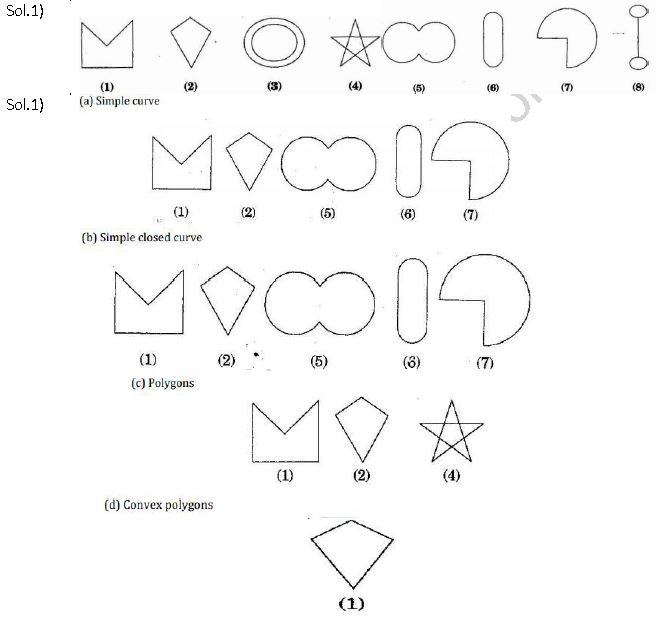
Q.1) Given here are some figures:
Classify each of them on the basis of the following:
(a) Simple curve (b) Simple closed curve (c) Polygon (d) Convexn polygon
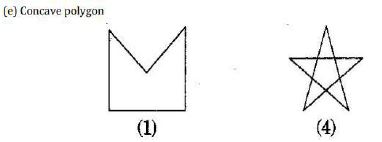
(e) Concave polygon
Q.2) How many diagonals does each of the following have?
(a) A convex quadrilateral (b) A regular hexagon (c) A triangle
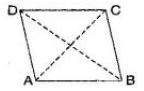
Sol.2) (a) A convex quadrilateral has two diagonals.
Here, AC and BD are two diagonals.'
(b) A regular hexagon has 9 diagonals.
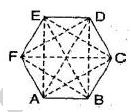
Here, diagonals are AD, AE, BD, BE, FC, FB, AC, EC and FD.
(c) A triangle has no diagonal
Q.3) What is the sum of the measures of the angles of a convex quadrilateral? Will this property hold if the quadrilateral is not convex? (Make a non-convex quadrilateral and try)
Sol.3) Let ABCD is a convex quadrilateral, then we draw a diagonal AC which divides the quadrilateral in two triangles.
∠ 𝐴 + 𝐵 + ∠ 𝐶 + ∠ 𝐷 = ∠ 1 + ∠ 6 + ∠ 5 + ∠ 4 + ∠ 3 + ∠ 2
= ( ∠ 1 + ∠ 2 + ∠ 3) + ( ∠ 4 + ∠ 5 + ∠ 6)
= 180° + 180° [By Angle sum property of triangle]
= 360°
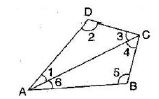
Hence, the sum of measures of the triangles of a convex quadrilateral is 360°.
Yes, if quadrilateral is not convex then, this property will also be applied.
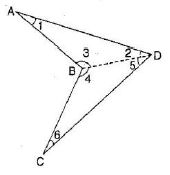
Let ABCD is a non-convex quadrilateral and join BD, which also divides the quadrilateral in two triangles.
Using angle sum property of triangle,
In Δ ABD, ∠ 1 + ∠ 2 + ∠ 3 = 180° ……….(i)
In Δ BDC, ∠ 4 + ∠ 5 + ∠ 6 = 180° ……….(i)
Adding eq. (i) and (ii),
∠ 1 + ∠ 2 + ∠ 3 + ∠ 4 + ∠ 5 + ∠ 6 = 360°
⇒ ∠ 1 + ∠ 2 + ( ∠ 3 + ∠ 4) + ∠ 5 + ∠ 6 = 360°
⇒ ∠ 𝐴 + ∠ 𝐵 + ∠ 𝐶 + ∠ 𝐷 = 360°
Hence proved.
Q.4) Examine the table. (Each figure is divided into triangles and the sum of the angles deduced from that.)
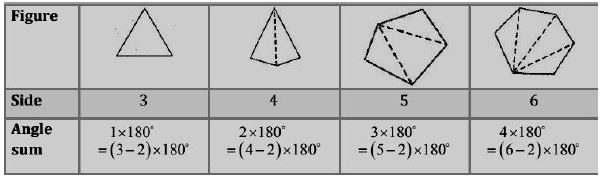
What can you say about the angle sum of a convex polygon with number of sides?
Sol.4) (a) When n = 7, then
Angle sum of a polygon = (𝑛 − 2) × 180° = (7 − 2) × 180° = 5 × 180° = 900°
(b) When n = 8, then
Angle sum of a polygon = (𝑛 − 2) × 180° = (8 − 2) × 180° = 6 × 180° = 1080°
(c) When n = 10, then
Angle sum of a polygon = (𝑛 − 2) × 180° = (10 − 2) × 180° = 8 × 180° = 1440°
(d) When n = n, then
Angle sum of a polygon = (𝑛 − 2) × 180°
Q.5) What is a regular polygon? State the name of a regular polygon of:
(a) 3 sides (b) 4 sides (c) 6 sides
Sol.5) A regular polygon:
A polygon having all sides of equal length and the interior angles of equal size is known as regular polygon.
(i) 3 sides
Polygon having three sides is called a triangle.
(ii) 4 sides
Polygon having four sides is called a quadrilateral.
(iii) 6 sides
Polygon having six sides is called a hexagon.
Q.6) Find the angle measures 𝑥 in the following figures:
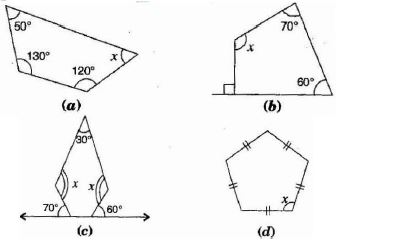
Sol.6) (a) Using angle sum property of a quadrilateral,
50° + 130° + 120° + 𝑥 = 360°
⇒ 300° + 𝑥 + 360°
⇒ 𝑥 = 360° − 300°
⇒ 𝑥 = 60°
(b) Using angle sum property of a quadrilateral,
90° + 60° + 70° + 𝑥 = 360°
⇒ 220° + 𝑥 = 360°
⇒ 𝑥 = 360° − 220°
⇒ 𝑥 = 140°
(c) First base interior angle = 180° − 70° = 110°
Second base interior angle = 180° − 60° = 120°
There are 5 sides, 𝑛 = 5
∴ Angle sum of a polygon = (𝑛 − 2) × 180°
= (5 − 2) × 180° = 3 × 180° = 540°
∴ 30° + 𝑥 + 110° + 120° + 𝑥 = 540°
⇒ 260° + 2𝑥 = 540°
⇒ 2𝑥 = 540° − 260°
⇒ 2𝑥 = 280°
⇒ 𝑥 = 140°
(d) Angle sum of a polygon = (𝑛 − 2) × 180°
= (5 − 2) × 180° = 3 × 180° = 540°
∴ 𝑥 + 𝑥 + 𝑥 + 𝑥 + 𝑥 = 540°
⇒ 5𝑥 = 540°
⇒ 𝑥 = 180°
Hence each interior angle is 108° .
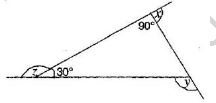
Q.7) (a) Find 𝑥 + 𝑦 + 𝑧
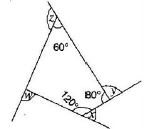
(b) Find 𝑥 + 𝑦 + 𝑧 + 𝑤
Sol.7) (a) Since sum of linear pair angles is 180°.
∴ 90° + 𝑥 = 180°
⇒ 𝑥 = 180° − 90° = 90°
And 𝑧 + 30° = 180°
⇒ 𝑧 = 180° − 30° = 150
Also 𝑦 = 90° + 30° = 120° [Exterior angle property]
∴ 𝑥 + 𝑦 + 𝑥 = 90° + 120° + 150° = 360°
(b) Using angle sum property of a quadrilateral,
60° + 80° + 120° + 𝑛 = 360°
⇒ 260° + 𝑛+= 360°
⇒ 𝑛 = 360° − 260°
⇒ 𝑛 = 100°
Since sum of linear pair angles is
∴ 𝑤 + 100° = 180° ……….(i)
𝑥 + 120° = 180° ……….(ii)
𝑦 + 80° = 180° ……….(iii)
𝑧 + 60° = 180° ……….(iv)
Adding eq. (i), (ii), (iii) and (iv),
⇒ 𝑥 + 𝑦 + 𝑧 + 𝑤 + 100° + 120° + 80° + 60° = 180° + 180° + 180° + 180°
⇒ 𝑥 + 𝑦 + 𝑧 + 𝑤 + 360° = 720°
⇒ 𝑥 + 𝑦 + 𝑧 + 𝑤 = 720° − 360°
⇒ 𝑥 + 𝑦 + 𝑧 + 𝑤 = 360°
Exercise 3.2
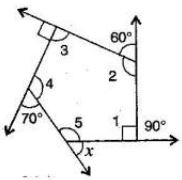
Q.1) Find x in the following figures.
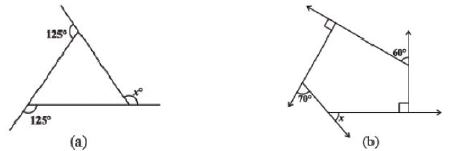
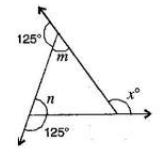
Sol.1) (a) Here, 125° + 𝑚 = 180° [Linear pair]
⇒ 𝑚 = 180° − 125°+= 55°
And 125° + 𝑛 = 180° [Linear pair]
⇒ 𝑛 = 180° − 125°+= 55°
Exterior angle 𝑥°= Sum of opposite interior angles
∴ 𝑥 = 55° + 55° = 110°
(b) Sum of angles of a pentagon = (𝑛 − 2) × 180°
= (5 − 2) × 180°
= 3 × 180° = 540°
By linear pairs of angles,
∠ 1 + 90° = 180° ……….(i)
∠ 2 + 60° = 180° ……….(ii)
∠ 3 + 90° = 180° ……….(iii)
∠ 4 + 70° = 180° ……….(iv)
∠ 5 + 𝑥 = 180° ……….(v)
Adding eq. (i), (ii), (iii), (iv) and (v),
𝑥 + (∠1 + ∠2 + ∠3 + ∠4 + ∠5) + 360° = 900°
⇒ 𝑥 + 540° + 310° = 900°
⇒ 𝑥 + 850° = 900°
⇒ 𝑥 = 900° − 850° = 50°
Q.2) Find the measure of each exterior angle of a regular polygon of:
(a) 9 sides (b) 15 sides
Sol.2) (i) Sum of angles of a regular polygon = (𝑛 − 2) × 180°
= (9 − 2) × 180° = 7 × 180° = 1260°
Each interior angle = 𝑠𝑢𝑚 𝑜𝑓 𝑖𝑛𝑡𝑒𝑟𝑖𝑜𝑟 𝑎𝑛𝑔𝑙𝑒𝑠/𝑛𝑢𝑚𝑏𝑒𝑟 𝑜𝑓 𝑠𝑖𝑑𝑒𝑠 = 1260°/9 = 140°
Each exterior angle = 180° − 140° = 40°
(ii) Sum of exterior angles of a regular polygon = 360°
Each interior angle = 𝑠𝑢𝑚 𝑜𝑓 𝑖𝑛𝑡𝑒𝑟𝑖𝑜𝑟 𝑎𝑛𝑔𝑙𝑒𝑠/𝑛𝑢𝑚𝑏𝑒𝑟 𝑜𝑓 𝑠𝑖𝑑𝑒𝑠 = 360°/15 = 24
Q.3) How many sides does a regular polygon have, if the measure of an exterior angle is 24° ?
Sol.3) Let no. of sides be 𝑛.
Sum of exterior angles of a regular polygon = 360°
Each interior angle = 𝑠𝑢𝑚 𝑜𝑓 𝑒𝑥𝑡𝑒𝑟𝑖𝑜𝑟 𝑎𝑛𝑔𝑙𝑒𝑠/𝑒𝑎𝑐ℎ 𝑖𝑛𝑡𝑒𝑟𝑖𝑜𝑟 𝑎𝑛𝑔𝑙𝑒
= 360°/15 = 24
Hence, the regular polygon has 15 sides.
Q.4) How many sides does a regular polygon have if each of its interior angles is 165° ?
Sol.4) Let number of sides be n.
Exterior angle = 180° − 165° = 15°
Sum of exterior angles of a regular polygon = 360°
Each interior angle= 𝑠𝑢𝑚 𝑜𝑓 𝑒𝑥𝑡𝑒𝑟𝑖𝑜𝑟 𝑎𝑛𝑔𝑙𝑒𝑠/𝑒𝑎𝑐ℎ 𝑖𝑛𝑡𝑒𝑟𝑖𝑜𝑟 𝑎𝑛𝑔𝑙𝑒 = 360°/15 = 24°
Hence, the regular polygon has 24 sides.
Q.5) (a) Is it possible to have a regular polygon with of each exterior angle as 22° ?
(b) Can it be an interior angle of a regular polygon? Why?
Sol,5) (a) Exterior angle = 22°
Number of sides = 𝑠𝑢𝑚 𝑜𝑓 𝑒𝑥𝑡𝑒𝑟𝑖𝑜𝑟 𝑎𝑛𝑔𝑙𝑒𝑠/𝑒𝑎𝑐ℎ 𝑖𝑛𝑡𝑒𝑟𝑖𝑜𝑟 𝑎𝑛𝑔𝑙𝑒
⇒ Number of sides = 360°/22° = 16.36
No, we can't have a regular polygon with each exterior angle as 22° as it is not divisor of 360.
(b) Interior angle = 22°
Exterior angle = 180° − 22° = 158°
No, we can't have a regular polygon with each exterior angle as 158° as it is not divisor of 360.
Q.6) (a) What is the minimum interior angle possible for a regular polygon? Why?
(b) What is the maximum exterior angle possible for a regular polygon?
Sol.6) (a) The equilateral triangle being a regular polygon of 3 sides has the least measure of an interior angle of 60° .
Sum of all the angles of a triangle = 180°
∴ 𝑥 + 𝑥 + 𝑥 = 180°
⇒ 3𝑥 = 180°
⇒ 𝑥 = 60°
(b) Equilateral triangle is regular polygon with 3 sides has the maximum exterior angle because the regular polygon with least number of sides have the maximum exterior angle possible.
Maximum exterior possible = 180 − 60° = 120°
Exercise 3.3
Q.1) Given a parallelogram ABCD. Complete each statement along with the definition or property used.
(i) AD = _______
(ii) ∠ 𝐷𝐶𝐵 = ________ (iii) OC = _________
(iv) 𝑚∠ 𝐷𝐴𝐵 + 𝑚∠ 𝐶𝐷𝐴 = ________
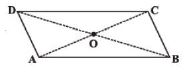
Sol.1) (i) 𝐴𝐷 = 𝐵𝐶 [Since opposite sides of a parallelogram are equal]
(ii) ∠ 𝐷𝐶𝐵 = ∠ 𝐷𝐴𝐵 [Since opposite angles of a parallelogram are equal]
(iii) 𝑂𝐶 = 𝑂𝐴 [Since diagonals of a parallelogram bisect each other]
(iv) 𝑚∠ 𝐷𝐴𝐵 + 𝑚∠ 𝐶𝐷𝐴 = 180° [Adjacent angles in a parallelogram are supplementary]
Q.2) Consider the following parallelograms. Find the values of the unknowns 𝑥 , 𝑦, 𝑧.
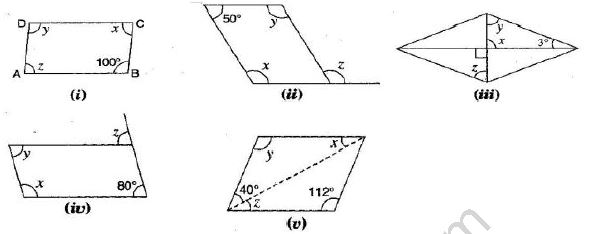
Sol.2) i) ∠B + ∠C = 180°
𝑦 = 100° (opposite angles of a parallelogram)
𝑥 + 100° = 180° (Adjacent angles of a parallelogram)
⇒ 𝑥 = 180° − 100° = 80°
𝑥 = 𝑧 = 80° (opposite angles of a parallelogram)
Thus, 𝑥 = 𝑧 = 80°, and 𝑦 = 100°
ii) 50° + 𝑥 = 180°
⇒ 𝑥 = 180° − 50° = 130° (Adjacent angles of a parallelogram)
𝑥 = 𝑦 = 130° (opposite angles of a parallelogram)
𝑥 = 𝑧 = 130° (corresponding angle)
Thus, 𝑥 = 𝑦 = 𝑧 = 130°
iii) 𝑥 = 90° (vertical opposite angles)
𝑥 + 𝑦 + 30° = 180° (angle sum property of a triangle)
⇒ 90° + 𝑦 + 30° = 180°
⇒ 𝑦 = 180° − 120° = 60°
also, 𝑦 = 𝑧 = 60° (alternate angles)
iv) 𝑧 = 80° (corresponding angle)
𝑧 = 𝑦 = 80° (alternate angles)
𝑥 + 𝑦 = 180° (adjacent angles)
⇒ 𝑥 + 80° = 180°
⇒ 𝑥 = 180° − 80° = 100°
v) 𝑦 = 112° [Opposite angles are equal in a ||𝑔𝑚]
⇒ 40° + 𝑦 + 𝑥 = 180°
⇒ 40° + 112° + 𝑥 = 180° [Angle sum property of a triangle]
⇒ 152° + 𝑥 = 180°
⇒ 𝑥 = 180° − 152° = 28°
And 𝑧 = 𝑥 = 180° [Alternate angles]
Q.3) Can a quadrilateral ABCD be a parallelogram if
(i) ∠𝐷 + ∠𝐵 = 180°? (ii) 𝐴𝐵 = 𝐷𝐶 = 8 𝑐𝑚, 𝐴𝐷 = 4 𝑐𝑚 𝑎𝑛𝑑 𝐵𝐶 = 4.4 𝑐𝑚?
(iii) ∠𝐴 = 70° and ∠𝐶 = 65°?
Sol.3) (i) ∠ 𝐷 + ∠ 𝐵 = 180°It can be, but here, it needs not to be.
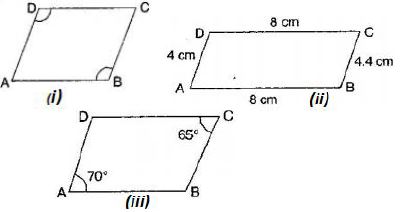
(ii) No, in this case because one pair of opposite sides are equal and another pair of opposite sides are unequal. So, it is not a parallelogram.
(iii) No. ∠ 𝐴 ≠ ∠ 𝐶. Since opposite angles are equal in parallelogram and here opposite angles are not equal in quadrilateral ABCD. Therefore it is not a parallelogram
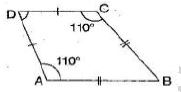
Q.4) Draw a rough figure of a quadrilateral that is not a parallelogram but has exactly two opposite angles of equal measure.
Sol.4) ABCD is a quadrilateral in which angles ∠ 𝐴 = ∠ 𝐶 = 110°
Therefore, it could be a kite.
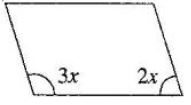
Q.5) The measure of two adjacent angles of a parallelogram are in the ratio 3:2. Find the measure of each of the angles of the parallelogram.
Sol.5) Let two adjacent angles be 3𝑥 and 2𝑥
Since the adjacent angles in a parallelogram are supplementary.
∴ 3𝑥 + 2𝑥 = 180°
⇒ 5𝑥 = 180°
⇒ 𝑥 = 180°/5 = 36°
∴ one angle = 3𝑥 = 3 × 36° = 108°
And another angle = 2𝑥 = 2 × 36° = 72
Q.6) Two adjacent angles of a parallelogram have equal measure. Find the measure of the angles of the parallelogram.
Sol.6) Let each adjacent angle be 𝑥.
Since the adjacent angles in a parallelogram are supplementary.
∴ 𝑥 + 𝑥 = 180°
⇒ 2𝑥 = 180°
⇒ 𝑥 = 180°/2 = 90°
Hence, each adjacent angle is 90°.
𝑥 + 𝑥 + 𝑥 = 180°
⇒ 3𝑥 = 180°
⇒ 𝑥 = 180°/3 = 60°
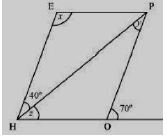
Q.7) The adjacent figure HOPE is a parallelogram. Find the angle measures 𝑥, 𝑦 and z. State the properties you use to find them.
Sol.7) 𝑦 = 40° (alternate interior angle)
∠𝑃 = 70° (alternate interior angle)
∠𝑃 = ∠𝐻 = 70° (opposite angles of a parallelogram)
𝑧 = ∠𝐻 − 40° = 70° − 40° = 30°
∠𝐻 + 𝑥 = 180°
⇒ 70° + 𝑥 = 180°
⇒ 𝑥 = 180° − 70° = 110°
Q.8) The following figures GUNS and RUNS are parallelograms . Find 𝑥 and 𝑦. (Lengths are in cm)

Sol.8) (i) In parallelogram GUNS,
GS = UN [Opposite sides of parallelogram are equal]
⇒ 3𝑥 = 18
⇒ 𝑥 = 18/3 = 6𝑐𝑚
Also 𝐺𝑈 = 𝑆𝑁 [Opposite sides of parallelogram are equal]
⇒ 3𝑦 − 1 = 26
⇒ 3𝑦 = 26 + 1
⇒ 3𝑦 = 27
⇒ 𝑦 = 27/3 = 9
Hence, 𝑥 = 6 𝑐𝑚 and 𝑦 = 9 𝑐𝑚.
(ii) In parallelogram RUNS,
𝑦 + 7 = 20 [Diagonals of ||𝑔𝑚 bisects each other]
⇒ 𝑦 = 20 − 7 = 13𝑐𝑚 and 𝑥 + 𝑦 = 16
⇒ 𝑥 + 13 = 16
⇒ 𝑥 = 16 − 13
⇒ 𝑥 = 3 𝑐𝑚
Hence, 𝑥 = 3 𝑐𝑚 and 𝑦 =13 𝑐𝑚
Q.9) In the figure, both RISK and CLUE are parallelograms. Find the value of 𝑥.
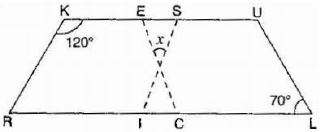
Sol.9) In parallelogram 𝑅𝐼𝑆𝐾,
∠ 𝑅𝐼𝑆 = ∠ 𝐾 = 120° [Opposite angles of a ||gm are equal]
∠ 𝑚 + 120° = 180° [Linear pair]
⇒ ∠ 𝑚 = 180° − 120° = 60°
and ∠ 𝐸𝐶𝐼 = ∠ 𝐿 = 70° [Corresponding angles]
⇒ 𝑚 + 𝑛 + ∠ 𝐸𝐶𝐼 = 180° [Angle sum property of a triangle]
⇒ 60° + 𝑛 + 70° = 180°
⇒ 130° + 𝑛 = 180°
⇒ 𝑛 = 180° − 130° = 50°
also 𝑥 = 𝑛 = 50° [Vertically opposite angles]
Q.10) Explain how this figure is a trapezium. Which is its two sides are parallel?
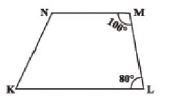
Sol.10) Here, ∠ 𝑀 + ∠ 𝐿 = 100° + 80° = 180° [Sum of interior opposite angles is 180° ]
∴ NM and KL are parallel.
Hence, KLMN is a trapezium.
Q.11) Find 𝑚∠ 𝐶 in figure , if 𝐴𝐵|| 𝐷𝐶,
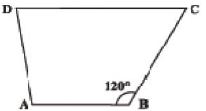
Sol.11) Here, ∠ 𝐵 + ∠ 𝐶 = 180° [ 𝐴𝐵 || 𝐷𝐶]
∴ 120° + 𝑚 ∠ 𝐶 = 180°
⇒ 𝑚∠𝐶 = 180° − 120° = 60°
Q.12) Find the measure of ∠ 𝑃 and ∠ 𝑆 if 𝑆𝑃 || 𝑅̅𝑄 in given figure.
(If you find 𝑚∠ 𝑅 is there more than one method to find 𝑚∠ 𝑃)
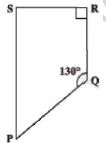
Sol.12) Here, ∠ 𝑃 + ∠ 𝑄 = 180° [Sum of co-interior angles is 180° ]
⇒ ∠ 𝑃 + 130° = 180°
⇒ ∠ 𝑃 = 180° − 130°
⇒ ∠ 𝑃 = 50°
∠ 𝑅 = 90° [Given]
∴ ∠ 𝑆 + 90° = 180°
⇒ ∠ 𝑆 = 180° − 90°
⇒ ∠ 𝑆 = 90°
Yes, one more method is there to find ∠ 𝑃.
∠ 𝑆 + ∠ 𝑅 + ∠ 𝑄 + ∠ 𝑃 = 360° [Angle sum property of quadrilateral]
⇒ 90° + 90° + 130° + ∠ 𝑃 = 360°
⇒ 310° + ∠ 𝑃 = 360°
⇒ ∠ 𝑃 = 360° − 310°
⇒ ∠ 𝑃 = 50°
Exercise 3.4
Q.1) State whether true or false:
(a) All rectangles are squares.
(b) All rhombuses are parallelograms.
(c) All squares are rhombuses and also rectangles.
(d) All squares are not parallelograms.
(e) All kites are rhombuses.
(f) All rhombuses are kites.
(g) All parallelograms are trapeziums.
(h) All squares are trapeziums.
Sol.1) (a) False. Since, squares have all sides are equal.
(b) True. Since, in rhombus, opposite angles are equal and diagonals intersect at mid- point.
(c) True. Since, squares have the same property of rhombus but not a rectangle.
(d) False. Since, all squares have the same property of parallelogram.
(e) False. Since, all kites do not have equal sides.
(f) True. Since, all rhombuses have equal sides and diagonals bisect each other.
(g) True. Since, trapezium has only two parallel sides.
(h) True. Since, all squares have also two parallel lines.
Q.2) Identify all the quadrilaterals that have:
(a) four sides of equal lengths. (b)four right angles.
Sol.2) (a) Rhombus and square have sides of equal length.
(b) Square and rectangle have four right angles.
Q.3) Explain how a square is:
(i) a quadrilateral (ii) a parallelogram (iii) a rhombus (iv) a rectangle
Sol.3) (i) A square is a quadrilateral, if it has four unequal lengths of sides.
(ii) A square is a parallelogram, since it contains both pairs of opposite sides equal.
(iii) A square is already a rhombus. Since, it has four equal sides and diagonals bisect at 90 °to each other.
(iv) A square is a parallelogram, since having each adjacent angle a right angle and opposite sides are equal
Q.4) Name the quadrilateral whose diagonals: (i) bisect each other.
(ii) are perpendicular bisectors of each other. (iii) are equal.
Sol.4) (i) If diagonals of a quadrilateral bisect each other then it is a rhombus, parallelogram, rectangle or square.
(ii) If diagonals of a quadrilateral are perpendicular bisector of each other, then it is a rhombus or square.
(iii) If diagonals are equal, then it is a square or rectangle.
Q.5) Explain why a rectangle is a convex quadrilateral.
Sol.5) A rectangle is a convex quadrilateral since its vertex are raised and both of its diagonals lie in its interior.
Q.6) ABC is a right-angled triangle and O is the mid-point of the side opposite to the right angle. Explain why O is equidistant from A, B and C. (The dotted lines are drawn additionally to help you.)
Sol.6) Since, two right triangles make a rectangle where O is equidistant point from A, B, C and D because O is the mid-point of the two diagonals of a rectangle. Since AC and BD are equal diagonals and intersect at mid-point.
So, O is the equidistant from A, B, C and D.
Free study material for Mathematics
Free NCERT Textbook Explanations: Class 8 Mathematics Chapter 03 Understanding Quadrilaterals
Chapter Exercise Answers for Class 8 Mathematics
Review comprehensive exercise answers for Class 8 Mathematics Chapter 03 Understanding Quadrilaterals. Fully updated to match current NCERT syllabus guidelines, these textbook solutions help students verify their work and maintain accurate study notes.
Detailed Answer Guides for Chapter 03 Understanding Quadrilaterals
Clear, methodical explanations accompany every challenging problem within the Class 8 Mathematics text. Engaging with these detailed answers lays a solid foundation for advanced learning and improves foundational clarity for upcoming assessments.
Complete Preparation Kit for Class 8 Exams
Consistent practice with these solution guides cultivates faster problem-solving habits and clearer logical structuring. For a complete preparation experience, pair these textbook answers with our dedicated revision notes and sample papers for Class 8 Mathematics.
FAQs
The complete and updated NCERT Solutions Class 8 Mathematics Chapter 3 Understanding Quadrilaterals is available for free on StudiesToday.com. These solutions for Class 8 Mathematics are as per latest NCERT curriculum.
Yes, our experts have revised the NCERT Solutions Class 8 Mathematics Chapter 3 Understanding Quadrilaterals as per 2026 exam pattern. All textbook exercises have been solved and have added explanation about how the Mathematics concepts are applied in case-study and assertion-reasoning questions.
Toppers recommend using NCERT language because NCERT marking schemes are strictly based on textbook definitions. Our NCERT Solutions Class 8 Mathematics Chapter 3 Understanding Quadrilaterals will help students to get full marks in the theory paper.
Yes, we provide bilingual support for Class 8 Mathematics. You can access NCERT Solutions Class 8 Mathematics Chapter 3 Understanding Quadrilaterals in both English and Hindi medium.
Yes, you can download the entire NCERT Solutions Class 8 Mathematics Chapter 3 Understanding Quadrilaterals in printable PDF format for offline study on any device.