

Official NCERT Solutions for Class 8 Mathematics: Chapter 02 Linear Equations In One Variable
Access comprehensive textbook solutions for Chapter 02 Linear Equations In One Variable using the official curriculum guides for Class 8 Mathematics. Designed to align with the 2026-27 NCERT standards, these detailed answers help students reinforce core academic concepts.
Chapter-wise Solutions for Mathematics: Chapter 02 Linear Equations In One Variable
Navigate directly to the solved Mathematics textbook exercises using the digital viewer below. Each solution includes detailed step-by-step explanations, allowing students to instantly cross-check their work and identify areas requiring further revision.
Exercise 2.1
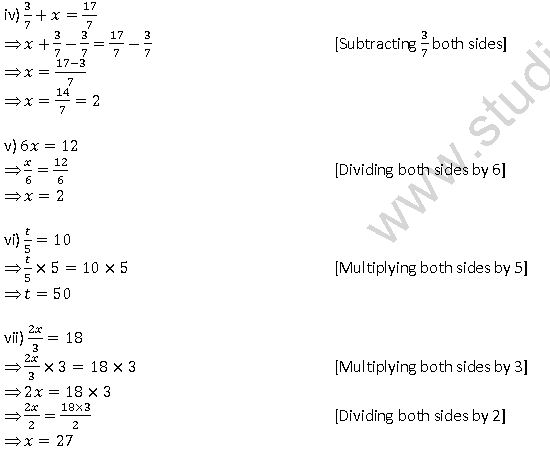
Q.1) Solve the following equations.
i) 𝑥 − 2 = 7 ii) 𝑦 + 3 = 10 iii) 6 = 𝑧 + 2 iv) 3/7 + 𝑥 = 17/7
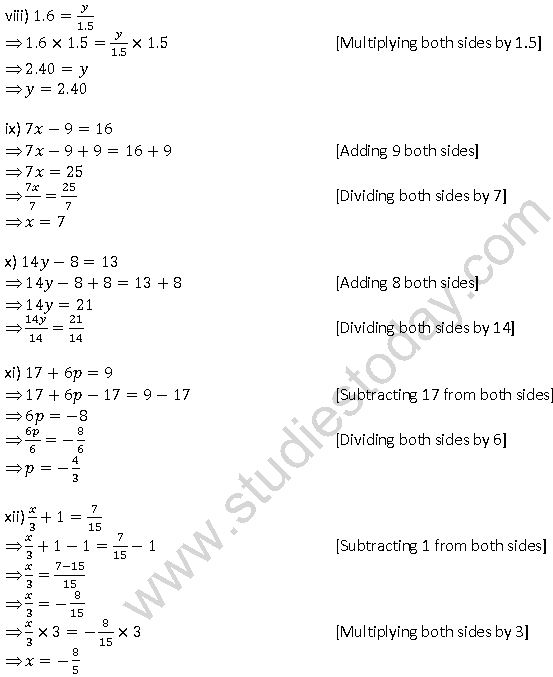
v) 6𝑥 = 12 vi) 𝑡/5 = 10 vii) 2𝑥/3 = 18 viii) 1.6 = 𝑦/1.5
ix) 7𝑥 − 9 = 16 x) 14𝑦 − 8 = 13 xi) 17 + 6𝑝 = 9 xii) 𝑥/3 + 1 = 7/15
Sol.1) i) 𝑥 − 2 = 7
⇒ 𝑥 − 2 + 2 = 7 + 2 [Adding 2 both sides]
⇒ 𝑥 = 9
ii) 𝑦 + 3 = 10
⇒ 𝑦 + 3 − 3 = 10 − 3 [Subtracting 3 both sides]
⇒ 𝑦 = 7
iii) 6 = 𝑧 + 2
⇒ 6 − 2 = 𝑧 + 2 − 2 [Subtracting 2 both sides]
⇒ 4 = 𝑧
⇒ 𝑧 = 4
Exercise 2.2
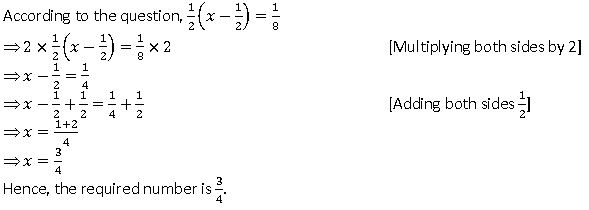
Q.1) If you subtract 1/2 from a number and multiply the result by 1/2, you get 1/8. What is the number?
Sol.1) Let the number be 𝑥
Q.2) The perimeter of a rectangular swimming pool is 154 m. Its length is 2 m more than twice its breadth. What are the length and breadth?
Sol.2) Let the breadth of the pool be 𝑥 𝑚.
Then, the length of the pool = (2𝑥 + 2)𝑚
Perimeter = 2(𝑙 + 𝑏)
⇒ 154 = 2(2𝑥 + 2 + 𝑥)
⇒ 154/2 = 2(2𝑥+2+𝑥)2 [Dividing both sides by 2]
⇒ 77 = 3𝑥 + 2
⇒ 77 − 2 = 3𝑥 + 2 − 2 [Subtracting 2 from both sides]
⇒ 75 = 3𝑥
⇒ 75/3 = 3𝑥/3
[Dividing both sides by 3]
⇒ 25 = 𝑥
⇒ 𝑥 = 25𝑚
Length of the pool = 2𝑥 + 2
= 2 × 25 + 2 = 50 + 2 = 52𝑚
Breadth of the pool = 25 𝑚
Hence, the length of the pool is 52 𝑚 and breadth is 25𝑚.
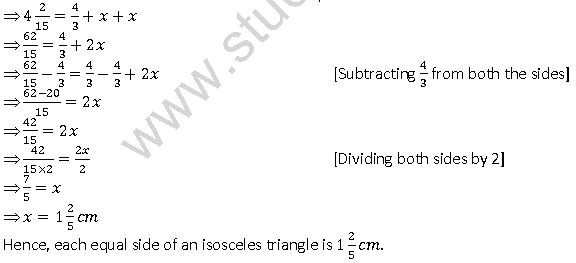
Q.3) The base of an isosceles triangle is 4/3 cm. The perimeter of the triangle is 4(2/15) cm. What is the length of either of the remaining equal sides?
Sol.3) Let each of equal sides of an isosceles triangle be 𝑥 𝑐𝑚.
Perimeter of a triangle = Sum of all three sides
NCERT-Solutions-Class-8-Mathematics-Linear-Equations-In-One-Variable-17Q.4) Sum of two numbers is 95. If one exceeds the other by 15, find the numbers.
Sol.4) Sum of two number = 95
Let the first number be x, then another number be x 15.
According to the question, 𝑥 + 𝑥 + 15 = 95
⇒ 2𝑥 + 15 = 95
⇒ 2𝑥 + 15 − 15 = 95 − 15
⇒ 2𝑥 = 80
⇒ 2𝑥/2 = 80/2
⇒ 𝑥 = 40
So, the first number = 40 and another number = 40 + 15 = 55
Hence, the two numbers are 40 and 55.
Q.5) Two numbers are in the ratio 5:3. If they differ by 18, what are the numbers?
Sol.5) Let the two number be 5𝑥 and 3𝑥.
According to question,
5𝑥 − 3𝑥 = 18
⇒ 2𝑥 = 18
⇒ 𝑥 = 18/2
⇒ 𝑥 = 9
Thus, the numbers are 5𝑥 = 45 and 3𝑥 = 27.
Q.6) Three consecutive integers add up to 51. What are these integers?
Sol.6) Let the three consecutive integers be 𝑥, 𝑥 + 1 and 𝑥 + 2.
According to the question, 𝑥 + 𝑥 + 1 + 𝑥 + 2 = 51
⇒ 3𝑥 + 3 = 51
⇒ 3𝑥 + 3 − 3 = 51 − 3 [Subtracting 3 from both sides]
⇒ 3𝑥 = 48
⇒ 3𝑥/3 = 48/3 [Dividing both sides by 3]
⇒ 𝑥 = 16
Hence, first integer = 16, second integer = 16 + 1 = 17 and third integer = 16 + 2 = 18.
Q.7) The sum of three consecutive multiples of 8 is 888. Find the multiples
Sol.7) Let the three consecutive multiples of 8 be 𝑥, 𝑥 + 8 and 𝑥 + 16.
According to question, 𝑥 + 𝑥 + 8 + 𝑥 + 16 = 888
⇒ 3𝑥 + 24 = 888
⇒ 3𝑥 + 24 − 24 = 888 − 24 [Subtracting 24 from both sides]
⇒ 3𝑥 = 864
⇒ 3𝑥/3 = 864/3 [Dividing both sides by 3]
⇒ 𝑥 = 288
Hence, first multiple of 8 = 288, second multiple of 8 = 288 + 8 = 296 and third
multiple of 8 = 288 + 16 = 304.
Q.8) Three consecutive integers are such that when they are taken in increasing order and multiplied by 2, 3 and 4 respectively, they add up to 74. Find these numbers.
Sol.8) Let the three consecutive integers be 𝑥, 𝑥 + 1 and 𝑥 + 2
According to the question, 2𝑥 + 3(𝑥 + 1) + 4(𝑥 + 2) = 74
⇒ 2𝑥 + 3𝑥 + 3 + 4𝑥 + 8 = 74
⇒ 9𝑥 + 11 = 74
⇒ 9𝑥 + 11 − 11 = 74 − 11 [Subtracting 11 from both sides]
⇒ 9𝑥 = 63
⇒ 9𝑥/9 = 63/9 [Dividing both sides by 9]
⇒ 𝑥 = 7
Hence first integer = 7, second integer = 7 + 1 = 8 and third integer = 7 + 2 = 9.
Q.9) The ages of Rahul and Haroon are in the ratio 5:7. Four years later the sum of their ages will be 56 years. What are their present ages?
Sol.9) Let the present ages of Rahul and Haroon be 5𝑥 𝑦𝑒𝑎𝑟𝑠 and 7𝑥 𝑦𝑒𝑎𝑟𝑠 respectively.
According to condition, (5𝑥 + 4) + (7𝑥 + 4) = 56
⇒ 12𝑥 + 8 = 56
⇒ 12𝑥 + 8 − 8 = 56 − 8 [Subtracting 8 from both sides]
⇒ 12𝑥 = 48
⇒ 12𝑥/12 = 48/12 [Dividing both sides by 12]
⇒ 𝑥 = 4
Hence, present age of Rahul = 5 × 4 = 20 𝑦𝑒𝑎𝑟𝑠 and present age of Haroon = 7 × 4 = 28 𝑦𝑒𝑎𝑟𝑠.
Q.10) The number of boys and girls in a class are in the ratio 7 : 5. The number of boys is 8 more than the number of girls. What is the total class strength?
Sol.10) Let the number of girls be 𝑥.
Then, the number of boys = 𝑥 + 8
According to the question, 𝑥+8/𝑥 = 7/5
⇒ 5(𝑥 + 8) = 7𝑥
⇒ 5𝑥 + 40 = 7𝑥
⇒ 5𝑥 − 7𝑥 = −40 [Transposing 7𝑥 to L.H.S. and 40 to R.H.S.]
⇒ −2𝑥 = −40
⇒ −2𝑥/−2 = −40/−2 [Dividing both sides by -2]
⇒ 𝑥 = 20
Hence the number of girls = 20
and number of boys 𝑥 + 8 = 20 + 8 = 28
Q.11) Baichung’s father is 26 years younger than Baichung’s grandfather and 29 years older than Baichung. The sum of the ages of all the three is 135 years. What is the age of each one of them?
Sol.11) Let Baichung’s age be x years, then Baichung’s father’s age = ( x + 29) years and
Baichung’s granddaughter’s age = (𝑥 + 29 + 26) = (𝑥 + 55)𝑦𝑒𝑎𝑟𝑠
According to condition, 𝑥 + 𝑥 + 29 + 𝑥 + 55 = 135
⇒ 3𝑥 + 84 = 135
⇒ 3𝑥 + 84 − 84 = 135 − 84 [Subtracting 84 from both sides]
⇒ 3𝑥 = 51
⇒ 3𝑥/3 = 51/3 [Dividing both sides by 3]
⇒ 𝑥 = 17 𝑦𝑒𝑎𝑟𝑠
Hence, Baichung’s age = 17 𝑦𝑒𝑎𝑟𝑠,
Baichung’s father’s age = 17 + 29 = 46 𝑦𝑒𝑎𝑟𝑠 and
Baichung’s granddaughter’s age = 17 + 29 + 26 = 72 𝑦𝑒𝑎𝑟𝑠.
Q.12) Fifteen years from now Ravi’s age will be four times his present age. What is Ravi’s present age?
Sol.12) Let Ravi’s present age be x years. After fifteen years, Ravi’s age = 4x years. Fifteen years
from now, Ravi’s age = (𝑥 + 15) 𝑦𝑒𝑎𝑟𝑠.
According to question, 415 x x = +
⇒ 4𝑥 = 𝑥 + 15 [Transposing 𝑥 to L.H.S.]
⇒ 3𝑥 = 15
⇒ 3𝑥/3 = 15/3 [Dividing both sides by 3]
⇒ 𝑥 = 5 𝑦𝑒𝑎𝑟𝑠
Hence, Ravi’s present age be 5 years.
Q.13) A rational number is such that when you multiply it by 5/2 and 2/3 to the product, you get − 7/12. What is the number?
Sol.13) Let the rational number be 𝑥.
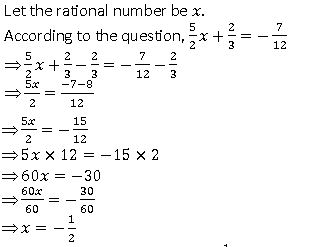
Hence, the rational number is − 1/2.
Q.14) Lakshmi is a cashier in a bank. She has currency notes of denominations Rs.100, Rs.50 and Rs.10 respectively. The ratio of the number of these notes is 2:3:5. The total cash with Lakshmi is Rs.4,00,000. How many notes of each denomination does she have?
Sol.14) Let number of notes be 2𝑥 , 3𝑥 and 5𝑥.
According to question, 100 × 2𝑥 + 50 × 3𝑥 + 10 × 5𝑥 = 4,00,000
⇒ 200𝑥 + 150𝑥 + 50𝑥 = 4,00,000
⇒ 400𝑥 = 4,00,000
⇒ 400𝑥/400 = 4,00,000 400 [Dividing both sides by 400]
⇒ 𝑥 = 1,000
Hence, number of denominations of Rs.100 notes = 2 × 1000 = 2000
Number of denominations of Rs.50 notes = 3 × 1000 = 3000
Number of denominations of Rs.10 notes = 5 × 1000 = 5000
Therefore, required denominations of notes of Rs.100, Rs.50 and Rs.10 are 2000, 3000 and 5000 respectively.
Q.15) I have a total of Rs.300 in coins of denomination Rs.1, Rs.2 and Rs.5. The number of Rs.2 coins is 3 times the number of Rs.5 coins. The total number of coins is 160. How many coins of each denomination are with me?
Sol.15) Total sum of money = Rs.300
Let the number of rRs.5 coins be 𝑥, number of Rs.2 coins be 3𝑥 and number of Rs.1 coins
be 160 − (𝑥 − 3𝑥) = 160 − 4𝑥.
According to question, 5 × 𝑥 + 2 × (3𝑥) + 1 × (160 − 4𝑥) = 300
⇒ 5𝑥 + 6𝑥 + 160 − 4𝑥 = 300
⇒ 7𝑥 + 160 = 300
⇒ 7𝑥 + 160 − 160 = 300 − 160 [Subtracting 160 from both sides]
⇒ 7𝑥 = 140
⇒ 7𝑥/7 = 140 7 [Dividing both sides by 7]
⇒ 𝑥 = 20
Hence, the number of coins of Rs.5 denomination = 20
Number of coins of Rs.2 denomination = 3 × 20 = 60
Number of coins of Rs.1 denomination = 160 – 4 × 20 = 160 – 80 = 80
Q.16) The organizers of an essay competition decide that a winner in the competition gets a prize of Rs.100 and a participant who does not win, gets a prize of Rs.25. The total prize money distributed is Rs.3,000. Find the number of participants is 63.
Sol.16) Total sum of money 𝑅𝑠. 3000
Let the number of winners of Rs.100 be 𝑥.
And those who are not winners = 63 - 𝑥
According to the question, 100 × 𝑥 + 25 × (63 − 𝑥) = 3000
⇒ 100𝑥 + 1575 − 25𝑥 = 3000
⇒ 75𝑥 + 1575 = 3000
⇒ 7𝑥 + 1575 − 1575 = 3000 − 1575 [Subtracting 1575 from both sides]
⇒ 7𝑥 = 1425
⇒ 7𝑥/7 = 1425/7 [Dividing both sides by 7]
⇒ 𝑥 = 19
Hence the number of winner is 19.
Exercise 2.3
Q.1) Solve the following equations and check your results.
(1) 3𝑥 = 2𝑥 + 18 (2) 5𝑡 – 3 = 3𝑡 – 5 (3) 5𝑥 + 9 = 5 + 3𝑥
(4) 4𝑧 + 3 = 6 + 2𝑧 (5) 2𝑥 – 1 = 14 – 𝑥 (6) 8x + 4 = 3 (x – 1) + 7
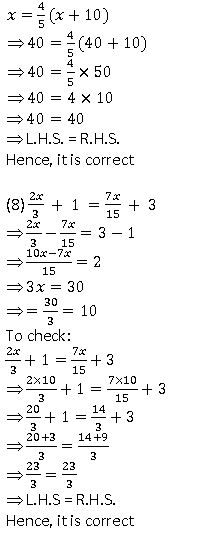
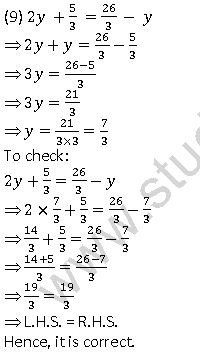
(7) 𝑥 = 4/5 (𝑥 + 10) (8) 2𝑥/3 + 1 = 7𝑥/15 + 3 (9) 2𝑦 + 5/3 = 26/3 − 𝑦
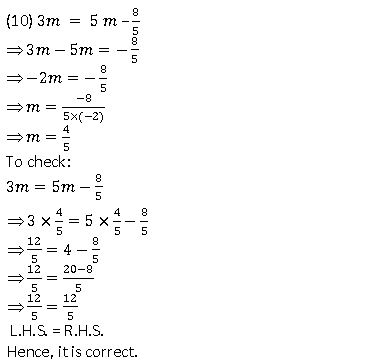
(10) 3𝑚 = 5 𝑚 – 8/5
Sol.1) (1) 3𝑥 = 2𝑥 + 18
⇒ 3𝑥 − 2𝑥 = 18
⇒ 𝑥 = 18
To check: 3𝑥 = 2𝑥 + 18
⇒ 3 × 18 = 2 × 18 + 18
⇒ 54 = 36 + 18
⇒ 54 = 54
⇒ L.H.S. = R.H.S.
Hence, it is correct.
(2) 5𝑡 – 3 = 3𝑡 – 5
⇒ 5𝑡 − 3𝑡 = −5 + 3
⇒ 2𝑡 = −2
⇒ 𝑡 = − 2/2 = −1
To check:
5𝑡 − 3 = 3𝑡 − 5
⇒ 5 × (−1) − 3 = 3 × (−1) − 5
⇒ −5 − 3 = −3 − 5
⇒ −8 = −8
⇒ L.H.S. = R.H.S.
Hence, it is correct.
(3) 5𝑥 + 9 = 5 + 3𝑥
⇒ 5𝑥 − 3𝑥 = 5 − 9
⇒ 2𝑥 = −4
⇒ 𝑥 = − 4/2 = −2
To check:
5𝑥 + 9 = 5 + 3𝑥
⇒ 5 × (−2) + 9 = 5 + 3 × (−2)
⇒ −10 + 9 = 5 − 6
⇒ −1 = −1
⇒ L.H.S. = R.H.S.
Hence, it is correct.
(4) 4𝑧 + 3 = 6 + 2𝑧
⇒ 4𝑧 − 2𝑧 = 6 − 3
⇒ 2𝑧 = 3
⇒ 𝑧 = 3/2
To check:
4𝑧 + 3 = 6 + 2𝑧
⇒ 4 × 3/2 + 3 = 6 + 2 × 3/2
⇒ 2 × 3 + 3 = 6 + 3
⇒ 6 + 3 = 9
⇒ 9 = 9
⇒ L.H.S. = R.H.S. Hence, it is correct
(5) 2𝑥 – 1 = 14 – 𝑥
⇒ 2𝑥 + 𝑥 = 14 + 1
⇒ 3𝑥 = 15
⇒ 𝑥 = 15/3 = 5
To check:
2𝑥 − 1 = 14 − 𝑥
⇒ 2 × 5 − 1 = 14 − 5
⇒ 10 − 1 = 9
⇒ 9 = 9
⇒ L.H.S. = R.H.S.
Hence, it is correct.
(6) 8𝑥 + 4 = 3 (𝑥 – 1) + 7
⇒ 8𝑥 + 4 = 3𝑥 − 3 + 7
⇒ 8𝑥 − 3𝑥 = −3 + 7 − 4
⇒ 5𝑥 = 0
⇒ 𝑥 = 0/5 = 0
To check:
8𝑥 + 4 = 3(𝑥 − 1) + 7
⇒ 8 × 0 + 4 = 3(0 − 1) + 7
⇒ 0 + 4 = 3 × (−1) + 7
⇒ 4 = −3 + 7
⇒ 4 = 4
L.H.S = R.H.S
Hence, it is correct.
(7) 𝑥 = 4/5 (𝑥 + 10)
⇒ 5𝑥 = 4(𝑥 + 10)
⇒ 5𝑥 = 4𝑥 + 40
⇒ 5𝑥 − 4𝑥 = 40
⇒ 𝑥 = 40
To check:
Exercise 2.4
Q.1) Amina thinks of a number and subtracts 5 /2 from it. She multiplies the result by 8. The result now obtained is 3 times the same number she thought of. What is the number?
Sol.1) Let Amina thinks a number be 𝑥
According to question, 8 (𝑥 − 5/5) = 3𝑥
⇒ 8𝑥 − 8×5/2 = 3𝑥
⇒ 8𝑥 − 4 × 5 = 3𝑥
⇒ 8𝑥 − 20 = 3𝑥
⇒ 8𝑥 − 3𝑥 = 20
⇒ 5𝑥 = 20
⇒ 𝑥 = 20/5 = 4
Hence, the number is 4.
Q.2) A positive number is 5 times another number. If 21 is added to both the numbers, then one of the new numbers becomes twice the other new number. What are the numbers?
Sol.2) Let another number be 𝑥.
Then positive number = 5𝑥
According to the question, 5𝑥 + 21 = 2(𝑥 + 21)
⇒ 5𝑥 + 21 = 2𝑥 + 42
⇒ 5𝑥 − 2𝑥 = 42 − 21
⇒ 3𝑥 = 21
⇒ 𝑥 = 21/3 = 7
Hence another number = 7 and
positive number = 5 × 7 = 35
Q.3) Sum of the digits of a two-digit number is 9. When we interchange the digits, it is found that the resulting new number is greater than the original number by 27. What is the two-digit number?
Sol.3) Let the unit place digit of a two-digit number be 𝑥.
Therefore, the tens place digit = 9 𝑥
2-digit number = 10 x tens place digit + unit place digit
∴ Original number = 10(9 − 𝑥) + 𝑥
According to the question,
New number = Original number + 27
⇒ 10𝑥 + (9 − 𝑥) = 10(9 − 𝑥) + 𝑥 + 27
⇒ 10 + 9 − 𝑥 = 90 − 10𝑥 + 𝑥 + 27
⇒ 9𝑥 + 9 = 117 − 9𝑥
⇒ 9𝑥 + 9𝑥 = 117 − 9
⇒ 18𝑥 = 108
⇒ 𝑥 = 108/18 = 6
Hence, the 2-digit number = 10(9 − 𝑥) + 𝑥 = 10(9 − 6) + 6
= 10 × 3 + 6 = 30 + 6 = 36
Q.4) One of the two digits of a two-digit number is three times the other digit. If you interchange the digits of this two-digit number and add the resulting number to the original number, you get 88. What is the original number?
Sol.4) Let the unit place digit of a two-digit number be 𝑥.
Therefore, the tens place digit = 3𝑥
2-digit number = 10 x tens place digit + unit place digit
∴ Original number 10 × 3𝑥 + 𝑥 = 30𝑥 + 𝑥 = 31𝑥
According to the question, New number + Original number = 88
⇒ 10𝑥 + 3𝑥 + 31𝑥 = 88
⇒ 44𝑥 = 88
⇒ 𝑥 = 88/44 = 2
Hence, the 2-digit number = 31𝑥 = 31 × 2 = 62
Q.5) Shobo’s mother’s present age is six times Shobo’s present age. Shobo’s age five years from now will be one third of his mother’s present age. What are their present age?
Sol.5) Let Shobo’s present age be 𝑥 𝑦𝑒𝑎𝑟𝑠.
And Shobo’s mother’s present age = 6𝑥 𝑦𝑒𝑎𝑟𝑠
According to the question, 𝑥 + 5 = 1/3 × 6𝑥
⇒ 𝑥 + 5 = 2𝑥
⇒ 2𝑥 = 𝑥 + 5
⇒ 2𝑥 − 𝑥 = 5
⇒ 𝑥 = 5 𝑦𝑒𝑎𝑟𝑠.
Hence, Shobo’s present age = 5 years and
Shobo’s mother’s present age = 6 x 5 = 30 years
Q.6) There is a narrow rectangular plot, reserved for a school, in Mahuli village. The length and breadth of the plot are in the ratio 11:4. At the rate ` 100 per meter it will cost the village panchayat ` 75,000 to fence the plot. What are the dimensions of the plot?
Sol.6) Let the length and breadth of the rectangular plot be 11𝑥 and 4𝑥 respectively.
∴ Perimeter of the plot = 𝑡𝑜𝑡𝑎𝑙 𝑐𝑜𝑠𝑡/𝑐𝑜𝑠𝑡 𝑜𝑓 1 𝑚𝑒𝑡𝑒𝑟 = 75000/100 = 750 𝑚
We know that Perimeter of rectangle = 2(𝑙𝑒𝑛𝑔𝑡ℎ + 𝑏𝑟𝑒𝑎𝑑𝑡ℎ)
Therefore, according to the question, 750 = 2(11𝑥 + 4𝑥)
⇒ 750 = 2 × 15𝑥
⇒ 750 = 30𝑥
⇒ 𝑥 = 750/30 = 25
Hence, length of rectangular plot = 11 × 25 = 275 𝑚 and
breadth of rectangular plot = 4 × 25 = 100 𝑚
Q.7) Hasan buys two kinds of cloth materials for school uniforms, shirt material that costs him Rs.50 per meter and trouser material that costs him Rs.90 per meter. For every 2 meters of the trouser material he buys 3 meters of the shirt material. He sells the materials at 12% and 10% respectively. His total sale is Rs.36,000. How much trouser material did he buy?
Sol.7) Let ratio between shirt material and trouser material be 3𝑥 ∶ 2𝑥
The cost of shirt material = 50 × 3𝑥 = 150𝑥
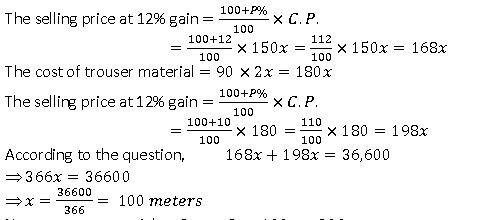
Now, trouser material = 2𝑥 = 2 × 100 = 200 𝑚𝑒𝑡𝑒𝑟𝑠
Hence, Hasan bought 200 meters of the trouser material.
Q.8) Half of a herd of deer are grazing in the field and three fourths of the remaining are playing nearby. The rest 9 are drinking water from the pond. Find the number of deer in the herd
Sol.8) Let the total number of deer in the herd be 𝑥.
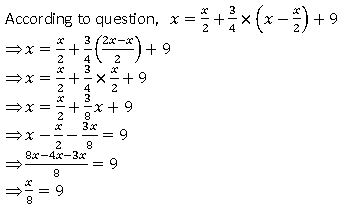
⇒ 𝑥 = 9 × 8 = 72
Hence, the total number of deer in the herd is 72.
Q.9) A grandfather is ten times older than his granddaughter. He is also 54 years older than her. Find their present ages
Sol.9) Let present age of granddaughter be 𝑥 𝑦𝑒𝑎𝑟𝑠.
Therefore, Grandfather’s age = 10𝑥 𝑦𝑒𝑎𝑟𝑠
According to question, 10𝑥 = 𝑥 + 54
⇒ 10𝑥 − 𝑥 = 54
⇒ 9𝑥 = 54
⇒ 𝑥 = 54/9
= 6 𝑦𝑒𝑎𝑟𝑠
Hence, granddaughter’s age = 6 𝑦𝑒𝑎𝑟𝑠 and
grandfather’s age = 10 × 6 = 60 𝑦𝑒𝑎𝑟𝑠.
Q.10) Aman’s age is three times his son’s age. Ten years ago he was five times his son’s age.
Find their present ages.
Sol.10) Let the present age of Aman’s son be 𝑥 𝑦𝑒𝑎𝑟𝑠.
Therefore, Aman’s age = 3𝑥 𝑦𝑒𝑎𝑟𝑠
According to question, 3𝑥 − 10 = 5(𝑥 − 10)
⇒ 3𝑥 − 10 = 5𝑥 − 50
⇒ 3𝑥 − 5𝑥 = −50 + 10
⇒ −2𝑥 = −40
⇒ 𝑥 = −40/−2 = 20 𝑦𝑒𝑎𝑟𝑠
Hence, Aman’s son’s age = 20 𝑦𝑒𝑎𝑟𝑠 and
Aman’s age = 3 × 2 = 60 𝑦𝑒𝑎𝑟𝑠
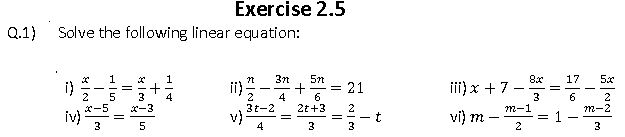
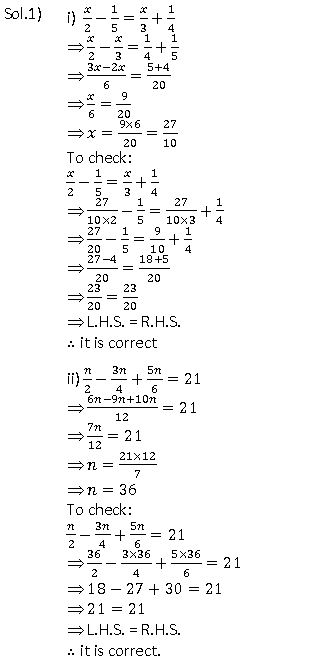
Q.2) Simplify and solve the following linear equations.
i) 3(𝑡 − 3) = 5(2𝑡 + 1)
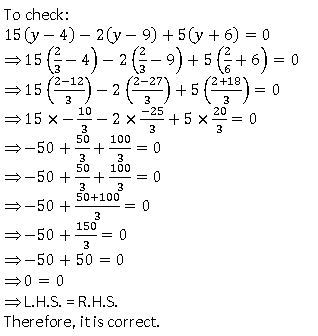
ii) 15(𝑦 − 4) − 2(𝑦 − 9) + 5(𝑦 + 6) = 0
iii) 3(5𝑧 − 7) − 2(9𝑧 − 11) = 4(8𝑧 − 13) − 17
iv) 0.25(4𝑓 − 3) = 0.05(10𝑓 − 9)
Sol.2) i) 3(𝑡 − 3) = 5(2𝑡 + 1)
⇒ 3𝑡 − 9 = 10𝑡 − 5
⇒ 3𝑡 − 10𝑡 = 5 + 9
⇒ −7𝑡 = 14
⇒ 𝑡 = 14/−7
⇒ 𝑡 = −2
To check:
3(𝑡 − 3) = 5(2𝑡 + 1)
⇒ 3(−2 − 3) = 5{2 × (−2) + 1}
⇒ 3 × −5 = 5(−4 + 1)
⇒ −15 = 5 × (−3)
⇒ −15 = −15
⇒ L.H.S. = R.H.S.
Therefore, it is correct.
ii) 15(𝑦 − 4) − 2(𝑦 − 9) + 5(𝑦 + 6) = 0
⇒ 15𝑦 − 60 − 2𝑦 + 18 + 5𝑦 + 30 = 0
⇒ 18𝑦 − 12 = 0
⇒ 18𝑦 = 12
⇒ 𝑦 = 12/18 = 2/3
iii) 3(5𝑧 − 7) − 2(9𝑧 − 11) = 4(8𝑧 − 13) − 17
⇒ 15𝑧 − 21 − 18𝑧 + 22 = 32𝑧 − 52 − 17
⇒ −3𝑧 + 1 = 32𝑧 − 69
⇒ −3𝑧 − 32𝑧 = −69 − 1
⇒ −35𝑧 = −70
⇒ 𝑧 = −70/−35 = 2
To check:
3(5𝑧 − 7) − 2(9𝑧 − 11) = 4(8𝑧 − 13) − 17
⇒ 3(5 × 2 − 7) − 2(9 × 2 − 11) = 4(8 × 2 − 13) − 17
⇒ 3(10 − 7) − 2(18 − 11) = 4(16 − 13) − 17
⇒ 3 × 3 − 2 × 7 = 4 × 3 − 17
⇒ 9 − 14 = 12 − 17
⇒ −5 = −5
⇒ L.H.S. = R.H.S.
Therefore, it is correct.
iv) 0.25(4𝑓 − 3) = 0.05(10𝑓 − 9)
⇒ 1.00𝑓 − 0.75 = 0.50𝑓 − 0.45
⇒ 1.00𝑓 − 0.50𝑓 = −0.45 + 0.75
⇒ 0.50𝑓 = 0.3
⇒ 𝑓 = 0.3/0.50
⇒ 0.6
To check:
0.25(4𝑓 − 3) = 0.05(10𝑓 − 9)
⇒ 0.25(4 × 0.6 − 3) = 0.05(10 × 0.6 − 9)
⇒ 0.25(2.4 − 3) = 0.05(6.0 − 9)
⇒ 0.25 × (−0.6) = 0.05 × (−3)
⇒ −0.150 = −0.150
⇒ L.H.S. = R.H.S.
Therefore, it is correct.
Exercise 2.6
Q.1) Solve the following equation:
i) 8𝑥−3/3𝑥 = 2 ii) 9𝑥/7−6𝑥 = 15 iii) 𝑧/𝑧+15 = 4/9
iv) 3𝑦+4/2−6𝑦 = −2/5
v) 7𝑦+4/𝑦+2 = −4/3
Sol.1) i) 8𝑥−3/3𝑥 = 2
⇒ 8𝑥 − 3 = 2 × 3𝑥
⇒ 8𝑥 − 3 = 6𝑥
⇒ 8𝑥 − 6𝑥 = 3
⇒ 2𝑥 = 3
⇒ 𝑥 = 3/2
ii) 9𝑥/7−6𝑥 = 15
⇒ 9𝑥 = 15(7 − 6𝑥)
⇒ 9𝑥 = 105 − 90𝑥
⇒ 9𝑥 + 90𝑥 = 105
⇒ 99𝑥 = 105
⇒ 𝑥 = 105/99
⇒ 𝑥 = 35/33
iii) 𝑧/𝑧+15 = 4/9
⇒ 𝑧 × 9 = 4(𝑧 + 15)
⇒ 9𝑧 = 4𝑧 + 60
⇒ 9𝑧 − 4𝑧 = 60
⇒ 5𝑧 = 60
⇒ 𝑧 = 60/5 = 12
iv) 3𝑦+4/2−6𝑦 = −2/5
⇒ 5(3𝑦 + 4) = −2(2 − 6𝑦)
⇒ 15𝑦 + 20 = −4 + 12𝑦
⇒ 15𝑦 − 12𝑦 = −4 − 20
⇒ 3𝑦 = −24
⇒ 𝑦 = −24/3 = −8
v) 7𝑦+4/𝑦+2 = −4/3
⇒ 3(7𝑦 + 4) = −4(𝑦 + 2)
⇒ 21𝑦 + 12 = −4𝑦 − 8
⇒ 21𝑦 + 4𝑦 = −8 − 12
⇒ 25𝑦 = −20
⇒ 𝑦 = −20/25
⇒ 𝑦 = −4/5
Q.2) The ages of Hari and Harry are in the ratio 5:7. Four years from now the ratio of their ages will be 3:4. Find their present ages.
Sol.2) Let the Ages of Hari and Harry be 5𝑥 years and 7𝑥 𝑦𝑒𝑎𝑟𝑠.
According to question, 5𝑥+4/7𝑥+4 = 3/4
⇒ 4(5𝑥 + 4) = 3(7𝑥 + 4)
⇒ 20𝑥 + 16 = 21𝑥 + 12
⇒ 20𝑥 − 21𝑥 = 12 − 16
⇒ −𝑥 = −4
⇒ 𝑥 = 4
Hence, the age of Hari = 5𝑥 = 5 × 4 = 20 𝑦𝑒𝑎𝑟𝑠 and the age of Harry = 7𝑥 = 7 × 4 = 28 𝑦𝑒𝑎𝑟𝑠.
Q.3) The denominator of a rational number is greater than its numerator by 8. If the numerator is increased by 17 and the denominator is decreased by 1, the number obtained is 3/2. Find the rational number.
Sol.3) Let the numerator of a rational number be 𝑥, then the denominator is 𝑥 + 8.
Therefore, Rational number = 𝑥/𝑥+8
According to question,
𝑥+17/𝑥+8−1
= 3/2
⇒ 𝑥+17/𝑥+7 = 3/2
⇒ 2(𝑥 + 17) = 3(𝑥 + 7)
⇒ 2𝑥 + 34 = 3𝑥 + 21
⇒ 2𝑥 − 3𝑥 = 21 − 34
⇒ −𝑥 = −13
⇒ 𝑥 = 13
Hence, the required rational number = 𝑥/𝑥+8 = 13/13+8 = 13/21
Free study material for Mathematics
Free NCERT Textbook Explanations: Class 8 Mathematics Chapter 02 Linear Equations In One Variable
Textbook Solutions for Class 8 Mathematics Chapter 02 Linear Equations In One Variable
Review comprehensive exercise answers for Class 8 Mathematics Chapter 02 Linear Equations In One Variable. Fully updated to match current NCERT syllabus guidelines, these textbook solutions help students verify their work and maintain accurate study notes.
Mastering Theoretical and Practical Questions
Beyond providing final answers, these guides offer step-by-step breakdowns for complex queries in the Class 8 Mathematics module. This approach helps students balance theoretical depth with practical problem-solving skills required for NCERT exams.
Effective Self-Study and Homework Assistance
Frequent review of these structured answers builds strong analytical capabilities and response efficiency. Maximize your academic readiness by combining these textbook solutions with our curated study materials and mock evaluations for Class 8 Mathematics.
FAQs
The complete and updated NCERT Solutions Class 8 Mathematics Chapter 2 Linear Equations In One Variable is available for free on StudiesToday.com. These solutions for Class 8 Mathematics are as per latest NCERT curriculum.
Yes, our experts have revised the NCERT Solutions Class 8 Mathematics Chapter 2 Linear Equations In One Variable as per 2026 exam pattern. All textbook exercises have been solved and have added explanation about how the Mathematics concepts are applied in case-study and assertion-reasoning questions.
Toppers recommend using NCERT language because NCERT marking schemes are strictly based on textbook definitions. Our NCERT Solutions Class 8 Mathematics Chapter 2 Linear Equations In One Variable will help students to get full marks in the theory paper.
Yes, we provide bilingual support for Class 8 Mathematics. You can access NCERT Solutions Class 8 Mathematics Chapter 2 Linear Equations In One Variable in both English and Hindi medium.
Yes, you can download the entire NCERT Solutions Class 8 Mathematics Chapter 2 Linear Equations In One Variable in printable PDF format for offline study on any device.