

NCERT Solutions for Class 4 Environmental Studies: Chapter 09 Changing Families
Explore reliable textbook solutions for Chapter 09 Changing Families tailored for Class 4 learners. Utilizing these Environmental Studies answers ensures thorough preparation and strengthens foundational knowledge before final NCERT evaluations.
Practice Class 4 Environmental Studies Solutions: Chapter 09 Changing Families
View or download the dedicated Chapter 09 Changing Families solution resource below. Engaging with these textbook answers under focused study conditions ensures continuous academic progress and mastery of the 2026-27 curriculum for Environmental Studies.
NCERT Solutions for Class 4 EVS Looking Around for Chapter 9 Changing Families
Look at the pictures and write (Page 67)
Q.1. Who were the members of Nimmi’s family before the arrival of her baby sister?
Ans. Father, mother, grandmother, uncle and Nimmi.
Q.2. How many members are there in nimmi’s family now?
Ans. Six.
Let us Talk (Page 68)
Q.1. How do you think the lives of Nimmi’s family members have changed after the arrival of the new baby? For example-
(1) How will Nimmi spend her day now?
Ans. Playing with the newborn baby.
(2) What new work will her mother don now?
Ans. Looking after the newborn baby.
(3) There will be a change in the daily work of Nimmi’s father, grandmother and uncle with the arrival of the new baby. Can you tell how?
Ans. Thy will be looking after the new baby. They will be playing with her.
Page 68
(4) Has a small brother or sister been born in you home or in any house in your neighborhood?
Ans. Yes, a baby boy is born to my aunty.
(5) How does it feel to have a new baby at home?
Ans. It feels very nice.
(6) How have things changed at home with the new baby?
Ans. Everybody is very happy. They are palaying with new baby.
Q.1. Find out all about the youngest child in your home or in the home of a relative. Then write:
(1) When was the baby born?
Ans. Two months back.
(2) Is the baby a boy or a girl?
Ans. Boy.
(3) How are you related to him or her?
Ans. He is my cousin.
(4) Where was the baby born?
Ans. In the hospital.
(5) Who does the baby look born?
Ans. He looks like his father i.e., my uncle.
(6) What is the colour of his or her hair?
Ans. Black.
(7) What is the colour of his or her eyes?
Ans. Brown.
(8) Does the baby have any teeth?
Ans. No.
(9) What is the baby’s length?
Ans. Around one and half feet.
Page 69
(10)How many hours a day does the baby sleep?
Ans. More than 17 hours.
(11)What different sounds does the baby make?
Ans. He cries and makes various other sounds.
(12)Who does the baby stay with most of the time?
Ans. His mother i.e., my aunty.
(13)Stick a photograph of the baby or draw a picture in you notebook.
Ans.
To be done by students themselves
Q.1. When Tsering’s father showed the letter to his family, how do you think the different members would have felt?
Ans. Everyone was happy that Tsering’s father got promotion. At the same time, all were a little sad also that he has to go to another city.
Page 70
Q.1. What will change in Tsering’s family after his father’s transfer? For example:
Who from Tsering’s family will live with his father at the new place? Which school will Tsering go to now? Will he have new friends?
Ans. Tsering’s mother. Tsering’s sister and Tsering. Tsering will go to a school there. He will have new friends there.
Q.2. Has anybody in your family moved to a new palce because of work?
Ans. Yes, my uncle.
Q.3. What do you feel about this change?
Ans. We feel sad.
Q.4. Is there anyone in your class or school who has come to your school from another place? If so, talk to him or her?
Ans. Yes, one girl came to our school last month.
Q.5. Where has she or he come form?
Ans. She came from Varanasi.
Q.6. What was his or her old school like?
Ans. Her old school was like this school.
Q.7. What does he or she find different here?
Ans. Different people, different uniform, different timing.
Q.8. Does he or she like the change?
Ans. At first, she had some problems to adjust to new conditions. Now, she enjoys it.
Let us talk (Page 71)
Q.1. Do you think that there will be any change in Nazli’s family after his wedding? What will changed?
Ans. Yes, there will be a new member in Nazli’s family. She in Nazli’s sister-in-law.
Q.2. Do you think there will be changes in the home from where the new bride has come? What kind of changes?
Ans. Nazli’s sister in law stays with them family member and works for them.
Q.3. Talk to your mother and aunts in family. Ask them about where they lived before they got married.
Ans. They lived with their parents.
Page 72
Q.1. Who were the members in their families?
Ans. Their parents, brothers, sisters.
Q.2. Has anybody in your family been married recently? Who?
Ans. My cousin sister had been married.
Q.3. What kind of special food is cooked?
Ans. Vegetables, shahi paneer, Basmati rice, dal, etc.
Q.4. What special clothes do the bride and bridegroom wear?
Ans. Traditional bride and dances.
Write down the reasons for these changes (Page 72)
(1) In Nimmi’s family:
Ans. In Nimmi’s family, a new baby is born. One family member increases.
(2) In Tsering’s family:
Ans. Tsering’s father got transfer in job. Family members are reduced.
(3) In Nazli’s family:
Ans. Her cousing got married. As a result, her sister-in-law came in their family.
Page 73
Q.1. There can be many reasons for changes in families. Can you think of some more reasons.?
Ans. (1) Getting married.
(2) Transfer in job.
(3) Birth of new child.
Q.2. Talk to three old people-one form your family, one from your friend’s family and one from a family in your neighborhood. Ask them these question and fill in the table.
Questions | Your family | Friend’s family | Neighbour’s family |
* Since how many years has family been staying here? | More than hundred | Fifty years | Five years |
* Where did your family live before coming here? | Originally | In Rajasthan | In Uttar Pradesh |
* How many members are there are there in your family today? | Five | Six | Seven |
* How many member were there in your family 10 years ago? | Six | Five | Ten |
* What were the reasons for the changes in your family in the last 10 years? | Death of Grandfather | Birth of sister | Changes of place |
How do you feel about all these changes? | I feel bad for my grandfather | He feels good for his sister | Misses other family members. |
My family- Yesterday, Today, Tomorrow (Page 74)
Q.1. All families change in some way or the other because of different reasons. Has your family changed too?
Ans. Yes.
Q.2. When your grandmother and grandfather were children like you, was your family just like it is today?
Ans. No.
Q.3. You had drawn a family tree of your own family? Let us again draw the family tree oflast year in your notebook?
Ans.

Q.4. Ask your Grandmother or grandfather how many members were there in their family when they were your age? Then draw a family tree in your notebook of their family when were young.
Ans.
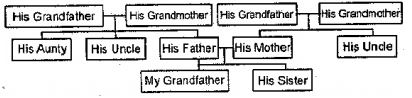
Q.5. Can you see yourself, your brother or your sister, your mother or your
Ans. No.
Q.6. Now draw a family tree of your present family in your notebook.
Ans.

Q.7. Can you see yourself anywhere in their family tree? Who are the members of your family today? Where are your grandparents?
Ans. Yes. My parents, sibling’s grandparents. My grandparents are at the top of the family tree.
Let us Talk (Page 75)
Q.1. Can you tell in what ways the family tree of your grandmother or grandfather in their childhood is different form your family tree today?]
Ans. During their childhood, my grandparents were at the bottom of the family tree. Now, they are at the top.
Going Back to School (Page 75)
Q.1. Upto which lass do you want to study?
Ans. Master degree.
Q.2. Upto which class have your parents studied?
Ans. Graduation.
Q.3. Till which lass did your grandmother get a chance to study?
Ans. Class X.
Q.4. At what age did your grandmother get married?
And.21
Q.5. Have you heard of a law that talks about the ages before, which girls and boys must not get married?
Ans. Yes. Boys must not get married before 21 years and girls should not get married before 18 years.
Find out and write (Page 76)
Q.1. Are there any such children in your neighborhood who had to drop out of school? Do they want to go back to school?
Ans. No.
Q.2. Has anybody in your family got married recently?
Ans. Yes, my cousin.
Q.3. What was the age of the bride and the groom?
Ans. Yes, my cousin.
Q.4. What was the age of the bride and the groom?
Ans. Bride was 24 years and groom was 27 years of age.
Environmental Studies Class 4 Curriculum Solutions: Chapter 09 Changing Families
Chapter Exercise Answers for Class 4 Environmental Studies
Access structured NCERT textbook solutions for Chapter 09 Changing Families. Designed in alignment with the latest academic curriculum for Class 4 Environmental Studies, these answers cover all end-of-chapter exercises to support daily learning and homework completion.
Detailed Answer Guides for Chapter 09 Changing Families
Each solution includes detailed reasoning to foster genuine comprehension of Chapter 09 Changing Families concepts. Reviewing these step-by-step breakdowns allows learners to master both analytical and descriptive questions expected in school evaluations.
Complete Preparation Kit for Class 4 Exams
These resources act as an effective roadmap for daily homework tasks and independent study. Supplement your review of Chapter 09 Changing Families with official sample papers and interactive practice tests available on our platform free of charge.
FAQs
The complete and updated NCERT Solutions Class 4 EVS Chapter 9 Changing Families is available for free on StudiesToday.com. These solutions for Class 4 Environmental Studies are as per latest NCERT curriculum.
Yes, our experts have revised the NCERT Solutions Class 4 EVS Chapter 9 Changing Families as per 2026 exam pattern. All textbook exercises have been solved and have added explanation about how the Environmental Studies concepts are applied in case-study and assertion-reasoning questions.
Toppers recommend using NCERT language because NCERT marking schemes are strictly based on textbook definitions. Our NCERT Solutions Class 4 EVS Chapter 9 Changing Families will help students to get full marks in the theory paper.
Yes, we provide bilingual support for Class 4 Environmental Studies. You can access NCERT Solutions Class 4 EVS Chapter 9 Changing Families in both English and Hindi medium.
Yes, you can download the entire NCERT Solutions Class 4 EVS Chapter 9 Changing Families in printable PDF format for offline study on any device.