

Download NCERT Solutions for Class 4 Environmental Studies Chapter 04 The Story of Amrita
Explore reliable textbook solutions for Chapter 04 The Story of Amrita tailored for Class 4 learners. Utilizing these Environmental Studies answers ensures thorough preparation and strengthens foundational knowledge before final NCERT evaluations.
Access NCERT Solutions and Answers
Access the complete solution PDF for Class 4 Environmental Studies below. Regular practice with these targeted textbook answers builds familiarity with standard question patterns and helps secure higher marks in final school evaluations.
NCERT Solutions for Class 4 EVS Looking Around for Chapter 4 The Story of Amrita
Amrita’s Friends (Page 32)
Q.1. Is there a place near your house, school or along the road side where trees have been planted?
Ans. Yes, trees are planted in the road side.
Q.2. Were these trees planted by anyone, or did they grow by themselves?
Ans. Some of them grew by themselves, some were planted by man.
Page 33
Q.1. Why were they planted there?
Ans. To get fruits and shade.
Q.2. Have you seen anyone taking care of the trees? Who does this?
Ans. No, nobody looks after them.
Q.3. Have you seen fruits on any of the trees? Who eats three fruits?
Ans. Yes, Young children eat these fruits.
Q.4. Do you know of any place where grass, small plants or trees are growing on their own without being planted.
Ans. Yes, in the fields, grass grows on its own.
Q.5. Why do you feel that these are growing on their own?
Ans. Nobody has planted the grass. Still they are growing there.
Page 34
Q.1. Do you remember what the elders of this village used to say?
Ans. They used to say “Agar perh hain to hum hain plants and animals can survive without us, but we cannot survive without them”.
Q.2. Do you think we could survive if there were no trees and no animals?
Ans. No, without trees we will get food and fresh air.
The Village is Protected (Page 34)
Q.1. Does the tree has flower?
Ans. Yes.
Q.2. Do the flowers remain always on the tree?
Ans. No.
Q.3. When do the leaves of the tree fall (month)
Ans. December.
Q.4. Does it bear fruits?
Ans. Yes.
Q.5. What kind of fruit? And when does it grow?
Ans. Mango, May
Q.6. Have you eaten fruits like this?
Ans. Yes.
Discuss (Page 36)
Q.1. Why do people hunt?
Ans. (i) To have fun.
(ii) For bone.
(iii) For skin.
Q.2. Do you know that you can be punished for hunting animals?
Ans. Yes.
Q.3. Why do you think there is the punishment?
Ans. To protect the innocent animals.
Q.4. What were some animals and birds that they could see when they were of your age?
Ans. Goat, cow, cuckoo, sparrow, pigeon, etc.
Q.5. Can we still see those animals and birds?
Ans. Yes.
Q.6. Which of them can we see less than before?
Ans. Cuckoo.
Page 37
Q.1. Shanti’s grandfather told her that when he was a small child he saw more birds like sparrow and mynah than he sees today. Can you make two guesses why their number have becomes less?
Ans. (1) Hunting
(2) Destruction of forests and trees which reduce their living area.
Q.2. Which kind of tree you see a lot in your area? Name two such trees.
Ans. Mango, Coconut.
Q.3. Find out more about these from your elder?
Ans. Mango: It is a very tasty fruit. Mango trees grow very large and branchy. The buds of mango come in the month of January. The fruit starts ripening from middle of April. There are many varieties of mango.
Coconut: The coconut is fruit with water inside. Coconut trees grows very tall. It has no branches. The leaves of coconut trees are very large. The season of ripening of coconut is September.
Question. Which item is made from a material got from animals?

Answer : D
Question. Which of the following is usual in winters?
(a) shorter days, longer nights
(b) shorter days, shorter nights
(c) longer days, shorter nights
(d) longer days, longer nights
Answer : B
Question. Why do leaves have veins?
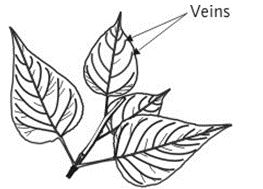
(a) to make the leaf look brighter
(b) to absorb sunlight from the atmosphere
(c) to transport food and water
(d) to help the plant breathe
Answer : C
Question. Which of these do we get from plants?
(a) BUTTER
(b) RUBBER
(c) SILK
(d) CHEESE
Answer : B
Question. Saira's friend tells her that plants grow better if watered with SALT WATER. To check this, she sets up the experiment as shown. Is she doing anything wrong?

(a) No, she is not doing anything wrong.
(b) Yes, she should water the plant alternately with normal and salt water.
(c) Yes, she should grow another similar plant watering it with salt water.
(d) Yes, she should grow another similar plant watering it with normal water.
Answer : D
Question. Sushmita has learnt in class that plants lose water through their leaves. This is called transpiration. What experiment can she set up to test if this is true?
(a) Tie a wet plastic bag around the whole plant.
(b) Tie a dry plastic bag around some of the leaves.
(c) Tie a wet plastic bag around some of the leaves.
(d) Tie a dry plastic bag around the whole plant.
Answer : B
Question. Abhijit wanted to find out if MANURE can help a plant grow well. He has two identical tomato plants with him. What should he do?
(a) Grow one in the light and one in the dark.
(b) Grow both in the light but put manure in only one of them.
(c) Put manure in both, but water only one of them.
(d) Grow one with manure in the light, and the other without manure in the dark.
Answer : B
Question. Sohan wanted to find out how tall a plant grows each day. Sohan would
(a) give the plant a half-cup of water each day.
(b) put the plant in a sunny place each day.
(c) measure the plant with a ruler each day.
(d) put the plant on a weighing scale each day and weigh it.
Answer : C
Question. Sonia did the following activity. She put some moist cotton on two identical trays and left a few seeds on each tray. She kept one tray in a shoe box with some holes on the top and the other near the window. She sprinkled water on both the trays and noted her observations for a week everyday. Why did Sonia do this experiment?

(a) She wanted to find out if plants grow well in a shoe box.
(b) she wanted to find out if plants grow well near the window.
(c) She wanted to find out if the amount of water affects growth of the plant from the seed.
(d) She wanted to find out if the amount of light affects growth of the plant from the seed.
Answer : D
Question. Which of these is an important function of the roots of a plant?
(a) to absorb oxygen from the atmosphere
(b) to absorb carbon dioxide from the soil
(c) to absorb water and minerals from the soil
(d) to transport water and minerals to different parts of the plant
Answer : C
Free NCERT Textbook Explanations: Class 4 Environmental Studies Chapter 04 The Story of Amrita
Chapter Exercise Answers for Class 4 Environmental Studies
Explore reliable textbook solutions for Chapter 04 The Story of Amrita tailored for Class 4 learners. Utilizing these complete exercise answers ensures your preparation aligns exactly with official NCERT standards for Environmental Studies.
Detailed Answer Guides for Chapter 04 The Story of Amrita
Beyond providing final answers, these guides offer step-by-step breakdowns for complex queries in the Class 4 Environmental Studies module. This approach helps students balance theoretical depth with practical problem-solving skills required for NCERT exams.
Complete Preparation Kit for Class 4 Exams
These resources act as an effective roadmap for daily homework tasks and independent study. Supplement your review of Chapter 04 The Story of Amrita with official sample papers and interactive practice tests available on our platform free of charge.
FAQs
The complete and updated NCERT Solutions Class 4 Environmental Studies Chapter 4 The Story of Amrita is available for free on StudiesToday.com. These solutions for Class 4 Environmental Studies are as per latest NCERT curriculum.
Yes, our experts have revised the NCERT Solutions Class 4 Environmental Studies Chapter 4 The Story of Amrita as per 2026 exam pattern. All textbook exercises have been solved and have added explanation about how the Environmental Studies concepts are applied in case-study and assertion-reasoning questions.
Toppers recommend using NCERT language because NCERT marking schemes are strictly based on textbook definitions. Our NCERT Solutions Class 4 Environmental Studies Chapter 4 The Story of Amrita will help students to get full marks in the theory paper.
Yes, we provide bilingual support for Class 4 Environmental Studies. You can access NCERT Solutions Class 4 Environmental Studies Chapter 4 The Story of Amrita in both English and Hindi medium.
Yes, you can download the entire NCERT Solutions Class 4 Environmental Studies Chapter 4 The Story of Amrita in printable PDF format for offline study on any device.