

Official NCERT Solutions for Class 4 Environmental Studies: Chapter 01 Going To School
Access comprehensive textbook solutions for Chapter 01 Going To School using the official curriculum guides for Class 4 Environmental Studies. Designed to align with the 2026-27 NCERT standards, these detailed answers help students reinforce core academic concepts.
Chapter-wise Solutions for Environmental Studies: Chapter 01 Going To School
Access the complete solution PDF for Class 4 Environmental Studies below. Regular practice with these targeted textbook answers builds familiarity with standard question patterns and helps secure higher marks in final school evaluations.
NCERT Solutions for Class 4 EVS Looking Around for Chapter 1 Going To School
These (Page 1)
Q.1. Collect some bricks. Lay them on the ground in the line as shown in the picture. Try walking on them. Was it easy?
Ans. Yes.
Q.2. Make a small bridge by trying together 4 or 5 bamboo poles. Ask your teacher to help you. Now wlk on your bridge. How did your feeil? Did you fall down? If you walk like this a few times, you will start finding it easy.
Ans. At first, I found it difficult to walk. Later, it became easy.
Q.3. Do you think it would be easier to walk on this bridge in bare feet, or with shoes or slippers? Why?
Ans. It is easier to walk on this bridge in bare feet. It has more grip with toes.
Q.4. Could you tell the difference in both thye pictures? Which would be easierusing pulley or without it?
Ans. The first boy is pulling out bucket with bare hands. The second boy is using a pulley. Pulley makes it easier.
Q.5. Look around you where all do you see the use of pulleys? List them.
Ans. Lifting heavy loads, hosting flage, etc.
Cement Bridge (Page 3)
Q.1. How is this bridge different form a bamboo bridge?
Ans. Cement bridge is wide and stable.
Q.2. How many people do you think can cross the bridge at one time?
Ans. About twenty.
Q.3. If you had a chance, which bridge would you like to use? Why?
Ans. I would like to use cement bridge. It is easier to walk on and safe also.
Q.4. Do you have to cross any bridge on the wqay to your school? If yes, what is ther bridge like?
Ans. I have to cross a cement bridge.
Q.5. Find out from your grand parents, what kind of bridges were there when they were young?
Ans. At that time, there were only bamboo and wooden bridges.
Page 4
Is there any bridge near your house? Find out more about the bridge.
Q.1. Where is the bridge-over water, over a road, between two mountains of anywhere else?
Ans. It is over water.
Q.2. Who all use the bridge? Is it by people on foot, or also vehicles and animals?
Ans. It is used by all.
Q.3. Find our what materials are used in making this bridge. List them.
Ans. Cement, iron rod, sand brick, small stones.
Q.4. Draw a picture of the bridge. Do not forget to draw the train, vehicles, animals or people who cross the bridge.
Ans.
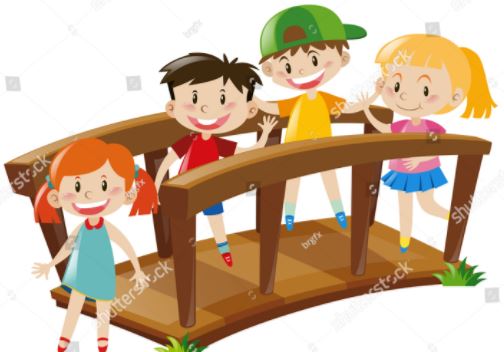
Q.5. Imagine what difficulties we would face, if the bridge were not there?
Ans. People will not be able to cross rivers or drains easily. They will have to use boats.
Vallam
Q.1. Have you seen any other kind of boats?
Ans. Yes, I have seen larger boats with small rooms.
Q.2. Can you think of other ways by which we can travel on water?
Ans. There are boat like things like steamer, etc.
Camel chart (Page 5)
Q.1. Have your ever sat in a camel cart of horse carriage (tanga)? Wher? Did you climb on it yourself, or did someone help you?
Ans. Yes, The tangawala helped me.
Q.2. How did you feel riding in the cart?
Ans. It is a bit shaky, still I liked it.
Bullock Cart (Page 5)]
Q.1. Do you have bullock carts where you live?
Ans. No.
Q.2. Do they have a roof?
Ans. No.
Q.3. What kind of wheels do they have?
Ans. Large wooden wheels with iron rims.
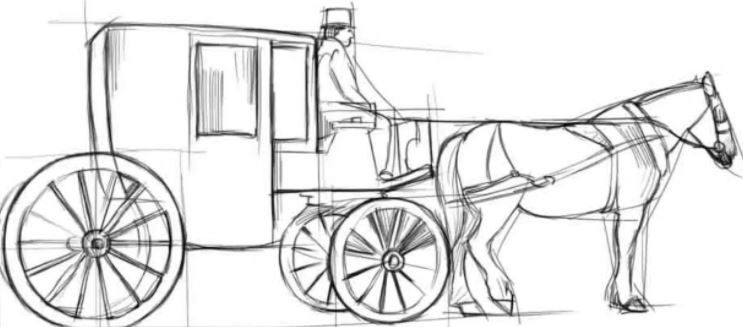
Q.4. Make a drawing of the cart.
Ans.
Bicycle-ride (Page 6)
Q.1. Can you ride a bicycle?
Ans. Yes.
Q.2. Who taught your to ride?
Ans. My elder brother.
Q.3. How many children come on bicycles to your school?
Ans. About twenty.
Jugad- What a vehicle (Page 7)
Q.1. Do you have such vehicle in your area?
Ans. Yes.
Q.2. What do you call this in your area?
Ans. Bike-van.
Q.3. Would you like to ride in something like this? Why?
Ans. Yes. It is great fun.
Q.4. Can you tell why is it called Jugad?
Ans. It is prepared for serving other purpose.
Children cross the jungle (Page 8)
Q.1. Have you ever been in a thick jungle?
Ans. Yes.
Q.2. Write about the jungle.
Ans. The jungle is full of large trees. There is always sound of birds, animals, etc.
Moving on the Snow (Page 8)
Q.1. Have you ever seen so much snow? Where? In films or anywhere else?
Ans. I have seen in films.
Q.2. Do you think that such places have snow all the time? Why?
Ans. Yes. These places are very cold and located at great height form the surface of the earth.
Rocky paths (Page 9)
Q.1. Do you face any difficulty on the way to your school?
Ans. No.
Q.2. Which is the best month, in which you like to go school? Why?
Ans. In the month of September. It is neither hot nor cold.
See Me walk (Page 9)
Go to a ground or an open space with your friends. Act the way you with walk in these situation.
Q.1 The ground is made of soft and smooth rose petals.
(i) The ground is covered with thorns and there is tall grass on the side.
(ii) The ground is covered with snow.
(iii) Was there a difference in the way you walked each time?
Ans. Yes, every time the way of walking was different.
(i) When on rose petals, I walked smoothly. It is a very pleasing experience.
(ii) When on thorns, I walked very cautiously.
(iii) When on snow, I walked with small steps as snow is slippery.
Talk about it (Page 10)
Q.1. Do you also have punishment in your school. What kind of?
Ans. Yes. The teacher rebuked me for not preparing to lesson.
Q.2. How do you feel when you are punished?
Ans. I felt ashamed. I promised myself never fail prepare lessons.
Q.3. Do you think that there should be punishment in school?
Ans. Yes. Otherwise there will be no difference between good and bad students.
Q.4. Is punishment the only solution to misdeeds. Frame some rules for school that avoid misdeed without punishments.
Ans. No, punishment is not the only solution to misdeed. There are other methods like,
(1) Students who behave well, should be reward.
(2) There should be mark allotted in the examination for not doing any misdeeds.
Q.5. Draw a picture of your dream school and write about it.
Ans. My dream school has a nice building. It has a garden in the front. It also has a play ground. There is proper facility of drinking water and toilet. There Are lots of books in the school library.
Question. Students of a class were given two objects and asked to find out which was heavier. Here are some suggestions - which is the best?
(a) Put the objects one by one into a bucket filled with water. The one that sinks is heavier.
(b) Place the objects one on each palm. Estimate which one feels heavier. That is heavier.
(c) Put both the objects on a table. Identify the object that looks big. This is the object that is heavier.
(d) Tie each object to the ends of a ruler and balance at the mid point. One that goes down is heavier.
Answer : D
Question. Find the odd one out.
(a) elevators
(b) wells
(c) flagpoles
(d) axe
Answer : D
Question. Pulley and lever are called simple machines as they:
(a) Aid human efforts by acting as force multipliers.
(b) Are simple to arrange and operate.
(c) Do not comprise of several internal components.
(d) Are not machines.
Answer : B
Question. In a high rise building there is an arrangement to pull small packets up various floors. In the arrangement a rope straddles across and down a wheel which is fixed in a wall. The rope is supporting a basket at its one end while the other end is tethered to the handle of the recipient flat.
The system is such that when the rope is tugged from the handle's end it moves up and down the basket attached to it.
(a) The system comprises of a lever as well as a pulley.
(b) The system is an example only of an pulley system.
(c) The system employs neither pulley or lever but is simply a vertical uplift arrangement.
(d) The wheel system is an example of pulley while the attached basket is an example of lever.
Answer : B
Question. Find the wrongly matched
(a) Pulley- flagpole
(b) Inclined plane- ramp
(c) Lever- sea saw
(d) Wedge- flagpole
Answer : D
Question. In which of the following will a wheel DEFINITELY be present?
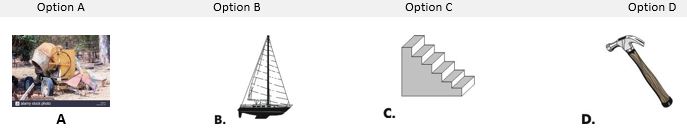
Answer : A
Question. The length of this pencil is about__________.

(a) 4 cm
(b) 5 cm
(c) 6 cm
(d) 7 cm
Answer : B
Question. Imagine you are finding it difficult to pull water bucket from the well. Which of the following machine can you use to make your work easy.
(a) Wheel and axle
(b) wedge
(c) screw
(d) pulley
Answer : D
Question. The picture shows the people crossing at a pedestrian crossing. The signal shown is for the traffic. What would be the colour of the signal at this time?

(a) Red
(b) Amber
(c) Green
(d) Could be any colour
Answer : A
Question. Which of the following best represents the example of pulley?
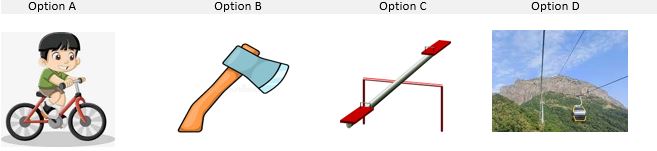
Answer : B
Free NCERT Textbook Explanations: Class 4 Environmental Studies Chapter 01 Going To School
Chapter Exercise Answers for Class 4 Environmental Studies
Access structured NCERT textbook solutions for Chapter 01 Going To School. Designed in alignment with the latest academic curriculum for Class 4 Environmental Studies, these answers cover all end-of-chapter exercises to support daily learning and homework completion.
Detailed Answer Guides for Chapter 01 Going To School
Beyond providing final answers, these guides offer step-by-step breakdowns for complex queries in the Class 4 Environmental Studies module. This approach helps students balance theoretical depth with practical problem-solving skills required for NCERT exams.
Complete Preparation Kit for Class 4 Exams
Consistent practice with these solution guides cultivates faster problem-solving habits and clearer logical structuring. For a complete preparation experience, pair these textbook answers with our dedicated revision notes and sample papers for Class 4 Environmental Studies.
FAQs
The complete and updated NCERT Solutions Class 4 Environmental Studies Chapter 1 Going To School is available for free on StudiesToday.com. These solutions for Class 4 Environmental Studies are as per latest NCERT curriculum.
Yes, our experts have revised the NCERT Solutions Class 4 Environmental Studies Chapter 1 Going To School as per 2026 exam pattern. All textbook exercises have been solved and have added explanation about how the Environmental Studies concepts are applied in case-study and assertion-reasoning questions.
Toppers recommend using NCERT language because NCERT marking schemes are strictly based on textbook definitions. Our NCERT Solutions Class 4 Environmental Studies Chapter 1 Going To School will help students to get full marks in the theory paper.
Yes, we provide bilingual support for Class 4 Environmental Studies. You can access NCERT Solutions Class 4 Environmental Studies Chapter 1 Going To School in both English and Hindi medium.
Yes, you can download the entire NCERT Solutions Class 4 Environmental Studies Chapter 1 Going To School in printable PDF format for offline study on any device.