

Step-by-Step Textbook Solutions for Class 4 Environmental Studies Chapter 15 From Market To Home
Explore reliable textbook solutions for Chapter 15 From Market To Home tailored for Class 4 learners. Utilizing these Environmental Studies answers ensures thorough preparation and strengthens foundational knowledge before final NCERT evaluations.
Download Chapter 15 From Market To Home Textbook Solutions PDF
Navigate directly to the solved Environmental Studies textbook exercises using the digital viewer below. Each solution includes detailed step-by-step explanations, allowing students to instantly cross-check their work and identify areas requiring further revision.
NCERT Solutions for Class 4 EVS Looking Around for Chapter 15 From Market To Home
Dayat night! (Page 118)
Q.1. Does anyone in your house have to get up very early? What time do they get up? What time do they get up? Why do they need to get up so early?
Ans. My father gets up very early. He has to go to his factory.
Preparing for the Day (Page 120)
Q.1. Why do you think he does this?
Ans. The previous days vegetables would spoil early.
Q.2. Have you seen dried or spoilt vegetables? Where?
Ans. Yes. I have seen them in my kitchen.
Q.3. How could you know that the vegetables were spoilt?
Ans. Some liquid come out of them. They also smell foul.
Q.4. Look at the clocks given below. Write what you do, and what Vaishali does, at the time which the clock is showing.
Ans. Vaishali –> takes out vegetables
You –> Sleep
Vaishali –> Putting vegetables in the bag
You –> prepare lessons
Vaishali –> sleeps
You –> watch T.V.
Q.5. From where do you get vegetables for your home? Who brings the vegetables?
Ans. We get vegetables from the market. Both my father and I bring the vegetables.
Fun with vegetables (Page 123)
Q.1. Are all of them the same size?
Ans. No.
Q.2. Find the longest and the shortest one. Measure them?
Ans. (Do yourself)
Q.3. Are all of the same thickness?
Ans. No.
Q.4. Are they all the same colour?
Ans. Yes.
Q.5. Cut two lady’s finger lengthwise. Do both of them have the same number of seeds?
Ans. No.
Q.6. Seema’s mother has brought some fruits and vegetables form the market. Can youfind them in this picture?
Ans. Brinjal Potato, carrot.
Find out (Page 124)
Q.1. Given here is a list of vegetables and fruits. Which of these well spoil soon, and whichwill stay for some days. Write the names in the correct column. Add more names.
Names: Spinach, potato, banana, tomato, pear, chikoo, pineapple, gourd, onion,cabbage, cucumber.
Ans.
| Fruits and vegetables that spoil quickyl | Fruits and vegetables that can stay for some days |
| Tomato | Potato |
| Banana | Chikoo |
| Pear | Gourd |
| Pineapple | Onion |
| Spinach | Cabbage |
| cucumber |
Q.2. Some of these fruits and vegetables are smooth to touch, some have a rought skin.Put names in the correct column.
Ans. Smooth skin –> Rough skin
Tomato –> cabbage
Brinjal –> chikoo
Potato –> onion
Q.3. Which is the vegetable that you find the heaviest to carry? Write its name and draw its picture.
Ans. Pumpkin
Q.4. Of the fruits and vegetables that you have eaten, which is the lightest one one? Writeits name and draw a picture.
Ans. Lady’s finger.
Q.5. Write names of three vegetables which do not have seeds.
Ans. Potato, cabbage, cauliflower.
| Colour | Length | Price (How much is it sold for) | |
| Apple | Red | 5 cm | () Rs. 20 |
| Banana | Yellow | 15 cm | (1 dozen) Rs. 15 |
| Potato | Grey | 5 cm | () Rs. 5 |
| Cabbage | Green | 10 cm | () Rs. 5 |
| Cauliflower | White | 10 cm | () Rs. 4 |
| Tomato | Red | 4 cm | () Rs. 6 |
Q.6. Talk with a vegetable seller in your area and find out:
(i) What is his/her name?
Ans. Mukund Srivastava
(ii) How many people are there in his/her house. How many children?
Ans. There are six people, his fater, mother, wife and two children.
(iii) What are their names? How old are they?
Ans. Father – Bhumidhar Srivastava, 60 years
Mother – Laxmi Srivastava, 50 years
Wife – Surbhi Srivastava, 30 years
Boy – Laxman Srivastava, 5 years
Girl – rani Srivastava, 3 years.
(iv) Who all help in the work of selling vegetables?
Ans. His wife, father and mother.
(v) Who all stay with the vegetable cart or sit in the shop?
Ans. His boy.
(vi) What vegetable do they sell?
Ans. Patato, onion, tomato, cabbage, cauliflower.
(vii) What time do they start work?
Ans. Very early in the morning. (4 o’clock)
(viii) For about how many hours in a day do the work?
Ans. 15 hours.
(ix) Ask them about any three vegetables that the sell.
Ans.
| Vegetable 1 | Vegetable 2 | Vegetable 3 | ||
| Name of the vegetable The price of the vegetable From where does it come? How much of the vegetable do they buy at one time? In which season does this vegetable usually comes? | Potato Rs. 10/kg Sabzi mandi 100 kg all | Onion Rs. 15/kg Sabzi mandi 100 kg All | Tomato Sabzi mandi 50 kg winter |
Question. In the table given below one of the items has been listed under the wrong heading. Identify this item.
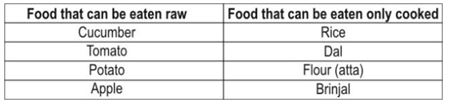
(a) Rice
(b) Potato
(c) Apple
(d) Brinjal
Answer : B
Question. Which of these could be a stone of 90 grams?

Answer : D
Question. In which list are all the given food items normally eaten after cooking?
(a) tomato, apple, onion
(b) banana, cucumber, radish
(c) carrot, peas, beetroot
(d) brinjal, cauliflower, potato
Answer : D
Question. Most fruits are eaten raw. Some of them are eaten with skin and some without. Swati has made a table of fruits eaten with or without skin. She has made a mistake in listing the fruits. Which fruit has she listed in the wrong place?
| Fruits eaten with skin | Fruits eaten without skin |
| Guava | Orange |
| Pineapple | Custard Apple |
| Grapes | Pomrgranate |
(a) Custard Apple
(b) Grapes
(c) Pomegranate
(d) Pineapple
Answer : D
Question. Identify this plant shown below:
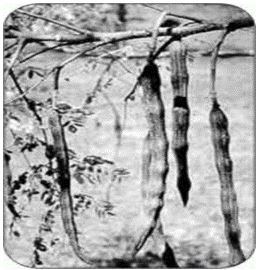
(a) Drumstick
(b) Papaya
(c) Carrot
(d) Pumpkin
Answer : A
Question. Study the figure given below. Which of the blocks shown is the heaviest?

(a) P
(b) Q
(c) R
(d) We cannot say for sure
Answer : C
Environmental Studies Class 4 Curriculum Solutions: Chapter 15 From Market To Home
Accessing Chapter 15 From Market To Home Solutions
Explore reliable textbook solutions for Chapter 15 From Market To Home tailored for Class 4 learners. Utilizing these complete exercise answers ensures your preparation aligns exactly with official NCERT standards for Environmental Studies.
Concept-Driven Answers for Class 4 Environmental Studies
Beyond providing final answers, these guides offer step-by-step breakdowns for complex queries in the Class 4 Environmental Studies module. This approach helps students balance theoretical depth with practical problem-solving skills required for NCERT exams.
Maximizing Study Efficiency
These resources act as an effective roadmap for daily homework tasks and independent study. Supplement your review of Chapter 15 From Market To Home with official sample papers and interactive practice tests available on our platform free of charge.
FAQs
The complete and updated NCERT Solutions Class 4 Environmental Studies Chapter 15 From Market To Home is available for free on StudiesToday.com. These solutions for Class 4 Environmental Studies are as per latest NCERT curriculum.
Yes, our experts have revised the NCERT Solutions Class 4 Environmental Studies Chapter 15 From Market To Home as per 2026 exam pattern. All textbook exercises have been solved and have added explanation about how the Environmental Studies concepts are applied in case-study and assertion-reasoning questions.
Toppers recommend using NCERT language because NCERT marking schemes are strictly based on textbook definitions. Our NCERT Solutions Class 4 Environmental Studies Chapter 15 From Market To Home will help students to get full marks in the theory paper.
Yes, we provide bilingual support for Class 4 Environmental Studies. You can access NCERT Solutions Class 4 Environmental Studies Chapter 15 From Market To Home in both English and Hindi medium.
Yes, you can download the entire NCERT Solutions Class 4 Environmental Studies Chapter 15 From Market To Home in printable PDF format for offline study on any device.