

Download NCERT Solutions for Class 4 Environmental Studies Chapter 16 A Busy Month
Explore reliable textbook solutions for Chapter 16 A Busy Month tailored for Class 4 learners. Utilizing these Environmental Studies answers ensures thorough preparation and strengthens foundational knowledge before final NCERT evaluations.
Access NCERT Solutions and Answers
Access the complete solution PDF for Class 4 Environmental Studies below. Regular practice with these targeted textbook answers builds familiarity with standard question patterns and helps secure higher marks in final school evaluations.
NCERT Solutions for Class 4 EVS Looking Around for Chapter 16 A Busy Month
Q.1. How many years ago did Gijubhai write this letter?
Ans. About 71 years.
Q.2. This letter talks about many different birds. How many of these birds have your seen?
Ans. I have seen dove, Indian robin, crow koel, barbet, sunbird, etc.
Q.3. How many other birds have your seen?
Ans. Many for example, sparrow.
Q.4. Have you seen a bird’s nest? Where did you see it?
Ans. Yes. On the branch of a tree.
Q.5. Which is your favorite bird? Can you show your friends in the class how it flies, and what sound it makes?
Ans. My favorite bird is koel.
Q.6. Guess this bird: A crown on the head and coins on the tail. So many shades of blue from top to tail.
A clue: It is our national bird.
Ans. Peacock.
Q.7. Do you know of any other bird that makes its nest in a tree trunk like the barbet does?
Ans. Woodpecker.
Q.8. If there is a nest inside or around your house. Look at it carefully. Remember, do not go near to the nest, and do not touch it. If you do, then the bird will not come to the nest ageing.
Observe the nest for some days and note down some things:
(i) Where is the nest made?
Ans. On a branch.
(ii) What is the nest made of?
Ans. Straw, dried leaves.
(iii) Is the nest complete, or are the birds still making it?
Ans. It is complete.
(iv) Can you recognise what bird it is?
Ans. It is a sparrow.
(v) What things does the bird bring to the nest?
Ans. Straw.
(vi) Is there any bird sitting on the nest?
Ans. Yes.
(vii) Do you think there are eggs in the nest?
Ans. Yes.
(viii) Can you hear nay sounds-chee chee-from the nest?
Ans. Yes.
(ix) If there are chicks in the nest, what do the parent birds brings for them to eat?
Ans. Insects, grains.
(x) how many times in one hour do the birds come to the nest?
Ans. Two to three times.
(xi) After how many days did the chicks leave the nest?
Ans. One and half month.
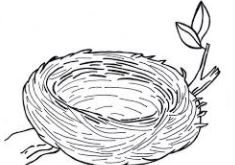
(xii) Make picture of the nest that you observed.
Ans. Nest
Q.9. You have seen how birds use many different things to make their nests. Use some of these to make a nest. Make a small paper bird to put in the nest.
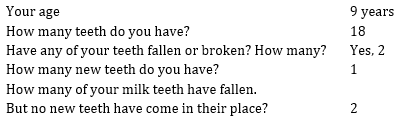
Find out about your own teeth and write (Page 135)
Ans.
Find out more (Page 135)
Q.1. Look at each other’s teeth. Are there different kinds of teeth. Draw the front teeth. Draw on front teeth and on back teeth in the boxes given below.
Ans.
Front teeth

Back teeth

Q.2. Can you see any difference between these teeth?
Ans. The front teeth are flat. The back teeth are round.
Page 136
Q.1. Draw a Picture. How would you look if you had no teeth?
Ans.

Q.2. Find out from old people who do not have teeth, what are the kind of things that they cannot eat.
Ans. They cannot eat hard things. They cannot eat iaddoo, tandoori roti, etc.
Question. Which animal probably made these footprints?

Answer : D
Question. Which of these shows’ food-storing behaviour?
(a) a dog barking at a cat
(b) a bird building a nest
(c) a cockroach running from light
(d) a squirrel burying nuts
Answer : D
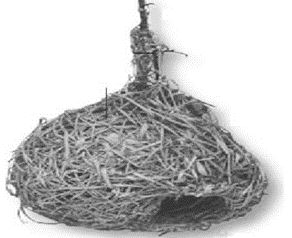
Question. Which of the following is likely to live in the home shown below?
(a) Honeybee
(b) Butterfly
(c) Weaver bird
(d) Squirrel
Answer : C
Question. What is the object or structure shown in this picture?

(a) a planetarium
(b) a cave
(c) an igloo
(d) a tunnel
Answer : C
Question. Which of these is likely to be the footprint of a DOG?
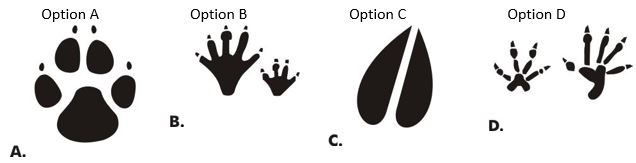
Answer : A
Question. Which of these animals has teeth meant for tearing flesh?
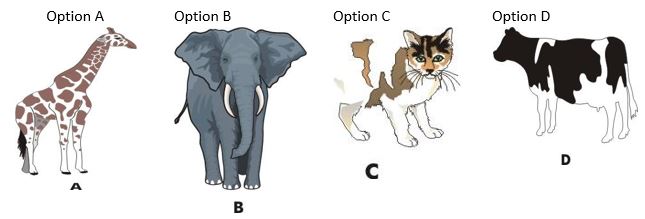
Answer : C
Question. Which of these birds often makes its nest inside homes and buildings?
(a) crow
(b) Parrots
(c) Pigeons
(d) Peacock
Answer : C
Question. Use the information given in the graph and answer the question. The graph below gives the average monthly temperatures during a year in New Delhi.
In which of these months was the average temperature higher than the previous month?

(a) April
(b) May
(c) August
(d) November
Answer : A
Question. Use the information given in the graph and answer the question. The graph below gives the average monthly temperatures during a year in New Delhi.
What was the average temperature in the month of January?

(a) 10 degrees C
(b) 20 degrees C
(c) 25 degrees C
(d) 30 degrees C
Answer : A
Question. Which of the following footprints was made by the animal in the picture shown above?
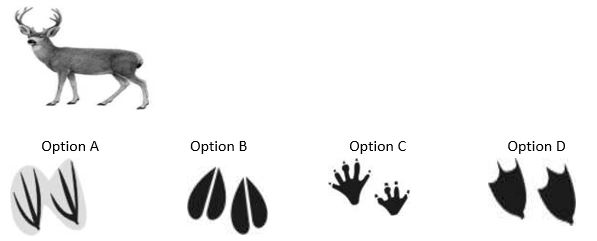
Answer : B
Question. The beaks of birds can tell us what they eat, and how they eat it. See the information below:
Here is a bird which doesn't have a beak. This bird feeds on dead animals. The beak of this bird will look like which of the ones above?
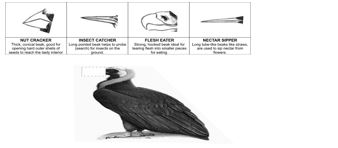
(a) NUT CRACKER
(b) INSECT CRACKER
(c) FLESH EATER
(d) NECTER SIPPER
Answer : C
NCERT Solutions for Class 4 Environmental Studies Chapter 16 A Busy Month
Accessing Chapter 16 A Busy Month Solutions
Review comprehensive exercise answers for Class 4 Environmental Studies Chapter 16 A Busy Month. Fully updated to match current NCERT syllabus guidelines, these textbook solutions help students verify their work and maintain accurate study notes.
Concept-Driven Answers for Class 4 Environmental Studies
Beyond providing final answers, these guides offer step-by-step breakdowns for complex queries in the Class 4 Environmental Studies module. This approach helps students balance theoretical depth with practical problem-solving skills required for NCERT exams.
Maximizing Study Efficiency
These resources act as an effective roadmap for daily homework tasks and independent study. Supplement your review of Chapter 16 A Busy Month with official sample papers and interactive practice tests available on our platform free of charge.
FAQs
The complete and updated NCERT Solutions Class 4 Environmental Studies Chapter 16 A Busy Month is available for free on StudiesToday.com. These solutions for Class 4 Environmental Studies are as per latest NCERT curriculum.
Yes, our experts have revised the NCERT Solutions Class 4 Environmental Studies Chapter 16 A Busy Month as per 2026 exam pattern. All textbook exercises have been solved and have added explanation about how the Environmental Studies concepts are applied in case-study and assertion-reasoning questions.
Toppers recommend using NCERT language because NCERT marking schemes are strictly based on textbook definitions. Our NCERT Solutions Class 4 Environmental Studies Chapter 16 A Busy Month will help students to get full marks in the theory paper.
Yes, we provide bilingual support for Class 4 Environmental Studies. You can access NCERT Solutions Class 4 Environmental Studies Chapter 16 A Busy Month in both English and Hindi medium.
Yes, you can download the entire NCERT Solutions Class 4 Environmental Studies Chapter 16 A Busy Month in printable PDF format for offline study on any device.