

Step-by-Step Textbook Solutions for Class 4 Environmental Studies Chapter 11 Valley Of Flowers
Access comprehensive textbook solutions for Chapter 11 Valley Of Flowers using the official curriculum guides for Class 4 Environmental Studies. Designed to align with the 2026-27 NCERT standards, these detailed answers help students reinforce core academic concepts.
Download Chapter 11 Valley Of Flowers Textbook Solutions PDF
Access the complete solution PDF for Class 4 Environmental Studies below. Regular practice with these targeted textbook answers builds familiarity with standard question patterns and helps secure higher marks in final school evaluations.
NCERT Solutions for Class 4 EVS Looking Around for Chapter 11 Valley Of Flowers
Q.1. Have you ever seen so many flowers grow together any where?
Ans. Yes.
Q.2. Write their colours.
Ans. White, red, blue, green, yellow, purple, orange, violet.
The World of flowers (Page 86)
Q.1. have are same pictures of flowers. Mark a 3 on the flowers which you recognise. Write their names also if you know.
Ans.
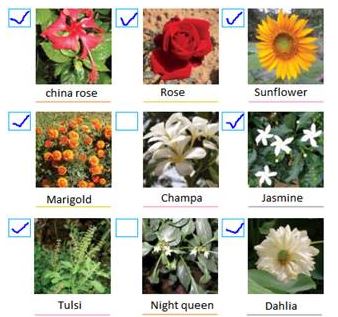
Q.2. From the picture given above and other flowers that you know, give names of two flowers which.
Ans.
* Grow on trees | Gulmohar | Kadam |
* Grow on bushes | Rose | Hibiscus |
* Grow on creepers | Champa | Snow white |
* Grow on water plants | Lotus | Water Lily |
* Bloom only at night | Jasmine | Night queen |
* Bloom in the day and close at night | Sunflower | Lotus |
* Which you can recognise by their scent even with your eyes closed | Rose | Jasmine |
* Which bloom all the year round | Rose | Kumudini |
* Which flower bloom only in certain months | Marigold | Tulip |
Q.3. Are there any trees or plants which never have any flowers? Find out and write.
Ans. Money plant.
Why this (Page 87)
Q.1. Have you ever seen a board like this put up anywhere?
Ans. Yes.
Q.2. Do people pluck flowers even when this board is here?
Ans. Yes.
Q.3. Why do you think they do this?
Ans. They do not obey the rules.
Q.4. Should they do this?
Ans. No.
Q.5. If everybody plucked flowers, then what would happen?
Ans. There will be no flowers.
Let us look closely (Page 88)
Q.1. What is the colour of the flower?
Ans. Pink.
Q.2. What kind of scent does it have?
Ans. Very pleasant.
Q.3. What does it look this-a bell, a bowl, a brush or anything else?
Ans. It looks like a brush.
Q.4. Do these flowers grow in bunches?
Ans. No.
Q.5. How many petals do they have?
Ans. Many.
Q.6. Are their petals all joined together or separate?
Ans. Separate.
Q.7. Inside the petals, in the middle of the flower, what thin parts can you see? Write itscolour.
Ans. Pink?
Q.8. When you touch these, do you find a powdery thing on your hadns?
Ans. Yes.
Blooming buds! (Page 89)
You must have seen buds on the plants. If there are any flower bearing plants growing near your school or home, look carefully at their buds.
Q.1. What differences do you find between a flower and a bud?
Ans. Bud is small and pointed, flower is larger and spread.
Q.2. Draw the picture of a flower and its bud in your notebook.
Ans.
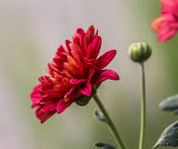
Can you say how many days a bud will take to bloom into a flower? Let’s try and find out.
(1) Choose a bud that is growing on plant and look at it every day. Write the name of the plant.
Ans. Rose.
Flowers are even eaten (Page 90)
Q.1. Are flower cooked in your home as a dry vegetable, a gravy dish or as a ‘chutney’?
Ans. Yes.
Q.2. Find out which flower are used for these?
Ans. Vegetable and gravy – flower of banana, sahjan, kachnar.
Chatni – Shefalika
Flowers in Medicines (Page 90)
Q.1. Can you name any two flowers which are used in medicines?
Ans. Rose, Cedar.
Q.2. How is rose water used in your house?
Ans. It is used in medicine, sweets, lassi etc.
Colours form Flowers (Page 90)
Q.1. Find out and write the names of some more flowers that are used to make colours.
Ans. Rose, china rose.
Q.2. Can you think of any such colour of which there is no flower?
Ans. Silver or Grey.
Q.3. Write the names of such flowers which are used to make scents.
Ans. Jasmine, rose etc.
Talk about it (Page 92)
Q.1. Do you know when such songs are sung?
Ans. During marriage.
Q.2. Do you or anybody else at home know other such song?
Ans. Yes, my mother and grandmother know such songs.
Q.3. Are any special flowers used on certain occasions by your elders? Make a list of different occasion and the flowers used.
Ans.
Occasion | Name of flowers |
Friendship day | Pink Rose |
Birthday | Rose, tulip |
Marriage Anniversary | Bouquet |
Valentine day | Red Rose |
Cemeteries | Bouquet |
Religious ceremony | Marigold. |
Let us know some more (Page 93)
Q.1. What are the different flowers that they sell? Are them the names of three flowers?
Ans. Rose, Jasmine, dahlia.
Q.2. Why do people buy flowers?
Ans. For decoration, worship, as gift item.
Q.3. In what forms do flower sellers sell their flowers? Tick mark on the boxes belw:
Ans.
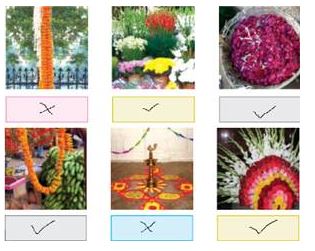
Q.4. Any other form that you here seen.
Ans. Gajra.
Q.5. Find out the prices.
Ans. One garland = Rs. 50
One stared = Rs. 20
One flower = Rs. 10
Q.6. Has the flower seller learnt to make bouquet or a net of flowers from anybody? From whom?
Ans. Yes, from his father.
Q.7. Would they like the other members of their family to do this work? Why?
Ans. Yes, so that all members can help each other and also earn a lot.
Question. The table gives the number of roses of different colours seen in a garden. Which would be the graph showing the details correctly?
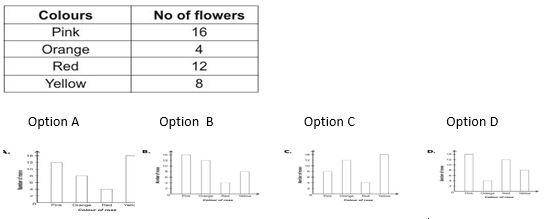
Answer : D
Question. Ram had seen a plant and he wanted Arjun to guess the name of the plant. Given below is the question answer session between the two of them.
Arjun: Does the plant give shade?
Ram: No
Arjun: Does the plant have thorns?
Ram: No
Arjun:Does the plant bear flowers?
Ram : Yes
Arjun: What is the colour of the flowers? Ram: White
Arjun: Does the flower have a sweet smell? Ram: Yes. Which is the plant that Ram is describing?
(a) Rose
(b) Hibiscus
(c) Bougainvillaea
(d) Jasmine
Answer : D
Question. Every day Ravi observes and draws the shape of the moon. On the 21st July Ravi copied the shape of the moon as shown in the figure below. After about how many days will Ravi see the same shape next?

(a) 14 days
(b) 28 days
(c) 2 months
(d) 1 year
Answer : B
Question. Sushila wanted to know if her marigold plants would grow better in the sun. What would be the best way to find out?

Answer : A
NCERT Solutions for Class 4 Environmental Studies Chapter 11 Valley Of Flowers
Textbook Solutions for Class 4 Environmental Studies Chapter 11 Valley Of Flowers
Review comprehensive exercise answers for Class 4 Environmental Studies Chapter 11 Valley Of Flowers. Fully updated to match current NCERT syllabus guidelines, these textbook solutions help students verify their work and maintain accurate study notes.
Mastering Theoretical and Practical Questions
Clear, methodical explanations accompany every challenging problem within the Class 4 Environmental Studies text. Engaging with these detailed answers lays a solid foundation for advanced learning and improves foundational clarity for upcoming assessments.
Effective Self-Study and Homework Assistance
These resources act as an effective roadmap for daily homework tasks and independent study. Supplement your review of Chapter 11 Valley Of Flowers with official sample papers and interactive practice tests available on our platform free of charge.
FAQs
The complete and updated NCERT Solutions Class 4 Environmental Studies Chapter 11 Valley Of Flowers is available for free on StudiesToday.com. These solutions for Class 4 Environmental Studies are as per latest NCERT curriculum.
Yes, our experts have revised the NCERT Solutions Class 4 Environmental Studies Chapter 11 Valley Of Flowers as per 2026 exam pattern. All textbook exercises have been solved and have added explanation about how the Environmental Studies concepts are applied in case-study and assertion-reasoning questions.
Toppers recommend using NCERT language because NCERT marking schemes are strictly based on textbook definitions. Our NCERT Solutions Class 4 Environmental Studies Chapter 11 Valley Of Flowers will help students to get full marks in the theory paper.
Yes, we provide bilingual support for Class 4 Environmental Studies. You can access NCERT Solutions Class 4 Environmental Studies Chapter 11 Valley Of Flowers in both English and Hindi medium.
Yes, you can download the entire NCERT Solutions Class 4 Environmental Studies Chapter 11 Valley Of Flowers in printable PDF format for offline study on any device.